
|
시장보고서
상품코드
2120618
북미의 보호 포장 : 시장 점유율 분석, 업계 동향 및 통계, 성장 예측(2026-2031년)North America Protective Packaging - Market Share Analysis, Industry Trends & Statistics, Growth Forecasts (2026 - 2031) |
||||||
 Mordor Intelligence
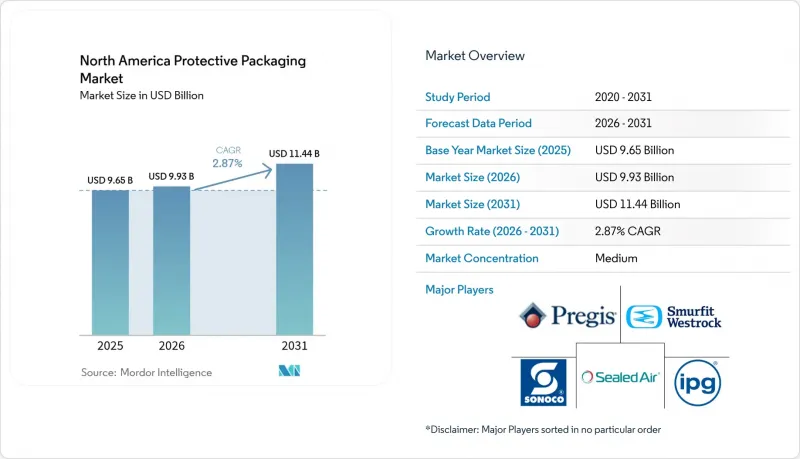
Mordor Intelligence에 의하면, 북미의 보호 포장 시장 규모는 2025년 96억 5,000만 달러로 평가되었습니다. 2026년에는 99억 3,000만 달러로 확대되어 2026-2031년에 걸쳐 CAGR 2.87%로 성장을 지속하여, 2031년까지 114억 4,000만 달러에 이를 것으로 예측됩니다.
본 보고서는 소재 유형별(종이, 플라스틱, 발포재, 바이오), 제품 유형별(경질, 연질, 발포재), 기능별(충격 흡수, 틈새 충전, 단열),최종 사용자별(식품, 산업, 제약, 전자, 전자상거래), 기술별(팽창식, 성형 펄프, 단열 컨테이너), 지역별로 분류되어 있습니다. 시장 전망은 금액(달러) 기준으로 제시되어 있습니다.
북미의 보호 포장 시장 동향 및 인사이트
전자상거래 붐과 소포 처리량 증가
소포 처리량의 급증은 보호 포장 시장의 요구 사항을 지속적으로 재정의하고 있습니다. 자동화된 풀필먼트 센터에서는 포장 시간을 최대 40% 단축하고 당일 배송 약속을 지킬 수 있도록 성형된 우편 봉투와 에어필로우가 활용되고 있습니다. 쉴드 에어(Shield Air)는 2024년에 견조한 전자상거래 매출을 보고했으며, 그 성장 요인으로 고속 라인과 원활하게 통합되는 자동화 대응 솔루션을 꼽았습니다. 한편, 소매업체들은 불필요한 빈 공간을 줄여주는 부피 최적화 소프트웨어 도입을 확대하며, 출하량이 증가하는 상황에서도 자재 사용량을 줄이고 있습니다. 이러한 양면성으로 인해 자동화 방식의 출하량은 계속 증가하는 반면, 기존 유형의 빈 공간 충전재 사용량은 억제되고 있습니다.
지속 가능한 소재 및 재활용 소재로의 전환
다국적 기업의 지속가능성 노력에 힘입어, 높은 비용에도 불구하고 섬유계 및 퇴비화 가능한 솔루션의 도입이 가속화되고 있습니다. 네슬레는 2025년까지 지속가능한 포장에 15억 유로(16억 달러)를 배정하고, 바이오 완충재 및 성형 펄프 인서트에 대한 자금 투자를 추진했습니다. 2024년 12월에 발효되는 캐나다 보건부의 일회용 플라스틱 금지 조치로 인해 일부 화석 유래 포장 형태가 배제되면서, 북미 공급망 전반에 걸쳐 급속한 소재 대체가 진행되고 있습니다. 20-25%의 추가 비용이 발생함에도 불구하고, 브랜드 소유자의 ESG 목표와 소비자 선호도의 변화를 배경으로 식물 유래 필름, 전분 기반 완충재, 균사체 완충재의 개발이 착실히 진행되고 있습니다.
일회용 플라스틱 및 생분해성에 관한 엄격한 규제
캐나다 보건부의 금지 조치로 인해 비닐봉지, 식기, 지정된 포장 형태가 배제됨에 따라, 가공업체들은 신속한 제품 재설계와 막대한 연구개발비 지출을 강요받고 있습니다. 동시에, 미국 환경보호청(EPA)은 식품 접촉용 코팅에 대한 PFAS 제한을 제안하고 있으며, 이로 인해 보호 포장재의 선택지에서 기존 불소 수지 배리어 소재가 배제될 것입니다. 규정 준수 비용은 이미 개발 예산의 8-12%를 차지하고 있으며, 시행 시기와 관련된 불확실성으로 인해 대체 화학 물질에 대한 투자가 미뤄지고 있습니다.
부문별 분석
플라스틱은 2025년 매출의 51.45%를 차지했으며, 보호 포장 시장에서 방습 및 내천자성 배리어로서 여전히 필수적인 존재입니다. 그러나 규제 압력과 기업의 ESG 목표를 반영하여 바이오 부문은 연평균 성장률(CAGR) 5.49%로 확대되고 있습니다. 보호 포장 산업에서는 PHA 필름 및 균사체 폼에 관한 미국 특허상표청(USPTO) 특허 출원 건수가 35% 증가하여 연구 개발의 모멘텀을 보여주고 있습니다. 가격 프리미엄이 여전히 지속되는 가운데, 각 제조업체는 성장 잠재력이 있는 퇴비화 가능한 수지에 대한 설비 투자를 추진하고 있습니다.
종이와 성형 섬유로 만든 대체재는 재활용 가능성에 대한 높은 평가로 혜택을 보고 있지만, 섬유 가격 변동으로 인해 비용 측면의 우위는 줄어들고 있습니다. 발포 플라스틱은 폐기 처리 문제에 대해 엄격한 시선이 쏠리고 있지만, 깨지기 쉬운 화물이나 온도에 민감한 화물에 대한 대체할 수 없는 단열 특성을 유지하고 있습니다. 보호 포장 시장은 고성능 폴리머 용도와 지속가능성을 중시하는 섬유 또는 퇴비화 가능한 틈새 시장으로 점점 더 양극화되고 있으며, 실드 에어(Sealed Air)와 같은 가공 제조업체는 순환형 소재 개발에 1억 5,000만 달러를 할당하고 있습니다.
전자상거래 발송업체들이 가볍고 자동화에 적합한 대안을 모색함에 따라, 연질 우편 봉투, 기포 완충재, 에어 필로는 2025년 매출의 46.12%를 차지했습니다. 부피 중량에 따른 화물 운임 체계가 이러한 우위를 더욱 증폭시켜, 저부피 솔루션에 대한 수요를 촉진하고 있습니다. 발포 소재는 의약품 콜드체인의 확장으로 다시 활기를 되찾아, 2031년까지의 연평균 성장률(CAGR) 전망에서 가장 높은 4.38%를 기록했습니다. 화이자(Pfizer)사의 20억 달러 규모의 콜드체인 강화 방안은 바이오의약품에 대한 내구성이 뛰어난 단열재 수요를 부각시키고 있습니다.
산업용 공급망에서는 경질 골판지 인서트가 여전히 주류를 이루고 있는 반면, 전자기기 부문에서는 OEM 업체들이 재활용 규제를 충족하기 위해 EPS에서 섬유 소재로 전환하는 추세에 따라 성형 펄프의 점유율이 확대되고 있습니다. 보호 포장 시장에서는 온도 센서, QR 코드를 통한 추적 기능, 위변조 방지 기능을 통합한 스마트 제품으로의 선택적 업그레이드가 진행되고 있으며, 이를 통해 가공업체는 재료비를 비례적으로 늘리지 않고도 고성능 제품을 업셀링할 수 있게 되었습니다.
기타 혜택
- 엑셀 형식 시장 예측(ME) 시트
- 3개월간의 애널리스트 지원
자주 묻는 질문
목차
제1장 서론
제2장 조사 방법
제3장 주요 요약
제4장 시장 구도
제5장 시장 규모 및 성장 예측
제6장 경쟁 구도
제7장 시장 기회 및 향후 전망
KTHAccording to Mordor Intelligence, the North America protective packaging market size is expected to grow from USD 9.65 billion in 2025 to USD 9.93 billion in 2026 and is forecast to reach USD 11.44 billion by 2031 at 2.87% CAGR over 2026-2031.
This report is Segmented by Material Type (Paper, Plastics, Foam, and Bio-Based), Product Type (Rigid, Flexible, and Foam), Functionality (Cushioning, Void Fill, and Insulation), End-User (Food, Industrial, Pharma, Electronics, E-Commerce), Technology (Inflatable, Molded Pulp, and Insulated Containers), and Geography. The Market Forecasts are Provided in Terms of Value (USD).
North America Protective Packaging Market Trends and Insights
E-commerce boom and parcel-volume growth
Surging parcel volumes continue to redefine protective packaging market requirements. Automated fulfillment centers rely on pre-formed mailers and air pillows that cut packing time by up to 40%, keeping pace with same-day delivery promises. Sealed Air reported robust e-commerce sales in 2024, attributing growth to automation-ready solutions that integrate seamlessly with high-speed lines. Retailers, however, increasingly deploy cube-optimization software that trims excess void, reducing material intensity even as shipment counts climb. This duality sustains volume growth for automation-compatible formats while capping runaway tonnage gains for traditional void-fill.
Shift toward sustainable and recycled materials
Sustainability commitments from multinationals accelerate the adoption of fiber-based and compostable solutions despite cost premiums. Nestle earmarked EUR 1.5 billion (USD 1.6 billion) for sustainable packaging through 2025, funneling funds toward bio-based cushioning and molded-pulp inserts. Health Canada's single-use plastics prohibition, effective December 2024, eliminates several fossil-based formats, prompting rapid material substitution across North American supply chains. Despite 20-25% cost premiums, brand-owner ESG targets and consumer preference shifts underpin a steady pipeline of plant-derived films, starch loose-fill, and mycelium cushioning.
Stringent regulations on single-use plastics and degradability
Health Canada's prohibition eliminates checkout bags, cutlery, and defined packaging types, forcing rapid reformulation and significant R&D outlays for converters. Simultaneously, the U.S. EPA proposed limits on PFAS in food-contact coatings, removing conventional fluoropolymer barriers from the protective packaging toolbox. Compliance spending already absorbs 8-12% of development budgets, and uncertainty over enforcement timelines postpones investment in alternative chemistries.
Other drivers and restraints analyzed in the detailed report include:
- Cold-chain expansion in food and pharma
- Dim-weight freight rules favoring light flexible formats
- Volatile resin and fiber prices
For complete list of drivers and restraints, kindly check the Table Of Contents.
Segment Analysis
Plastics secured 51.45% of 2025 revenue and remain indispensable for moisture and puncture barriers in the protective packaging market. However, the bio-based segment advances at a 5.49% CAGR, reflecting regulatory pressure and corporate ESG targets. The protective packaging industry logged a 35% rise in USPTO patent filings for PHA films and mycelium foams, signaling R&D momentum. Producers channel capex toward scalable compostable resins even as price premiums persist.
Paper and molded-fiber alternatives benefit from recyclability perceptions, though fiber price volatility narrows cost advantages. Foam plastics face scrutiny for disposal challenges yet retain irreplaceable insulation properties for fragile or temperature-sensitive loads. The protective packaging market is increasingly split into high-performance polymer applications and sustainability-driven fiber or compostable niches, with converters like Sealed Air earmarking USD 150 million for circular-material development.
Flexible mailers, bubble wrap, and air pillows captured 46.12% of 2025 revenue as e-commerce shippers chase lightweight, automation-friendly options. Dim-weight freight economics amplify this edge, reinforcing demand for low-cube solutions. Foam regained momentum through pharmaceutical cold-chain expansion, registering the highest 4.38% CAGR outlook to 2031. Pfizer's USD 2 billion cold-chain push underscores durable insulation demand for biologics.
Rigid corrugated inserts persist in industrial supply chains, while molded pulp gains share in electronics as OEMs swap EPS for fiber to meet recycling mandates. The protective packaging market sees discretionary upgrades toward smart variants embedding temperature sensors, QR tracking, and tamper evidence, enabling converters to upsell performance without proportionate material increases.
Complete Report Scope:
- By Material Type
- Paper and Paperboard
- Plastics
- Foam Plastics
- Bio-based and Compostable Materials
- By Product Type
- Rigid
- Corrugated Paperboard Protectors
- Molded Pulp
- Insulated Shipping Containers
- Flexible
- Protective Mailers
- Bubble Wraps
- Air Pillows/Air Bags
- Paper Fill
- Foam
- Molded Foam
- Foam-in-Place (FIP)
- Loose Fill
- Foam Rolls/Sheets
- Rigid
- By Functionality
- Cushioning
- Blocking and Bracing
- Void Fill
- Insulation
- Wrapping and Surface Protection
- Other Functionalities
- By End-user Vertical
- Food and Beverage
- Industrial
- Pharmaceuticals
- Consumer Electronics
- Cosmetics and Home Care
- E-commerce and Logistics
- Other End-user Verticals
- By Packaging Technology
- Inflatable Packaging Systems
- Molded Pulp and Fiber-based Systems
- Suspension and Retention Packaging
- Insulated Shipping Containers
- Dunnage and Layer Pads
- Honeycomb Paper Solutions
- By Country
- United States
- Canada
- Mexico
List of Companies Covered in this Report:
- Sealed Air Corporation
- Pregis LLC
- Sonoco Products Company
- Intertape Polymer Group Inc.
- Smurfit WestRock
- International Paper Company
- Amcor plc
- Storopack Hans Reichenecker GmbH
- Huhtamaki Oyj
- UFP Technologies, Inc.
- Ranpak Holdings Corp.
- Pro-Pac Packaging Limited
- 3M Company
- Mondi plc
- Veritiv Corporation
- ProAmpac LLC
- Dow Inc.
Additional Benefits:
- The market estimate (ME) sheet in Excel format
- 3 months of analyst support
TABLE OF CONTENTS
1 INTRODUCTION
- 1.1 Study Assumptions and Market Definition
- 1.2 Scope of the Study
2 RESEARCH METHODOLOGY
3 EXECUTIVE SUMMARY
4 MARKET LANDSCAPE
- 4.1 Market Overview
- 4.2 Market Drivers
- 4.2.1 E-commerce boom and parcel-volume growth
- 4.2.2 Shift toward sustainable and recycled materials
- 4.2.3 Cold-chain expansion in food and pharma
- 4.2.4 Dim-weight freight rules favoring light flexible formats
- 4.2.5 Reverse-logistics uptick demanding re-usable protection
- 4.2.6 On-site AI-driven packaging automation at fulfilment hubs
- 4.3 Market Restraints
- 4.3.1 Stringent regulations on single-use plastics and degradability
- 4.3.2 Volatile resin and fiber prices
- 4.3.3 Warehouse cube-optimization reducing void-fill volumes
- 4.3.4 High CAPEX for smart-packaging machinery
- 4.4 Industry Value Chain Analysis
- 4.5 Porter's Five Forces Analysis
- 4.5.1 Bargaining Power of Suppliers
- 4.5.1.1 Bargaining Power of Buyers
- 4.5.1.2 Threat of New Entrants
- 4.5.1.3 Threat of Substitutes
- 4.5.1.4 Intensity of Competitive Rivalry
- 4.5.1 Bargaining Power of Suppliers
- 4.6 The Impact of Macroeconomic Factors on the Market
- 4.7 Regulatory Landscape
- 4.8 Technological Outlook
5 MARKET SIZE AND GROWTH FORECASTS (VALUE)
- 5.1 By Material Type
- 5.1.1 Paper and Paperboard
- 5.1.2 Plastics
- 5.1.3 Foam Plastics
- 5.1.4 Bio-based and Compostable Materials
- 5.2 By Product Type
- 5.2.1 Rigid
- 5.2.1.1 Corrugated Paperboard Protectors
- 5.2.1.2 Molded Pulp
- 5.2.1.3 Insulated Shipping Containers
- 5.2.2 Flexible
- 5.2.2.1 Protective Mailers
- 5.2.2.2 Bubble Wraps
- 5.2.2.3 Air Pillows/Air Bags
- 5.2.2.4 Paper Fill
- 5.2.3 Foam
- 5.2.3.1 Molded Foam
- 5.2.3.2 Foam-in-Place (FIP)
- 5.2.3.3 Loose Fill
- 5.2.3.4 Foam Rolls/Sheets
- 5.2.1 Rigid
- 5.3 By Functionality
- 5.3.1 Cushioning
- 5.3.2 Blocking and Bracing
- 5.3.3 Void Fill
- 5.3.4 Insulation
- 5.3.5 Wrapping and Surface Protection
- 5.3.6 Other Functionalities
- 5.4 By End-user Vertical
- 5.4.1 Food and Beverage
- 5.4.2 Industrial
- 5.4.3 Pharmaceuticals
- 5.4.4 Consumer Electronics
- 5.4.5 Cosmetics and Home Care
- 5.4.6 E-commerce and Logistics
- 5.4.7 Other End-user Verticals
- 5.5 By Packaging Technology
- 5.5.1 Inflatable Packaging Systems
- 5.5.2 Molded Pulp and Fiber-based Systems
- 5.5.3 Suspension and Retention Packaging
- 5.5.4 Insulated Shipping Containers
- 5.5.5 Dunnage and Layer Pads
- 5.5.6 Honeycomb Paper Solutions
- 5.6 By Country
- 5.6.1 United States
- 5.6.2 Canada
- 5.6.3 Mexico
6 COMPETITIVE LANDSCAPE
- 6.1 Market Concentration
- 6.2 Strategic Moves
- 6.3 Market Share Analysis
- 6.4 Company Profiles (includes Global level Overview, Market level overview, Core Segments, Financials as available, Strategic Information, Market Rank/Share for key companies, Products and Services, and Recent Developments)
- 6.4.1 Sealed Air Corporation
- 6.4.2 Pregis LLC
- 6.4.3 Sonoco Products Company
- 6.4.4 Intertape Polymer Group Inc.
- 6.4.5 Smurfit WestRock
- 6.4.6 International Paper Company
- 6.4.7 Amcor plc
- 6.4.8 Storopack Hans Reichenecker GmbH
- 6.4.9 Huhtamaki Oyj
- 6.4.10 UFP Technologies, Inc.
- 6.4.11 Ranpak Holdings Corp.
- 6.4.12 Pro-Pac Packaging Limited
- 6.4.13 3M Company
- 6.4.14 Mondi plc
- 6.4.15 Veritiv Corporation
- 6.4.16 ProAmpac LLC
- 6.4.17 Dow Inc.
7 MARKET OPPORTUNITIES AND FUTURE OUTLOOK
- 7.1 White-space and Unmet-Need Assessment