

|
시장보고서
상품코드
2120649
유럽의 공장 자동화 및 산업 제어 : 시장 점유율 분석, 업계 동향 및 통계, 성장 예측(2026-2031년)Europe Factory Automation And Industrial Controls - Market Share Analysis, Industry Trends & Statistics, Growth Forecasts (2026 - 2031) |
||||||
 Mordor Intelligence
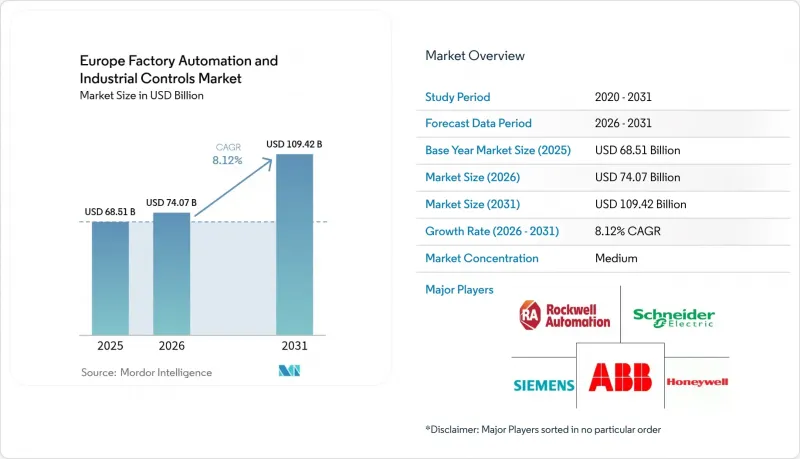
유럽의 공장 자동화 및 산업 제어 시장 규모는 2025년에 685억 1,000만 달러로 평가되었습니다. 2026년 740억 7,000만 달러에서 2031년까지 1,094억 2,000만 달러에 이를 것으로 예상되며, 예측 기간(2026-2031년) CAGR은 8.12%를 나타낼 전망입니다.
본 보고서는 제품 유형(DCS를 포함한 산업 제어 시스템 등), 필드 디바이스 유형(산업용 로봇, 머신 비전 시스템 등), 최종 사용자 산업(자동차, 식품 및 음료 등), 도입 모델(On-Premise, 클라우드 지원, 하이브리드 엣지·클라우드), 그리고 지역별로 분류되어 있습니다. 시장 예측은 금액(달러) 기준으로 제시되어 있습니다.
유럽의 공장 자동화 및 산업 제어 시장 동향 및 인사이트
에너지 효율이 높은 스마트 팩토리에 대한 관심 증가
EU의 제조업체들은 탄소 발자국을 줄이고 전력 가격 변동으로부터 이익률을 보호하기 위해 에너지 효율이 높은 자동화를 우선시하고 있습니다. 2025년 4월에 출범한 ‘Made in Europe Partnership’은 AI와 실시간 데이터 분석을 결합하여 결함 제로, 가동 중단 시간 제로의 생산을 목표로 하고 있습니다. 한편, 스웨덴 전력 공급의 98%가 화석 연료에 의존하지 않는다는 점이 대규모 로봇 도입을 뒷받침하고 있습니다. ‘디지털 팩토리 액셀러레이션(Digital Factory Acceleration)’ 프로그램에 참여하는 덴마크의 중소기업들은 실시간 성과 대시보드를 갖춘 종이 없는 워크플로로 전환한 후 10-20%의 효율 향상을 보고하고 있습니다. ABB의 Sensorfact 인수는 ISO 50001을 준수하며, 유럽의 공장 자동화 및 산업 제어 시장 전반에 걸쳐 지속적인 개선 주기를 촉진하는 정교한 에너지 모니터링 플랫폼에 대한 수요가 급증하고 있음을 여실히 보여줍니다.
가속화되는 자동차 전기화가 가져오는 수요
유럽의 자동차 제조업체들이 전기차 생산량에 대응하기 위해 설비를 갱신하는 가운데, 배터리 셀 생산 라인이 신규 프로젝트의 주류를 이루고 있습니다. 전극 적층, 전해액 주입 및 최종 공정 검사를 위해 구축된 로봇 솔루션이 기존의 용접 셀을 대체하고 있습니다. 10ppm 미만의 결함을 감지할 수 있는 머신 비전 시스템은 배터리 부품 분야에서 표준 사양으로 자리 잡고 있습니다. 유연성이 높은 프로그래머블 로직 컨트롤러(PLC)와 적응형 제조 실행 시스템(MES)을 통해 공장은 장시간 가동 중단 없이 리튬 이온 배터리의 화학 성분을 전환할 수 있게 되었으며, 모듈식이며 미래 지향적인 제어 시스템에 대한 수요가 증가하고 있습니다.
오래된 레거시 시스템의 사이버 보안 취약성
유럽의 공장의 5분의 4에 가까운 곳에서는 최신 보안 프레임워크가 존재하지 않았던 시대에 도입된 프로그래머블 로직 컨트롤러(PLC)를 적어도 한 대는 여전히 가동하고 있어, 생산 자산이 랜섬웨어의 위협에 노출된 상태입니다. 일시적인 네트워크 분할이나 산업용 방화벽을 통해 일부는 완화되고 있지만, IEC 62443을 완전히 준수하려면 컨트롤러를 개조해야 하므로 자본 예산에 부담을 주고 있습니다. 구형 제어 시스템을 사용하는 제조업체의 보험료는 상승하고 있어, 이로 인해 단계적 업데이트에 대한 이사회 차원의 승인이 촉진되고 있지만, 프로젝트 일정은 장기화되고 있습니다.
부문별 분석
2025년, 프로그래머블 로직 컨트롤러(PLC)는 유럽의 공장 자동화 및 산업 제어 시장 점유율의 27.98%를 차지했으며, 이는 결정론적 제어가 필요한 이산형 제조 라인에서 PLC가 널리 보급된 현실을 반영합니다. 브라운필드 업그레이드를 통해 노후화된 하드웨어가 사이버 보안 기능을 기본으로 탑재한 에너지 효율이 높은 장비로 교체됨에 따라, 이 부문은 안정적인 상태를 유지하고 있습니다. 제조 실행 시스템(MES)은 ISO 9001에 기반한 실시간 생산 가시화 의무화 및 자동차·제약 업계 규격의 추적성 조항에 힘입어 2031년까지 연평균 성장률(CAGR) 9.78%를 나타낼 것으로 예측됩니다. 클라우드 구독을 통해 중견 공급업체의 진입 비용이 낮아짐에 따라, MES 도입에 따른 유럽의 공장 자동화 및 산업 제어 시장 규모는 확대되고 있습니다. 수요 예측과 생산 라인 스케줄링을 동기화하여 재공 재고를 최소화하는 보다 긴밀한 ERP 통합을 통해 부수적인 이점이 발생하고 있습니다.
분산 제어 시스템은 고가용성 아키텍처를 중시하는 공정 산업에서 계속해서 활용되고 있지만, 예측 분석 기능을 구현하는 소프트웨어 계층과 비교하면 그 성장세는 완만한 수준에 그치고 있습니다. 감시 제어 및 데이터 수집(SCADA) 플랫폼은 브라우저 기반 클라이언트로 전환되고 있어, 여러 거점에 걸친 업무의 원격 감시가 가능해졌습니다. HMI(Human-Machine Interface)에는 모바일 알림 및 상황에 따른 동영상 스트리밍이 통합되어 있어, 원격지의 전문가가 신속하게 문제를 해결할 수 있도록 지원하고 있습니다. EU가 자금을 지원하는 디지털 트윈 시범 프로젝트의 일환으로 제품 수명 주기 관리(PLM) 도입이 진행되고 있으며, 설계자는 설비 건설 전에 시뮬레이션을 통해 지속가능성 지표를 검증할 수 있게 되었습니다.
2025년, 산업용 로봇은 유럽의 공장 자동화 및 산업 제어 시장에서 31.05%의 점유율을 차지했습니다. 이는 독일에서 근로자 1만 명당 429대가 도입된 것이 뒷받침하고 있습니다. 자동차의 전동화 및 소비재 포장 분야에서는 6축 로봇과 델타 로봇에 대한 수요가 여전히 높은 반면, 협동 로봇은 안전 요구 사항의 완화로 인해 대수 기준으로 두 자릿수 성장을 기록하고 있습니다. 연평균 성장률(CAGR) 9.05%로 발전하고 있는 머신 비전 시스템은 AI 알고리즘을 통해 배터리 셀 검사 및 무균 의약품 충전 과정에서 발생하는 불합격률을 낮춤으로써, 유럽의 공장 자동화 및 산업 제어 시장 규모를 급속히 확대시키고 있습니다. 스마트 카메라가 내장된 엣지 프로세서가 로컬에서 추론을 수행함으로써 클라우드 지연을 피하고, 기밀성이 높은 생산 데이터를 보호하고 있습니다.
진동 및 온도 데이터 스트림에 의존하는 예측 유지보수의 도입에 따라 센서 및 트랜스미터의 출하 대수도 증가하고 있습니다. 모터와 드라이브는 고효율 등급으로 전환되고 있으며, 넷 제로 목표를 달성하기 위해 가변 주파수 드라이브에서는 IE5 규격의 모터가 표준화되고 있습니다. 지능형 액추에이터에는 토크 이상을 감지하는 자가 진단 기능이 내장되어 있으며, 중앙 컨트롤러가 오프라인 상태가 되었을 때의 내결함성을 높이는 분산형 아키텍처를 지원합니다.
기타 혜택 :
- 엑셀 형식 시장 예측(ME) 시트
- 3개월간 애널리스트 지원
자주 묻는 질문
목차
제1장 서론
제2장 조사 방법
제3장 주요 요약
제4장 시장 구도
제5장 시장 규모 및 성장 예측
제6장 경쟁 구도
제7장 시장 기회 및 향후 전망
KTH 26.09.04According to Mordor Intelligence, the Europe factory automation and industrial controls market size was valued at USD 68.51 billion in 2025 and estimated to grow from USD 74.07 billion in 2026 to reach USD 109.42 billion by 2031, at a CAGR of 8.12% during the forecast period (2026-2031).
This report is Segmented by Product Type (Industrial Control Systems Including DCS, and More), Field Device Type (Industrial Robots, Machine Vision Systems, and More), End-User Industry (Automotive, Food and Beverage, and More), Deployment Model (On-Premise, Cloud-Enabled, and Hybrid Edge-Cloud), and Geography. The Market Forecasts are Provided in Terms of Value (USD).
Europe Factory Automation And Industrial Controls Market Trends and Insights
Growing Emphasis on Energy-Efficient Smart Factories
EU manufacturers are prioritizing energy-efficient automation to reduce carbon footprints and shield margins from volatile power prices. The Made in Europe Partnership, launched in April 2025, targets zero-defect and zero-downtime production by combining AI with real-time data analytics, while Sweden's 98% fossil-free electricity underpins large-scale robotics rollouts. Danish SMEs in the Digital Factory Acceleration program report 10-20% efficiency gains after migrating to paperless workflows with live performance dashboards. ABB's purchase of Sensorfact highlights the surge in demand for granular energy-monitoring platforms that comply with ISO 50001 and feed continuous-improvement loops across the Europe factory automation and industrial controls market.
Accelerated Automotive Electrification Demands
Battery-cell production lines now dominate greenfield projects as European automakers retool for electric-vehicle volumes. Robotic solutions built for electrode stacking, electrolyte filling, and end-of-line inspection are replacing legacy welding cells. Machine-vision systems capable of detecting defects below 10 parts per million are becoming standard on battery components. Flexible programmable logic controllers and adaptive manufacturing execution systems let plants switch between lithium-ion chemistries without extended downtime, reinforcing demand for modular, future-proof controls.
Persistent Legacy-System Cybersecurity Gaps
Nearly four-fifths of European plants still operate at least one programmable logic controller installed before modern security frameworks existed, leaving production assets exposed to ransomware. Temporary network segmentation and industrial firewalls offer partial relief, yet full IEC 62443 compliance demands controller retrofits that strain capital budgets. Insurance premiums for manufacturers with outdated controls have risen, nudging board-level approval for phased replacements but stretching project timelines.
Other drivers and restraints analyzed in the detailed report include:
- Regulatory Push for Net-Zero Industrial Emissions
- AI-Enabled Predictive Maintenance Adoption
- Trade Tensions on Semiconductor Supply Chains
For complete list of drivers and restraints, kindly check the Table Of Contents.
Segment Analysis
Programmable logic controllers accounted for 27.98% of the Europe factory automation and industrial controls market share in 2025, reflecting their ubiquity in discrete manufacturing lines that demand deterministic control. The segment remains stable as brownfield upgrades replace aging hardware with energy-efficient units featuring native cybersecurity. Manufacturing execution systems are projected to grow at a 9.78% CAGR to 2031, propelled by real-time production visibility mandates under ISO 9001 and traceability clauses in automotive and pharmaceutical standards. The Europe factory automation and industrial controls market size tied to MES adoption is widening as cloud subscriptions lower entry costs for mid-tier suppliers. Second-order gains emerge from tighter ERP integration that synchronizes demand forecasts with line scheduling, minimizing work-in-progress inventory.
Distributed control systems continue to serve process industries that value high-availability architectures, though growth is modest compared with software layers that unlock predictive-analytics functions. Supervisory control and data acquisition platforms are shifting toward browser-based clients, enabling remote oversight for multi-site operations. Human-machine interfaces integrate mobile alerts and contextual video streams that support faster troubleshooting from off-site experts. Product-lifecycle-management deployments are increasing under EU-funded digital-twin pilots, allowing designers to validate sustainability metrics in silico before capital builds.
Industrial robots held 31.05% of the Europe factory automation and industrial controls market share in 2025, underpinned by Germany's installed base of 429 units per 10,000 workers. Automotive electrification and consumer-goods packaging keep six-axis and delta robots in high demand, while collaborative variants post double-digit unit growth thanks to reduced guarding requirements. Machine-vision systems, advancing at a 9.05% CAGR, are rapidly expanding the Europe factory automation and industrial controls market size as AI algorithms cut false-rejection rates in battery-cell inspection and sterile drug filling. Edge processors inside smart cameras execute inference locally, avoiding cloud latency and securing sensitive production data.
Sensor and transmitter volumes rise alongside predictive-maintenance rollouts that depend on vibration and temperature data streams. Motors and drives are trending toward high-efficiency classes, with variable-frequency drives standardizing on IE5-rated motors to meet net-zero targets. Intelligent actuators embed self-diagnostics that flag torque anomalies, supporting decentralized architectures that improve resilience when central controllers go offline.
Complete Report Scope:
- By Product Type
- Distributed Control Systems (DCS)
- Programmable Logic Controllers (PLC)
- Supervisory Control and Data Acquisition (SCADA)
- Manufacturing Execution Systems (MES)
- Product Lifecycle Management (PLM)
- Human Machine Interface (HMI)
- Enterprise Resource Planning (ERP)
- By Field Device Type
- Industrial Robots
- Machine Vision Systems
- Sensors and Transmitters
- Motors and Drives
- Intelligent Actuators
- By End-User Industry
- Automotive
- Food and Beverage
- Pharmaceutical and Biotech
- Chemical and Petrochemical
- Energy and Utilities
- Metals and Mining
- Other End-User Industries (Textile, Pulp and Paper, etc.)
- By Deployment Model
- On-premise
- Cloud-enabled
- Hybrid Edge-Cloud
- By Country
- Germany
- United Kingdom
- France
- Italy
- Spain
- Netherlands
- Poland
- Rest of Europe
List of Companies Covered in this Report:
- Siemens AG
- Schneider Electric SE
- ABB Ltd.
- Rockwell Automation, Inc.
- Mitsubishi Electric Corporation
- Honeywell International Inc.
- Emerson Electric Co.
- Omron Corporation
- Robert Bosch GmbH
- Yokogawa Electric Corporation
- Beckhoff Automation GmbH and Co. KG
- Phoenix Contact GmbH and Co. KG
- B and R Industrial Automation GmbH
- FANUC Europe Corporation S.A.
- Pepperl+Fuchs SE
- Balluff GmbH
- Endress+Hauser Group Services AG
- GE Vernova
- Danfoss A/S
- WAGO Kontakttechnik GmbH and Co. KG
Additional Benefits:
- The market estimate (ME) sheet in Excel format
- 3 months of analyst support
TABLE OF CONTENTS
1 INTRODUCTION
- 1.1 Study Assumptions and Market Definition
- 1.2 Scope of the Study
2 RESEARCH METHODOLOGY
3 EXECUTIVE SUMMARY
4 MARKET LANDSCAPE
- 4.1 Market Overview
- 4.2 Market Drivers
- 4.2.1 Growing Emphasis on Energy-Efficient Smart Factories
- 4.2.2 Accelerated Automotive Electrification Demands
- 4.2.3 Regulatory Push for Net-Zero Industrial Emissions
- 4.2.4 AI-Enabled Predictive Maintenance Adoption (Under-reported)
- 4.2.5 Reshoring of Strategic Industries into Europe (Under-reported)
- 4.2.6 EU Digital Twin Funding for Manufacturing (Under-reported)
- 4.3 Market Restraints
- 4.3.1 Persistent Legacy-System Cybersecurity Gaps
- 4.3.2 Trade Tensions on Semiconductor Supply Chains
- 4.3.3 Fragmented SME Funding for Automation (Under-reported)
- 4.3.4 Workforce Resistance to Hyper-Automation (Under-reported)
- 4.4 Industry Value-Chain Analysis
- 4.5 Regulatory Landscape
- 4.6 Impact of Macroeconomic Factors
- 4.7 Technological Outlook
- 4.8 Porter's Five Forces Analysis
- 4.8.1 Bargaining Power of Suppliers
- 4.8.2 Bargaining Power of Consumers
- 4.8.3 Threat of New Entrants
- 4.8.4 Threat of Substitutes
- 4.8.5 Intensity of Competitive Rivalry
5 MARKET SIZE AND GROWTH FORECASTS (VALUE)
- 5.1 By Product Type
- 5.1.1 Distributed Control Systems (DCS)
- 5.1.2 Programmable Logic Controllers (PLC)
- 5.1.3 Supervisory Control and Data Acquisition (SCADA)
- 5.1.4 Manufacturing Execution Systems (MES)
- 5.1.5 Product Lifecycle Management (PLM)
- 5.1.6 Human Machine Interface (HMI)
- 5.1.7 Enterprise Resource Planning (ERP)
- 5.2 By Field Device Type
- 5.2.1 Industrial Robots
- 5.2.2 Machine Vision Systems
- 5.2.3 Sensors and Transmitters
- 5.2.4 Motors and Drives
- 5.2.5 Intelligent Actuators
- 5.3 By End-User Industry
- 5.3.1 Automotive
- 5.3.2 Food and Beverage
- 5.3.3 Pharmaceutical and Biotech
- 5.3.4 Chemical and Petrochemical
- 5.3.5 Energy and Utilities
- 5.3.6 Metals and Mining
- 5.3.7 Other End-User Industries (Textile, Pulp and Paper, etc.)
- 5.4 By Deployment Model
- 5.4.1 On-premise
- 5.4.2 Cloud-enabled
- 5.4.3 Hybrid Edge-Cloud
- 5.5 By Country
- 5.5.1 Germany
- 5.5.2 United Kingdom
- 5.5.3 France
- 5.5.4 Italy
- 5.5.5 Spain
- 5.5.6 Netherlands
- 5.5.7 Poland
- 5.5.8 Rest of Europe
6 COMPETITIVE LANDSCAPE
- 6.1 Market Concentration
- 6.2 Strategic Moves
- 6.3 Market Share Analysis
- 6.4 Company Profiles (includes Global Level Overview, Market Level Overview, Core Segments, Financials as available, Strategic Information, Market Rank/Share for key companies, Products and Services, and Recent Developments)
- 6.4.1 Siemens AG
- 6.4.2 Schneider Electric SE
- 6.4.3 ABB Ltd.
- 6.4.4 Rockwell Automation, Inc.
- 6.4.5 Mitsubishi Electric Corporation
- 6.4.6 Honeywell International Inc.
- 6.4.7 Emerson Electric Co.
- 6.4.8 Omron Corporation
- 6.4.9 Robert Bosch GmbH
- 6.4.10 Yokogawa Electric Corporation
- 6.4.11 Beckhoff Automation GmbH and Co. KG
- 6.4.12 Phoenix Contact GmbH and Co. KG
- 6.4.13 B and R Industrial Automation GmbH
- 6.4.14 FANUC Europe Corporation S.A.
- 6.4.15 Pepperl+Fuchs SE
- 6.4.16 Balluff GmbH
- 6.4.17 Endress+Hauser Group Services AG
- 6.4.18 GE Vernova
- 6.4.19 Danfoss A/S
- 6.4.20 WAGO Kontakttechnik GmbH and Co. KG
7 MARKET OPPORTUNITIES AND FUTURE OUTLOOK
- 7.1 White-space and Unmet-Need Assessment


