

|
시장보고서
상품코드
2121645
미국의 공장 자동화 및 산업용 제어 : 시장 점유율 분석, 업계 동향과 통계, 성장 예측(2026-2031년)United States Factory Automation And Industrial Controls - Market Share Analysis, Industry Trends & Statistics, Growth Forecasts (2026 - 2031) |
||||||
 Mordor Intelligence
Mordor Intelligence에 따르면 미국의 공장 자동화 및 산업용 제어 시장 규모는 2025년 492억 2,000만 달러에서 2026년에는 542억 3,000만 달러로 확대되고, 2026년부터 2031년까지 CAGR 10.18%를 기록하며 2031년까지 880억 5,000만 달러에 달할 것으로 예측됩니다.
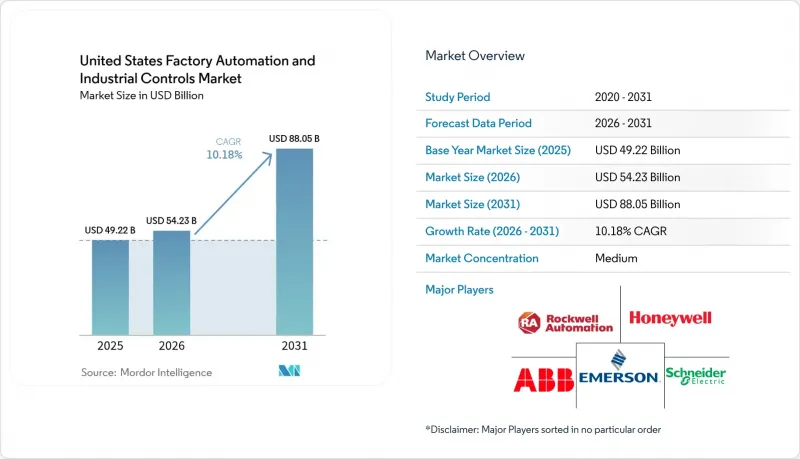
본 보고서는 구성요소별(하드웨어, 소프트웨어 등), 유형별(산업용 제어 시스템 및 필드 디바이스), 최종사용자 산업별(석유·가스, 금속·광업 등)로 분류되어 있습니다. 시장 예측은 금액(달러) 기준으로 제시되어 있습니다.
미국 공장 자동화 및 산업용 제어 시장의 동향과 인사이트
리쇼어링 장려책과 CHIPS법이 반도체 공장 자동화를 가속화
‘CHIPS and Science Act’는 사상 최대 규모의 국내 반도체 투자 열풍을 일으키고 있으며, 애리조나주, 텍사스주, 오하이오주에 건설되는 수십억 달러 규모의 팹에서는 초고청정 로봇 기술, 나노미터 정밀도의 모션 시스템,및 입자 오염을 최소화하는 자동화된 자재 취급 시스템이 채택되고 있습니다. 반도체 제조에 10억 달러가 투자될 때마다 일반적으로 2억-3억 달러의 자동화 관련 지출이 수반되며, 고속 웨이퍼 이송 로봇, 기계 학습을 활용한 공정 제어, 안전 기능을 통합한 PLC 플랫폼에 대한 수요가 확대되고 있습니다. 주 차원의 감세 조치로 인해 대규모 프로젝트는 남부 및 산악 서부 지역으로 더욱 이동하고 있으며, 이러한 지역에서는 전용으로 건설된 그린필드 부지에서 가동 첫날부터 완전히 디지털화된 무인 제조 셀을 도입할 수 있습니다. 팹 소유주들이 인증 주기를 단축하고 기밀 정보를 보호하는 턴키 솔루션을 요구함에 따라, 하드웨어, MES 소프트웨어, 라이프사이클 서비스를 번들로 제공하는 공급업체들이 경쟁 우위를 확보하고 있습니다.
인력 부족이 협업 로봇 도입을 촉진
현재 제조업 고용 인력은 75만 명 부족하며, 2030년까지 210만 명의 인력 부족이 우려되고 있습니다. 이러한 상황에 따라 경영진은 단조롭고 반복성이 높은 작업을 협업 로봇(코봇)에 맡기고, 직원들이 품질 관리, 유지보수, 데이터 분석 분야로 역량을 강화하도록 유도해야 하는 압박을 받고 있습니다. 조사에 따르면, 공장의 57%가 로봇이 인간의 일자리를 대체하는 것이 아니라 보완한다고 보고하고 있으며, 노동조합이 있는 시설에서도 도입이 촉진되고 있습니다. 자동차 조립 제조업체가 선구자이지만, 플러그 앤 플레이 방식의 코봇 가격이 하락하고 노코드 프로그래밍 인터페이스가 보급됨에 따라 중소 규모의 수탁 제조업체들도 이에 뒤따르고 있습니다. 연방 및 주 정부의 교육 보조금은 로봇 조작 및 안전에 관한 인증 프로그램 수강료를 지원함으로써 이러한 추세를 뒷받침하고, 노동과 기술의 융합을 가속화하고 있습니다.
미국의 다양한 브라운필드 시설에서 발생하는 레거시 OT 상호 운용성 문제
여러 차례의 산업 혁명을 거치며 건설된 공장에서는 독자적인 프로토콜이 뒤죽박죽으로 혼재되어 있어 원활한 데이터 흐름이 어렵습니다. 통합업체들은 Y2K 이전에 설치되어 네이티브 이더넷 인터페이스를 갖추지 않은 PLC를 종종 마주하게 되며, 프로젝트 비용과 위험을 증가시키는 맞춤형 드라이버를 사용해야만 하는 상황에 처합니다. TSN 기반 OPC UA와 같은 개방형 아키텍처의 움직임은 연결성의 표준화를 목표로 하고 있지만, 가동 중지 시간을 허용할 여지가 여전히 좁고 자본 예산도 빠듯하기 때문에 그 진전은 벤더들이 예측한 것보다 더디게 진행되고 있습니다. 자동화 대기업과 부품 공급업체가 참여하는 공동 이니셔티브를 통해 사전 인증된 상호 운용성 번들의 제공이 시작되고 있지만, 많은 중소기업은 더 명확한 투자 대비 효과가 드러날 때까지 프로젝트를 미루고 있습니다
부문 분석
2025년에는 제조업체들이 생산 라인의 디지털화를 위해 로봇, 드라이브, 센서, HMI를 구매한 결과, 하드웨어가 지출의 71.25%를 차지했습니다. 미국 공장 자동화 및 산업용 제어 시장에서 하드웨어 시장 규모는 한 자릿수 중반의 성장이 예상되는 반면, 서비스 부문은 더 빠르게 확대되고 있으며, 이는 구독형 지원, 원격 상태 모니터링 및 성능 보증으로의 전환을 시사합니다. 주요 공급업체들은 소프트웨어 라이선스, 사이버 보안 관리, 직원 교육을 다년 계약에 포함시켜 수익을 안정화하는 동시에, 인센티브를 고객의 생산 실적과 연계하고 있습니다. 소프트웨어 플랫폼은 현장 데이터를 MES 및 클라우드 분석과 연계하여 폐쇄 루프 최적화를 실현함으로써 불량률과 에너지 소비량을 저감합니다. 따라서 하드웨어 계층은 여전히 필수적이지만, 가치 창출은 장치, 데이터, 전문 지식을 통합하여 측정 가능한 성과를 창출하는 통합업체나 OEM으로 이동하고 있습니다.
서비스 부문의 연평균 성장률(CAGR) 12.42%는 제조업체들이 초기 자본 지출보다 예측 가능한 운영 비용을 선호하는 경향을 반영합니다. '서비스형' 로봇 용접 셀, 비전-어-서비스(Vision-as-a-Service)를 통한 검사, 보안-어-서비스(Security-as-a-Service) 패키지는 기술의 노후화에 대한 헤지를 원하는 주요 자동차 제조사 및 소비재 제조업체들의 공감을 얻고 있습니다. 원격 운영 센터를 공동으로 구축하는 벤더들은 연중무휴 24시간 지원과 실시간 인사이트를 제공함으로써 평균 수리 시간을 단축하는 동시에, 인력을 증원하지 않고도 지속적인 개선 주기를 추진하고 있습니다. 이러한 모델은 새로운 수익원을 개척하고, 경쟁이 치열한 하드웨어 시장에서 공급업체의 차별화를 도모합니다.
기타 혜택:
- 엑셀 형식의 시장 예측(ME) 시트
- 3개월간의 애널리스트 지원
자주 묻는 질문
목차
제1장 소개
제2장 조사 방법
제3장 주요 요약
제4장 시장 구도
제5장 시장 규모와 성장 예측
제6장 경쟁 구도
제7장 시장 기회와 향후 전망
KSM 26.09.07According to Mordor Intelligence, the United States factory automation and industrial controls market size is expected to grow from USD 49.22 billion in 2025 to USD 54.23 billion in 2026 and is forecast to reach USD 88.05 billion by 2031 at 10.18% CAGR over 2026-2031.
This report is Segmented by Component (Hardware, Software, and More), Type (Industrial Control Systems and Field Devices), and End-User Industry (Oil and Gas, Metals and Mining, and More). The Market Forecasts are Provided in Terms of Value (USD).
United States Factory Automation And Industrial Controls Market Trends and Insights
Reshoring incentives & CHIPS Act accelerate semiconductor factory automation
The CHIPS and Science Act has triggered the largest wave of domestic semiconductor investment on record, with multibillion-dollar fabs in Arizona, Texas, and Ohio specifying ultra-clean robotics, nanometer-precision motion systems, and automated material handling that minimize particle contamination. Every USD 1 billion allocated to chip fabrication typically pulls USD 200-300 million of automation spend, magnifying demand for high-speed wafer transfer robots, machine-learning-driven process control, and safety-integrated PLC platforms. State-level abatements further shift large projects toward the South and Mountain West, where purpose-built greenfield sites can adopt fully digital, lights-out manufacturing cells from day one. Suppliers that bundle hardware, MES software, and lifecycle services gain a competitive edge as fab owners seek turnkey solutions that shorten qualification cycles and protect sensitive.
Labor shortage drives collaborative robotics adoption
Manufacturing payrolls face a 750,000-person gap today and risk 2.1 million unfilled roles by 2030, pressing management teams to deploy collaborative robots (cobots) that assume monotonous, high-repetition tasks while up-skilling employees into quality, maintenance, and data-analytics positions. Surveys show 57% of plants report that robots augment rather than eliminate human jobs, reinforcing adoption even in unionized facilities. Automotive assemblers are first movers, but small and midsize job shops follow suit as plug-and-play cobots drop in price and gain no-code programming interfaces. Federal and state training grants amplify the trend by covering tuition for certificate programs in robot operation and safety, accelerating labor-technology convergence.
Legacy OT interoperability challenges in diverse U.S. brownfield facilities
Plants built across several industrial revolutions run a patchwork of proprietary protocols, making seamless data flow difficult. Integrators often confront PLCs installed before Y2K with no native Ethernet interface, forcing custom drivers that inflate project cost and risk. Open-architecture movements such as OPC UA over TSN aim to standardize connectivity, but progress is slower than software vendors predict because downtime windows remain narrow and capital budgets are stretched. Collaborative initiatives involving automation majors and component suppliers have begun to release pre-certified interoperability bundles, yet many small firms still delay projects until clearer return on investment emerges
Other drivers and restraints analyzed in the detailed report include:
- Clean-energy manufacturing boost from Inflation Reduction Act
- OSHA-enforced machine-safety compliance raises demand for safety-integrated control systems
- Cyber-security risks in connected control systems hinder deployment
For complete list of drivers and restraints, kindly check the Table Of Contents.
Segment Analysis
Hardware accounted for 71.25% spending in 2025 as manufacturers purchased robots, drives, sensors, and HMIs to digitalize production lines. The United States factory automation and industrial controls market size for hardware is projected to post mid-single-digit growth while services expand faster, signaling a transition toward subscription-based support, remote condition monitoring, and performance guarantees. Leading suppliers bundle software licenses, cybersecurity management, and workforce training into multi-year agreements that stabilize revenue and align incentives with customer output. Software platforms bridge field data to MES and cloud analytics, enabling closed-loop optimization that lowers scrap and energy intensity. The hardware layer thus remains indispensable, yet value capture is migrating to integrators and OEMs that orchestrate devices, data, and domain expertise into measurable outcomes.
The services segment's 12.42% CAGR reflects manufacturer preference for predictable operating expenditure over upfront capital outlay. As-a-service robotic welding cells, vision-as-a-service inspection, and security-as-a-service packages resonate with tier-one automotive and consumer packaged goods firms seeking to hedge technology obsolescence. Vendors that co-locate remote operations centers provide 24/7 support and real-time insight, shortening mean time to repair and driving continuous improvement cycles without inflating headcount. Such models unlock new margin pools and differentiate suppliers in a crowded hardware market.
Complete Report Scope:
- By Component
- Hardware
- Software
- Services
- By Type
- Industrial Control Systems
- Distributed Control System (DCS)
- Programmable Logic Controller (PLC)
- Supervisory Control and Data Acquisition (SCADA)
- Product Lifecycle Management (PLM)
- Manufacturing Execution System (MES)
- Human Machine Interface (HMI)
- Other Industrial Control Systems
- Field Devices
- Machine Vision
- Industrial Robotics
- Motors and Drives
- Safety Systems
- Sensors and Transmitters
- Other Field Devices
- Industrial Control Systems
- By End-user Industry
- Oil and Gas
- Chemical and Petrochemical
- Power and Utilities
- Food and Beverage
- Automotive and Transportation
- Pharmaceutical
- Semiconductor and Electronics
- Metals and Mining
- Pulp and Paper
- Other End-user Industries
- By Region (United States)
- Northeast U.S.
- Midwest U.S.
- South U.S.
- West U.S.
List of Companies Covered in this Report:
- Rockwell Automation Inc.
- Siemens AG
- Schneider Electric SE
- Emerson Electric Co.
- ABB Ltd
- Mitsubishi Electric Corporation
- Honeywell International Inc.
- Omron Corporation
- Yokogawa Electric Corporation
- Fanuc Corporation
- Bosch Rexroth AG
- KUKA AG
- Kawasaki Heavy Industries Ltd.
- Beckhoff Automation GmbH and Co. KG
- GE Vernova (GE Automation and Controls)
- Keyence Corporation
- Danfoss Drives A/S
- Parker Hannifin Corporation
- Yaskawa Electric Corporation
- Banner Engineering Corp.
- Advantech Co.
- Cognex Corporation
- Delta Electronics
- Hitachi Industrial Equipment Systems Co.
- BandR Industrial Automation GmbH
Additional Benefits:
- The market estimate (ME) sheet in Excel format
- 3 months of analyst support
TABLE OF CONTENTS
1 INTRODUCTION
- 1.1 Study Assumptions and Market Definition
- 1.2 Scope of the Study
2 RESEARCH METHODOLOGY
3 EXECUTIVE SUMMARY
4 MARKET LANDSCAPE
- 4.1 Market Overview
- 4.2 Market Drivers
- 4.2.1 Reshoring Incentives and CHIPS Act Accelerating Semiconductor Factory Automation in the U.S.
- 4.2.2 Labor Shortage Driving Collaborative Robotics Adoption Across U.S. Manufacturing
- 4.2.3 Clean-Energy Manufacturing Boost from Inflation Reduction Act Stimulating Advanced Automation Investments
- 4.2.4 OSHA-Enforced Machine-Safety Compliance Elevating Demand for Safety-Integrated Control Systems
- 4.2.5 Brownfield IIoT Retrofits for Real-Time OEE Optimization Among U.S. OEM Supplier Network
- 4.2.6 EV Production Expansion Necessitating Flexible High-Speed Assembly Automation Lines
- 4.3 Market Restraints
- 4.3.1 Legacy OT Interoperability Challenges in Diverse U.S. Brownfield Facilities
- 4.3.2 High Initial CapEx Limiting Adoption by Mid-Sized U.S. Manufacturers Despite Tax Credits
- 4.3.3 Cyber-Security Risks in Connected Control Systems Hindering Deployment
- 4.3.4 Trade Policy Volatility Impacting Supply of Critical Automation Components
- 4.4 Value / Supply-Chain Analysis
- 4.5 Industry Policies and Regulations
- 4.6 Regulatory or Technological Outlook
- 4.7 Porter's Five Forces Analysis
- 4.7.1 Bargaining Power of Suppliers
- 4.7.2 Bargaining Power of Consumers
- 4.7.3 Threat of New Entrants
- 4.7.4 Threat of Substitutes
- 4.7.5 Intensity of Competitive Rivalry
- 4.8 Investment Analysis
- 4.9 Key Case Studies and Implementation Scenarios
5 MARKET SIZE AND GROWTH FORECASTS (VALUE)
- 5.1 By Component
- 5.1.1 Hardware
- 5.1.2 Software
- 5.1.3 Services
- 5.2 By Type
- 5.2.1 Industrial Control Systems
- 5.2.1.1 Distributed Control System (DCS)
- 5.2.1.2 Programmable Logic Controller (PLC)
- 5.2.1.3 Supervisory Control and Data Acquisition (SCADA)
- 5.2.1.4 Product Lifecycle Management (PLM)
- 5.2.1.5 Manufacturing Execution System (MES)
- 5.2.1.6 Human Machine Interface (HMI)
- 5.2.1.7 Other Industrial Control Systems
- 5.2.2 Field Devices
- 5.2.2.1 Machine Vision
- 5.2.2.2 Industrial Robotics
- 5.2.2.3 Motors and Drives
- 5.2.2.4 Safety Systems
- 5.2.2.5 Sensors and Transmitters
- 5.2.2.6 Other Field Devices
- 5.2.1 Industrial Control Systems
- 5.3 By End-user Industry
- 5.3.1 Oil and Gas
- 5.3.2 Chemical and Petrochemical
- 5.3.3 Power and Utilities
- 5.3.4 Food and Beverage
- 5.3.5 Automotive and Transportation
- 5.3.6 Pharmaceutical
- 5.3.7 Semiconductor and Electronics
- 5.3.8 Metals and Mining
- 5.3.9 Pulp and Paper
- 5.3.10 Other End-user Industries
- 5.4 By Region (United States)
- 5.4.1 Northeast U.S.
- 5.4.2 Midwest U.S.
- 5.4.3 South U.S.
- 5.4.4 West U.S.
6 COMPETITIVE LANDSCAPE
- 6.1 Market Concentration
- 6.2 Strategic Moves
- 6.3 Market Share Analysis
- 6.4 Company Profiles (includes Global level Overview, Market level overview, Core Segments, Financials as available, Strategic Information, Market Rank/Share for key companies, Products and Services, and Recent Developments)
- 6.4.1 Rockwell Automation Inc.
- 6.4.2 Siemens AG
- 6.4.3 Schneider Electric SE
- 6.4.4 Emerson Electric Co.
- 6.4.5 ABB Ltd
- 6.4.6 Mitsubishi Electric Corporation
- 6.4.7 Honeywell International Inc.
- 6.4.8 Omron Corporation
- 6.4.9 Yokogawa Electric Corporation
- 6.4.10 Fanuc Corporation
- 6.4.11 Bosch Rexroth AG
- 6.4.12 KUKA AG
- 6.4.13 Kawasaki Heavy Industries Ltd.
- 6.4.14 Beckhoff Automation GmbH and Co. KG
- 6.4.15 GE Vernova (GE Automation and Controls)
- 6.4.16 Keyence Corporation
- 6.4.17 Danfoss Drives A/S
- 6.4.18 Parker Hannifin Corporation
- 6.4.19 Yaskawa Electric Corporation
- 6.4.20 Banner Engineering Corp.
- 6.4.21 Advantech Co.
- 6.4.22 Cognex Corporation
- 6.4.23 Delta Electronics
- 6.4.24 Hitachi Industrial Equipment Systems Co.
- 6.4.25 BandR Industrial Automation GmbH
7 MARKET OPPORTUNITIES AND FUTURE OUTLOOK
- 7.1 White-Space and Unmet-Need Assessment


