|
시장보고서
상품코드
2120666
북미의 수의과 의료 : 시장 점유율 분석, 업계 동향과 통계, 성장 예측(2026-2031년)North America Veterinary Healthcare - Market Share Analysis, Industry Trends & Statistics, Growth Forecasts (2026 - 2031) |
||||||
 Mordor Intelligence
Mordor Intelligence에 의하면, 북미의 수의과 의료 시장 규모는 2025년 274억 2,000만 달러, 2026년 292억 달러에서 2031년까지 399억 9,000만 달러에 달하고, 2026년부터 2031년까지 CAGR은 6.41%를 기록할 전망입니다.
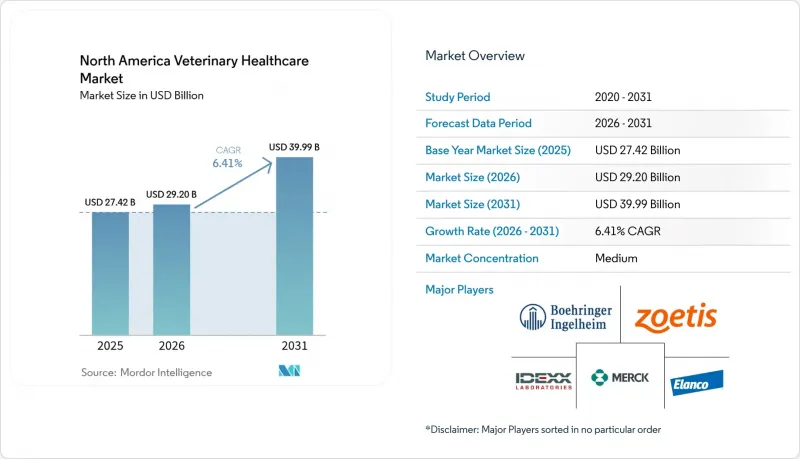
본 보고서는 제품별(치료제(백신, 구충제 등) 및 진단제(면역 진단 검사 등)), 동물 종별(개, 고양이 등), 투여 경로별(경구 등), 최종 사용자별(동물병원 및 진료소 등), 지역별(미국, 캐나다, 멕시코)로 분류되어 있습니다. 시장 예측은 금액(달러) 기준으로 제시되어 있습니다.
북미 반려동물 의료 시장 동향 및 인사이트
반려동물 사육 마릿수 증가
반려동물을 키우는 가구 수는 계속 증가하고 있으며, 2024년에는 미국에서 7,000만 가구, 캐나다에서 790만 가구에 달하고, 멕시코에서는 가구 보급률이 70%에 달하고 있습니다. 젊은 반려인들 사이에서는 한 번에 여러 마리의 반려동물을 키우는 경향이 강해지고 있으며, 이로 인해 정기적인 관리 주기가 단축되어 인력 부족에 시달리는 동물병원에 부담이 가중되고 있습니다. 이러한 상황으로 인해 내원 시 바로 결과를 확인할 수 있어 효율성을 높이는 POC(Point-of-Care) 진단에 대한 수요가 높아지고 있습니다. 특히 건강검진 예약이 밀려 있는 상황을 배경으로, 기업 그룹들은 주말 진료 시간을 연장하거나, 긴급성이 없는 사례를 온라인 진료 플랫폼으로 유도하는 ‘원격 분류(텔레트리아지)’ 옵션을 제공합니다.
반려동물 헬스케어 증가
미국의 수의학 지출은 2024년 398억 달러에서 2025년에는 414억 달러로 증가했습니다. 한편, 캐나다에서는 2023년에 21억 캐나다 달러가 수의학 서비스에 지출되었습니다. 기업 그룹들은 서비스를 ‘단계별 건강 관리 패키지’와 ‘긴급성이 높은 전문 진료’로 구분함으로써, 가격에 민감한 계층과 프리미엄 계층 양쪽 수요를 모두 흡수하면서도 상호 간 고객 유치 경쟁을 방지하는 데 성공하고 있습니다. 2024년 반려동물 보험료 총액은 47억 달러에 달했으나, 수의사의 94%가 여전히 ‘비용’을 권장 치료의 장벽으로 꼽고 있어, 보험 적용 대상이 부유층 고객에게 편중되어 있음을 시사합니다.
수의 의료 종사자 부족
AVMA(미국수의사회)는 2030년까지 1만 5,000명의 수의사가 부족할 것으로 예측하고 있으며, 캐나다에서는 1,500명의 수의사 부족이 예상됩니다. 소득 대비 부채의 불균형으로 인해 졸업생들은 지방에서의 개업을 꺼리고 있으며, 그 결과 인력이 도시 지역에 집중되어 선택적 치료의 대기 시간이 길어지고 있습니다. 기업 간 통합이 진행되는 가운데, 채용 보너스나 대출 상환 지원 패키지를 통해 급여가 인상되고 있지만, 이러한 조치는 총 공급량을 확대하기보다는 주로 기존 임상의를 재배치하는 데 그치고 있습니다. 도덕적 고뇌나 장시간 근무로 인한 번아웃은 인재의 정착률을 더욱 낮추고 있습니다.
부문 분석
진단 분야의 매출액은 연평균 성장률(CAGR) 6.43%로 증가할 전망이며, 진료 현장의 의사결정을 가속화하고 소모품 판매를 견인하는 병원 내 분자진단 플랫폼의 도입이 진행됨에 따라 치료 분야의 성장세를 앞지를 기세입니다. 심충 및 진드기 매개 질환 패널 검사를 위한 SNAP 면역 분석법은 현재 미국 건강 검진의 80%에서 채택되고 있으며, 북미 헬스케어 시장에서 진단용 소모품 매출을 뒷받침하는 정기적인 키트 판매의 기반이 되고 있습니다. 치료제는 여전히 절대액 기준으로 지배적인 위치를 차지하고 있지만, 항생제 내성 문제와 규제 감독 강화로 인해 판매량 확대는 억제되고 있습니다. ‘심파리카 트리오’나 ‘크레델리오 콰트로’와 같은 복합 기생충 구제제는 편의성이 반려인의 투약 순응도를 높여, 투약 누락으로 인한 수익 손실을 줄인다는 점이 입증되었습니다. 백신 분야에서는 가축 사육업자들이 취급의 부담을 줄여주는 다가 제제를 선호하는 반면, 반려동물용 백신에는 더 광범위한 균주를 커버하기 위한 키메라 기술이 도입되고 있습니다.
2025년에도 반려동물 분야는 매출의 45.78%를 계속 차지하고 있으며, 이는 반려동물의 ‘인간화’라는 정착된 행동이 전문 동물병원으로의 의뢰와 만성 질환 관리를 뒷받침하고 있음을 반영합니다. 그럼에도 불구하고, 가금류 건강 관련 지출은 다른 모든 범주를 상회하며, 고병원성 조류 인플루엔자(HPAI) 이후의 생물 보안 강화 및 더욱 엄격해진 수출 인증 규정을 배경으로 연평균 성장률(CAGR) 6.66%로 성장할 전망입니다. 진단 검사 기관에서는 조류용 PCR 검사 패널에 대한 수요가 급증하고 있는 반면, 백신 공급업체들은 가축 군 전체를 대상으로 한 예방 접종 의무화에 대응하기 위해 생산을 확대되고 있습니다. 반추동물 분야에서의 보급은 상품 가격 변동으로 인해 여전히 제약을 받고 있지만, 스크류웜과 관련된 무역 혼란으로 인해 소 사육업자들은 미국 시장 접근을 회복하기 위해 구충제 및 혈청학적 선별 검사의 도입을 서두르고 있습니다.
기타 혜택:
- 엑셀 형식 시장 예측(ME) 시트
- 3개월간의 애널리스트 지원
자주 묻는 질문
목차
제1장 서론
제2장 조사 방법
제3장 주요 요약
제4장 시장 구도
제5장 시장 규모와 성장 예측
제6장 경쟁 구도
제7장 시장 기회와 향후 전망
LSH 26.09.08According to Mordor Intelligence, the North America veterinary healthcare market size is projected to expand from USD 27.42 billion in 2025 and USD 29.20 billion in 2026 to USD 39.99 billion by 2031, registering a CAGR of 6.41% between 2026 to 2031.
This report is Segmented by Product (Therapeutics [Vaccines, Parasiticides, and More] and Diagnostics [Immunodiagnostic Tests, and More]), Animal Type (Dogs & Cats, and More), Route of Administration (Oral, and More), End User (Veterinary Hospitals & Clinics, and More), and Geography (United States, Canada, and Mexico). The Market Forecasts are Provided in Terms of Value (USD).
North America Veterinary Healthcare Market Trends and Insights
Growth in Companion Animal Ownership
Pet-owning households continue to climb, reaching 70 million in the United States in 2024 and 7.9 million in Canada, with Mexico showing 70% household penetration. Younger owners increasingly adopt multiple pets at once, compressing routine-care cycles and straining under-staffed clinics. This intensifies demand for efficiency-enhancing POC diagnostics that deliver results during the same visit. Scheduling backlogs, particularly for wellness appointments, are steering corporate groups to extend weekend hours and to offer teletriage options that direct non-urgent cases to virtual platforms.
Increasing Pet Healthcare Expenditure
U.S. veterinary-care outlays grew from USD 39.8 billion in 2024 to USD 41.4 billion in 2025, while Canada allocated CAD 2.1 billion to veterinary services in 2023. Corporate groups segment offerings into tiered wellness packages versus high-acuity specialties, capturing both price-sensitive and premium spend without cannibalization. Although pet insurance premiums reached USD 4.7 billion in 2024, 94% of veterinarians still cite cost as a barrier to recommended care, signaling that coverage skews toward affluent clients.
Shortage of Veterinary Professionals
The AVMA projects a 15,000-veterinarian deficit by 2030, while Canada anticipates a 1,500-practitioner shortfall. Debt-to-income imbalance discourages graduates from rural practice ownership, concentrating talent in urban centers and raising wait times for elective care. Corporate consolidators are bidding up salaries with sign-on bonuses and loan-repayment packages, but the measures mostly re-shuffle existing clinicians rather than expand total supply. Burnout, driven by moral distress and long hours, further erodes retention.
Other drivers and restraints analyzed in the detailed report include:
- Advancements in Veterinary Diagnostics and Therapeutics
- Rising Adoption of Pet Insurance
- High Cost of Advanced Veterinary Care
For complete list of drivers and restraints, kindly check the Table Of Contents.
Segment Analysis
Diagnostics revenue is poised to climb at a 6.43% CAGR, eclipsing therapeutic growth as practices embrace in-clinic molecular platforms that accelerate decision-making and generate consumable pull-through. SNAP immunoassays for heartworm and tick-borne panels are now featured in 80% of U.S. wellness visits, anchoring recurring kit sales that bolster the North American veterinary healthcare market for diagnostic consumables. Therapeutics continue to dominate absolute value; however, antimicrobial resistance constraints and heightened regulatory oversight temper volume expansion. Combination parasiticides, such as Simparica Trio and Credelio Quattro, demonstrate that convenience drives owner adherence, mitigating revenue leakage from missed doses. Within vaccines, livestock operators favor multivalent formulations that reduce handling stress, while companion-animal updates now incorporate chimeric technologies for broader strain coverage.
Companion animals retain 45.78% revenue in 2025, reflecting entrenched pet-humanization behaviors that propel specialty referrals and chronic-disease management. Nevertheless, poultry health spending will outpace all other categories, expanding at 6.66% CAGR on the back of post-HPAI biosecurity upgrades and stricter export certification rules. Diagnostic laboratories report a surge in avian PCR panels, while vaccine suppliers ramp production to meet flock-wide prophylaxis mandates. Ruminant uptake remains constrained by commodity-price volatility; however, screwworm-related trade disruptions are spurring cattle operators to integrate parasiticides and serology screens to regain U.S. market access.
Complete Report Scope:
- By Product
- Therapeutics
- Vaccines
- Parasiticides
- Anti-Infectives
- Medical Feed Additives
- Other Therapeutics
- Diagnostics
- Immunodiagnostic Tests
- Molecular Diagnostics
- Diagnostic Imaging
- Clinical Chemistry
- Other Diagnostics
- Therapeutics
- By Animal Type
- Dogs & Cats
- Horses
- Ruminants
- Swine
- Poultry
- Other Animal Types
- By Route Of Administration
- Oral
- Parenteral
- Topical
- Other Routes
- By End User
- Veterinary Hospitals & Clinics
- Reference Laboratories
- Point-Of-Care / In-House Settings
- Academic & Research Institutes
- By Country
- United States
- Canada
- Mexico
List of Companies Covered in this Report:
- Antech Diagnostics
- Boehringer Ingelheim
- Ceva Sante Animale
- Covetrus
- Dechra Pharmaceuticals
- Elanco Animal Health Inc.
- Henry Schein Animal Health
- Heska
- IDEXX
- Mars Veterinary Health / VCA
- Merck Animal Health (Merck & Co.)
- Neogen
- Patterson Companies (Animal Health)
- Phibro Animal Health
- Thermo Fisher Scientific (Vet)
- Vetoquinol
- Virbac Corp.
- Zoetis
Additional Benefits:
- The market estimate (ME) sheet in Excel format
- 3 months of analyst support
TABLE OF CONTENTS
1 Introduction
- 1.1 Study Assumptions & Market Definition
- 1.2 Scope Of The Study
2 Research Methodology
3 Executive Summary
4 Market Landscape
- 4.1 Market Overview
- 4.2 Market Drivers
- 4.2.1 Growth in Companion Animal Ownership
- 4.2.2 Increasing Pet Healthcare Expenditure
- 4.2.3 Advancements in Veterinary Diagnostics and Therapeutics
- 4.2.4 Rising Adoption of Pet Insurance
- 4.2.5 Expansion of Corporate Veterinary Chains
- 4.2.6 Supportive Government Animal Health Policies
- 4.3 Market Restraints
- 4.3.1 Shortage of Veterinary Professionals
- 4.3.2 High Cost of Advanced Veterinary Care
- 4.3.3 Stringent Regulatory Compliance Requirements
- 4.3.4 Concerns Over Antimicrobial Resistance
- 4.4 Value / Supply-Chain Analysis
- 4.5 Regulatory Landscape
- 4.6 Technological Outlook
- 4.7 Porter's Five Forces Analysis
- 4.7.1 Bargaining Power Of Buyers
- 4.7.2 Bargaining Power Of Suppliers
- 4.7.3 Threat Of New Entrants
- 4.7.4 Threat Of Substitutes
- 4.7.5 Industry Rivalry
5 Market Size & Growth Forecasts (Value, USD)
- 5.1 By Product
- 5.1.1 Therapeutics
- 5.1.1.1 Vaccines
- 5.1.1.2 Parasiticides
- 5.1.1.3 Anti-Infectives
- 5.1.1.4 Medical Feed Additives
- 5.1.1.5 Other Therapeutics
- 5.1.2 Diagnostics
- 5.1.2.1 Immunodiagnostic Tests
- 5.1.2.2 Molecular Diagnostics
- 5.1.2.3 Diagnostic Imaging
- 5.1.2.4 Clinical Chemistry
- 5.1.2.5 Other Diagnostics
- 5.1.1 Therapeutics
- 5.2 By Animal Type
- 5.2.1 Dogs & Cats
- 5.2.2 Horses
- 5.2.3 Ruminants
- 5.2.4 Swine
- 5.2.5 Poultry
- 5.2.6 Other Animal Types
- 5.3 By Route Of Administration
- 5.3.1 Oral
- 5.3.2 Parenteral
- 5.3.3 Topical
- 5.3.4 Other Routes
- 5.4 By End User
- 5.4.1 Veterinary Hospitals & Clinics
- 5.4.2 Reference Laboratories
- 5.4.3 Point-Of-Care / In-House Settings
- 5.4.4 Academic & Research Institutes
- 5.5 By Country
- 5.5.1 United States
- 5.5.2 Canada
- 5.5.3 Mexico
6 Competitive Landscape
- 6.1 Market Concentration
- 6.2 Market Share Analysis
- 6.3 Company Profiles (Includes Global-Level Overview, Market-Level Overview, Core Segments, Financials As Available, Strategic Information, Market Rank/Share For Key Companies, Products & Services, And Recent Developments)
- 6.3.1 Antech Diagnostics
- 6.3.2 Boehringer Ingelheim Animal Health
- 6.3.3 Ceva Sante Animale
- 6.3.4 Covetrus Inc.
- 6.3.5 Dechra Pharmaceuticals PLC
- 6.3.6 Elanco Animal Health Inc.
- 6.3.7 Henry Schein Animal Health
- 6.3.8 Heska Corporation
- 6.3.9 IDEXX Laboratories Inc.
- 6.3.10 Mars Veterinary Health / VCA
- 6.3.11 Merck Animal Health (Merck & Co.)
- 6.3.12 Neogen Corporation
- 6.3.13 Patterson Companies (Animal Health)
- 6.3.14 Phibro Animal Health Corporation
- 6.3.15 Thermo Fisher Scientific (Vet)
- 6.3.16 Vetoquinol SA
- 6.3.17 Virbac Corp.
- 6.3.18 Zoetis Inc.
7 Market Opportunities & Future Outlook
- 7.1 White-Space & Unmet-Need Assessment