

|
시장보고서
상품코드
2120756
유럽의 화장품 포장 : 시장 점유율 분석, 업계 동향과 통계, 성장 예측(2026-2031년)Europe Cosmetic Packaging - Market Share Analysis, Industry Trends & Statistics, Growth Forecasts (2026 - 2031) |
||||||
 Mordor Intelligence
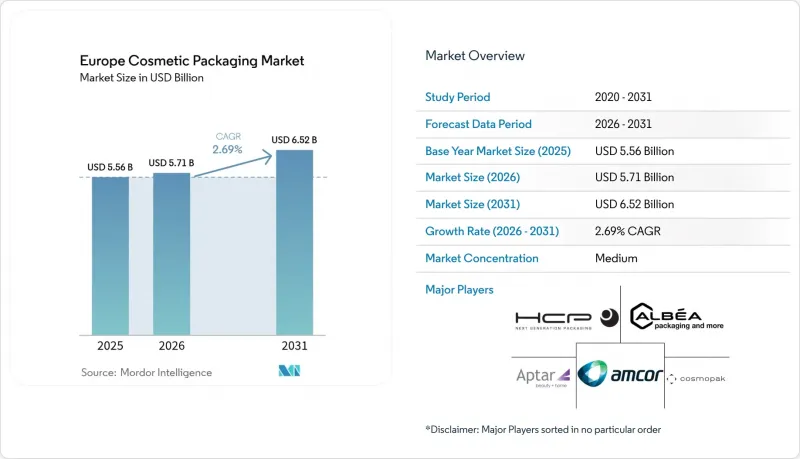
Mordor Intelligence에 따르면 유럽의 화장품 포장 시장 규모는 2025년에 55억 6,000만 달러, 2026년에 57억 1,000만 달러에 달하고, 2031년까지 65억 2,000만 달러에 달할 것으로 예측되며, 2026년부터 2031년까지 CAGR 2.69%로 성장할 것으로 전망됩니다.
본 보고서는 소재 종류(플라스틱 등), 제품 유형(병·용기, 튜브·스틱 등), 화장품 종류(스킨케어, 헤어케어 등), 유통 채널(직접 판매, 간접 판매), 포장 형태(경질 용기 등), 지속가능성 속성(재활용 가능 등), 및 지역별로 분류되어 있습니다. 시장 전망은 금액(달러) 기준으로 제시되어 있습니다.
유럽 화장품 포장 시장의 동향 및 인사이트
EU의 포장 및 포장 폐기물 규제 추진
2025년 전면 시행에 따라 2030년까지 모든 화장품 포장은 재활용 가능하거나 재사용 가능해야 하며, PET 병의 경우 2027년까지 25%, 2030년까지 30%라는 재활용 소재 함유율의 중간 목표가 설정되어 있습니다. 각 브랜드는 다층 라미네이트 재질을 단일 소재 튜브로 재설계하고 있지만, 이를 위해서는 플라즈마 코팅에 대한 투자가 필요하며, 많은 중견 컨버터는 단독으로는 그 자금을 조달할 수 없습니다. 현재, 확대 생산자 책임(EPR) 수수료는 재활용이 불가능한 형태의 원자재 비용에 필적하는 수준에 도달하여, 입고 가격이 2배로 치솟는 동시에 리필 시스템에 대한 관심이 급속히 높아지고 있습니다. 투명한 PET는 현재 불투명한 검은색 제품보다 수수료가 낮아져, 고급스러운 느낌을 연출하기 위해 불투명한 검은색에 의존해 온 명품 브랜드 기업들에게 과제가 되고 있습니다. 독일과 네덜란드의 선도 기업들로부터는 소매업체의 생산 라인 인증 승인이 신속하게 이루어져, 후발 기업보다 앞서 우선적인 진열 공간을 확보하고 있다는 보고가 접수되고 있습니다.
리필 및 재사용 가능한 패키지의 급증
2025년, 유럽에서 새로 출시된 화장품 중 리필 가능한 패키지가 15%를 차지하여 2023년 수준의 거의 2배에 달했습니다. 프랑스의 AGEC 법은 2027년까지 중량 기준으로 10%의 리필 가능 제품을 의무화하고 있으며, 이에 따라 매장 및 정기 구독용 카트리지에 대응하는 자석식 개폐 방식의 콤팩트와 트위스트 잠금 방식의 립스틱 케이스가 보급되고 있습니다. 게레스하이머사의 모듈식 유리 용기는 소비자가 외부 케이스를 그대로 사용하고 내부 라이너만 교체할 수 있도록 설계되어, 5회 사용 시 재료 사용량을 60% 절감합니다. 3개월 이내에 다 쓰게 되는 회전율이 높은 크림의 경우 경제성이 가장 높지만, 사용 빈도가 낮은 아이섀도우의 경우 초기 프리미엄 가격을 회수하기 어렵습니다. 유럽 약국의 20% 미만에 설치된 리필 스테이션의 수가 제한적이기 때문에 도시 외곽 지역에서의 보급은 더딘 편입니다. 이에 각 브랜드는 NFC 칩을 내장하고, 반복적으로 리필하는 소비자에게 혜택을 제공함으로써 고객 참여를 유지하고 있습니다.
바이오 기반 폴리머의 높은 가격 차이
2025년, 바이오 기반 폴리에틸렌 및 폴리프로필렌은 화석 유래 대체품보다 20-35% 높은 가격에 거래되고 있으며, 그 가격 차이를 감당할 수 있는 프리미엄 브랜드에만 채택이 제한되고 있습니다. 이 지역의 바이오플라스틱 생산능력은 연간 8만 톤 미만이므로, 가공업체의 15% 이상이 동시에 전환할 경우 수요가 공급을 초과하게 됩니다. 가공 허용 범위가 좁아 생산 라인 전환 시 스크랩률이 3포인트 상승하고 있습니다. 매스 밸런스 회계에 관한 규제의 명확화는 2026년 후반까지 예상되지 않아, 이로 인해 수량 확약이 미뤄지고 있습니다. 소비자가 8-12%의 환경 프리미엄을 지불할 의향이 있다 하더라도, 가공업체의 비용 증가를 완전히 상쇄할 수는 없으며, 마진 격차를 메우기 위해서는 수년에 걸친 인수 계약이 필수적입니다.
부문별 분석
유럽 화장품 포장 시장에서 2025년 플라스틱은 소재 매출의 43.26%를 차지했습니다. 이 압도적인 점유율은 플라스틱의 범용성, 높은 가성비, 그리고 다양한 화장품 카테고리에서의 광범위한 사용에 기인합니다. 유리는 무한히 재활용이 가능하다는 점과 고급스러운 매력 덕분에 약 22%의 시장 점유율을 확보했습니다. 미관과 지속가능성이 중요한 요소인 향수나 고급 크림 분야에서는 여전히 선호되는 선택지입니다.
연평균 성장률(CAGR) 3.34%로 성장할 것으로 예상되는 생분해성 및 퇴비화 가능한 수지는 가장 빠르게 확대될 전망입니다. 각 브랜드가 환경 문제에 적극적으로 대응하고 미세 플라스틱 금지 가능성에 대비하는 가운데, 이러한 소재들이 주목받고 있습니다. 기업들은 EN 13432 인증을 획득한 공급 계약을 체결함으로써 엄격한 규제를 준수하면서도 지속가능한 노력을 추진하고 있습니다. 이러한 변화로 인해 유럽 화장품 포장 업계는 더욱 다양한 원료로 전환되고 있으며, 기존 소재에 대한 의존도는 낮아지고 있습니다. 76%라는 높은 회수율을 자랑하는 알루미늄 튜브는 선크림 및 컬러 코스메틱 두 부문 모두에서 그 중요성을 확고히 하고 있습니다. 뛰어난 재활용성과 내구성을 바탕으로, 지속가능성 목표 달성을 지향하는 브랜드에게 신뢰할 수 있는 선택지가 되고 있습니다. 새로운 금형 없이도 플라스틱에서 유리로 전환이 가능한, 다중 소재에 대한 유연성을 보여주는 공급업체들은 확대된 생산자 책임(EPR) 요금이 엄격해지는 가운데 결정적인 우위를 확보하고 있습니다. 이러한 적응력을 통해 그들은 업무 차질을 최소화하면서 끊임없이 변화하는 시장의 수요에 대응할 수 있습니다.
2025년, 유럽 화장품 포장 시장에서는 병과 용기가 주류를 차지하며 매출의 29.84%를 차지했습니다. 이러한 포장 형태는 내구성, 재사용 가능성, 그리고 제품 품질을 유지하는 능력 덕분에 여전히 인기를 끌고 있습니다. 그 뒤를 이어 튜브와 스틱이 시장의 약 24%를 차지하고 있어, 크림이나 밤의 휴대성을 중시하는 소비자의 선호도가 두드러지게 나타나고 있습니다. 이러한 형태가 제공하는 편의성, 특히 외출 시 사용 시의 편의성이 계속해서 수요를 견인하고 있습니다.
플렉서블 파우치와 향낭은 증가 추세를 보이고 있으며, 2031년까지의 연평균 성장률(CAGR)은 3.21%로 예상됩니다. 경량이기 때문에 운송 비용을 절감할 수 있을 뿐만 아니라 저탄소화 목표에도 부합하여, 환경 의식이 높은 브랜드와 소비자에게 매력적인 선택지가 되고 있습니다. 이러한 동향은 보호 성능과 지속가능성 측면에서 뛰어난 이점을 제공하는 고차단성 라미네이트 소재로 유럽 화장품 포장 시장의 관심이 이동할 가능성을 시사하고 있습니다. 산소에 민감한 세럼에 필수적인 펌프와 드롭퍼는 꾸준한 수요를 유지하고 있지만, 각 브랜드는 재활용을 간소화하고 지속가능성 목표를 달성하기 위해 금속 스프링을 사용하지 않는 디자인을 점점 더 많이 채택하는 추세입니다. 또한, 컨버터들이 인디 브랜드를 지원하고 활기찬 온라인 마켓플레이스에서 차별화를 꾀함에 따라, 장식 서비스, 특히 디지털 인쇄는 더 높은 수익률을 창출하고 있습니다. 맞춤화된 시각적으로 매력적인 디자인을 제공할 수 있는 능력은 경쟁이 치열한 디지털 환경에서 소비자의 관심을 끌고자 하는 브랜드에게 중요한 차별화 요소가 되고 있습니다.
기타 혜택:
- 엑셀 형식의 시장 예측(ME) 시트
- 3개월간의 애널리스트 지원
자주 묻는 질문
목차
제1장 소개
제2장 조사 방법
제3장 주요 요약
제4장 시장 구도
제5장 시장 규모와 성장 예측
제6장 경쟁 구도
제7장 시장 기회와 향후 전망
KSM 26.09.02According to Mordor Intelligence, the Europe cosmetic packaging market size is projected to be USD 5.56 billion in 2025, USD 5.71 billion in 2026, and reach USD 6.52 billion by 2031, growing at a CAGR of 2.69% from 2026 to 2031.
This report is Segmented by Material Type (Plastic, and More), Product Type (Bottles and Jars, Tubes and Sticks, and More), Cosmetic Type (Skin Care, Hair Care, and More), Distribution Channel (Direct Sales, and Indirect Sales), Packaging Format (Rigid, and More), Sustainability Attribute (Recyclable, and More), and Geography. The Market Forecasts are Provided in Terms of Value (USD).
Europe Cosmetic Packaging Market Trends and Insights
EU Packaging and Packaging-Waste Regulation Push
Full enforcement in 2025 obliges all cosmetic packs to be recyclable or reusable by 2030 with interim recycled-content targets of 25% for PET bottles by 2027 and 30% by 2030. Brands are redesigning multi-layer laminates into single-material tubes, which requires plasma-coating investments many mid-tier converters cannot fund alone. Extended producer responsibility fees now rival material costs for non-recyclable formats, doubling landed prices and accelerating interest in refillable systems. Transparent PET now earns lower fees than dark variants, challenging prestige firms that relied on opaque black to signal luxury. Early movers in Germany and the Netherlands report faster line-qualification approvals from retailers, securing priority shelf space ahead of laggards.
Surge in Refillable and Reusable Formats
Refillable packaging represented 15% of new European cosmetic launches in 2025, nearly double 2023 levels. France's AGEC law mandates a 10% refillable share by weight by 2027, spurring magnetic-closure compacts and twist-lock lipstick cases that accept in-store or subscription cartridges. Gerresheimer's modular glass jar lets consumers keep an outer shell and replace an inner liner, cutting 60% of material over five cycles. Economics work best for high-turnover creams depleted within three months, while low-usage eye shadow struggles to recoup the initial premium. Limited retail refill stations under 20% of European drugstores restrain uptake outside urban hubs, so brands embed NFC chips to reward repeat refills and maintain engagement.
High-Cost Differential for Bio-Based Polymers
Bio-based polyethylene and polypropylene traded 20-35% above fossil alternatives during 2025, limiting uptake to premium brands able to absorb the gap. The region's bio-plastic capacity sits below 80 000 t annually, so broader adoption would outstrip supply if more than 15% of converters switch simultaneously. Processing windows are tighter, driving scrap rates three points higher during line changeovers. Regulatory clarity on mass-balance accounting will not arrive until late 2026, postponing volume commitments. Consumer willingness to pay an 8-12% green premium fails to fully offset converter cost increases, making multi-year offtake contracts essential to close the margin gap.
Other drivers and restraints analyzed in the detailed report include:
- E-commerce Led Demand for Protective Aesthetics
- Gen-Z Preference for Minimalist Mono-Material Designs
- Intra-EU rPET Supply Shortages
For complete list of drivers and restraints, kindly check the Table Of Contents.
Segment Analysis
In the European cosmetic packaging market, plastics accounted for 43.26% of the material revenue in 2025. This dominance is attributed to its versatility, cost-effectiveness, and widespread use across various cosmetic product categories. Glass, benefiting from its infinite recyclability and premium appeal, secured about 22% of the market share. It remains a preferred choice for fragrances and high-end creams, where aesthetics and sustainability are key considerations.
Forecasted to grow at a rate of 3.34% CAGR, bio-degradable and compostable resins are set to expand the fastest. These materials are gaining traction as brands proactively address environmental concerns and prepare for potential microplastic bans. By securing EN 13432-certified supply contracts, companies are ensuring compliance with stringent regulations while promoting sustainable practices. This shift is steering the European cosmetic packaging industry towards a more diverse range of feedstocks, reducing dependency on traditional materials. Aluminum tubes, with an impressive 76% collection rate, solidify their significance in both sunscreen and color cosmetic segments. Their high recyclability and durability make them a reliable choice for brands aiming to meet sustainability goals. Suppliers showcasing multi-material agility, capable of transitioning from plastic to glass without the need for new tooling, gain a crucial edge as Extended Producer Responsibility (EPR) fees become more stringent. This adaptability allows them to cater to evolving market demands while minimizing operational disruptions
In 2025, bottles and jars dominated the European cosmetic packaging market, accounting for 29.84% of the revenue. These packaging formats remain popular due to their durability, reusability, and ability to preserve product integrity. Following closely, tubes and sticks made up roughly 24% of the market, highlighting consumers' preference for the portability of creams and balms. The convenience offered by these formats, especially for on-the-go usage, continues to drive their demand.
Flexible pouches and sachets are on the rise, boasting a 3.21% CAGR through 2031. Their lighter weights not only reduce shipping costs but also align with lower carbon targets, making them an attractive option for environmentally conscious brands and consumers. This trend suggests a potential shift in the European cosmetic packaging market's focus towards high-barrier laminates, which offer enhanced protection and sustainability benefits. While pumps and droppers, essential for oxygen-sensitive serums, see robust demand, brands are increasingly leaning towards metal-spring-free designs to simplify recycling and meet sustainability goals. Additionally, decoration services, particularly digital printing, are reaping higher margins as converters assist indie labels in distinguishing themselves in the bustling online marketplace. The ability to offer customized and visually appealing designs has become a key differentiator for brands aiming to capture consumer attention in a competitive digital landscape.
Complete Report Scope:
- By Material Type
- Plastic
- Glass
- Metal
- Paper and Paperboard
- Bio-Degradable/Compostable
- By Product Type
- Bottles and Jars
- Tubes and Sticks
- Folding Cartons
- Pump, Dispenser and Droppers
- Caps, Closures and Applicators
- Flexible Pouches and Sachets
- By Cosmetic Type
- Skin Care
- Hair Care
- Color Cosmetics
- Fragrances
- Other Cosmetic Types
- By Distribution Channel
- Direct Sales Channel
- Indirect Sales Channel
- By Packaging Format
- Rigid
- Semi-Rigid
- Flexible
- By Sustainability Attribute
- Recyclable
- Reusable/Refillable
- Bio-Based Content ?30 %
- Compostable
- By Country
- Germany
- United Kingdom
- France
- Italy
- Spain
- Rest of Europe
List of Companies Covered in this Report:
- Albea SA
- AptarGroup Inc.
- Amcor Plc
- Silgan Holdings Inc.
- Gerresheimer AG
- Quadpack Industries SA
- Berlin Packaging LLC
- International Paper Company
- Smurfit WestRock
- HCP Packaging Co., Ltd.
- Coverpla SAS
- Cosmopak USA LLC
- Huhtamaki Oyj
- Graham Packaging Company
- Mondi Group
- Sealed Air Corporation
- Rexam Plc (Ball Corporation)
- Raepak Ltd.
- Stoelzle Glass Group
- Verescence SA
- SGD Pharma SA
- Vetroplast SA
Additional Benefits:
- The market estimate (ME) sheet in Excel format
- 3 months of analyst support
TABLE OF CONTENTS
1 INTRODUCTION
- 1.1 Study Assumptions and Market Definition
- 1.2 Scope of the Study
2 RESEARCH METHODOLOGY
3 EXECUTIVE SUMMARY
4 MARKET LANDSCAPE
- 4.1 Market Overview
- 4.2 Market Drivers
- 4.2.1 EU Packaging and Packaging-Waste Regulation (PPWR) Push
- 4.2.2 Surge in Refillable and Reusable Formats
- 4.2.3 E-commerce Led Demand for Protective Aesthetics
- 4.2.4 Gen-Z Preference for Minimalist, Mono-Material Designs
- 4.2.5 Microplastic Restriction Shifting Material Mix
- 4.2.6 On-Demand 3D-Printed Packaging for Indie Brands
- 4.3 Market Restraints
- 4.3.1 High Cost Differential for Bio-Based Polymers
- 4.3.2 Intra-EU rPET Supply Shortages
- 4.3.3 Energy Price Volatility Impacting Glass Furnaces
- 4.3.4 Escalating EPR Fees for Non-Recyclable Formats
- 4.4 Industry Value-Chain Analysis
- 4.5 Regulatory Landscape
- 4.6 Technological Outlook
- 4.7 Porter's Five Forces Analysis
- 4.7.1 Bargaining Power of Suppliers
- 4.7.2 Bargaining Power of Buyers
- 4.7.3 Threat of New Entrants
- 4.7.4 Threat of Substitutes
- 4.7.5 Intensity of Competitive Rivalry
- 4.8 Impact of Macroeconomic Factors on the Market
5 MARKET SIZE AND GROWTH FORECASTS (VALUE)
- 5.1 By Material Type
- 5.1.1 Plastic
- 5.1.2 Glass
- 5.1.3 Metal
- 5.1.4 Paper and Paperboard
- 5.1.5 Bio-Degradable/Compostable
- 5.2 By Product Type
- 5.2.1 Bottles and Jars
- 5.2.2 Tubes and Sticks
- 5.2.3 Folding Cartons
- 5.2.4 Pump, Dispenser and Droppers
- 5.2.5 Caps, Closures and Applicators
- 5.2.6 Flexible Pouches and Sachets
- 5.3 By Cosmetic Type
- 5.3.1 Skin Care
- 5.3.2 Hair Care
- 5.3.3 Color Cosmetics
- 5.3.4 Fragrances
- 5.3.5 Other Cosmetic Types
- 5.4 By Distribution Channel
- 5.4.1 Direct Sales Channel
- 5.4.2 Indirect Sales Channel
- 5.5 By Packaging Format
- 5.5.1 Rigid
- 5.5.2 Semi-Rigid
- 5.5.3 Flexible
- 5.6 By Sustainability Attribute
- 5.6.1 Recyclable
- 5.6.2 Reusable/Refillable
- 5.6.3 Bio-Based Content ?30 %
- 5.6.4 Compostable
- 5.7 By Country
- 5.7.1 Germany
- 5.7.2 United Kingdom
- 5.7.3 France
- 5.7.4 Italy
- 5.7.5 Spain
- 5.7.6 Rest of Europe
6 COMPETITIVE LANDSCAPE
- 6.1 Market Concentration
- 6.2 Strategic Moves
- 6.3 Market Share Analysis
- 6.4 Company Profiles (includes Global Level Overview, Market Level Overview, Core Segments, Financials as available, Strategic Information, Market Rank/Share, Products and Services, Recent Developments)
- 6.4.1 Albea SA
- 6.4.2 AptarGroup Inc.
- 6.4.3 Amcor Plc
- 6.4.4 Silgan Holdings Inc.
- 6.4.5 Gerresheimer AG
- 6.4.6 Quadpack Industries SA
- 6.4.7 Berlin Packaging LLC
- 6.4.8 International Paper Company
- 6.4.9 Smurfit WestRock
- 6.4.10 HCP Packaging Co., Ltd.
- 6.4.11 Coverpla SAS
- 6.4.12 Cosmopak USA LLC
- 6.4.13 Huhtamaki Oyj
- 6.4.14 Graham Packaging Company
- 6.4.15 Mondi Group
- 6.4.16 Sealed Air Corporation
- 6.4.17 Rexam Plc (Ball Corporation)
- 6.4.18 Raepak Ltd.
- 6.4.19 Stoelzle Glass Group
- 6.4.20 Verescence SA
- 6.4.21 SGD Pharma SA
- 6.4.22 Vetroplast SA
7 MARKET OPPORTUNITIES AND FUTURE OUTLOOK
- 7.1 White-Space and Unmet-Need Assessment


