|
시장보고서
상품코드
2120828
모바일 클라우드 컴퓨팅 : 시장 점유율 분석, 업계 동향과 통계, 성장 예측(2026-2031년)Mobile Cloud Computing - Market Share Analysis, Industry Trends & Statistics, Growth Forecasts (2026 - 2031) |
||||||
 Mordor Intelligence
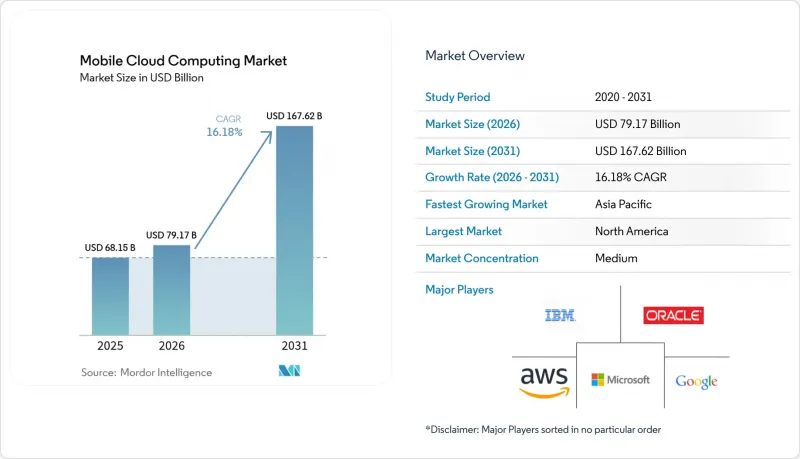
Mordor Intelligence에 의하면, 모바일 클라우드 컴퓨팅 시장 규모는 2025년에 681억 5,000만 달러로 평가되었고, 2026년 791억 7,000만 달러에서 2031년까지 1,676억 2,000만 달러에 이를 것으로 예측되며, 예측 기간(2026년-2031년) CAGR은 16.18%를 기록할 전망입니다.
본 보고서는 용도별(게임, 금융·비즈니스, 엔터테인먼트, 교육, 헬스케어, 여행 등), 사용자별(기업, 일반 소비자), 서비스 모델별(SaaS(Software-As-A-Service),PaaS(Platform-As-A-Service) 등), 도입 형태별(퍼블릭 클라우드 등), 모바일 OS별(Android, iOS 등), 지역별로 분류되어 있습니다. 시장 예측은 금액(달러) 기준으로 제시되어 있습니다.
전 세계 모바일 클라우드 컴퓨팅 시장 동향 및 인사이트
신흥국의 IT 인프라 구축
인도, 인도네시아, 브라질, 나이지리아의 대규모 광섬유 백본과 데이터센터의 국내 설치 의무화로 인해 지연 시간이 단축되고 커버리지가 확대되어, Tier 2 및 Tier 3 도시에서도 클라우드를 활용한 용도 사용이 가능해졌습니다. 인도의 ‘디지털 인디아(Digital India)’ 프로그램은 2024년에 12억 달러를 배정하여, 현지 스타트업이 해외에 의존하지 않고 이용할 수 있는 국영 클라우드 존을 구축했습니다. 인도네시아에서는 공공 모바일 앱을 국내 구역에 배치하도록 의무화하는 규제에 따라, 이미 자카르타와 수라바야에서 새로운 하이퍼스케일 시설 건설이 시작되었습니다. 브라질에서도 유사한 인프라 구축이 진행되어, 2024년에는 4G 커버리지율이 지자체의 94%에 달했으며, 농촌 지역의 농업 비즈니스에 클라우드 도입이 촉진되었습니다. 엣지 노드가 보급됨에 따라 용도 제공업체들은 기능을 사용자와 가까운 곳으로 이전하고 있으며, 이로 인해 모바일 클라우드 컴퓨팅 시장은 두 자릿수 성장을 유지하고 있습니다.
인터넷 연결의 발전
2024년, 전 세계 모바일 데이터 트래픽은 월간 131 엑사바이트에 달하고, 전년 대비 25% 증가했습니다. 이는 고해상도 동영상 스트리밍과 항상 동기화된 상태를 유지하는 생산성 앱에 힘입은 결과입니다. 2Africa와 같은 해저 케이블 시스템 덕분에 도매 대역폭 가격이 30% 하락함에 따라, 세네갈, 케냐, 탄자니아의 통신 사업자들은 무제한 데이터 통신과 클라우드 스토리지를 세트로 제공할 수 있게 되었으며, 가끔씩만 이용하던 사용자를 매일 데이터를 업로드하는 사용자로 변화시켰습니다. Starlink와 OneWeb의 LEO 위성 군집은 알래스카와 아마존 분지의 연결 사각지대를 메우며, 클라우드를 활용한 모바일 서비스의 이용 기반을 확대했습니다. 데이터 통신량 단가 하락과 이용량 증가라는 선순환이 서비스 보급을 가속화하며, 모바일 클라우드 컴퓨팅 시장을 뒷받침하고 있습니다.
데이터 보안에 대한 우려
멀티테넌트 아키텍처는 전송 중의 도청이나 저장된 데이터에 대한 무단 접근에 대한 위험을 높입니다. 2024년에 1,200개 기업을 대상으로 실시한 설문조사에 따르면, 62%가 특히 의료 및 은행 부문에서 키 관리의 불확실성이나 감사상의 미비점을 이유로 마이그레이션을 연기하고 있는 것으로 나타났습니다. 유럽 규제 당국은 해외 클라우드에 거래 데이터를 캐싱하는 모바일 뱅킹 앱에 대한 감시를 강화했고, 그 결과 여러 은행이 프라이빗 존으로 복귀할 수밖에 없었습니다. 엔드투엔드 암호화 계층은 10-15밀리초의 지연을 초래하여 실시간 이용 경험을 저해하고, 서비스 보급을 둔화시키고 있습니다.
부문 분석
원격 의료, 원격 환자 모니터링, 클라우드를 활용한 진단이 확대됨에 따라, 모바일 클라우드 컴퓨팅 시장 내 의료 분야 시장 규모는 2031년까지 연평균 성장률(CAGR) 17.12%로 성장할 전망입니다. 미국 식품의약국(FDA)은 2024년, 클라우드 데이터 처리를 목적으로 하는 87개의 모바일 의료 앱을 승인했는데, 이는 2023년의 52건에서 증가한 수치입니다. Philips는 영상을 방사선과 전문의에게 스트리밍으로 전송하는 모바일 초음파 진단 장치를 출시하여, 지방 지역의 진단 주기를 48시간에서 4시간으로 단축했습니다. 게임 분야는 여전히 매출 점유율의 27.78%를 차지하고 있지만, 포화 상태에 이른 시장에서는 성장이 성숙기에 접어들었습니다. 금융, 엔터테인먼트, 교육 앱은 안정적인 수요에 힘입고 있지만, 의료 분야의 규제 당국 승인 및 보상 모델 정비를 통해 이 분야는 모바일 클라우드 컴퓨팅 시장의 다음 물결을 형성하는 원동력이 되는 수직 시장으로서의 입지를 확고히 하고 있습니다.
클라우드 게임이 시장 점유율 1위를 차지하고 있다는 사실은 저지연 렌더링, 소액 결제, 소셜 플레이 기능에 대한 확고한 수요가 있음을 보여줍니다. 그러나 FPS(1인칭 슈팅 게임)의 경우 30밀리초 미만의 왕복 전송 시간이 요구되므로, 제공업체는 사용자 반경 50킬로미터 이내에 엣지 컴퓨팅을 도입할 수밖에 없으며, 최대 규모의 하이퍼스케일러를 제외한 모든 사업자에게 자본 집약적인 과제가 되고 있습니다. 대조적으로, 의료 분야에서는 지연 시간에 대한 허용 범위가 밀리초 단위가 아닌 초 단위로 길기 때문에 워크로드를 클라우드의 더 깊은 위치에 배치할 수 있으며, 엣지 인프라가 제한적인 신흥 시장에서의 전개도 용이해집니다. 2031년까지 의료 부문의 사용자 기반 확대와 규제 명확화로 인해 게임 분야와의 점유율 격차는 줄어들 것이며, 모바일 클라우드 컴퓨팅 시장에서 다양한 산업에 걸친 회복력이 확고해질 것입니다.
모바일 근로자들이 고객 기록, 협업 스위트, 현장 서비스 앱에 대한 지속적인 접근을 요구하는 가운데, 기업 부문은 2025년 매출의 70.55%를 차지했습니다. Salesforce, Microsoft 365 및 SAP의 모바일 클라이언트가 이 지출의 주축을 이루고 있습니다. 2024년에 800명의 IT 리더를 대상으로 실시한 설문조사에 따르면, 73%가 모바일과 클라우드의 통합을 새로운 소프트웨어 도입 시 구매 기준 상위 3가지 중 하나로 간주하는 것으로 나타났습니다(JMIR.ORG). 한편, 구독형 클라우드 스토리지, 스트리밍, 게임 서비스가 보급됨에 따라 소비자 시장은 연평균 성장률(CAGR) 17.95%로 확대되고 있습니다. Dropbox는 2024년 모바일 업로드량이 전년 대비 35% 증가했다고 보고했으며, Apple 역시 같은 해 유료 iCloud 계정 수가 10억 건을 돌파했습니다.
이러한 소비자 동향으로 인해 서비스 제공업체들은 간헐적인 연결 환경에 대한 최적화, UI 흐름의 경량화, 그리고 엔트리 레벨 가격 인하를 요구받고 있으며, 그동안 기업의 규정 준수 및 서비스 수준 계약(SLA)에 중점을 두었던 설계상의 우선순위가 변화하고 있습니다. 기업은 계속해서 예산 측면에서 영향력을 행사하겠지만, 급증하는 소비자 기반이 대규모 시장과 브랜드 인지도를 가져와 모바일 클라우드 컴퓨팅 시장의 고객 확보 범위를 넓히고 있습니다.
지역별 분석
북미는 2025년 매출의 36.25%를 차지하며, 고밀도 가용성 영역과 2억 8,000만 명의 5G 독립형 가입자의 혜택을 누리고 있습니다. 이들은 모바일 워크로드에 대해 20밀리초 미만의 지연 시간을 실현하고 있습니다. Amazon Web Services, Microsoft Azure, Google Cloud는 이 지역에서 40개 이상의 존을 운영하며 자율주행차 텔레메트리, 산업용 IoT, 고빈도 거래 금융 용도를 지원하고 있습니다. 캐나다는 2024년 공공 모바일 서비스에 주권 클라우드를 의무화하여 Telus와 Bell의 투자를 촉진했으나, 상용 트래픽의 대부분은 여전히 미국의 하이퍼스케일러에 의존하고 있습니다.
아시아태평양은 2031년까지 연평균 성장률(CAGR) 16.65%로 성장을 주도할 것으로 예측됩니다. 중국에서는 2024년에 5G 기지국 수가 350만 개를 돌파하여 도시 지역의 95%를 커버함에 따라, 알리바바 클라우드와 텐센트 클라우드는 8억 명의 모바일 사용자를 대상으로 10밀리초 이내의 지연 시간으로 엣지 노드를 구축할 수 있게 되었습니다. 인도의 ‘Unified Payments Interface(UPI)’는 2024년에 클라우드 결제 게이트웨이를 통해 월간 120억 건의 모바일 거래를 처리하며, 모바일 퍼스트의 규모를 여실히 보여주고 있습니다. 일본 통신 사업자들의 네트워크 슬라이싱은 기업용 저지연을 보장하고 있는 반면, 한국은 라이브 스트리밍 및 게임 수요에 대응하기 위해 하이퍼스케일 용량을 두 배로 늘렸습니다.
유럽, 중동 및 아프리카, 그리고 남미에서는 상황이 제각각입니다. 유럽의 ‘가이아-X(Gaia-X)’는 데이터 주권을 강화하고 있으며, 공공 모바일 앱에는 현지 클라우드 처리가 의무화되어 있습니다. 두바이의 스마트 시티에서는 행정 서비스에 모바일 클라우드를 활용하고 있어 인근 걸프 국가들에 자극을 주고 있습니다. 아프리카는 새로운 해저 회선 용량과 데이터 및 클라우드를 결합한 서비스의 혜택을 누리고 있지만, 전력 공급의 불안정성으로 인해 On-Premise 백업이 필수적입니다. 남미는 거시경제의 변동에 직면해 있지만, 상파울루와 라고스에 신설된 텐센트 클라우드 리전 덕분에 핀테크 및 게임 분야의 지연 시간이 단축되고 있습니다. 규제의 엄격함, 인프라의 성숙도, 소비자의 구매력 불균형이 모바일 클라우드 컴퓨팅 시장의 성장 양상을 모자이크처럼 복잡하게 만들고 있습니다.
기타 혜택:
- 엑셀 형식 시장 예측(ME) 시트
- 3개월간의 애널리스트 지원
자주 묻는 질문
목차
제1장 서론
제2장 조사 방법
제3장 주요 요약
제4장 시장 구도
제5장 시장 규모와 성장 예측
제6장 경쟁 구도
제7장 시장 기회와 향후 전망
LSH 26.09.08According to Mordor Intelligence, the mobile cloud computing market size was valued at USD 68.15 billion in 2025 and estimated to grow from USD 79.17 billion in 2026 to reach USD 167.62 billion by 2031, at a CAGR of 16.18% during the forecast period (2026-2031).
This report is Segmented by Application (Gaming, Finance and Business, Entertainment, Education, Healthcare, Travel, and More), User (Enterprise, and Consumer), Service Model (Software-As-A-Service, Platform-As-A-Service, and More), Deployment (Public Cloud, and More), Mobile Operating System (Android, IOS, and More), and Geography. The Market Forecasts are Provided in Terms of Value (USD).
Global Mobile Cloud Computing Market Trends and Insights
Development in IT Infrastructure in Emerging Countries
Massive fiber backbones and sovereign data-center mandates in India, Indonesia, Brazil, and Nigeria are shrinking latency and widening coverage, making cloud-backed apps viable in tier-2 and tier-3 cities. India's Digital India program allocated USD 1.2 billion in 2024 to build state-owned cloud zones that local start-ups can tap without foreign dependency. Indonesia's requirement that public mobile apps reside in domestic zones has already triggered new hyperscale facilities in Jakarta and Surabaya. Similar upgrades in Brazil lifted 4G availability to 94% of municipalities in 2024, catalyzing rural agribusiness adoption. As edge nodes propagate, application publishers migrate functions closer to users, sustaining double-digit expansion in the mobile cloud computing market.
Advancing Internet Connectivity
Global mobile data traffic reached 131 exabytes per month in 2024, a 25% jump year-on-year, underpinned by high-definition video streaming and always-synced productivity apps. Submarine systems such as 2Africa lowered wholesale bandwidth prices 30%, letting carriers in Senegal, Kenya, and Tanzania bundle unlimited data with cloud storage, flipping intermittent users into daily uploaders. LEO satellite constellations from Starlink and OneWeb filled connectivity gaps in Alaska and the Amazon basin, widening the accessible base for cloud-powered mobile services. The reinforcing cycle of cheaper gigabytes and higher usage accelerates service uptake, boosting the mobile cloud computing market.
Concerns Associated with Data Security
Multi-tenant architectures elevate exposure to interception during transit and unauthorized access at rest. A 2024 study of 1,200 enterprises found 62% delayed migrations over key-management uncertainty and audit gaps, notably in healthcare and banking sectors. European regulators tightened scrutiny around mobile banking apps caching transaction data in foreign clouds, pushing several banks back to private zones. End-to-end encryption layers add 10-15 milliseconds of latency, impairing real-time experience and tempering uptake.
Other drivers and restraints analyzed in the detailed report include:
- Growing Adoption of Edge AI for Mobile Applications
- Rising Usage of Cloud Gaming Platforms
- Limited Battery Life of Mobile Devices
For complete list of drivers and restraints, kindly check the Table Of Contents.
Segment Analysis
The healthcare slice of the mobile cloud computing market size is on track to expand at a 17.12% CAGR through 2031 as telemedicine, remote patient monitoring, and cloud-sourced diagnostics scale. The U.S. FDA cleared 87 mobile medical apps for cloud data processing in 2024, up from 52 in 2023. Philips rolled out a mobile ultrasound that streams images to radiologists, shortening rural diagnostic cycles from 48 hours to 4 hours. Gaming still holds 27.78% revenue share, but growth is maturing in saturated markets. Finance, entertainment, and education apps ride steady demand, yet healthcare's regulatory green lights and reimbursement models position it as the catalytic vertical shaping the next wave of the mobile cloud computing market.
Cloud gaming's share leadership signals entrenched demand for low-latency rendering, micro-transactions, and social play features. Yet first-person shooters require sub-30 millisecond round-trip time, compelling providers to deploy edge compute within 50 kilometers of users, capital-intensive for all but the largest hyperscalers. In contrast, healthcare gains from longer tolerance for latency seconds rather than milliseconds allowing workloads to reside deeper in the cloud and easing rollout across emerging markets with limited edge presence. By 2031, the healthcare segment's expanding user base and regulatory clarity will narrow the share gap with gaming and solidify multi-vertical resilience in the mobile cloud computing market.
Enterprises contributed 70.55% of 2025 revenue as mobile workforces demanded continuous access to customer records, collaboration suites, and field service apps. Salesforce, Microsoft 365, and SAP mobile clients anchor this spend. A survey of 800 IT leaders in 2024 showed 73% view mobile-cloud integration as top-three purchase criteria for new software deployments JMIR.ORG. Meanwhile, consumers are expanding at an 17.95% CAGR as subscription cloud storage, streaming, and gaming services gain traction. Dropbox reported 35% year-on-year growth in mobile uploads in 2024, and Apple recorded more than 1 billion paid iCloud accounts the same year.
The consumer trajectory forces providers to optimize for intermittent connectivity, lighter UI flows, and lower entry-level price points, shifting design priorities previously centered on enterprise compliance and service-level agreements. Enterprises will continue to wield budget influence, but the swelling consumer base adds volume scale and brand visibility, widening the funnel for the mobile cloud computing market.
Complete Report Scope:
- By Application
- Gaming
- Finance and Business
- Entertainment
- Education
- Healthcare
- Travel
- Other Applications
- By User
- Enterprise
- Consumer
- By Service Model
- Software-as-a-Service (SaaS)
- Platform-as-a-Service (PaaS)
- Infrastructure-as-a-Service (IaaS)
- By Deployment
- Public Cloud
- Private Cloud
- Hybrid Cloud
- By Mobile Operating System
- Android
- iOS
- Others
- Geography
- North America
- United States
- Canada
- Mexico
- Europe
- United Kingdom
- Germany
- France
- Italy
- Rest of Europe
- Asia-Pacific
- China
- Japan
- India
- South Korea
- Rest of Asia
- Middle East
- Israel
- Saudi Arabia
- United Arab Emirates
- Turkey
- Rest of Middle East
- Africa
- South Africa
- Egypt
- Rest of Africa
- South America
- Brazil
- Argentina
- Rest of South America
- North America
Geography Analysis
North America generated 36.25% of 2025 revenue, benefiting from dense availability zones and 280 million 5G standalone subscribers, which deliver sub-20 millisecond latency for mobile workloads. Amazon Web Services, Microsoft Azure, and Google Cloud operate more than 40 zones in the region, powering autonomous vehicle telemetry, industrial IoT, and high-frequency finance apps. Canada mandated sovereign cloud for public mobile services in 2024, prompting Telus and Bell investments but leaving most commercial traffic on U.S. hyperscalers.
Asia Pacific is projected to lead growth at a 16.65% CAGR to 2031. China surpassed 3.5 million 5G base stations in 2024, covering 95% of urban zones, allowing Alibaba Cloud and Tencent Cloud to place edge nodes within 10 milliseconds of 800 million mobile users. India's Unified Payments Interface processed 12 billion mobile transactions monthly in 2024 over cloud payment gateways, illustrating mobile-first scale. Japan's carrier network slicing guarantees enterprise latency, while South Korea doubled hyperscale capacity to feed live streaming and gaming hunger.
Europe, the Middle East and Africa, and South America present mixed scenarios. Europe's Gaia-X hardens data sovereignty, requiring local cloud processing for public mobile apps. Dubai's Smart City uses mobile cloud for civic services, inspiring neighboring Gulf states. Africa benefits from new subsea capacity and bundled data-plus-cloud offerings, yet power instability compels on-premises backups. South America contends with macro volatility, though new Tencent Cloud regions in Sao Paulo and Lagos cut latency for fintech and gaming. The imbalance of regulatory stringency, infrastructure maturity, and consumer purchasing power sets a mosaic growth profile for the mobile cloud computing market.
- International Business Machines Corporation
- Amazon Web Services Inc.
- Google LLC
- Oracle Corporation
- Microsoft Corporation
- SAP SE
- Akamai Technologies, Inc.
- Salesforce, Inc.
- Cloudways Ltd.
- Kony, Inc.
- Alibaba Cloud (Alibaba Group Holding Limited)
- Tencent Cloud Computing Beijing Co., Ltd.
- Huawei Technologies Co., Ltd.
- VMware, Inc.
- Rackspace Technology, Inc.
- Fujitsu Limited
- Citrix Systems, Inc.
- Red Hat, Inc.
- Box, Inc.
- Dropbox, Inc.
Additional Benefits:
- The market estimate (ME) sheet in Excel format
- 3 months of analyst support
TABLE OF CONTENTS
1 INTRODUCTION
- 1.1 Study Assumptions and Market Definition
- 1.2 Scope of the Study
2 RESEARCH METHODOLOGY
3 EXECUTIVE SUMMARY
4 MARKET LANDSCAPE
- 4.1 Market Overview
- 4.2 Market Drivers
- 4.2.1 Development in IT Infrastructure in Emerging Countries
- 4.2.2 Advancing Internet Connectivity
- 4.2.3 Growing Adoption of Edge AI for Mobile Applications (UNDER-THE-RADAR)
- 4.2.4 Rising Usage of Cloud Gaming Platforms
- 4.2.5 Expansion of 5G Stand-Alone Networks
- 4.2.6 Proliferation of Low-Code Mobile Backend Services (UNDER-THE-RADAR)
- 4.3 Market Restraints
- 4.3.1 Concerns Associated with Data Security
- 4.3.2 Limited Battery Life of Mobile Devices
- 4.3.3 Escalating Cloud-Service Egress Fees (UNDER-THE-RADAR)
- 4.3.4 Data-Residency and Digital-Sovereignty Regulations
- 4.4 Value-Chain Analysis
- 4.5 Regulatory Landscape
- 4.6 Technological Outlook
- 4.7 Impact of Macroeconomic Factors on the Market
- 4.8 Porter's Five Forces Analysis
- 4.8.1 Threat of New Entrants
- 4.8.2 Bargaining Power of Buyers or Consumers
- 4.8.3 Bargaining Power of Suppliers
- 4.8.4 Threat of Substitute Products
- 4.8.5 Intensity of Competitive Rivalry
5 MARKET SIZE AND GROWTH FORECASTS (VALUE)
- 5.1 By Application
- 5.1.1 Gaming
- 5.1.2 Finance and Business
- 5.1.3 Entertainment
- 5.1.4 Education
- 5.1.5 Healthcare
- 5.1.6 Travel
- 5.1.7 Other Applications
- 5.2 By User
- 5.2.1 Enterprise
- 5.2.2 Consumer
- 5.3 By Service Model
- 5.3.1 Software-as-a-Service (SaaS)
- 5.3.2 Platform-as-a-Service (PaaS)
- 5.3.3 Infrastructure-as-a-Service (IaaS)
- 5.4 By Deployment
- 5.4.1 Public Cloud
- 5.4.2 Private Cloud
- 5.4.3 Hybrid Cloud
- 5.5 By Mobile Operating System
- 5.5.1 Android
- 5.5.2 iOS
- 5.5.3 Others
- 5.6 Geography
- 5.6.1 North America
- 5.6.1.1 United States
- 5.6.1.2 Canada
- 5.6.1.3 Mexico
- 5.6.2 Europe
- 5.6.2.1 United Kingdom
- 5.6.2.2 Germany
- 5.6.2.3 France
- 5.6.2.4 Italy
- 5.6.2.5 Rest of Europe
- 5.6.3 Asia-Pacific
- 5.6.3.1 China
- 5.6.3.2 Japan
- 5.6.3.3 India
- 5.6.3.4 South Korea
- 5.6.3.5 Rest of Asia
- 5.6.4 Middle East
- 5.6.4.1 Israel
- 5.6.4.2 Saudi Arabia
- 5.6.4.3 United Arab Emirates
- 5.6.4.4 Turkey
- 5.6.4.5 Rest of Middle East
- 5.6.5 Africa
- 5.6.5.1 South Africa
- 5.6.5.2 Egypt
- 5.6.5.3 Rest of Africa
- 5.6.6 South America
- 5.6.6.1 Brazil
- 5.6.6.2 Argentina
- 5.6.6.3 Rest of South America
- 5.6.1 North America
6 COMPETITIVE LANDSCAPE
- 6.1 Market Concentration
- 6.2 Strategic Moves
- 6.3 Market Share Analysis
- 6.4 Company Profiles (includes Global level Overview, Market level overview, Core Segments, Financials as available, Strategic Information, Market Rank or Share for key companies, Products and Services, and Recent Developments)
- 6.4.1 International Business Machines Corporation
- 6.4.2 Amazon Web Services Inc.
- 6.4.3 Google LLC
- 6.4.4 Oracle Corporation
- 6.4.5 Microsoft Corporation
- 6.4.6 SAP SE
- 6.4.7 Akamai Technologies, Inc.
- 6.4.8 Salesforce, Inc.
- 6.4.9 Cloudways Ltd.
- 6.4.10 Kony, Inc.
- 6.4.11 Alibaba Cloud (Alibaba Group Holding Limited)
- 6.4.12 Tencent Cloud Computing Beijing Co., Ltd.
- 6.4.13 Huawei Technologies Co., Ltd.
- 6.4.14 VMware, Inc.
- 6.4.15 Rackspace Technology, Inc.
- 6.4.16 Fujitsu Limited
- 6.4.17 Citrix Systems, Inc.
- 6.4.18 Red Hat, Inc.
- 6.4.19 Box, Inc.
- 6.4.20 Dropbox, Inc.
7 MARKET OPPORTUNITIES AND FUTURE OUTLOOK
- 7.1 White-Space and Unmet-Need Assessment