

|
시장보고서
상품코드
2121279
홈케어 포장 : 시장 점유율 분석, 업계 동향과 통계, 성장 예측(2026-2031년)Home Care Packaging - Market Share Analysis, Industry Trends & Statistics, Growth Forecasts (2026 - 2031) |
||||||
 Mordor Intelligence
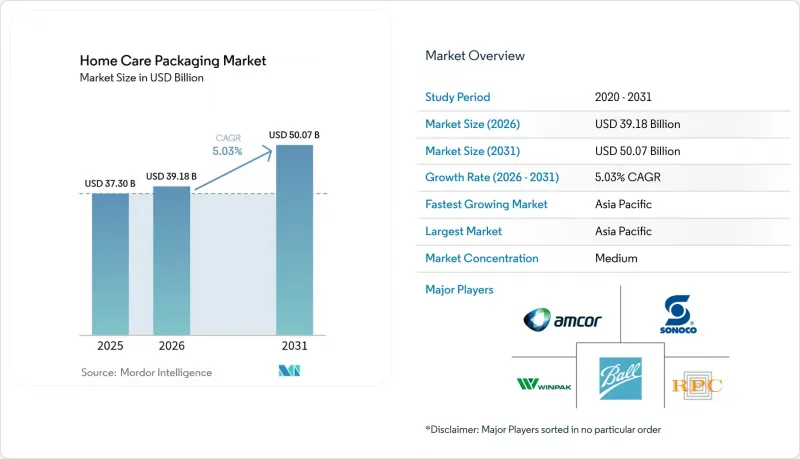
Mordor Intelligence에 의하면, 2026년 홈케어 포장 시장 규모는 391억 8,000만 달러로 추정되며, 2025년 373억 달러에서 2031년에는 500억 7,000만 달러에 달할 것으로 예측됩니다.
또한 2026-2031년 연평균 성장률(CAGR) 5.03%를 기록하며 성장할 것으로 전망됩니다.
본 보고서에서는 업계를 소재(플라스틱, 종이 등), 포장 유형(병 및 경질 용기, 파우치 및 봉지 등), 제품 카테고리(식기 세제, 살충제 등), 형태(액체, 분말 등), 그리고 지역별로 분류하고 있습니다. 시장 전망은 금액(미 달러) 기준으로 제시되어 있습니다.
세계 홈케어 포장 시장 동향 및 인사이트
프리미엄화의 진전과 브랜드 주도의 SKU 증가
고급 세정 제품에 대한 수요가 단순한 기능적 수납을 넘어선 패키지 혁신을 주도하고 있습니다. 각 브랜드는 더 높은 가격 책정을 정당화하기 위해 고도의 차단 기능, 스마트한 개폐 구조, 그리고 독창적인 디자인을 채택하고 있습니다. 2024년에 출시된 ‘Tide evo 파이버 타일’은 플라스틱 대신 용해 가능한 6층 구조의 파이버를 채택하여 프리미엄층 소비자를 타겟으로 하고 있습니다. 2027년까지 470억 달러에 달할 것으로 예상되는 중동의 뷰티 관련 지출은 홈케어용 패키지에 대해서도 유사한 기대를 뒷받침하고 있습니다. 디스펜서 및 특수 캡 제조업체들은 이러한 추세로 인해 혜택을 보고 있으며, 실간(Silgan)사의 2024년 4분기 매출이 6억 3,940만 달러로 급증한 것이 그 증거입니다. 프리미엄화는 소형이며 디자인성이 뛰어난 포맷을 촉진하는 동시에, 수지 비용 변동에 대한 이익률의 회복력을 높이고 있습니다. 이러한 동향은 선진국 시장과 신흥 시장 모두에서 공통적으로 나타나고 있으며, 홈케어 포장 시장의 진열대 경쟁 구도를 재편하고 있습니다.
재활용 가능한 단일 소재 포장에 대한 순환 경제 규제
규제 당국은 생산자들에게 재활용이 용이한 설계를 채택하도록 촉구하고 있습니다. EU의 PPWR(플라스틱 포장 및 용기 규정)에서는 2030년까지 100% 재활용 가능성과 일회용 플라스틱 음료병에 30%의 재생 재료 함유율을 규정하고 있어, 단일 소재 구조로의 전환이 시급합니다. 유니레버의 종이 세제 병은 기업의 연구개발이 임박한 할당 기준과 어떻게 부합하고 있는지를 여실히 보여줍니다. 현재 63개국이 공식적인 확대 생산자 책임(EPR) 제도를 운영하고 있으며, 폐기 비용이 지자체에서 제조업체로 이전됨에 따라 재활용을 전제로 한 설계 접근 방식이 장려되고 있습니다. 단일 소재 필름 분야에 속한 컨버터는 가격 결정력을 확보하는 한편, 다층 배리어 소재 공급업체는 설비 갱신을 강요받게 되며, 그렇지 않으면 수주 감소에 직면하게 될 것입니다. 장기적으로는 규정 준수를 위한 투자가 안정화되어 가정용 케어 제품 포장 시장 전체의 성장 궤도를 뒷받침할 것으로 예측됩니다.
석유화학 수지 가격 변동
폴리에틸렌(PE) 및 폴리프로필렌(PP) 가격 변동은 컨버터의 이익률을 압박하고 가격 전략을 복잡하게 만들고 있습니다. PE는 가동 중단 및 원자재 가격 급등으로 인해 2024년부터 2025년에 걸쳐 여러 차례에 걸쳐 파운드당 5센트의 가격 인상을 기록했습니다. PET는 열대성 폭풍 알베르트로 인한 공급 차질로 1.1%의 가격 상승을 보였습니다. 소규모 가공업체들은 헤지 수단이 부족하여 가정용 케어 포장 시장에서 비용 전가를 감수하거나 이익률 하락을 겪게 되고 있습니다. 가격 변동으로 인해 경량화 및 대체 기판에 대한 관심이 높아지고 있습니다. 바이오 및 재생 소재로의 전환을 신속하게 진행할 수 있는 가공업체는 화석 연료 가격 변동에 따른 영향을 완화할 수 있습니다.
부문 분석
2025년, 플라스틱은 가정용 케어 제품 포장 시장 점유율의 62.35%를 차지하며, 비용 효율성이 뛰어나고 높은 차단성이 요구되는 용도에서 확고한 입지를 입증하고 있습니다. 이 부문은 성숙한 공급망과 범용성이 높은 가공 기술을 앞으로도 계속 활용할 것입니다. 그러나 연평균 성장률(CAGR) 11.55%로 성장하는 바이오플라스틱은 규제 당국과 브랜드가 재생 가능한 원료를 우선시하는 가운데, 디자인 관련 논의에서 점점 더 중요한 위치를 차지하고 있습니다.
종이 및 판지는 높은 재활용률과 낮은 탄소 발자국으로 다시 주목받고 있지만, 무게와 습기에 취약하여 일반적인 액체 세제 용도로는 채택되기 어려운 상황입니다. 금속은 가압 에어로졸 제품에서 틈새 시장의 중요성을 유지하고 있으며, 유리는 전자상거래에서의 파손 위험으로 인해 사용이 극히 제한적입니다. 바이오플라스틱의 기세는 PLA 및 PHA 수지에 대한 투자를 촉진하고 있으며, 가공업체들은 산소 차단성 요건을 충족하는 단일 소재 필름을 시험하고 있습니다. 재활용 소재 함유율에 대한 규제가 엄격해지는 가운데, PCR(소비 후 재활용 소재)과 바이오 원료의 호환성 블렌드는 홈케어 포장 시장에서 공급 안정성과 비용 경쟁력을 높일 수 있습니다.
2025년, 병 및 경질 용기는 홈케어 포장 시장 규모의 46.40%를 차지할 것으로 예상되며, 이는 기존 생산 라인과 소비자들이 기존 형태에 익숙해져 있음을 반영합니다. 경량 HDPE 및 PET 병은 뛰어난 낙하 충격 저항성과 브랜드 광고로서의 기능성 덕분에 여전히 주류를 이루고 있습니다. 그러나 연평균 성장률(CAGR) 9.42%로 확대되고 있는 리필용 파우치와 디스펜서 시스템은 재료 절약과 순환형 루프를 통한 편의성을 통해 가치 제안을 재정의하고 있습니다. 아프터(Aptar)사의 더모코스메틱용 재활용 가능한 에어리스 병과 B-CAP사의 친환경 디스펜서 캡은 이미 확립된 형태라 할지라도 혁신을 통해 어떻게 현대화될 수 있는지를 보여줍니다.
파우치는 물류 효율을 높이고 화물의 무게와 부피를 줄여줍니다. 이는 전자상거래의 수익성에 있어 매우 중요합니다. 재사용 가능한 디스펜서와 경량 리필용 파우치를 결합함으로써 수명 주기 동안의 배출량을 줄일 수 있으며, 이는 EPR(확대 생산자 책임) 요금 체계와도 부합합니다. 한편, 금속 캔과 스틱팩은 특정 공급 형태가 필요한 특수 세정제 분야에서 여전히 중요한 역할을 하고 있습니다. 모든 유형의 제품에 대해 컨버터 기업들은 재활용 절차를 안내하는 QR 코드를 삽입하여, 소비자의 순환형 시스템 참여를 용이하게 하고, 홈케어 포장 시장 전망 성장을 뒷받침할 규정 준수 지표 향상을 목표로 하고 있습니다.
지역별 분석
2025년에는 아시아태평양이 가정용 케어 제품 포장 시장 점유율의 38.45%를 차지하며 시장을 주도했습니다. 이는 중국, 인도, 동남아시아의 급속한 도시화, 전자상거래의 성장, 그리고 중산층의 확대를 반영한 것입니다. 중국에서 곧 시행될 식품 접촉용 재활용 플라스틱에 관한 규제는 지역 전체에 새로운 규정 준수 기준을 확립하게 될 것입니다. 일본의 고령화 사회는 소인 가구에 적합한 간편 개봉 포장 및 1회용 세제에 대한 수요를 견인하고 있습니다. 이 지역의 포장 기계 투자액은 2024년까지 180억 달러를 넘어설 것으로 예상되며, 이는 컨버터의 사업 확장을 뒷받침할 것입니다.
중동은 가장 빠르게 성장하는 지역으로, 2031년까지 연평균 성장률(CAGR)이 7.41%를 나타낼 것으로 예측되며, 이는 걸프협력회의(GCC) 시장의 프리미엄화 추세에 힘입은 것입니다. 이 지역의 미용 및 퍼스널케어 분야 지출은 2027년까지 470억 달러에 달할 것으로 예상되며, 이를 통해 고급 홈케어 포장에 대한 파급 수요가 발생하고 있습니다. 고온 다습한 기후로 인해 차단 성능 향상 및 자외선 안정성을 갖춘 안료가 필수적이며, 이것이 공급업체의 사양을 형성하고 있습니다. GCC(걸프협력회의) 의약품 매출에서 사우디아라비아가 차지하는 비중이 34.6%에 달한다는 사실은 위생적인 1차 포장 분야에서 병행되는 비즈니스 기회를 부각시키고 있습니다.
북미와 유럽은 여전히 매우 중요하지만, 규제망이 더욱 엄격해지는 과제에 직면해 있습니다. EU의 PPWR(포장 폐기물 규정)만으로도 세계 브랜드 소유주의 포장재 재설계 예산을 끌어올리고 있습니다. 한편, 오리건주와 콜로라도주에서는 2025년 7월까지 EPR(생산자 책임 회수) 제도가 도입되어 생산자 부담에 의한 재활용 모델이 확대될 것입니다. 라틴아메리카에서는 새로운 가능성이 보이기 시작하고 있습니다. 2025년에는 원자재 비용 상승으로 인해 종이 포장재 가격이 오를 전망이며, 이는 시장의 성숙을 시사합니다(fastmarkets.com). 전반적으로, 지역별 규제와 소비자 행동에 따라 홈케어 포장 시장 전체에서 미묘한 차이를 보이는 성장 경로가 유지되고 있습니다.
기타 혜택:
- 엑셀 형식 시장 예측(ME) 시트
- 3개월간의 애널리스트 지원
자주 묻는 질문
목차
제1장 서론
제2장 조사 방법
제3장 주요 요약
제4장 시장 구도
제5장 시장 규모와 성장 예측
제6장 경쟁 구도
제7장 시장 기회와 향후 전망
LSH 26.09.08According to Mordor Intelligence, the home care packaging market size in 2026 is estimated at USD 39.18 billion, growing from 2025 value of USD 37.3 billion with 2031 projections showing USD 50.07 billion, growing at 5.03% CAGR over 2026-2031.
This report Segments the Industry Into Material (Plastic, Paper and More), Packaging Type (Bottles and Rigid Containers, Pouches and Bags and More), Product Category (Dishwashing, Insecticides and More), Form Factor(Liquids, Powders and More) and Geography. The Market Forecasts are Provided in Terms of Value (USD).
Global Home Care Packaging Market Trends and Insights
Rising Premiumisation and Brand-Led SKU Proliferation
Demand for upscale cleaning products drives packaging innovation beyond functional containment. Brands deploy advanced barriers, smart closures, and distinctive aesthetics to justify higher price points. Tide evo fibre tiles, launched in 2024, replace plastic with a dissolvable six-layer fibre structure and target premium shoppers. Middle East beauty spending, set to hit USD 47 billion by 2027, fuels similar expectations for home-care packs. Manufacturers of dispensing and specialty closures benefit, as evidenced by Silgan's Q4 2024 sales jump to USD 639.4 million. Premiumisation simultaneously promotes smaller, design-rich formats and boosts margin resilience against resin cost swings. The trend cuts across developed and emerging markets, reshaping shelf competition within the home care packaging market.
Circular-Economy Mandates for Recyclable Mono-Material Packs
Regulators push producers toward designs that enable straightforward recycling. The EU's PPWR stipulates 100% recyclability by 2030 and 30% recycled content for single-use plastic beverage bottles, compelling shifts to mono-material structures. Unilever's paper-based detergent bottle underscores how corporate R&D aligns with looming quotas. Sixty-three countries now run formal EPR schemes, moving disposal costs from municipalities to producers and rewarding design-for-recycling approaches. Converters positioned in mono-material films gain pricing power, whereas multi-layer barrier suppliers must retool or face declining order books. Over the long term, compliance investments are expected to stabilise and support the broader home care packaging market trajectory.
Petro-chemical Resin Price Volatility
Fluctuating polyethylene and polypropylene prices compress converter margins and complicate pricing strategy. PE registered several 5 ¢/lb hikes in 2024 - 2025 due to outages and feedstock spikes. PET saw a 1.1% jump after Tropical Storm Alberto disrupted supply. Smaller converters lack hedging tools, forcing cost-pass through or margin erosion in the home care packaging market. Volatility accelerates interest in lightweighting and alternative substrates. Converters able to shift to bio-based or recycled inputs faster can cushion against fossil-fuel price swings.
Other drivers and restraints analyzed in the detailed report include:
- E-commerce Boom Accelerating Demand for Shatter-Proof Formats
- Urban Asian Households Favouring Single-Dose Convenience Packs
- Extended-Producer-Responsibility Fees in Europe
For complete list of drivers and restraints, kindly check the Table Of Contents.
Segment Analysis
Plastics captured 62.35% of the home care packaging market share in 2025, underlining their entrenched role in cost-effective, barrier-rich applications. The segment continues to leverage mature supply chains and versatile processing techniques. However, bioplastics, propelled by a 11.55% CAGR, increasingly command design conversations as regulators and brands prioritise renewable feedstocks.
Paper and paperboard regain relevance through high recycling rates and lower carbon footprints, yet weight and moisture sensitivity keep them from mainstream liquid detergents. Metal retains niche importance in pressurised aerosols, and glass sees marginal use due to breakage risks in e-commerce. Bioplastics' momentum spurs investment in PLA and PHA resins, with converters trialling mono-material films that still meet oxygen-barrier demands. As recycled-content mandates tighten, compatibilised blends of PCR and bio-based inputs can bolster supply stability and cost competitiveness for the home care packaging market.
Bottles and rigid containers accounted for 46.40% of the home care packaging market size in 2025, reflecting legacy production lines and consumer familiarity with traditional formats. Lightweight HDPE and PET bottles remain prevalent thanks to excellent drop-impact resistance and brand-billboard capability. Yet refill pouches and dispensing systems, expanding at a 9.42% CAGR, are redefining value propositions through material savings and circular-loop convenience. Aptar's recyclable airless bottle for dermocosmetics and B-CAP's eco dosing cap demonstrate how innovation modernises even established formats.
Pouches deliver logistics efficiencies, shaving freight weight and cubic volume, crucial for e-commerce profitability. Reusable dispensers coupled with lightweight refill sachets reduce life-cycle emissions, resonating with EPR fee structures. Meanwhile, metal cans and stick packs maintain roles in specialty cleaners requiring specific delivery modes. Across all types, converters integrate QR codes for recycling instructions, aiming to ease consumer participation in circular schemes and boost compliance metrics that underpin the future growth of the home care packaging market.
Complete Report Scope:
- By Material
- Plastics
- Paper and Paperboard
- Metal
- Glass
- Bioplastics
- By Packaging Type
- Bottles and Rigid Containers
- Pouches and Bags
- Cartons and Corrugated Boxes
- Metal Cans and Aerosols
- Refill Pouches and Dispensing Systems
- Stick Packs and Sachets
- By Product Category
- Laundry Care
- Dishwashing
- Surface and Toilet Cleaners
- Air Care
- Insecticides
- Polishes and Specialty Cleaners
- By Form Factor
- Liquids
- Powders
- Capsules/Tabs
- Gels
- Sprays/Foams
- By Geography
- North America
- United States
- Canada
- Mexico
- South America
- Brazil
- Argentina
- Rest of South America
- Europe
- United Kingdom
- Germany
- France
- Italy
- Spain
- Russia
- Rest of Europe
- Asia-Pacific
- China
- Japan
- India
- South Korea
- Australia and New Zealand
- Rest of Asia-Pacific
- Middle East
- Israel
- Saudi Arabia
- United Arab Emirates
- Turkey
- Rest of Middle East
- Africa
- South Africa
- Egypt
- Nigeria
- Rest of Africa
- North America
Geography Analysis
Asia-Pacific dominated with 38.45% home care packaging market share in 2025, reflecting rapid urbanisation, e-commerce growth, and middle-class expansion in China, India, and Southeast Asia. China's forthcoming rules for recycled food-contact plastics will set new compliance benchmarks regionally. Japan's ageing society drives demand for easy-open packs and single-dose detergents suited to smaller households. Investment in regional packaging machinery is forecast to surpass USD 18 billion by 2024, underpinning scale-up for converters.
The Middle East is the fastest-growing territory, with a 7.41% CAGR through 2031, supported by premiumisation in Gulf Cooperation Council markets. Regional beauty and personal-care outlays-from which spillover demand for upscale home-care packs emerges-will hit USD 47 billion by 2027. Hot climates necessitate barrier enhancements and UV-stable pigments, shaping supplier specifications. Saudi Arabia's 34.6% share of GCC pharmaceutical sales highlights parallel opportunities for hygienic primary packs.
North America and Europe remain pivotal yet face tightening regulatory nets. The EU PPWR alone drives redesign budgets for global brand owners. Meanwhile, Oregon and Colorado introduce EPR schemes by July 2025, broadening producer-funded recycling models. Latin America shows emerging promise: higher raw-material costs push paper-pack prices up in 2025, signalling market maturation fastmarkets.com. Collectively, region-specific rules and consumer behaviours maintain nuanced growth paths across the home care packaging market.
- Amcor plc
- Ball Corporation
- RPC Group (Berry Global)
- Winpak Ltd
- Aptar Group Inc.
- Sonoco Products Company
- Silgan Holdings
- Constantia Flexibles GmbH
- DS Smith plc
- Can-Pack SA
- ProAmpac LLC
- Berry Global Group
- Mondi plc
- Huhtamaki Oyj
- Smurfit Kappa Group
- Sealed Air Corp.
- WestRock Company
- Albea Group
- Gerresheimer AG
- Tetra Pak
Additional Benefits:
- The market estimate (ME) sheet in Excel format
- 3 months of analyst support
TABLE OF CONTENTS
1 INTRODUCTION
- 1.1 Study Assumptions and Market Definition
- 1.2 Scope of the Study
2 RESEARCH METHODOLOGY
3 EXECUTIVE SUMMARY
4 MARKET LANDSCAPE
- 4.1 Market Overview
- 4.2 Market Drivers
- 4.2.1 Rising premiumisation and brand-led SKU proliferation
- 4.2.2 Circular-economy mandates for recyclable mono-material packs
- 4.2.3 E-commerce boom accelerating demand for shatter-proof formats
- 4.2.4 Urban Asian households favouring single-dose convenience packs
- 4.2.5 IoT-enabled smart dispensers and refill ecosystems
- 4.3 Market Restraints
- 4.3.1 Petro-chemical resin price volatility
- 4.3.2 Extended-producer-responsibility (EPR) fees in Europe
- 4.3.3 Scarcity of food-grade PCR resin for brand pledges
- 4.4 Regulatory Landscape
- 4.5 Technological Outlook
- 4.6 Porter's Five Forces Analysis
- 4.6.1 Threat of New Entrants
- 4.6.2 Bargaining Power of Buyers
- 4.6.3 Bargaining Power of Suppliers
- 4.6.4 Threat of Substitutes
- 4.6.5 Intensity of Competitive Rivalry
5 MARKET SIZE AND GROWTH FORECASTS (VALUES)
- 5.1 By Material
- 5.1.1 Plastics
- 5.1.2 Paper and Paperboard
- 5.1.3 Metal
- 5.1.4 Glass
- 5.1.5 Bioplastics
- 5.2 By Packaging Type
- 5.2.1 Bottles and Rigid Containers
- 5.2.2 Pouches and Bags
- 5.2.3 Cartons and Corrugated Boxes
- 5.2.4 Metal Cans and Aerosols
- 5.2.5 Refill Pouches and Dispensing Systems
- 5.2.6 Stick Packs and Sachets
- 5.3 By Product Category
- 5.3.1 Laundry Care
- 5.3.2 Dishwashing
- 5.3.3 Surface and Toilet Cleaners
- 5.3.4 Air Care
- 5.3.5 Insecticides
- 5.3.6 Polishes and Specialty Cleaners
- 5.4 By Form Factor
- 5.4.1 Liquids
- 5.4.2 Powders
- 5.4.3 Capsules/Tabs
- 5.4.4 Gels
- 5.4.5 Sprays/Foams
- 5.5 By Geography
- 5.5.1 North America
- 5.5.1.1 United States
- 5.5.1.2 Canada
- 5.5.1.3 Mexico
- 5.5.2 South America
- 5.5.2.1 Brazil
- 5.5.2.2 Argentina
- 5.5.2.3 Rest of South America
- 5.5.3 Europe
- 5.5.3.1 United Kingdom
- 5.5.3.2 Germany
- 5.5.3.3 France
- 5.5.3.4 Italy
- 5.5.3.5 Spain
- 5.5.3.6 Russia
- 5.5.3.7 Rest of Europe
- 5.5.4 Asia-Pacific
- 5.5.4.1 China
- 5.5.4.2 Japan
- 5.5.4.3 India
- 5.5.4.4 South Korea
- 5.5.4.5 Australia and New Zealand
- 5.5.4.6 Rest of Asia-Pacific
- 5.5.5 Middle East
- 5.5.5.1 Israel
- 5.5.5.2 Saudi Arabia
- 5.5.5.3 United Arab Emirates
- 5.5.5.4 Turkey
- 5.5.5.5 Rest of Middle East
- 5.5.6 Africa
- 5.5.6.1 South Africa
- 5.5.6.2 Egypt
- 5.5.6.3 Nigeria
- 5.5.6.4 Rest of Africa
- 5.5.1 North America
6 COMPETITIVE LANDSCAPE
- 6.1 Market Concentration
- 6.2 Strategic Moves
- 6.3 Market Share Analysis
- 6.4 Company Profiles (includes Global-level Overview, Market-level Overview, Core Segments, Financials, Strategic Info, Market Rank/Share, Products and Services, Recent Developments)
- 6.4.1 Amcor plc
- 6.4.2 Ball Corporation
- 6.4.3 RPC Group (Berry Global)
- 6.4.4 Winpak Ltd
- 6.4.5 Aptar Group Inc.
- 6.4.6 Sonoco Products Company
- 6.4.7 Silgan Holdings
- 6.4.8 Constantia Flexibles GmbH
- 6.4.9 DS Smith plc
- 6.4.10 Can-Pack SA
- 6.4.11 ProAmpac LLC
- 6.4.12 Berry Global Group
- 6.4.13 Mondi plc
- 6.4.14 Huhtamaki Oyj
- 6.4.15 Smurfit Kappa Group
- 6.4.16 Sealed Air Corp.
- 6.4.17 WestRock Company
- 6.4.18 Albea Group
- 6.4.19 Gerresheimer AG
- 6.4.20 Tetra Pak
7 MARKET OPPORTUNITIES AND FUTURE OUTLOOK
- 7.1 White-space and Unmet-Need Assessment


