

|
시장보고서
상품코드
2124084
유럽의 소비자용 포장 시장 : 시장 점유율 분석, 업계 동향 및 통계, 성장 예측(2026-2031년)Europe Consumer Packaging - Market Share Analysis, Industry Trends & Statistics, Growth Forecasts (2026 - 2031) |
||||||
 Mordor Intelligence
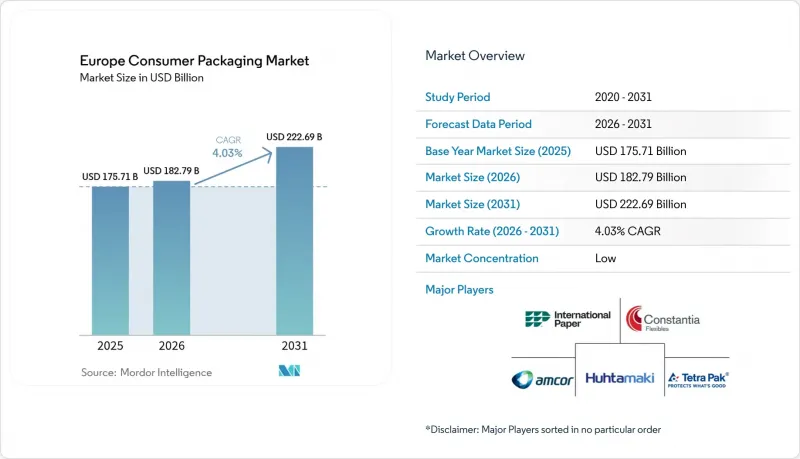
Mordor Intelligence에 의하면, 유럽의 소비자용 포장 시장 규모는 2025년에 1,757억 1,000만 달러로 평가되었고, 2026년 1,827억 9,000만 달러에서 2031년까지 2,226억 9,000만 달러에 이를 것으로 예측되며, 예측 기간(2026-2031년) CAGR은 4.03%를 나타낼 전망입니다.
본 보고서는 소재별(플라스틱(PE, PP, PET 등), 종이 및 판지(골판지, 성형 섬유 등), 유리, 금속(캔, 뚜껑 및 마개, 튜브 등)), 포장 형태별(경질, 연질, 반경질), 최종 사용자 산업별(식품, 음료, 제약 및 헬스케어 등), 그리고 국가별로 분류되어 있습니다. 시장 예측은 금액(달러) 기준으로 제시되어 있습니다.
유럽의 소비자용 포장 시장 동향 및 인사이트
편의성을 중시하는 유연성 플라스틱 포장에 대한 수요
도시 지역에서 외출 시 소비가 회복되는 가운데, 연포장재는 유리 및 금속 포장재로부터 시장 점유율을 계속 빼앗고 있습니다. 개봉하기 쉽고 재밀봉이 가능한 기능을 갖춘 정량 포장 파우치는 휴대성과 신선도를 중시하는 25세에서 45세 연령대의 이동성 높은 라이프스타일에 부합합니다. 가격 변동은 여전히 소폭에 그치고 있습니다. 2024년 하반기에는 7마이크론 알루미늄 포일이 4% 인상되었으나, 각 컨버터 업체들은 부피를 늘리지 않으면서도 유통기한을 연장하는 배리어 코팅이 적용된 경량 필름을 채택함으로써 비용 상승분을 상쇄했습니다. 현재는 포장 형태에 대한 고집보다는 기능성이 중시되는 추세로, 소스나 유아식 등의 액체 제품은 무거운 경질 포장에서 주둥이가 달린 파우치로 전환되고 있습니다. 그 결과, 식품 및 퍼스널케어 양 분야에서 연포장의 점유율이 지속적으로 확대되고 있습니다.
전자상거래의 급속한 성장이 라스트 마일 포장에 대한 수요를 창출하고 있습니다.
소비자에게 직접 배송하는 경우, 컨베이어에서 떨어지거나 온도 변화에 노출되고, 현관 앞에서 꼼꼼한 검사를 견뎌야 하는 포장이 여러 접촉 지점을 거치게 됩니다. PPWR(플라스틱 폐기물 감축 규정)은 2030년까지 운송 및 판매용 포장의 40%를 재사용 가능하도록 의무화하고 있어, 소매업체들에게 자동화와 지속가능성의 조화를 도모하도록 압력을 가하고 있습니다. 완충성과 치수 효율의 균형이 뛰어난 성형 섬유 삽입재나 정밀하게 설계된 골판지 상자에 대한 수요가 급증하고 있습니다. 폴란드와 스페인에서는 전자상거래 보급률이 가장 급격히 상승하고 있어, 유럽 소비자 포장 시장에서 지역 간 성장 격차가 확대되고 있습니다. 또한, 각 브랜드 소유 기업들은 디지털 인쇄를 활용하여 각 소포를 마케팅의 캔버스로 바꾸고, 개봉 경험을 단순한 비용 센터가 아닌 수익원으로 승화시키고 있습니다.
변동이 심한 폴리머 및 펄프 가격
원자재 가격 변동은 가공업체의 이익률을 압박하고 있으며, 분기별 지수를 기반으로 설정된 가격 계약을 혼란에 빠뜨리고 있습니다. 2024년 초, 하류 수요 부진을 배경으로 폴리에틸렌 가격은 하락세를 보였으나, 아시아 공급망이 혼란에 빠졌을 때는 PET 가격이 급등하며 원자재 가격 추이를 예측하기 어렵다는 점이 부각되었습니다. 섬유 분야에서는 제지 공장의 유지보수로 인한 가동 중단과 물류 병목 현상을 요인으로, 2024년 2분기에 코팅지 가격이 10% 가까이 급등한 후 안정세를 보였습니다. 재활용 사업이나 펄프 자산에 대한 수직 통합이 지지를 얻고 있지만, 이로 인해 혁신이나 지리적 확장에 투입되어야 할 자본이 묶이게 됩니다.
부문별 분석
종이 및 판지 부문은 전자상거래 업체 및 외식 산업용 일회용 제품을 주축으로 2025년 매출의 35.22%를 차지했습니다. 유럽의 소비자용 포장 시장에서 종이 기반 솔루션 시장 규모는 규제 당국의 우호적인 태도와 소비자 인식이 계속해서 호재로 작용함에 따라 완만하게 확대될 것으로 예측됩니다. 그러나 PET의 연평균 성장률(CAGR) 5.74%는 보증금 반환 제도의 경제성과 식품 등급 재활용 소재 사용을 약속하는 브랜드의 노력에 힘입어 결정적인 모멘텀 전환이 일어나고 있음을 여실히 보여줍니다. 유럽 소비자용 포장 시장에서 점유율이 확대된 것은 2024년에 평균 24%의 재활용 수지를 사용한 단일 소재 PET 식수 병 덕분이며, 이는 폐쇄형 순환 시스템의 실현 가능성을 뒷받침합니다. 대조적으로, PE 및 PP는 새로운 금지 조치로 인해 일회용 뚜껑, 수저, 얇은 식료품 봉지가 시장에서 사라지는 역풍에 직면해 있습니다.
PET의 우위는 최적화된 공장에서 75%에 달하는 기계적 재활용 수율로 더욱 뒷받침되고 있으며, 섬유계 골판지 상자와의 탄소 배출량 격차가 줄어들고 있습니다. 한편, 유리 업계 단체는 200억 유로 규모의 용해로 전기화를 추진하고 있지만, 전기 요금 급등이 경쟁력을 저해하고 있습니다. 알루미늄은 여전히 순환 경제에서 강력한 입지를 유지하고 있지만, 사용 후 캔 시트의 유동성은 지역별 회수율에 따라 변동합니다. 특수 폴리머는 의약품 블리스터 팩이나 개인 위생 용품의 펌프 부품과 같은 분야에서 성장 여지가 있으며, 이러한 분야에서는 균일한 재활용 가능성 요건보다 성능이 우선시됩니다.
기타 혜택 :
- 엑셀 형식 시장 예측(ME) 시트
- 3개월간의 애널리스트 지원
자주 묻는 질문
목차
제1장 서론
제2장 조사 방법
제3장 주요 요약
제4장 시장 구도
제5장 시장 규모 및 성장 예측
제6장 경쟁 구도
제7장 시장 기회 및 향후 전망
AJY 26.09.11According to Mordor Intelligence, the Europe consumer packaging market size was valued at USD 175.71 billion in 2025 and estimated to grow from USD 182.79 billion in 2026 to reach USD 222.69 billion by 2031, at a CAGR of 4.03% during the forecast period (2026-2031).
This report is Segmented by Material (Plastic (PE, PP, PET, and More), Paper and Board (Cartonboard, Molded Fiber, and More), Glass, and Metal (Cans, Caps and Closures, Tubes, and More)), Packaging Format (Rigid, Flexible, and Semi-Rigid), End-User Industry (Food, Beverage, Pharmaceutical and Healthcare, and More), and Country. The Market Forecasts are Provided in Terms of Value (USD).
Europe Consumer Packaging Market Trends and Insights
Convenience-driven demand for flexible plastic packs
Flexible formats continue to migrate volume from glass and metal as on-the-go consumption rebounds across urban corridors. Portion-controlled pouches with easy-open reclosable features meet the mobile lifestyle of 25- to 45-year-olds who prize portability and freshness. Price movements remain modest. 7-micron aluminum foil rose 4% in late 2024, but converters offset cost upticks through barrier-coated lightweight films that extend shelf life without adding bulk. Functionality now outweighs format loyalty, drawing liquid applications such as sauces and baby food toward spouted pouches and away from heavier rigid alternatives. The result is sustained share capture for flexibles in both food and personal-care aisles.
E-commerce boom creating last-mile packaging needs
Direct-to-consumer fulfillment adds multiple touchpoints where packs must survive conveyor drops, temperature shifts, and doorstep scrutiny. The PPWR mandates 40% reusable transport and sales packaging by 2030, pressuring retailers to harmonize automation with sustainability. Demand is surging for molded-fiber inserts and precision-engineered corrugated boxes that balance cushioning with dimensional efficiency. Poland and Spain show the steepest e-commerce penetration curves, widening the regional growth gap within the European consumer packaging market. Brand owners also leverage digital print to transform each parcel into a marketing canvas, elevating unboxing to a revenue lever rather than a cost center.
Volatile polymer and paper pulp prices
Feedstock swings erode converter margins and disrupt pricing contracts fixed on quarterly indices. Polyethylene values softened in early 2024 amid weak downstream demand, yet PET tightened when Asian supply lines faltered, demonstrating the difficulty of forecasting input trajectories. On the fiber side, coated paper spiked nearly 10% in Q2 2024 before easing, driven by mill maintenance outages and logistics bottlenecks. Vertical integration into recycling or pulp assets is gaining favor, but it locks capital that could fund innovation or geographic expansion.
Other drivers and restraints analyzed in the detailed report include:
- Shift toward lightweighting and easy-open formats
- EU Single-Use Plastics Directive spurring mono-material R&D
- Expanding EU bans on difficult-to-recycle formats
For complete list of drivers and restraints, kindly check the Table Of Contents.
Segment Analysis
Paper and board defended 35.22% of 2025 revenue on the strength of e-commerce shippers and foodservice disposables. The Europe consumer packaging market size for paper-based solutions is projected to expand modestly as regulatory goodwill and consumer perception remain supportive. However, PET's 5.74% CAGR underscores a decisive momentum swing driven by deposit-return economics and brand pledges for food-grade recycled content. Europe consumer packaging market share gains accrue to mono-PET beverage bottles that averaged 24% recycled resin in 2024, validating closed-loop viability. In contrast, PE and PP navigate headwinds from single-use caps, cutlery, and thin grocery bags disappearing under new bans.
The PET narrative is reinforced by mechanical recycling yields that reach 75% in optimized plants, narrowing the carbon delta versus fiber-based cartons. Meanwhile, glass lobbies are campaigning for EUR 20 billion in furnace electrification, but elevated electricity tariffs cloud competitiveness. Aluminum retains a strong circularity story, yet the liquidity of post-consumer can sheet fluctuates with regional redemption rates. Specialty polymers hold pockets of growth in pharma blister packs and personal-care pump components, where performance trumps uniform recyclability mandates.
Complete Report Scope:
- By Material
- Plastic
- PE (Polyethylene)
- PP (Polypropylene)
- PET (Polyethylene Terephthalate)
- PVC (Polyvinyl Chloride)
- Other Plastics
- Paper and Board
- Cartonboard
- Containerboard and Linerboard
- Molded Fiber
- Glass
- Metal
- Cans
- Caps and Closures
- Tubes
- Other Metals
- Plastic
- By Packaging Format
- Rigid
- Flexible
- Semi-rigid
- By End-user Industry
- Food
- Beverage
- Pharmaceutical and Healthcare
- Cosmetics, Personal and Home Care
- Other End-user Industry
- By Country
- Germany
- United Kingdom
- France
- Italy
- Spain
- Poland
- Rest of Europe
List of Companies Covered in this Report:
- Amcor PLC
- Huhtamaki Oyj
- Mondi PLC
- International Paper Company
- Tetra Pak International SA
- Ardagh Group S.A.
- Crown Holdings, Inc.
- Constantia Flexibles Holding GmbH
- Sealed Air Corporation
- Sonoco Products Company
- Stora Enso Oyj
- Smurfit Kappa Group Limited
- Ball Corporation
- Berry Global, Inc.
- Greiner Packaging International GmbH
- Albea Group S.A.S.
- Gerresheimer AG
- Vetropack Holding AG
- Massilly Holding
Additional Benefits:
- The market estimate (ME) sheet in Excel format
- 3 months of analyst support
TABLE OF CONTENTS
1 INTRODUCTION
- 1.1 Study Assumptions and Market Definition
- 1.2 Scope of the Study
2 RESEARCH METHODOLOGY
3 EXECUTIVE SUMMARY
4 MARKET LANDSCAPE
- 4.1 Market Overview
- 4.2 Market Drivers
- 4.2.1 Convenience-driven demand for flexible plastic packs
- 4.2.2 E-commerce boom creating last-mile packaging needs
- 4.2.3 Shift toward lightweighting and easy-open formats
- 4.2.4 EU Single-Use Plastics Directive spurring mono-material R&D
- 4.2.5 Deposit-return schemes scaling rPET demand
- 4.2.6 Digital printing enabling SKU proliferation and short-runs
- 4.3 Market Restraints
- 4.3.1 Volatile polymer and paper pulp prices
- 4.3.2 Expanding EU bans on difficult-to-recycle formats
- 4.3.3 Recycling gaps for multilayer flexibles
- 4.3.4 Energy-price shocks inflating glass and metal costs
- 4.4 Industry Supply Chain Analysis
- 4.5 Regulatory Landscape
- 4.6 Technological Outlook
- 4.7 Porter's Five Forces Analysis
- 4.7.1 Bargaining Power of Suppliers
- 4.7.2 Bargaining Power of Consumers
- 4.7.3 Threat of New Entrants
- 4.7.4 Threat of Substitutes
- 4.7.5 Intensity of Competitive Rivalry
5 MARKET SIZE AND GROWTH FORECASTS (VALUE)
- 5.1 By Material
- 5.1.1 Plastic
- 5.1.1.1 PE (Polyethylene)
- 5.1.1.2 PP (Polypropylene)
- 5.1.1.3 PET (Polyethylene Terephthalate)
- 5.1.1.4 PVC (Polyvinyl Chloride)
- 5.1.1.5 Other Plastics
- 5.1.2 Paper and Board
- 5.1.2.1 Cartonboard
- 5.1.2.2 Containerboard and Linerboard
- 5.1.2.3 Molded Fiber
- 5.1.3 Glass
- 5.1.4 Metal
- 5.1.4.1 Cans
- 5.1.4.2 Caps and Closures
- 5.1.4.3 Tubes
- 5.1.4.4 Other Metals
- 5.1.1 Plastic
- 5.2 By Packaging Format
- 5.2.1 Rigid
- 5.2.2 Flexible
- 5.2.3 Semi-rigid
- 5.3 By End-user Industry
- 5.3.1 Food
- 5.3.2 Beverage
- 5.3.3 Pharmaceutical and Healthcare
- 5.3.4 Cosmetics, Personal and Home Care
- 5.3.5 Other End-user Industry
- 5.4 By Country
- 5.4.1 Germany
- 5.4.2 United Kingdom
- 5.4.3 France
- 5.4.4 Italy
- 5.4.5 Spain
- 5.4.6 Poland
- 5.4.7 Rest of Europe
6 COMPETITIVE LANDSCAPE
- 6.1 Market Concentration
- 6.2 Strategic Moves
- 6.3 Market Share Analysis
- 6.4 Company Profiles (includes Global level Overview, Market level overview, Core Segments, Financials as available, Strategic Information, Market Rank/Share for key companies, Products and Services, and Recent Developments)
- 6.4.1 Amcor PLC
- 6.4.2 Huhtamaki Oyj
- 6.4.3 Mondi PLC
- 6.4.4 International Paper Company
- 6.4.5 Tetra Pak International SA
- 6.4.6 Ardagh Group S.A.
- 6.4.7 Crown Holdings, Inc.
- 6.4.8 Constantia Flexibles Holding GmbH
- 6.4.9 Sealed Air Corporation
- 6.4.10 Sonoco Products Company
- 6.4.11 Stora Enso Oyj
- 6.4.12 Smurfit Kappa Group Limited
- 6.4.13 Ball Corporation
- 6.4.14 Berry Global, Inc.
- 6.4.15 Greiner Packaging International GmbH
- 6.4.16 Albea Group S.A.S.
- 6.4.17 Gerresheimer AG
- 6.4.18 Vetropack Holding AG
- 6.4.19 Massilly Holding
7 MARKET OPPORTUNITIES AND FUTURE OUTLOOK
- 7.1 White-space and Unmet-need Assessment


