

|
시장보고서
상품코드
2121510
FMCG 포장 : 시장 점유율 분석, 업계 동향과 통계, 성장 예측(2026-2031년)FMCG Packaging - Market Share Analysis, Industry Trends & Statistics, Growth Forecasts (2026 - 2031) |
||||||
 Mordor Intelligence
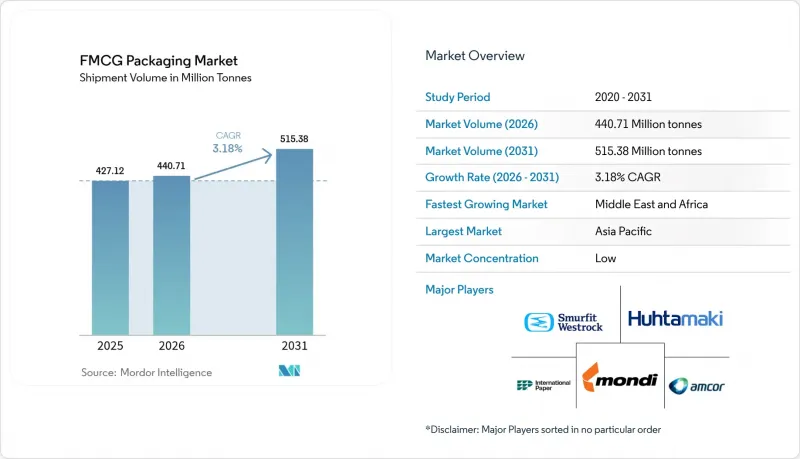
FMCG(일용소비재) 포장 시장 규모는 2025년에 4억 2,712만 톤으로 평가되며, 2026년 4억 4,071만 톤에서 2031년까지 5억 1,538만 톤에 달할 것으로 예측되며, 예측 기간(2026-2031년) 동안 CAGR은 3.18%가 될 전망입니다.
본 보고서는 소재 유형(종이·판지, 플라스틱, 금속, 유리, 바이오 기반 및 퇴비화 가능한 소재), 포장 유형(유연 포장, 경질 포장), 최종 이용 산업(식품, 음료, 퍼스널케어·화장품 등), 유통 채널(직접 판매, 간접 판매) 및 지역별로 분류되어 있습니다. 시장 전망은 톤 기준으로 제시되어 있습니다.
세계 FMCG 포장 시장의 동향 및 인사이트
보호 기능과 경량성을 겸비한 포장이 필요한 E-Commerce의 급속한 성장
현재 온라인 소매 업계에서는 소포의 내구성, 부피 중량 제한 및 원활한 반품 절차를 중심으로 디자인 요건이 수립되고 있습니다. 브랜드 소유주들은 쿠션이 내장된 우편 봉투, 에어 컬럼이 포함된 파우치, 그리고 빈 공간과 운송 비용을 대폭 절감하는 맞춤형 크기의 골판지 상자를 지정하고 있습니다. 포장 공장에서는 디지털 인쇄 라인을 도입하여 각 포장물에 스캔 가능한 코드를 부여함으로써, 진위 여부 확인 및 재고 보충 서비스의 촉매제로 활용하고 있습니다. 충격이나 온도 관리 미비를 감지하는 스마트 인디케이터는 프리미엄 상품 카테고리에서 표준 사양으로 자리 잡고 있으며, 이러한 추세는 추적 가능한 포장에 대해 보험료를 할인해 주는 소포 보험사들에 의해 뒷받침되고 있습니다. 이러한 수요로 인해 플렉서블 필름과 골판지의 수요는 높은 수준을 유지하고 있으며, 수지 공급업체들은 기계적 특성을 유지한 드롭인형 재생 등급의 개발을 가속화하고 있습니다.
아시아 도시 지역의 ‘1인분’ 소비 붐이 편의성이 높은 포장 형태를 뒷받침
중국, 인도, 동남아시아의 1인 가구 증가와 출퇴근 시간의 혼잡을 배경으로, 1회 분량이 조절된 파우치, 컵, 소포장의 보급이 확대되고 있습니다. 각 제조사는 대용량 팩과 경쟁할 수 있는 가격대를 실현하는 한편, 일부만 사용되고 버려지는 대형 패키지로 인한 식품 폐기물을 줄이기 위해 고속 충전·밀봉 라인의 자동화를 추진하고 있습니다. 소매업체들은 재밀봉 가능한 스낵 팩이나 1인분 즉석 식사에 프리미엄 진열 공간을 할당하고 있으며, 이에 따라 각 컨버터 기업들은 마지막 한 끼까지 내용물을 신선하게 유지하는 차단층을 강화해야 하는 압박을 받고 있습니다. 이러한 성장은 홈케어 및 퍼스널케어 용품 분야로도 파급되고 있으며, 리필용 포드와 여행에 편리한 미니 사이즈 제품은 바쁜 도시 생활자들에게 적합합니다. 쉽게 뜯을 수 있는 개봉구와 낙하 내구성을 겸비한 라미네이트 소재에 대한 수요가 아시아 지역의 생산능력 증강을 지탱하는 주요 요인으로 작용하고 있습니다.
수지 가격 변동이 계획의 불확실성을 초래
원유 및 나프타의 벤치마크 가격 변동은 분기별 계약 협상에 혼란을 초래하고 있으며, 각 변환 업체들은 원자재 헤지를 하거나 재활용 등급 및 바이오 기반 등급으로의 전환을 가속화할 수밖에 없는 상황입니다. 규모가 작은 기업들은 가격 급등을 흡수하는 데 어려움을 겪고 있으며, 그 결과 이익률이 압박을 받고 설비 투자 속도가 둔화되고 있습니다. 지정학적 사건과 관련이 많은 특수 첨가제의 갑작스러운 부족은 임시방편적인 배합 변경을 강요하며, 생산 중단이나 고객으로부터의 위약금 지불 위험을 초래합니다. 이에 반해, 다국적 기업들은 조달처를 다각화하고 수년에 걸친 공급 계약을 체결하는 한편, 재무 부서는 업계 지수에 연동된 비용 전가 조항을 도입하고 있습니다. 이러한 변동은 수지 자산을 통합하고 견고한 운전 자본 기반을 갖춘 생산자에게 유리하게 작용합니다.
부문별 분석
2025년, 플라스틱은 FMCG(일용소비재) 포장 시장에서 61.98%의 점유율을 유지했습니다. 이는 타의 추종을 불허하는 강도 대 중량비와 폭넓은 가공성을 반영한 결과입니다. 바이오 기반 및 퇴비화 가능한 등급은 여전히 틈새 시장으로 남아 있지만, 각 변환업체들이 산소 및 수분 차단성을 높인 PLA 및 PHA 블렌드의 상용화를 추진함에 따라 연평균 성장률(CAGR) 6.73%로 확대되고 있습니다. 경질 금속은 무한히 재활용이 가능하다는 점에서 프리미엄 음료 라인에서 지지를 얻고 있으며, 판지는 건조 식품이나 퍼스널케어 제품의 형태에서 섬유 기반 벽면이 허용되는 분야에서 점유율을 확대하고 있습니다. FMCG 포장 시장에서는 비용 효율성이 높아 플렉서블 라미네이트 분야에서 폴리에틸렌과 폴리프로필렌이 여전히 주류를 이루고 있지만, 현재 북미와 유럽에서 확대되고 있는 화학적 재활용은 고품질의 사용 후 수지 공급을 보장하여, 이를 통해 버진 수지에 대한 수요를 완화할 것으로 예상됩니다. 반응성 코팅 기술의 혁신으로 종이컵은 플라스틱 라이너 없이도 산성 주스를 담을 수 있게 되어, 플라스틱 대체를 향한 새로운 길이 열리고 있습니다.
플라스틱 공급업체들은 열분해유 유래의 인증된 순환형 PE 및 PP 등급을 출시함으로써 지속가능성에 대한 압력에 대응하고 있으며, 이를 통해 브랜드 소유자는 기존 가공 라인을 유지하면서 배출량을 줄이기 위한 ‘드롭인’ 방식을 채택할 수 있게 됩니다. 정부의 친환경 조달 규정이 정착됨에 따라, FMCG 포장 시장에서 바이오 기반 수지의 시장 규모는 2031년까지 823만 톤을 넘어설 것으로 예측됩니다. 한편, 에어로졸 캔이나 반려동물 사료 트레이에서 알루미늄이 가진 경량이라는 장점은, 여러 번 사용해도 견딜 수 있는 튼튼한 형태가 요구되는 리필 스테이션의 요구 사항과 부합합니다. 유리는 맛의 중립성이 중시되는 상황에서는 여전히 중요한 역할을 하고 있지만, 무게와 파손 위험이 시장 점유율 확대를 제한하고 있습니다. 전반적으로, 소재 선택은 현재 단가뿐만 아니라 기능적 성능, 규제 준수 및 총 탄소 영향의 균형을 고려하여 이루어지고 있습니다.
2025년에는 54.12%의 점유율을 차지할 유연한 형태의 포장이 FMCG(일용소비재) 포장 시장을 주도하고 있으며, 2031년까지 연평균 성장률(CAGR) 6.22%를 기록할 것으로 전망됩니다. 브랜드 소유주들은 재료 대 제품 비율이 낮고, 그래픽 표현 가능성이 높으며, 팔레트당 적재 수량을 늘릴 수 있는 포장 효율성을 중요시하고 있습니다. E-Commerce로의 전환에 따라 우편 발송에 적합한 필로우팩이나, 불필요한 완충재 없이도 자동 분류 과정을 견딜 수 있는 다층 소포장에 대한 수요가 증가하고 있습니다. 연속식 수평 성형·충진·밀봉(HFFS) 라인은 스낵 및 과자 카테고리를 대상으로 분당 1,500팩이 넘는 속도로 공급하고 있으며, 반복적인 포맷 최적화를 통해 업무 효율성이 현저히 향상되고 있습니다.
구조나 재밀봉 가능성이 중요한 분야에서는 여전히 경질 용기가 틈새 시장을 독점하고 있습니다. 탄산음료 분야에서는 PET 병이 주도적인 위치를 유지하고 있는 반면, 미식 소스 분야에서는 유리병이 프리미엄 이미지를 연출하고 있습니다. 성형 캡이 장착된 하이브리드형 ‘경질·연질 복합’ 파우치 디자인은 두 소재의 장점을 모두 갖추고 있으며, 같은 크기의 유리 용기에 비해 무게를 최대 70% 줄여줍니다. FMCG(일용소비재) 시장에서 경질 포장의 시장 규모는 성숙한 카테고리의 포화 상태를 반영하면서도, 리필이 가능한 퍼스널케어용 디스펜서 분야의 새로운 기회를 바탕으로 한 자릿수 초반의 성장이 예상됩니다. 현재 설비 제조사들은 하나의 라인에서 파우치, 항아리, 병 등 다양한 형태의 용기를 처리할 수 있는 모듈식 충전 블록을 제공하고 있으며, 이를 통해 컨버터 기업들은 포맷별 수요 변동에 대한 리스크 헤지가 가능해졌습니다.
지역별 분석
아시아태평양은 2025년 출하량의 45.21%를 차지하며, 이 지역은 FMCG 포장 시장의 중심적인 위치를 차지하고 있습니다. 중국과 인도는 통합된 수지 크래커, 필름 압출기, 가공 공장 클러스터를 활용하여 막대한 국내 수요를 충족시키는 동시에 수출 흐름을 뒷받침하고 있습니다. 도시 지역의 소형 주방과 외식 습관이 1회용 파우치의 보급을 촉진하는 한편, 각국의 플라스틱 감축 의무화로 인해 종이를 기재로 한 유연 포장재의 도입이 가속화되고 있습니다. 가처분 소득의 증가로 프리미엄 퍼스널케어 제품으로의 전환이 진행되면서 1인당 포장재 사용량이 증가하고 있습니다. 인도와 동남아시아에서 정부 주도로 콜드체인 회랑이 정비됨에 따라 단열 배송 용기와 위변조 방지 씰에 대한 수요가 더욱 높아지고 있습니다.
북미는 E-Commerce의 광범위한 보급과 높은 수준의 골판지 생산능력을 바탕으로 안정적인 시장 점유율을 유지하고 있습니다. 200억 달러 규모의 스마핏-웨스트록 합병은 고정비를 분산시키고, 순환 경제 연구 개발에 자금을 투입하기 위한 규모 확대 노력을 상징합니다. 그린베이 패키징(Green Bay Packaging)이 아칸소주에 건설한 10억 달러 규모의 크라프트 라이너보드 공장에 대한 투자 등은 국내 공급 안정성을 강화하고 경량 라이너 제품의 라인업을 확대하고 있습니다. 음료 용기의 재활용 소재 함유율에 관한 미국 주 정부 규제는 PET 회수 프로젝트를 촉진하고, 지역 가공업체로 하여금 rPET 원료를 확보하도록 압박하고 있습니다. 캐나다와 멕시코는 소비재 충전 라인을 주요 수요지 근처로 이전하는 ‘니어쇼어링’의 혜택을 누리고 있습니다.
유럽의 성숙한 시장에서는 ‘포장 및 포장 폐기물 규정’에 따른 엄격한 재활용 가능성 목표를 달성하기 위해 혁신이 활용되고 있습니다. 독일과 프랑스에서는 재활용 소재 함유율의 최저 기준을 충족하기 위해 MRF(분리 수거 시설) 및 화학 재활용 시범 사업을 확대하는 한편, 각 브랜드 소유 기업들은 ‘분리 수거 가능성’ 테스트를 통과할 수 있도록 개별 포장 디자인을 재검토하고 있습니다. 고급 제과 제조사들은 바이오 배리어 기능을 갖춘 섬유계 포장재를 채택하고 있으며, 영국의 슈퍼마켓에서는 반환 가능한 파우치에 대한 소비자 수용도를 검증하기 위한 리필 서비스의 시범 도입이 진행되고 있습니다. 이러한 노력으로 총 취급량은 안정적이지만, 부가가치는 더 높은 사양의 소재와 관련 디지털 서비스로 이동하고 있습니다.
중동 및 아프리카는 기반은 낮지만, 조직화된 소매업의 확대와 인구 증가가 포장된 생활 필수품의 수요를 견인하여 6.48%라는 가장 높은 연평균 성장률(CAGR)을 기록하고 있습니다. 걸프 국가들은 국내 패스트푸드 체인과 수출 주문 모두에 공급하는 최첨단 유연 포장 공장에 투자하고 있습니다. 남아프리카와 케냐에서는 냉장 시설이 부족한 지역에서 우유와 주스의 종이팩 유통 기한을 연장하는 이동식 충전 장치가 도입되고 있습니다. 유럽 및 아시아 기업 그룹의 직접 투자를 통해 다층 압출 기술이 도입되어 현지 생산능력이 향상되고 있습니다.
남미에서는 브라질과 콜롬비아의 경제 개혁이 개인 소비를 활성화시켜 꾸준한 성장이 예상됩니다. 지역 내 섬유 자원의 공급이 비용 경쟁력 있는 골판지 생산을 뒷받침하고 있으며, 브라질의 사탕수수 유래 바이오 PE 생산능력은 세계 브랜드에 재생 가능 원료를 전면에 내세울 기회를 제공하고 있습니다. 관세 구조는 여전히 공장 입지 결정에 영향을 미치고 있으며, 가공업체들은 메르코수르와 태평양 동맹 블록에 걸쳐 다국적 사업 전개를 채택하도록 유도되고 있습니다.
기타 혜택:
- 엑셀 형식의 시장 예측(ME) 시트
- 3개월간의 애널리스트 지원
자주 묻는 질문
목차
제1장 소개
제2장 조사 방법
제3장 주요 요약
제4장 시장 구도
제5장 시장 규모와 성장 예측
제6장 경쟁 구도
제7장 시장 기회와 향후 전망
KSM 26.09.07According to Mordor Intelligence, the FMCG packaging market size was valued at 427.12 million tonnes in 2025 and estimated to grow from 440.71 million tonnes in 2026 to reach 515.38 million tonnes by 2031, at a CAGR of 3.18% during the forecast period (2026-2031).
This report is Segmented by Material Type (Paper and Paperboard, Plastics, Metal, Glass, Bio-Based and Compostable Materials), Packaging Type (Flexible Packaging, Rigid Packaging), End-Use Industry (Food, Beverages, Personal Care and Cosmetics, and More), Distribution Channel (Direct Sales, Indirect Sales), and Geography. The Market Forecasts are Provided in Terms of Volume (Tonnes).
Global FMCG Packaging Market Trends and Insights
Rapid Growth of E-commerce Requiring Protective, Lightweight Packs
Online retail now frames design briefs around parcel durability, dimensional weight limits, and friction-free returns. Brand owners specify cushioned mailers, air-column pouches, and fit-to-size cartons that slash void space and freight spend. Packaging plants add digital print lines so each shipper can carry scannable codes that confirm authenticity or trigger replenishment services. Smart indicators that reveal impact or temperature misuse are becoming standard on premium categories, a trend reinforced by parcel insurers who offer lower premiums for traceable packs. These needs keep flexible films and corrugated board in high demand and encourage resin suppliers to accelerate drop-in recycled grades that retain mechanical properties.
Urban Single-Serve Consumption Boom in Asia Boosting Convenience Formats
Rising numbers of single-person households and congested commutes in China, India, and Southeast Asia spur uptake of portion-controlled pouches, cups, and sachets. Manufacturers are automating high-speed fill-seal lines to reach price points competitive with bulk packs while trimming food waste from partially used larger units. Retailers dedicate premium shelf space to resealable snack packs and ready-to-eat meals sized for one, pushing converters to enhance barrier layers that keep contents fresh until the last serving. Growth spills into home-care and personal-care items, where refill pods and travel-friendly minis fit hectic urban lifestyles. Demand for laminates that couple easy-tear openings with drop-resistance underpins a notable slice of incremental Asian capacity additions.
Resin Price Volatility Creating Planning Uncertainty
Fluctuating crude-oil and naphtha benchmarks upset quarterly contract negotiations, prompting converters to hedge feedstock or accelerate substitution toward recycled and bio-based grades. Smaller firms lacking scale struggle to absorb spikes, which compress margins and slow capital investment. Sudden shortages of specialty additives, often linked to geopolitical events, force ad-hoc reformulations that risk downtime and customer penalties. In response, multinationals diversify sourcing and lock in multi-year supply pacts, while financial teams roll out cost-pass-through clauses keyed to industry indices. Such turbulence favors producers with integrated resin assets and strong working-capital positions.
Other drivers and restraints analyzed in the detailed report include:
- RTD Beverage Surge Driving High-Barrier Pouch Adoption
- Premiumisation in Personal-Care Triggering Smart and Decorative Packs
- Single-Use-Plastic Bans Dampening Conventional Flexibles
For complete list of drivers and restraints, kindly check the Table Of Contents.
Segment Analysis
Plastics maintained a 61.98% share of the FMCG packaging market in 2025, reflecting unmatched strength-to-weight ratios and broad processability. Bio-based and compostable grades, though still niche, are expanding at 6.73% CAGR as converters commercialize PLA and PHA blends with enhanced oxygen and moisture barriers. Rigid metals find favor in premium beverage lines for infinite recyclability, and paperboard gains share where dry food or personal-care formats permit fiber-based walls. The FMCG packaging market continues to favor polyethylene and polypropylene in flexible laminates thanks to cost efficiency, but chemical recycling, now scaling in North America and Europe, promises high-quality post-consumer resins that moderate virgin demand. Innovations in reactive coating lines let paper cups hold acidic juices without plastic liners, opening another pathway for plastics displacement.
Plastics suppliers counter sustainability pressures by launching certified-circular PE and PP grades derived from pyrolysis oil, giving brand owners a drop-in route to lower emissions while retaining incumbent converting lines. The FMCG packaging market size for bio-based resins is projected to surpass 8.23 million tonnes by 2031 as governmental green-procurement rules take hold. Meanwhile, aluminum's light-weight advantage in aerosol cans and pet-food trays aligns with refill stations that prefer robust formats surviving multiple cycles. Glass stays relevant where taste neutrality is prized, yet weight and breakage limit its volume share. Overall, material choice now hinges on balancing functional performance, regulatory compliance, and total carbon impact rather than unit price alone.
With a 54.12% share in 2025, flexible formats dominate the FMCG packaging market and are tracking a 6.22% CAGR to 2031. Brand owners value lower material-to-product ratios, high graphics potential, and pack-out efficiency that allows more units per pallet. The shift to e-commerce adds demand for mail-friendly pillow packs and multi-layer sachets that endure automated sortation without extra void fill. Continuous-motion horizontal form-fill-seal (HFFS) lines supply snack and confectionery categories at speeds exceeding 1,500 packs per minute, highlighting the operational gains that recursive format optimisation delivers.
Rigid options still command niches where structure and reclosability are critical. PET bottles retain leadership in carbonated soft drinks, while glass jars project premium cues in gourmet sauces. Hybrid "rigid-in-flexible" pouch designs with molded caps combine both worlds, slicing weight by up to 70% versus equivalently sized glass containers. The FMCG packaging market size for rigid formats is forecast to post low-single-digit growth, reflecting saturation in mature categories but fresh opportunities in refillable personal-care dispensers. Equipment builders now offer modular filler blocs that handle fitment pouches, jars, and bottles on one line, letting converters hedge against demand swings across formats.
Complete Report Scope:
- By Material Type
- Paper and Paperboard
- Plastics
- Polyethylene (LDPE/HDPE)
- Polypropylene (PP)
- Polyethylene Terephthalate (PET)
- Other Plastics (PVC, PS,etc)
- Metal
- Glass
- Bio-based and Compostable Materials
- By Packaging Type
- Flexible Packaging
- Pouches and Bags
- Films and Wraps
- Other Flexible Packaging
- Rigid Packaging
- Bottles and Jars
- Cans
- Trays and Containers
- Other Rigid Packaging
- Flexible Packaging
- By End-use Industry
- Food
- Beverages
- Personal Care and Cosmetics
- Household Care Products
- Pharmaceuticals and Healthcare
- Other End-use Industry
- By Distribution Channel
- Direct Sales
- Indirect Sales
- By Geography
- North America
- United States
- Canada
- Mexico
- Europe
- Germany
- United Kingdom
- France
- Italy
- Spain
- Russia
- Rest of Europe
- Asia-Pacific
- China
- India
- Japan
- South Korea
- Australia and New Zealand
- Rest of Asia-Pacific
- Middle East and Africa
- Middle East
- United Arab Emirates
- Saudi Arabia
- Turkey
- Rest of Middle East
- Africa
- South Africa
- Nigeria
- Egypt
- Rest of Africa
- Middle East
- South America
- Brazil
- Argentina
- Rest of South America
- North America
Geography Analysis
Asia-Pacific generated 45.21% of 2025 shipments, positioning the region as the anchor of the FMCG packaging market. China and India supply mammoth domestic demand and serve export flows, leveraging clusters of integrated resin crackers, film extruders, and converting plants. Urban micro-kitchens and on-the-go eating habits fuel single-serve pouch uptake, while national plastic-reduction mandates accelerate trials of paper-based flexibles. Rising disposable incomes enable trading-up to premium personal-care formats, deepening per-capita packaging intensity. Government-backed cold-chain corridors in India and Southeast Asia unleash further need for insulated shippers and tamper-evident seals.
North America follows with a stable share rooted in broad e-commerce penetration and advanced corrugated capacity. The Smurfit-WestRock merger, valued at USD 20 billion, exemplifies the push for scale to dilute fixed costs and fund circular-economy R&D. Investments such as Green Bay Packaging's USD 1 billion kraft linerboard mill in Arkansas strengthen domestic supply security and expand lightweight liner offerings. United States state regulations on recycled content in beverage containers catalyze PET reclaim projects, pushing local converters to lock in rPET feedstock. Canada and Mexico gain from near-shoring that relocates consumer-goods filling lines closer to core demand.
Europe's mature market taps innovation to meet its stringent recyclability targets under the Packaging and Packaging Waste Regulation. Germany and France upgrade MRFs and chemical-recycling pilots to satisfy minimum recycled-content thresholds, while brand owners redesign individual packs to pass "sort-ability" tests. Premium confectionery chooses fiber-based wrapping with bio-barriers, and UK supermarkets roll out refill trials that test shopper uptake of returnable pouches. These initiatives stabilize overall tonnage but shift value toward higher-spec materials and linked digital services.
Middle East and Africa register the fastest 6.48% CAGR, albeit from a lower base, as organized retail expands and population growth drives packaged staples. Gulf states invest in state-of-the-art flexible plants that supply both domestic fast-food chains and export orders. South Africa and Kenya attract mobile filling units for milk and juice cartons that extend shelf life in areas lacking refrigeration. Foreign direct investment from European and Asian groups introduces multilayer extrusion technology, lifting local capabilities.
South America offers steady upside as economic reforms in Brazil and Colombia revive consumer spending. Regional fiber availability supports cost-competitive corrugated, and sugar-cane-based bio-PE capacity in Brazil gives global brands a renewable-content narrative. Tariff structures still influence plant-location decisions, nudging converters to adopt multinational footprints that straddle Mercosur and Pacific Alliance blocs.
- Amcor plc
- Ball Corporation
- Mondi Group
- International Paper Co.
- Sealed Air Corporation
- Constantia Flexibles
- Smurfit Westrock Plc
- Crown Holdings Inc.
- Coveris Holdings S.A.
- Graphic Packaging International LLC
- Tetra Pak International
- Stora Enso Oyj
- Sonoco Products Co.
- Huhtamaki Oyj
- Toyo Seikan Group HD
- Nampak Ltd
- Mpact Pty Ltd
- Albea S.A.
- Owens-Illinois (O-I)
- Verallia SA
- Napco National
- 3P Gulf Group
Additional Benefits:
- The market estimate (ME) sheet in Excel format
- 3 months of analyst support
TABLE OF CONTENTS
1 INTRODUCTION
- 1.1 Study Assumptions and Market Definition
- 1.2 Scope of the Study
2 RESEARCH METHODOLOGY
3 EXECUTIVE SUMMARY
4 MARKET LANDSCAPE
- 4.1 Market Overview
- 4.2 Market Drivers
- 4.2.1 Rapid Growth of E-commerce Requiring Protective, Lightweight Packs
- 4.2.2 Urban Single-Serve Consumption Boom in Asia Boosting Convenience Formats
- 4.2.3 RTD Beverage Surge Driving High-Barrier Pouch Adoption
- 4.2.4 Premiumisation in Personal-Care Triggering Smart and Decorative Packs
- 4.2.5 Cold-Chain Expansion in Emerging Markets Raising Multilayer Film Usage
- 4.3 Market Restraints
- 4.3.1 Resin Price Volatility Creating Planning Uncertainty
- 4.3.2 Recycling-Infrastructure Deficit in Developing Nations
- 4.3.3 Single-Use-Plastic Bans Dampening Conventional Flexibles
- 4.4 Supply-Chain Analysis
- 4.5 Regulatory Outlook
- 4.6 Technological Outlook
- 4.7 Porter's Five Forces Analysis
- 4.7.1 Bargaining Power of Suppliers
- 4.7.2 Bargaining Power of Buyers
- 4.7.3 Threat of New Entrants
- 4.7.4 Threat of Substitutes
- 4.7.5 Intensity of Competitive Rivalry
5 MARKET SIZE AND GROWTH FORECASTS (VOLUME)
- 5.1 By Material Type
- 5.1.1 Paper and Paperboard
- 5.1.2 Plastics
- 5.1.2.1 Polyethylene (LDPE/HDPE)
- 5.1.2.2 Polypropylene (PP)
- 5.1.2.3 Polyethylene Terephthalate (PET)
- 5.1.2.4 Other Plastics (PVC, PS,etc)
- 5.1.3 Metal
- 5.1.4 Glass
- 5.1.5 Bio-based and Compostable Materials
- 5.2 By Packaging Type
- 5.2.1 Flexible Packaging
- 5.2.1.1 Pouches and Bags
- 5.2.1.2 Films and Wraps
- 5.2.1.3 Other Flexible Packaging
- 5.2.2 Rigid Packaging
- 5.2.2.1 Bottles and Jars
- 5.2.2.2 Cans
- 5.2.2.3 Trays and Containers
- 5.2.2.4 Other Rigid Packaging
- 5.2.1 Flexible Packaging
- 5.3 By End-use Industry
- 5.3.1 Food
- 5.3.2 Beverages
- 5.3.3 Personal Care and Cosmetics
- 5.3.4 Household Care Products
- 5.3.5 Pharmaceuticals and Healthcare
- 5.3.6 Other End-use Industry
- 5.4 By Distribution Channel
- 5.4.1 Direct Sales
- 5.4.2 Indirect Sales
- 5.5 By Geography
- 5.5.1 North America
- 5.5.1.1 United States
- 5.5.1.2 Canada
- 5.5.1.3 Mexico
- 5.5.2 Europe
- 5.5.2.1 Germany
- 5.5.2.2 United Kingdom
- 5.5.2.3 France
- 5.5.2.4 Italy
- 5.5.2.5 Spain
- 5.5.2.6 Russia
- 5.5.2.7 Rest of Europe
- 5.5.3 Asia-Pacific
- 5.5.3.1 China
- 5.5.3.2 India
- 5.5.3.3 Japan
- 5.5.3.4 South Korea
- 5.5.3.5 Australia and New Zealand
- 5.5.3.6 Rest of Asia-Pacific
- 5.5.4 Middle East and Africa
- 5.5.4.1 Middle East
- 5.5.4.1.1 United Arab Emirates
- 5.5.4.1.2 Saudi Arabia
- 5.5.4.1.3 Turkey
- 5.5.4.1.4 Rest of Middle East
- 5.5.4.2 Africa
- 5.5.4.2.1 South Africa
- 5.5.4.2.2 Nigeria
- 5.5.4.2.3 Egypt
- 5.5.4.2.4 Rest of Africa
- 5.5.4.1 Middle East
- 5.5.5 South America
- 5.5.5.1 Brazil
- 5.5.5.2 Argentina
- 5.5.5.3 Rest of South America
- 5.5.1 North America
6 COMPETITIVE LANDSCAPE
- 6.1 Market Concentration
- 6.2 Strategic Moves
- 6.3 Market Share Analysis
- 6.4 Company Profiles (includes Global level Overview, Market level overview, Core Segments, Financials as available, Strategic Information, Market Rank/Share for key companies, Products and Services, and Recent Developments)
- 6.4.1 Amcor plc
- 6.4.2 Ball Corporation
- 6.4.3 Mondi Group
- 6.4.4 International Paper Co.
- 6.4.5 Sealed Air Corporation
- 6.4.6 Constantia Flexibles
- 6.4.7 Smurfit Westrock Plc
- 6.4.8 Crown Holdings Inc.
- 6.4.9 Coveris Holdings S.A.
- 6.4.10 Graphic Packaging International LLC
- 6.4.11 Tetra Pak International
- 6.4.12 Stora Enso Oyj
- 6.4.13 Sonoco Products Co.
- 6.4.14 Huhtamaki Oyj
- 6.4.15 Toyo Seikan Group HD
- 6.4.16 Nampak Ltd
- 6.4.17 Mpact Pty Ltd
- 6.4.18 Albea S.A.
- 6.4.19 Owens-Illinois (O-I)
- 6.4.20 Verallia SA
- 6.4.21 Napco National
- 6.4.22 3P Gulf Group
7 Market Opportunities and Future Outlook
- 7.1 White-space and Unmet-Need Assessment


