

|
시장보고서
상품코드
2121312
중국의 퍼스널케어 포장 : 시장 점유율 분석, 업계 동향과 통계, 성장 예측(2026-2031년)China Personal Care Packaging - Market Share Analysis, Industry Trends & Statistics, Growth Forecasts (2026 - 2031) |
||||||
 Mordor Intelligence
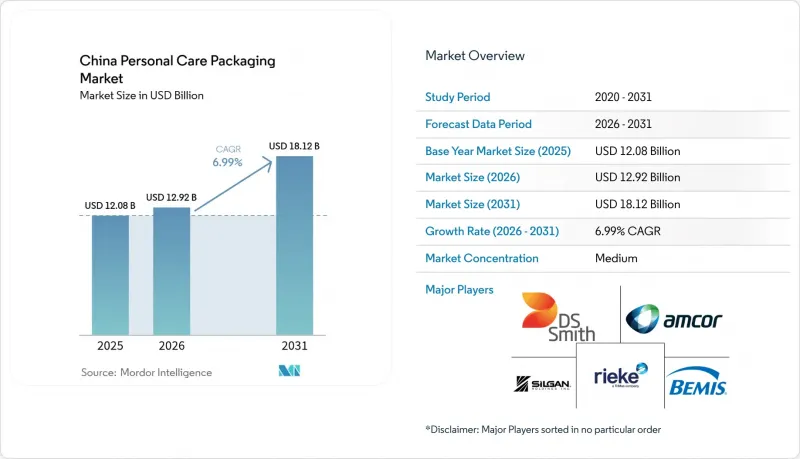
Mordor Intelligence에 따르면 중국의 퍼스널케어 포장 시장 규모는 2025년에 120억 8,000만 달러로 평가되며, 2026년 129억 2,000만 달러에서 2031년까지 181억 2,000만 달러에 달할 것으로 예측되며, 예측 기간(2026-2031년) 동안 CAGR은 6.99%가 될 전망입니다.
본 보고서는 소재 유형(플라스틱, 유리, 금속, 종이·판지, 바이오 기반·퇴비화 가능 플라스틱), 포장 유형(플라스틱 병·용기, 튜브·스틱, 펌프, 스프레이,드롭퍼, 기타), 제품 유형(스킨케어, 헤어케어, 구강 관리, 기타), 지속가능성 속성(재활용 가능, 사용 후 재활용 소재(PCR) 함유율, 생분해성, 기타)에 따라 분류되어 있습니다.
중국 퍼스널케어 포장 시장의 동향 및 인사이트
미용·퍼스널케어 부문의 E-Commerce 급성장
소셜 커머스의 폭발적인 성장으로 인해 각 브랜드는 광범위한 배송을 견디면서도 사진에 잘 나오는 개봉 장면을 연출할 수 있는 포장 개발을 강요받고 있습니다. Douyin의 미용 관련 GMV는 2021년부터 2023년 사이에 2배 이상 증가했으며, 플랫폼 알고리즘에 따른 동향이 포장 제조업체에게 거의 즉각적으로 반영되는 포장 요건이 되고 있습니다. 현재 각 브랜드는 내충격성, 부피 대비 중량, 사진에 잘 나오는 미관을 동등하게 중요시하고 있습니다. 연안 성 이외 지역의 풀필먼트 센터 증가에 따라, 완충성과 운송 비용 절감이라는 특징을 가진 연질 파우치와 경량 골판지가 지지를 얻고 있으며, 이는 중국 퍼스널케어 포장 시장의 성장세를 더욱 강화하고 있습니다.
리필형 소매 형태의 부상
고급 화장품 브랜드들의 순환 경제 목표 설정이 리필용 포드, 농축액이 들어 있는 소포장, 매장 내 대용량 디스펜서의 도입을 가속화했습니다. 시세이도는 2025년까지 포장재의 100% 지속가능성을 목표로 하고 있으며, 주력 SKU에도 리필 옵션을 확대함에 따라 현지 ODM 업체들은 플러그인식 카트리지에 대응하기 위해 사출 성형 라인을 재구축하고 있습니다. 상하이의 한 쇼핑몰에서 진행된 초기 시범 테스트 결과, 리필 스테이션이 판매처 바로 옆에 설치되어 있을 경우 소비자들이 재사용형 코어 용기를 수용하는 것으로 나타났습니다. 이를 통해 재구매가 정착되고, 재료 사용량 감축이 실현되고 있습니다.
수지·알루미늄 가격 변동
원유 가격의 급등락과 지정학적 불안에 따른 원자재 가격 변동이 컨버터의 이익률을 압박하고 있습니다. 완카이(Wankai) 등 PET 칩 제조업체들은 2024년 말 가동률을 76%로 낮췄고, 공급이 부족해짐에 따라 컨버터들은 수개월 단위의 계약을 통한 헤지나 HDPE와 PP 혼합으로의 다각화를 강요받고 있습니다. 추가 비용 부담을 감당하기 어려운 중소기업은 인수 대상이 될 가능성이 있어, 중국의 퍼스널케어 포장 시장에서 단계적인 산업 재편이 진행될 전망입니다.
부문 분석
플라스틱은 비용 효율성과 제조 공정의 유연성 덕분에 2025년 중국 퍼스널케어 포장 시장에서 58.12%의 점유율을 유지했습니다. 그러나 GB 23350-2021에 규정된 내부 간격 비율 상한으로 인해 각 브랜드는 벽 두께를 얇게 하거나 2차 포장재로 판지 슬리브 채택을 검토하고 있습니다. 종이와 판지는 소비자들이 섬유 기반 포장을 환경 보호 노력과 연결 짓고 있다는 점을 배경으로 연평균 성장률(CAGR) 8.11%를 기록하며 두드러진 성장 동력이 되고 있습니다. 무게가 럭셔리의 상징이 되는 고급 스킨케어 부문에서는 유리 사용량이 안정적인 반면, 프리미엄 데오도란트 시장에서는 무한히 재활용 가능하다는 개념에 부합하는 금속 에어로졸 용기가 지지를 얻고 있습니다. 수지 가격 변동은 중국 퍼스널케어 포장 시장 전체에서 복합 소재 전략의 채택을 더욱 촉진하고 있습니다.
바이오 기반 폴리머의 안정적인 공급원이 등장하고 있지만, 많은 혼합 소재의 경우 여전히 부족한 산업용 퇴비화 처리 조건이 필요합니다. 그 결과, 각 제조사는 차단 성능을 저해하지 않으면서 재활용 가능성 기준을 충족하는 단일 소재 PP 튜브나 PCR 함유율이 높은 PET 병에 대한 투자를 추진하고 있습니다. 국영 은행의 그린 파이낸스 상품을 통해 재활용 소재를 처리할 수 있는 생산 라인 개조에 드는 자본 비용이 감소할 것으로 예상되며, 소재 선정은 지속가능성 평가 기준과 원자재 비용 헤지 모두와 밀접하게 연계될 것으로 보입니다.
2025년 매출의 41.12%를 차지한 것은 플라스틱 병과 용기였으며, 이는 확립된 블로우 성형 설비와 소비자의 익숙함이 배경에 있습니다. 한편, 연질 플라스틱 파우치는 브랜드들이 무게 감소를 통한 배송비 절감을 활용하고 있기 때문에 연평균 성장률(CAGR) 7.95%를 기록하고 있습니다. 위조 방지 기능이 있는 지퍼와 거셋 바닥은 여러 배송 거점을 경유하는 배송 경로를 견디면서도 인플루언서의 동영상 클로즈업 촬영에 적합한 평평한 전면부를 연출하기 때문에 현재는 표준 사양이 되었습니다. 튜브 및 스틱 타입은 남성 그루밍 붐에 힘입어 점차 지지를 넓혀가고 있는 반면, 리필 카트리지는 고급 스킨케어 제품에서 환경 부하를 줄이는 데 기여하고 있습니다. 펌프, 드롭퍼, 액추에이터는 금속 스프링 부품으로 인한 비용 압박에 직면해 있지만, 중국 퍼스널케어 포장 시장에서 투여량의 정확성을 중시하는 프리미엄화 흐름의 혜택을 받고 있습니다.
골판지 운송 상자는 무지 크라프트지 큐브에서 소셜 미디어 스토리텔링을 위한 공동 브랜딩된 주문형 인쇄 캔버스로 진화하고 있습니다. 중금속 함량을 제한하는 특급 배송 포장 규정 ‘GB 43352-2023’을 여전히 준수해야 하므로, 이에 따라 가공업체들은 수성 잉크나 전분계 접착제로의 전환을 강요받고 있습니다. 에어로졸 캔과 특수 유리 용기는 수량 기준으로는 틈새 시장이지만, 평균 판매 가격이 높은 향수 및 스파 등급 트리트먼트 제품 덕분에 금액 기준으로는 평균 이상의 비중을 차지하고 있습니다.
기타 혜택
- 엑셀 형식의 시장 예측(ME) 시트
- 3개월간의 애널리스트 지원
자주 묻는 질문
목차
제1장 소개
제2장 조사 방법
제3장 주요 요약
제4장 시장 구도
제5장 시장 세분화
제6장 경쟁 구도
제7장 시장 기회와 향후 전망
KSM 26.09.03According to Mordor Intelligence, the China personal care packaging market size was valued at USD 12.08 billion in 2025 and estimated to grow from USD 12.92 billion in 2026 to reach USD 18.12 billion by 2031, at a CAGR of 6.99% during the forecast period (2026-2031).
This report is Segmented by Material Type (Plastic, Glass, Metal, Paper and Paperboard, and Bio-Based and Compostable Plastics), Packaging Type (Plastic Bottles and Jars, Tubes and Sticks, Pumps, Sprayers and Droppers, and More), Product Type (Skincare, Haircare, Oral Care, and More), and Sustainability Attribute (Recyclable, Post-Consumer Recycled (PCR) Content, Biodegradable, and More).
China Personal Care Packaging Market Trends and Insights
E-commerce boom for beauty and personal care
Explosive social-commerce growth is forcing brands to engineer packs capable of surviving wide-radius fulfilment while staging a photogenic unboxing moment. Douyin's beauty GMV more than doubled between 2021 and 2023, turning platform algorithm trends into near-instant packaging briefs for converters. Brands now weigh impact resistance, dimensional weight, and camera-ready aesthetics in equal measure. As fulfillment centers proliferate outside coastal provinces, flexible pouches and lightweight corrugates gain favor for their cushioning and freight-saving attributes, reinforcing the momentum of the China personal care packaging market.
Rise of refill-ready retail formats
Circularity targets from premium beauty houses accelerated trials of refill pods, concentrate sachets, and in-store bulk dispensers. Shiseido aims for 100% sustainable packaging by 2025 and has extended refill options to hero SKUs, prompting local ODMs to retool injection-molding lines for plug-in cartridges. Early pilots in Shanghai malls show consumers accepting reusable cores when refill stations are adjacent to point-of-sale, unlocking repeat-purchase stickiness and trimming material footprints.
Volatile resin and aluminum prices
Feedstock swings, driven by oil price gyrations and geopolitical uncertainty, are compressing converter margins. PET chip producers such as Wankai trimmed operating rates to 76% in late 2024, tightening supply and pushing converters to hedge through multi-month contracts or diversify into HDPE and PP blends. Smaller firms struggling to absorb surcharges may become acquisition targets, spurring gradual consolidation within the China personal care packaging market.
Other drivers and restraints analyzed in the detailed report include:
- Premiumization of skincare and cosmetic SKUs
- Male grooming uptake in lower-tier cities
- Recycling capacity bottlenecks for multi-layer laminates
For complete list of drivers and restraints, kindly check the Table Of Contents.
Segment Analysis
Plastic retained 58.12% of the China personal care packaging market share in 2025 owing to cost efficiency and process agility. Yet the GB 23350-2021 interspace ratio cap is prompting brands to trim wall thickness and explore paperboard sleeves for secondary packs. Paper and paperboard's 8.11% CAGR positions it as the standout growth engine, propelled by consumers equating fiber-based packs with environmental stewardship. Glass volumes are stabilizing in prestige skincare where weight signals luxury, while metal aerosols gain favor in premium deodorants as they align with infinitely recyclable narratives. Volatile resin prices further amplify the case for blended substrate strategies across the China personal care packaging market.
A steady pipeline of bio-based polymers has emerged, but many blends require industrial composting conditions that remain scarce. Consequently, producers are investing in mono-material PP tubes and PCR-rich PET bottles that meet recyclability thresholds without compromising barrier performance. State-owned banks' green finance instruments are expected to lower capital costs for retrofitting lines capable of handling recycled content, keeping material decisions tightly linked to both sustainability scorecards and input-cost hedging.
Plastic bottles and jars controlled 41.12% of 2025 revenues, backed by entrenched blow-molding assets and consumer familiarity. Flexible plastic pouches, however, are clocking an 7.95% CAGR as brands exploit weight savings that translate into lower courier tariffs. Tamper-evident zippers and gusseted bases are now standard to survive multi-node delivery routes while presenting flat fronts for influencer video close-ups. Tubes and sticks gain incremental traction alongside the male grooming boom, while refill cartridges enable footprint reduction in top-shelf skincare. Pumps, droppers, and actuators face cost pressure from metal spring components but benefit from premiumization that values dosage accuracy within the China personal care packaging market.
Corrugated shippers are evolving from plain kraft cubes into co-branded, print-on-demand canvases for social-media storytelling. Yet they must still comply with the GB 43352-2023 express-pack regulation limiting heavy-metal content, nudging converters toward water-based inks and starch adhesives. Aerosol cans and specialty glass remain niche by volume but over-index in value due to fragrance and spa-grade treatments that command higher averaged selling prices.
Complete Report Scope:
- By Material Type
- Plastic
- Glass
- Metal
- Paper and Paperboard
- Bio-based and Compostable Plastics
- By Packaging Type
- Plastic Bottles and Jars
- Tubes and Sticks
- Pumps, Sprayers and Droppers
- Aerosol Cans and Metal Containers
- Folding Cartons
- Corrugated Boxes
- Flexible Plastic (Pouches, Sachets, Wraps)
- Caps and Closures
- Refillable / Reuse Systems
- By Product Type
- Skincare
- Haircare
- Oral Care
- Color Cosmetics
- Men's Grooming
- Deodorants and Fragrances
- Baby Care
- By Sustainability Attribute
- Recyclable (Mono-material)
- Post-Consumer Recycled (PCR) Content
- Biodegradable / Compostable
- Refillable / Returnable
List of Companies Covered in this Report:
- Albea S.A.
- Amcor plc
- Silgan Holdings Inc.
- HCP Packaging (Shanghai) Co., Ltd.
- Berry Global Group, Inc.
- Gerresheimer AG
- AptarGroup, Inc.
- RPC Group Ltd (Berry Consumer Packaging Intl.)
- DS Smith Plc
- Huhtamaki Oyj
- Quadpack Industries, S.A.
- Rieke Packaging Systems Ltd.
- Shanghai Luxe-Pack Co., Ltd.
- Zhejiang Jinsheng New-Material Holding Group Co., Ltd.
- Shandong Yuhua Packing Products Co., Ltd.
- Guangzhou Beauty Packaging Co., Ltd.
- Xiamen Hexing Packaging Co., Ltd.
- Taizhou Forest Color Printing Packing Co., Ltd.
- Yunnan Yuxi Paper Co., Ltd.
- Ningbo NBG Plastic Packaging Co., Ltd.
Additional Benefits:
- The market estimate (ME) sheet in Excel format
- 3 months of analyst support
TABLE OF CONTENTS
1 INTRODUCTION
- 1.1 Study Assumptions and Market Definition
- 1.2 Scope of the Study
2 RESEARCH METHODOLOGY
3 EXECUTIVE SUMMARY
4 MARKET LANDSCAPE
- 4.1 Market Overview
- 4.2 Market Drivers
- 4.2.1 E-commerce boom for beauty and personal care
- 4.2.2 Rise of refill-ready retail formats
- 4.2.3 Premiumisation of skincare and cosmetic SKUs
- 4.2.4 Male grooming uptake in lower-tier cities
- 4.2.5 AI-enabled design and rapid prototyping
- 4.2.6 Mandatory "excessive-packaging" compliance (GB 23350-2021)
- 4.3 Market Restraints
- 4.3.1 Volatile resin and aluminum prices
- 4.3.2 Recycling capacity bottlenecks for multi-layer laminates
- 4.3.3 Stricter carbon-intensity quotas for plastics
- 4.3.4 Counterfeiting risk in secondary packaging
- 4.4 Evaluation of Critical Regulatory Framework
- 4.5 Value Chain Analysis
- 4.6 Technological Outlook
- 4.7 Porter's Five Forces
- 4.7.1 Bargaining Power of Suppliers
- 4.7.2 Bargaining Power of Buyers
- 4.7.3 Threat of New Entrants
- 4.7.4 Threat of Substitutes
- 4.7.5 Competitive Rivalry
- 4.8 Impact Assessment of Key Stakeholders
- 4.9 Key Use Cases and Case Studies
- 4.10 Impact on Macroeconomic Factors of the Market
- 4.11 Investment Analysis
5 MARKET SEGMENTATION
- 5.1 By Material Type
- 5.1.1 Plastic
- 5.1.2 Glass
- 5.1.3 Metal
- 5.1.4 Paper and Paperboard
- 5.1.5 Bio-based and Compostable Plastics
- 5.2 By Packaging Type
- 5.2.1 Plastic Bottles and Jars
- 5.2.2 Tubes and Sticks
- 5.2.3 Pumps, Sprayers and Droppers
- 5.2.4 Aerosol Cans and Metal Containers
- 5.2.5 Folding Cartons
- 5.2.6 Corrugated Boxes
- 5.2.7 Flexible Plastic (Pouches, Sachets, Wraps)
- 5.2.8 Caps and Closures
- 5.2.9 Refillable / Reuse Systems
- 5.3 By Product Type
- 5.3.1 Skincare
- 5.3.2 Haircare
- 5.3.3 Oral Care
- 5.3.4 Color Cosmetics
- 5.3.5 Men's Grooming
- 5.3.6 Deodorants and Fragrances
- 5.3.7 Baby Care
- 5.4 By Sustainability Attribute
- 5.4.1 Recyclable (Mono-material)
- 5.4.2 Post-Consumer Recycled (PCR) Content
- 5.4.3 Biodegradable / Compostable
- 5.4.4 Refillable / Returnable
6 COMPETITIVE LANDSCAPE
- 6.1 Market Concentration
- 6.2 Strategic Moves
- 6.3 Market Share Analysis
- 6.4 Company Profiles (includes Global level Overview, Market level overview, Core Segments, Financials as available, Strategic Information, Market Rank/Share for key companies, Products and Services, and Recent Developments)
- 6.4.1 Albea S.A.
- 6.4.2 Amcor plc
- 6.4.3 Silgan Holdings Inc.
- 6.4.4 HCP Packaging (Shanghai) Co., Ltd.
- 6.4.5 Berry Global Group, Inc.
- 6.4.6 Gerresheimer AG
- 6.4.7 AptarGroup, Inc.
- 6.4.8 RPC Group Ltd (Berry Consumer Packaging Intl.)
- 6.4.9 DS Smith Plc
- 6.4.10 Huhtamaki Oyj
- 6.4.11 Quadpack Industries, S.A.
- 6.4.12 Rieke Packaging Systems Ltd.
- 6.4.13 Shanghai Luxe-Pack Co., Ltd.
- 6.4.14 Zhejiang Jinsheng New-Material Holding Group Co., Ltd.
- 6.4.15 Shandong Yuhua Packing Products Co., Ltd.
- 6.4.16 Guangzhou Beauty Packaging Co., Ltd.
- 6.4.17 Xiamen Hexing Packaging Co., Ltd.
- 6.4.18 Taizhou Forest Color Printing Packing Co., Ltd.
- 6.4.19 Yunnan Yuxi Paper Co., Ltd.
- 6.4.20 Ningbo NBG Plastic Packaging Co., Ltd.
7 MARKET OPPORTUNITIES AND FUTURE OUTLOOK
- 7.1 White-space and Unmet-need Assessment


