|
시장보고서
상품코드
2121682
미국의 퍼스널케어 포장 : 시장 점유율 분석, 업계 동향과 통계, 성장 예측(2026-2031년)US Personal Care Packaging - Market Share Analysis, Industry Trends & Statistics, Growth Forecasts (2026 - 2031) |
||||||
 Mordor Intelligence
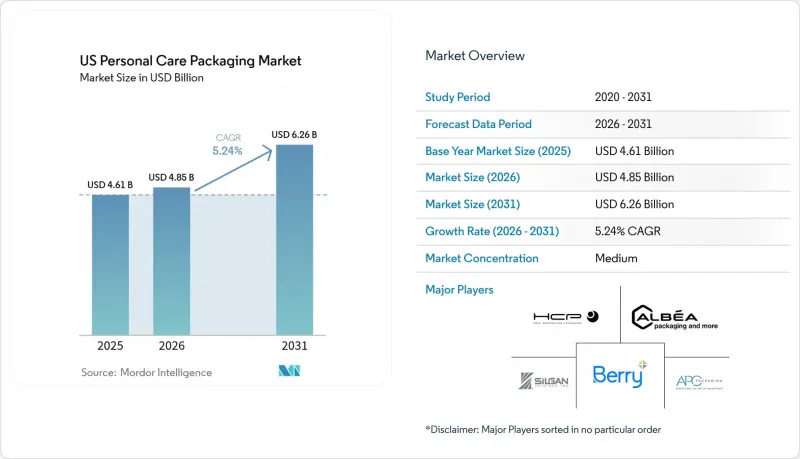
Mordor Intelligence에 따르면 미국의 퍼스널케어 포장 시장 규모는 2025년에 46억 1,000만 달러로 평가되며, 2026년 48억 5,000만 달러에서 2031년까지 62억 6,000만 달러에 달할 것으로 예측되며, 예측 기간(2026-2031년) 동안 CAGR은 5.24%가 될 전망입니다.
본 보고서는 소재 유형(플라스틱, 유리, 금속, 종이 및 판지), 제품 유형(병, 튜브 및 스틱, 펌프 및 디스펜서, 파우치 등), 용도(스킨케어, 헤어케어,구강 관리 등), 지속가능성 속성(재활용 가능, 사용 후 재활용 소재 함유, 리필 가능/재사용 가능, 퇴비화 가능/바이오 기반)별로 분류되어 있습니다. 시장 예측은 금액(달러) 기준으로 제시되어 있습니다.
미국 퍼스널케어 포장 시장의 동향 및 인사이트
가처분 소득 증가가 포장 수요를 견인
2024년 퍼스널케어 지출은 가구당 908달러에 달했으며, 연간 평균 지출이 1,038달러에 이른 서유럽 국가들에서는 더 높은 수준을 기록했습니다. 꾸준한 임금 상승은 SKU의 다양화, 고급스러운 포장 마감, 틈새 시장용 제품의 확대로 이어지며, 결과적으로 전미 퍼스널케어 포장 시장의 판매량 수요를 끌어올리고 있습니다. 소비자들이 품질과 지속가능성을 연상하기 때문에 유리 및 금속 용기가 가장 큰 혜택을 보고 있습니다.
인스타그램에 잘 어울리는 미학이 프리미엄화를 가속화
디자인은 이제 마케팅 채널로서의 역할도 수행하고 있으며, 각 브랜드는 사진에 잘 나오는 인상적인 형태, 엠보싱 가공, 맞춤형 색상 변형에 대한 투자를 적극적으로 추진하고 있습니다. 유리병이나 브러시드 알루미늄 에어로졸 용기는 소셜 플랫폼상의 친환경 메시지와 시각적 스토리텔링과 조화를 이루기 때문에 기존의 HDPE 병보다 더 높은 평가를 받고 있습니다. 로레알이 IBM과 제휴하여 지속가능한 처방을 AI에 학습시키고 있다는 사실은 기술의 융합이 외관과 기능을 모두 어떻게 뒷받침하고 있는지를 여실히 보여줍니다.
높은 연구개발비와 금형 비용이 혁신을 제한
새로운 블로우 성형 금형이나 정밀 펌프 개발에는 라인당 100만 달러 이상의 비용이 소요될 수 있습니다. 소규모 컨버터 기업들은, 특히 바이오 기반 수지가 특수한 기계나 장기간의 인증을 필요로 하는 경우, 여러 번의 시제품 제작에 자금을 조달하는 데 어려움을 겪고 있습니다. 접이식 어플리케이터에 대한 특허 출원은 차별화된 디스펜싱 기술 뒤에 숨겨진 복잡성과 자본 집약성을 여실히 보여줍니다.
부문 분석
플라스틱은 저렴한 비용, 디자인의 유연성, 그리고 확립된 공급망 덕분에 2025년 미국 퍼스널케어 포장 시장에서 50.12%의 점유율을 유지했습니다. 그러나 종이 및 판지 부문은 PFAS 규제 강화와 재생 가능한 기판에 대한 소비자의 지지에 힘입어 2031년까지 연평균 성장률(CAGR) 9.12%를 기록할 것으로 예측됩니다. 각 브랜드는 진열 시의 매력을 해치지 않으면서도 수분 테스트를 통과하는, 배리어 코팅이 적용된 판지 상자나 성형 섬유 재질의 용기를 시험적으로 도입하고 있습니다. 재생 PET의 채택과 화학 재활용 시범 공장의 가동은 순환형 사회에 대한 우려를 완화함으로써 플라스틱이 주도권을 유지하는 데 기여하고 있습니다.
순환 경제 정책에 따라 각 컨버터 기업들은 사용 후 플라스틱(PCR)의 함유율을 높이고 회수 체계를 구축하도록 압박받고 있습니다. 동시에, 유리와 금속은 고급 제품으로서의 포지셔닝 덕분에 혜택을 보고 있습니다. 고급 스킨케어 브랜드들은 두꺼운 벽 두께의 병이나 무광 알루미늄 스틱을 채택하여 무한한 재활용 가능성을 어필하면서 가격 프리미엄을 정당화하고 있습니다. 소재 혁신은 수직 통합을 통해서도 촉진되고 있으며, 그 대표적인 예로 미국 퍼스널케어 포장 시장의 확대에 대비해 PCR 공급을 확보하기 위한 암콜(Amcor)의 수지 조달 투자가 있습니다.
병은 친숙함, 진열 효과, 그리고 로션, 샴푸, 바디워시 등 폭넓은 제품에 대한 범용성 덕분에 2025년 미국 퍼스널케어 포장 시장 규모의 37.65%를 차지했습니다. 그러나 유연한 파우치는 E-Commerce에서 부피 효율성 향상과 재료 사용량 감축에 힘입어 연평균 성장률(CAGR) 10.78%를 기록할 것으로 예측됩니다. 재밀봉 가능한 주입구와 스탠드업 형태는 소비자의 편의성을 높이고, 초박형 필름은 운송 중량 감축에 기여하고 있습니다.
튜브, 스틱, 정밀 펌프는 단위 비용보다 투여 정밀도가 중시되는 용도, 예를 들어 자외선 차단제용 SPF 스틱이나 레티놀 세럼용 에어리스 펌프 등에 적합합니다. 브랜드들이 가정 내 재활용을 간소화하는 단일 소재의 종이 솔루션으로 전환함에 따라 접이식 카톤의 점유율이 확대되고 있습니다. 모든 형태에서 NFC 칩과 QR코드는 포장을 고객 참여의 거점으로 승화시켜, 경쟁이 치열한 미국 퍼스널케어 포장 시장에서 중요한 차별화 요소가 되고 있습니다.
기타 혜택:
- 엑셀 형식의 시장 예측(ME) 시트
- 3개월간의 애널리스트 지원
자주 묻는 질문
목차
제1장 소개
제2장 조사 방법
제3장 주요 요약
제4장 시장 구도
제5장 시장 규모와 성장 예측
제6장 경쟁 구도
제7장 시장 기회와 향후 전망
KSM 26.09.07According to Mordor Intelligence, the US personal care packaging market size was valued at USD 4.61 billion in 2025 and estimated to grow from USD 4.85 billion in 2026 to reach USD 6.26 billion by 2031, at a CAGR of 5.24% during the forecast period (2026-2031).
This report is Segmented by Material Type (Plastic, Glass, Metal, Paper and Paperboard), Product Type (Bottles, Tubes and Sticks, Pumps and Dispensers, Pouches and More), Application (Skin Care, Hair Care, Oral Care, and More), Sustainability Attribute (Recyclable, Post-Consumer-Recycled Content, Refillable/Reusable, Compostable/Bio-based). The Market Forecasts are Provided in Terms of Value (USD).
US Personal Care Packaging Market Trends and Insights
Rising Disposable Income Fuels Pack Demand
Personal-care outlays reached USD 908 per household in 2024 and climb even higher in the West, where annual spending averaged USD 1,038. Steady wage gains translate into greater SKU variety, premium pack finishes and niche formulations, which in turn boost unit-volume requirements across the US personal care packaging market. Glass and metal formats benefit the most because consumers associate them with quality and sustainability.
Instagram-Ready Aesthetics Accelerate Premiumization
Design now doubles as a marketing channel, prompting brands to invest in striking shapes, embossing and custom colorways that photograph well. Glass jars and brushed-aluminum aerosols outperform conventional HDPE bottles because they align with eco-messaging and visual storytelling on social platforms. L'Oreal's partnership with IBM to train AI on sustainable formulations underscores how tech convergence supports both look and function.
High R&D and Tooling Costs Limit Innovation
Developing a new blow-mold or precision pump can exceed USD 1 million per line. Small converters struggle to fund multiple trials, particularly when bio-based resins demand specialized machinery and extended qualification. Patent filings for collapsible applicators illustrate the complexity as well as the capital intensity behind differentiated dispensing technology.
Other drivers and restraints analyzed in the detailed report include:
- E-commerce Drives Ship-Ready Protective Formats
- Subscription and Refill Models Favor Durable Solutions
- State-Level PFAS Rules Add Compliance Burden
For complete list of drivers and restraints, kindly check the Table Of Contents.
Segment Analysis
Plastic retained 50.12% US personal care packaging market share in 2025 thanks to low cost, design flexibility and well-established supply chains. Yet the paper and paperboard segment is projected to log a 9.12% CAGR through 2031, buoyed by PFAS crackdowns and consumer favor for renewable substrates. Brands experiment with barrier-coated cartons and molded-fiber jars that pass moisture tests without compromising shelf appeal. Recycled PET integration and pilot chemical recycling plants help plastics defend their lead by easing circularity concerns.
Circular-economy policies push converters to raise post-consumer-resin (PCR) content and build take-back schemes. Simultaneously, glass and metal profit from luxury positioning: prestige skin-care labels deploy heavy-walled flacons and brushed-aluminum sticks to justify price premiums while touting infinite recyclability. Material innovation is also spurred by vertical integration, exemplified by Amcor's resin-sourcing investments that safeguard PCR supply for the expanding US personal care packaging market.
Bottles commanded 37.65% of the US personal care packaging market size in 2025 due to familiarity, shelf impact and versatility across lotions, shampoos and body washes. However, flexible pouches are projected to log an 10.78% CAGR, propelled by e-commerce cube-efficiency and lower material usage. Reclosable spouts and stand-up formats bolster consumer convenience, while ultra-thin films curb shipping weight.
Tubes, sticks and precision pumps cater to targeted applications think SPF sticks for sun-care or airless pumps for retinol serums where dosing accuracy matters more than unit cost. Folding cartons gain ground as brands migrate to mono-material paper solutions that simplify curbside recycling. Across all formats, NFC chips and QR codes elevate packs into engagement hubs, a key differentiator in the crowded US personal care packaging market.
Complete Report Scope:
- By Material Type
- Plastic
- Glass
- Metal
- Paper and Paperboard
- By Product Type
- Bottles
- Tubes and Sticks
- Pumps and Dispensers
- Pouches
- Folding Cartons
- Others
- By Application
- Skin Care
- Hair Care
- Oral Care
- Makeup and Color Cosmetics
- Deodorants and Fragrances
- Depilatories
- Others
- By Sustainability Attribute
- Recyclable (mono-material)
- Post-consumer-recycled (PCR) Content
- Refillable / Reusable
- Compostable / Bio-based
List of Companies Covered in this Report:
- Albea Services SA
- HCP Packaging Co. Ltd
- Berry Global Group Inc.
- Silgan Holdings Inc.
- DS Smith PLC
- Graham Packaging Company
- Kaufman Container
- AptarGroup Inc.
- Amcor PLC
- Cosmopak USA LLC
- APC Packaging
- Rieke Corp (Trimas)
- Berlin Packaging LLC
- Glenroy Inc.
- TricorBraun
- Quadpack
- ProAmpac
- WestRock Company
- Gerresheimer AG
- Sonoco Products Co.
- International Paper Co.
Additional Benefits:
- The market estimate (ME) sheet in Excel format
- 3 months of analyst support
TABLE OF CONTENTS
1 INTRODUCTION
- 1.1 Study Assumptions and Market Definition
- 1.2 Scope of the Study
2 RESEARCH METHODOLOGY
3 EXECUTIVE SUMMARY
4 MARKET LANDSCAPE
- 4.1 Market Overview
- 4.2 Market Drivers
- 4.2.1 Rising consumption of personal-care SKUs on higher disposable income
- 4.2.2 Demand for premium, "Instagram-ready" pack aesthetics
- 4.2.3 E-commerce boom needing ship-ready protective formats
- 4.2.4 Subscription and refill models driving durable / reusable packs
- 4.2.5 TSA-size travel packs for on-the-go consumers
- 4.2.6 Smart / IoT-enabled packs for engagement and traceability
- 4.3 Market Restraints
- 4.3.1 High RandD and tooling costs for novel formats and materials
- 4.3.2 Tightening U.S. plastics and PFAS regulations
- 4.3.3 Volatile recycled-resin price and supply quality
- 4.3.4 Reverse-logistics friction for refill / return programs
- 4.4 Regulatory Landscape
- 4.5 Technological Outlook
- 4.6 Porter's Five Forces Analysis
- 4.6.1 Bargaining Power of Buyers
- 4.6.2 Bargaining Power of Suppliers
- 4.6.3 Threat of New Entrants
- 4.6.4 Threat of Substitutes
- 4.6.5 Intensity of Rivalry
5 MARKET SIZE AND GROWTH FORECASTS (VALUE)
- 5.1 By Material Type
- 5.1.1 Plastic
- 5.1.2 Glass
- 5.1.3 Metal
- 5.1.4 Paper and Paperboard
- 5.2 By Product Type
- 5.2.1 Bottles
- 5.2.2 Tubes and Sticks
- 5.2.3 Pumps and Dispensers
- 5.2.4 Pouches
- 5.2.5 Folding Cartons
- 5.2.6 Others
- 5.3 By Application
- 5.3.1 Skin Care
- 5.3.2 Hair Care
- 5.3.3 Oral Care
- 5.3.4 Makeup and Color Cosmetics
- 5.3.5 Deodorants and Fragrances
- 5.3.6 Depilatories
- 5.3.7 Others
- 5.4 By Sustainability Attribute
- 5.4.1 Recyclable (mono-material)
- 5.4.2 Post-consumer-recycled (PCR) Content
- 5.4.3 Refillable / Reusable
- 5.4.4 Compostable / Bio-based
6 COMPETITIVE LANDSCAPE
- 6.1 Market Concentration
- 6.2 Strategic Moves and Developments
- 6.3 Market Share Analysis
- 6.4 Company Profiles (includes Global-level Overview, Market-level Overview, Core Segments, Financials as available, Strategic Information, Market Rank/Share, Products and Services, Recent Developments)
- 6.4.1 Albea Services SA
- 6.4.2 HCP Packaging Co. Ltd
- 6.4.3 Berry Global Group Inc.
- 6.4.4 Silgan Holdings Inc.
- 6.4.5 DS Smith PLC
- 6.4.6 Graham Packaging Company
- 6.4.7 Kaufman Container
- 6.4.8 AptarGroup Inc.
- 6.4.9 Amcor PLC
- 6.4.10 Cosmopak USA LLC
- 6.4.11 APC Packaging
- 6.4.12 Rieke Corp (Trimas)
- 6.4.13 Berlin Packaging LLC
- 6.4.14 Glenroy Inc.
- 6.4.15 TricorBraun
- 6.4.16 Quadpack
- 6.4.17 ProAmpac
- 6.4.18 WestRock Company
- 6.4.19 Gerresheimer AG
- 6.4.20 Sonoco Products Co.
- 6.4.21 International Paper Co.
7 MARKET OPPORTUNITIES AND FUTURE OUTLOOK
- 7.1 White-space and Unmet-Need Assessment