

|
시장보고서
상품코드
2121352
남미의 폴리염화비닐(PVC) : 시장 점유율 분석, 업계 동향과 통계, 성장 예측(2026-2031년)South America Polyvinyl Chloride (PVC) - Market Share Analysis, Industry Trends & Statistics, Growth Forecasts (2026 - 2031) |
||||||
 Mordor Intelligence
Mordor Intelligence에 의하면, 2026년 남미의 폴리염화비닐(PVC) 시장 규모는 1.93킬로톤으로 추정되고 있으며, 2025년 1.87킬로톤에서 2031년에는 2.26킬로톤에 이를 것으로 예측됩니다.
또한 2026-2031년 연평균 성장률(CAGR) 3.19%를 기록할 전망입니다.
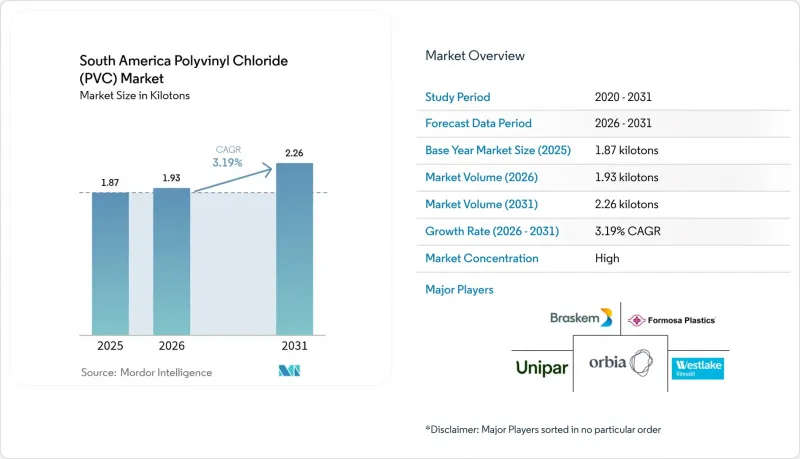
본 보고서는 제품 유형(경질 PVC, 연질 PVC, 저발연성 PVC, 염소화 PVC), 안정제 유형(칼슘계, 납계 등),용도(파이프·피팅, 필름 및 시트, 전선 및 케이블 등), 최종 사용자 산업(건축 및 건설, 자동차, 전기 및 전자 등), 지역(브라질, 아르헨티나, 칠레, 콜롬비아 등)별로 분류되어 있습니다.
남미의 폴리염화비닐(PVC) 시장 동향 및 인사이트
건설 수요에 힘입은 배관·이음쇠 수요 급증
하수 수집 시설이 없는 1억 명의 브라질 국민과 처리수를 이용할 수 없는 3,500만 명의 물 서비스 격차를 해소하기 위해서는 2035년까지 연간 276억 레알의 지출이 필요할 것으로 예측됩니다. 2020년 ‘위생법 체계’에서는 2033년까지 도시 지역의 하수 처리 커버리지를 90%로 끌어올릴 것을 의무화하고 있으며, 이에 따라 유틸리티자는 부식된 금속 배관을 단계적으로 폐지하고, 수명 50년,투자한 레알 1레알당 4배의 질병 예방 효과를 가져오는 PVC 시스템으로의 전환을 요구받고 있습니다. 콜롬비아의 식수 운영권 사업, 페루의 광산 배수 프로그램, 그리고 IDB Invest가 지원하는 1억 3,500만 달러 규모의 마라냥 주 프로젝트는 표준화된 PVC 인프라에 대한 지역 전체의 추진력을 여실히 보여주고 있습니다. 설치 속도 향상, 유지보수 비용 절감, 내식성 덕분에 급수, 하수 수집, 처리 네트워크 전반에 걸쳐 PVC의 가치 제안이 확고해지고 있습니다.
남미 자동차 생산 분야의 경량화 진전
브라질과 아르헨티나에서 조립되는 차량에서는 중량 감축, 난연성 향상, 실내 정숙성 향상을 위해 대시보드, 와이어 하네스, 엔진룸 내 밀봉재에 특수 PVC 컴파운드가 점점 더 많이 채택되고 있습니다. 산업 GDP의 25%를 차지하는 브라질의 자동차 업계는 효율성을 중시한 소재 도입을 장려하는 프로그램 하에 현지 조달률 향상을 추구하고 있습니다. 국내 컴파운더 각사는 전기차의 열 관리 기준을 충족하면서도 지역 특유의 비용 및 물류 현실에 부합하는 고유동성·저포깅성 PVC 등급을 시장에 출시하고 있습니다. 메르코수르(MERCOSUR)의 특혜 무역 규정은 국경을 넘는 부품 유통을 원활하게 하고 사양 통일을 촉진함으로써, 배선 및 내장재 분야의 PVC 수요를 끌어올리고 있습니다.
독성에 대한 인식과 EHS 규제 강화
생명주기 평가(LCA) 및 공개 의무 체계가 널리 채택됨에 따라 중소규모 PVC 가공업체의 규정 준수 비용이 증가하고 있습니다. 메르코수르(MERCOSUR)의 식품 접촉 규정과 ANVISA의 의료기기 신청 서류에서는 현재 첨가물에 대한 세밀한 추적 가능성이 요구되고 있어, 생산자들은 디지털 소재 여권 시스템에 대한 투자를 강요받고 있습니다. 시민 단체들은 염소계 제조 공정과 첨가물 잔류물에 주목하고 있으며, 기관 투자자들이 친환경 라벨을 채택하도록 유도하고 있습니다. 대책으로는 제품의 CO2 실적를 80% 감축하고 순환형 경제를 위한 노력을 강화하는 ‘Pevalen Pro 100’과 같은 재생 가능 가소제를 들 수 있습니다.
부문 분석
2025년에는 식수 프로젝트 및 건축물 설계에서 내구성과 내압성이 중시됨에 따라 경질 PVC가 지역 총생산량의 56.75%를 차지했습니다. 남미의 경질 PVC 시장 규모는 브라질이 연간 276억 레알을 투자하는 물 안보 관련 지출과 연동하여 확대될 것으로 예측되며, 이는 수지 수요의 안정적인 베이스 로드를 확보하게 될 것입니다. 저발연성 PVC는 취급 톤수는 적지만, 고층 상업 건축물의 방화 규제 강화를 배경으로 연평균 성장률(CAGR) 3.8%를 기록할 전망입니다.
연질 PVC의 용도는 자동차용 피복재 및 의료용 튜브에 이르기까지 다양하며, 저온 환경에서의 유연성과 투명성이라는 특징을 활용하고 있습니다. 염소화 PVC는 산업용 이송 설비 및 온수 배관 분야에서 수요가 있어, 높은 이익률을 자랑하는 수익원이 되고 있습니다. 의약품 검사용 창이나 식품 가공용 사이트글라스에 필수적인 투명 경질 등급은 GMP(우수 제조 관리 기준)에 대한 투자가 진행됨에 따라 꾸준히 성장하고 있습니다. 전반적으로, 제품 구성의 진화에 따라 남미의 폴리염화비닐 시장은 핵심 인프라 분야를 기반으로 하면서도 다양성을 지속적으로 유지하고 있습니다.
칼슘·아연계 안정제는 기존 납 화합물과의 비용 동등성(parity)과 간편한 드롭인 가공이 가능하다는 점으로 인해, 2025년에는 안정제 총 출하량의 40.78%를 차지했습니다. 주석/유기주석계 대체품은 가격이 비싸지만, 전선 피복 및 의료기기에 요구되는 뛰어난 내열·내노화성 덕분에 연평균 성장률(CAGR) 3.55%를 기록하며 남미 PVC 시장 전체를 상회하는 성장을 이룰 전망입니다. 납계 안정제는 단계적인 금지 조치로 인해 축소 추세를 보이고 있는 반면, 바륨·아연계 액체 안정제는 높은 광택이 요구되는 틈새 압출 성형 용도로 이용되고 있습니다.
이러한 시장 변화는 성능 주장과 규제 당국이 인정하는 수명 주기 데이터 세트를 결합할 수 있는 첨가제 공급업체에 유리하게 작용하고 있습니다. 안정제, 윤활제, 컬러 농축액을 단일 청구서로 통합하여 제공하는 통합 수지 제조업체는 조달 프로세스의 간소화와 확실한 기술적 문제 해결을 원하는 변환업체 수요에 부응하고 있습니다.
기타 혜택:
- 엑셀 형식 시장 예측(ME) 시트
- 3개월간의 애널리스트 지원
자주 묻는 질문
목차
제1장 서론
제2장 조사 방법
제3장 주요 요약
제4장 시장 구도
제5장 시장 규모와 성장 예측
제6장 경쟁 구도
제7장 시장 기회와 향후 전망
LSH 26.09.08According to Mordor Intelligence, the South America polyvinyl chloride market size in 2026 is estimated at 1.93 kilotons, growing from 2025 value of 1.87 kilotons with 2031 projections showing 2.26 kilotons, growing at 3.19% CAGR over 2026-2031.
This report is Segmented by Product Type (Rigid PVC, Flexible PVC, Low-Smoke PVC, and Chlorinated PVC), Stabilizer Type (Calcium-Based, Lead-Based, and More), Application (Pipes and Fittings, Films and Sheets, Wires and Cables, and More), End-User Industry (Building and Construction, Automotive, Electrical and Electronics, and More), and Geography (Brazil, Argentina, Chile, Colombia, and More).
South America Polyvinyl Chloride (PVC) Market Trends and Insights
Construction-led Surge in Pipe and Fittings Demand
Annual spending of BRL 27.6 billion is required through 2035 to bridge water-service gaps affecting 100 million Brazilians without sewage collection and 35 million lacking treated water. The 2020 Sanitation Legal Framework obliges 90% urban sewage coverage by 2033, prompting utilities to phase out corroded metal lines in favor of PVC systems that deliver 50-year lifespans and four-to-one disease-prevention paybacks for every real invested. Colombia's potable-water concessions, Peru's mine-water programs, and an IDB Invest-backed USD 135 million Maranhao project underscore region-wide momentum for standardized PVC infrastructure. Faster installation, lower maintenance, and corrosion resistance consolidate PVC's value proposition across distribution, collection, and treatment networks.
Rising Lightweighting in South American Automotive Production
Vehicles assembled in Brazil and Argentina increasingly embed specialty PVC compounds in dashboards, wire harnesses, and under-hood seals to cut mass, improve flame resistance, and enhance cabin acoustics. Brazil's automotive sector, equal to 25% of industrial GDP, is pursuing higher local content under programs that reward efficiency-driven materials adoption. Domestic compounders have introduced high-flow, low-fogging PVC grades that satisfy electric-vehicle thermal-management standards while aligning with region-specific cost and logistics realities. Preferential trade rules in MERCOSUR ease cross-border component circulation, encouraging harmonized specifications that elevate PVC demand in wiring and interiors.
Toxicity Perception and Tightening EHS Regulations
Broader adoption of lifecycle assessments and mandatory disclosure frameworks elevates compliance costs for small-to-mid-size PVC converters. MERCOSUR food-contact rules and ANVISA medical-device dossiers now demand granular additive traceability, pushing producers to invest in digital material-passport systems. Advocacy groups spotlight chlorine processes and additive residues, steering institutional buyers toward eco-labels. Counter-measures include renewable plasticizers such as Pevalen Pro 100 that slash product CO2 footprints by 80% and bolster circular-economy credentials.
Other drivers and restraints analyzed in the detailed report include:
- Expansion of PVC-based Medical Disposables
- Domestic Chlorine-vinyl Integration Lowering Feedstock Costs
- Volatile Electricity Tariffs Inflating Electrolysis OPEX
For complete list of drivers and restraints, kindly check the Table Of Contents.
Segment Analysis
Rigid PVC accounted for 56.75% of regional volume in 2025 as potable-water projects and building profiles prioritized its durability and pressure rating. The South America polyvinyl chloride market size tied to rigid formulations is forecast to progress in tandem with Brazil's annual BRL 27.6 billion water-security outlays, securing a dependable base load for resin demand. Low-smoke PVC, though representing a smaller tonnage, will clock a 3.8% CAGR on the back of tighter fire-safety rules in high-rise commercial construction.
Flexible PVC applications span automotive sheathing and healthcare tubing, benefitting from cold-temperature flexibility and clarity. Chlorinated PVC appeals to industrial conveying and hot-water piping segments, adding premium margin streams. Clear rigid grades, essential for pharmaceutical inspection windows and food-processing sight-glasses, grow steadily as GMP investments materialize. Collectively, the product mix evolution ensures the South America polyvinyl chloride market remains diversified while anchored in core infrastructure.
Calcium-zinc packages secured 40.78% of stabilizer tonnage in 2025, aided by cost parity with legacy lead compounds and straightforward drop-in processing. Tin/Organotin alternatives, although higher priced, will outpace the broader South America polyvinyl chloride market at 3.55% CAGR because of superior heat-ageing resistance demanded in wire jacketing and medical devices. Lead stabilizers are retreating under phased bans, whereas barium-zinc liquids serve niche extrusions needing elevated gloss.
Market shifts favor additive suppliers that can pair performance claims with life-cycle data sets recognized by regulators. Integrated resin makers bundling stabilizers, lubricants, and color concentrates into single invoices are meeting converter demand for simplified procurement and robust technical troubleshooting.
Complete Report Scope:
- By Product Type
- Rigid PVC
- Clear Rigid PVC
- Non-Clear Rigid PVC
- Flexible PVC
- Clear Flexible PVC
- Non-Clear Flexible PVC
- Low-smoke PVC
- Chlorinated PVC
- Rigid PVC
- By Stabilizer Type
- Calcium-based (Ca-Zn)
- Lead-based (Pb)
- Tin / Organotin (Sn)
- Barium-based and Liquid Mixed Metals
- By Application
- Pipes and Fittings
- Films and Sheets
- Wires and Cables
- Bottles
- Profiles, Hoses and Tubing
- Other Applications
- By End-User Industry
- Building and Construction
- Automotive
- Electrical and Electronics
- Packaging
- Footwear
- Healthcare
- Other End-User Industry
- By Geography
- Brazil
- Argentina
- Chile
- Colombia
- Peru
- Rest of South America
List of Companies Covered in this Report:
- Amanco Wavin
- Braskem
- Formosa Plastics Corporation
- Hanwha Solutions
- INEOS
- LG Chem
- Occidental Petroleum Corporation
- Orbia
- Pipelife Brasil
- Shin-Etsu Chemical Co., Ltd.
- Simona AG
- Unipar Carbocloro
- Westlake Vinnolit GmbH& Co.KG
- Xinjiang Zhongtai Chemical Co., Ltd
Additional Benefits:
- The market estimate (ME) sheet in Excel format
- 3 months of analyst support
TABLE OF CONTENTS
1 Introduction
- 1.1 Study Assumptions and Market Definition
- 1.2 Scope of the Study
2 Research Methodology
3 Executive Summary
4 Market Landscape
- 4.1 Market Overview
- 4.2 Market Drivers
- 4.2.1 Construction-led surge in pipe and fittings demand
- 4.2.2 Rising lightweighting in South-American automotive production
- 4.2.3 Expansion of PVC-based medical disposables
- 4.2.4 Lead-pipe replacement schemes in Brazil and Peru
- 4.2.5 Domestic chlorine-vinyl integration lowering feedstock costs
- 4.3 Market Restraints
- 4.3.1 Toxicity perception and tightening EHS regulations
- 4.3.2 Phthalate-free mandates in toys and childcare products
- 4.3.3 Volatile electricity tariffs inflating electrolysis OPEX
- 4.4 Value Chain Analysis
- 4.5 Porter's Five Forces
- 4.5.1 Bargaining Power of Suppliers
- 4.5.2 Bargaining Power of Buyers
- 4.5.3 Threat of New Entrants
- 4.5.4 Threat of Substitutes
- 4.5.5 Competitive Rivalry
5 Market Size and Growth Forecasts (Volume)
- 5.1 By Product Type
- 5.1.1 Rigid PVC
- 5.1.1.1 Clear Rigid PVC
- 5.1.1.2 Non-Clear Rigid PVC
- 5.1.2 Flexible PVC
- 5.1.2.1 Clear Flexible PVC
- 5.1.2.2 Non-Clear Flexible PVC
- 5.1.3 Low-smoke PVC
- 5.1.4 Chlorinated PVC
- 5.1.1 Rigid PVC
- 5.2 By Stabilizer Type
- 5.2.1 Calcium-based (Ca-Zn)
- 5.2.2 Lead-based (Pb)
- 5.2.3 Tin / Organotin (Sn)
- 5.2.4 Barium-based and Liquid Mixed Metals
- 5.3 By Application
- 5.3.1 Pipes and Fittings
- 5.3.2 Films and Sheets
- 5.3.3 Wires and Cables
- 5.3.4 Bottles
- 5.3.5 Profiles, Hoses and Tubing
- 5.3.6 Other Applications
- 5.4 By End-User Industry
- 5.4.1 Building and Construction
- 5.4.2 Automotive
- 5.4.3 Electrical and Electronics
- 5.4.4 Packaging
- 5.4.5 Footwear
- 5.4.6 Healthcare
- 5.4.7 Other End-User Industry
- 5.5 By Geography
- 5.5.1 Brazil
- 5.5.2 Argentina
- 5.5.3 Chile
- 5.5.4 Colombia
- 5.5.5 Peru
- 5.5.6 Rest of South America
6 Competitive Landscape
- 6.1 Market Concentration
- 6.2 Strategic Moves
- 6.3 Market Share/Ranking Analysis
- 6.4 Company Profiles (includes Global level Overview, Market level overview, Core Segments, Financials as available, Strategic Information, Market Rank/Share for key companies, Products and Services, and Recent Developments)
- 6.4.1 Amanco Wavin
- 6.4.2 Braskem
- 6.4.3 Formosa Plastics Corporation
- 6.4.4 Hanwha Solutions
- 6.4.5 INEOS
- 6.4.6 LG Chem
- 6.4.7 Occidental Petroleum Corporation
- 6.4.8 Orbia
- 6.4.9 Pipelife Brasil
- 6.4.10 Shin-Etsu Chemical Co., Ltd.
- 6.4.11 Simona AG
- 6.4.12 Unipar Carbocloro
- 6.4.13 Westlake Vinnolit GmbH& Co.KG
- 6.4.14 Xinjiang Zhongtai Chemical Co., Ltd
7 Market Opportunities and Future Outlook
- 7.1 White-Space and Unmet-Need Assessment


