|
시장보고서
상품코드
2121399
아시아태평양의 열화상 시스템 : 시장 점유율 분석, 업계 동향·통계, 성장 예측(2026-2031년)Asia-Pacific Thermal Imaging Systems - Market Share Analysis, Industry Trends & Statistics, Growth Forecasts (2026 - 2031) |
||||||
 Mordor Intelligence
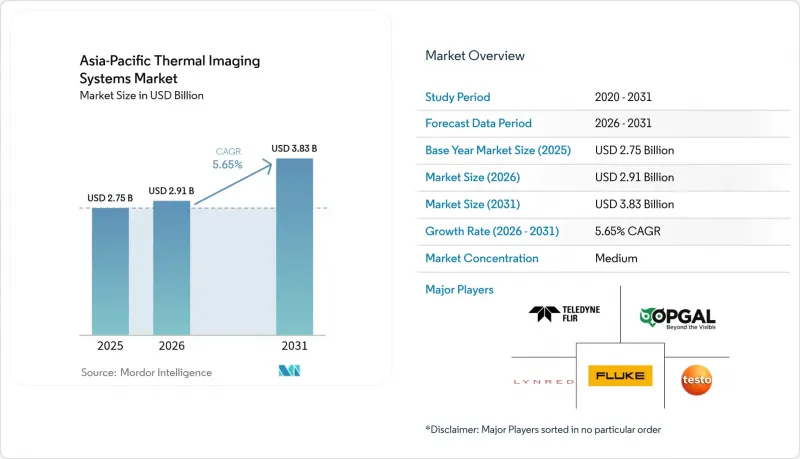
Mordor Intelligence에 따르면 아시아태평양의 열화상 시스템 시장 규모는 2025년에 27억 5,000만 달러로 평가되며, 2026년에는 29억 1,000만 달러로 증가하며, 2031년까지 38억 3,000만 달러에 달할 것으로 예측되고 있으며, 2026-2031년에 CAGR 5.65%를 기록할 전망입니다.
이 보고서는 용도별(열화상, 해상·연안 감시, 국경 감시, 대 UAS/드론, 중요 인프라 보안 등), 제품별(열화상 카메라 등), 기술별(비냉각식 LWIR 등), 최종사용자 업종별(항공우주·방위 등), 지역별로 분류되어 있습니다. 시장 전망은 금액(달러) 기준으로 제시되어 있습니다.
아시아태평양 열화상 시스템 시장의 동향 및 인사이트
비냉각 마이크로볼로미터 센서의 비용 감소
12인치 웨이퍼 가공 및 초점면 어셈블리의 자동화로 인해 2020년 이후 바나듐 산화물 검출기 가격은 약 30% 하락했습니다. 현재, 민용 모듈의 소매 가격은 200달러 미만으로, 스마트폰용 부착물이나 취미용 드론에 활용될 가능성이 넓어지고 있습니다. 중국 팹에서는 연간 50만 코어 이상을 출하하며 생산 규모를 확대하고 있습니다. 또한 12µm의 픽셀 피치를 통해 비용 증가를 최소화하면서 어레이 밀도를 2배로 높였습니다. 프리미엄 공급업체들은 여전히 낮은 노이즈 등가 온도차를 실현하고 있지만, 상업용 사용자들에게는 새로운 중급 센서라도 열화상 및 보안 용도로는 충분하다고 평가받고 있습니다.
아시아태평양의 국방 및 국경 경비 지출 증가
각국이 해양 영역의 감시 능력과 육상 국경 감시 체제를 강화한 결과, 2024-2025년에 이 지역의 전기광학 및 적외선 시스템에 대한 지출은 18% 증가했습니다. 인도는 80억 달러 규모의 현대화 패키지의 일환으로 보병용 차량용 열화상 드라이버 방식 야시장비를 승인한 반면, 일본은 2026년도 예산에서 드론 대응용 어레이에 5,200만 달러를 편성했습니다. 한국은 2024년에 국경 센서 업그레이드를 완료했고, 호주는 2025년에 ITAR 규제 대상에서 제외되는 열화상 드론을 배치하는 등 체계적인 수요가 지속되고 있음을 보여주고 있습니다.
냉각식 카메라의 높은 초기 비용과 수출 허가 제약
냉각식 안티몬화 인듐(InSb) 또는 수은 카드뮴 텔루르(HgCdTe) 시스템은 대당 5만 달러를 초과하는 경우가 많으며, 프레임 속도가 60Hz를 초과하거나 화소 수가 11만 1,000픽셀을 초과하는 어레이의 경우 미국의 수출 허가가 필요합니다. 승인 절차에는 6-12개월이 소요되므로 동남아시아 군 당국은 탐지 범위가 좁아진다는 점을 감수하고도 ITAR 규제의 대상이 아닌 중간 수준의 성능을 가진 대체품을 우선적으로 선택할 수밖에 없습니다. 일부 공급업체는 라이선스 취득을 피하기 위해 프레임 속도를 9Hz로 제한하기도 하지만, 이로 인해 동적 추적 능력이 제한될 수밖에 없습니다.
부문 분석
2025년에는 국경 감시 및 중요 인프라 보호에 대한 수요에 힘입어 보안 및 감시 부문이 아시아태평양 열화상 시스템 시장 매출의 38.19%를 차지했습니다. 무인 항공기(UAS) 대응 프로젝트는 분쟁 중인 육상 및 해상 국경에 대한 새로운 우선 순위를 반영하여 연평균 성장률(CAGR) 5.91%를 기록할 것으로 예측됩니다. 군에서 다층 방어를 위해 열 센서를 음향 및 RF 재머와 통합함에 따라 UAS 대응과 관련된 아시아태평양의 열화상 시스템 시장 규모는 확대될 전망입니다. 이와 더불어, 해상 기관들이 불법 어업 단속에 열화상 센서가 탑재된 무인수상정을 활용하는 추세도 나타나고 있으며, 이를 통해 기존 유인 선박 비용의 불과 몇 분의 일로 24시간 운영이 가능해집니다.
각 제조사가 비냉각식 카메라를 디지털 트윈 소프트웨어와 연동하여 장비 고장을 몇 주 전에 진단할 수 있게 됨에 따라 열화상 카메라의 응용 분야는 계속해서 확대되고 있습니다. 소방대는 핸즈프리 열화상 오버레이 기능을 갖춘 헬멧으로의 교체를 추진하고 있으며, 스마트폰 및 의료 분야에서의 활용을 통해 기존의 안전 시장을 넘어선 수입원의 다각화가 진행되고 있습니다. 도시의 공공사업자들은 변전소에 고정식 카메라를 도입하여 동작 감지 센서에 비해 오경보를 줄이고 있습니다. 이러한 변화들이 맞물려, 예측 기간이 끝날 무렵에는 민간 부문의 시장 점유율이 국방 부문을 앞지를 것으로 전망됩니다.
2025년에는 열화상 카메라가 매출의 46.78%를 차지하며, 실시간 시야 확보가 필수적인 휴대용 검사 및 고정 감시 분야에서 여전히 주요 툴로서의 지위를 유지할 전망입니다. 그러나 자동차 및 드론 제조업체들이 케이스나 디스플레이가 필요 없는 기판 수준의 부품을 요구함에 따라 현재 연평균 성장률(CAGR) 5.88%로 성장하고 있는 모듈 및 코어의 점유율은 상승하고 있습니다. 이러한 임베디드화 추세에 따라 부품 원가(BOM)가 약 40% 절감되고, 수출 허가와 관련된 지연도 피할 수 있게 됩니다. 아시아태평양의 열화상 시스템 시장에서 스마트홈 기기를 위한 초저전력 50×50 픽셀 센서가 소비자용 전자 기기에 채택됨에 따라 모듈의 점유율은 더욱 확대될 전망입니다.
스코프와 조준기는 기존 무기와 호환되는 견고한 광학 기기를 필요로 하는 군대 및 법 집행 기관 사이에서 여전히 특수한 수요를 유지하고 있습니다. 광학 기기 제조업체들은 픽셀 피치의 미세화와 AI를 활용한 이미지 보정을 중시하고 있지만, 로봇 공학에서 농업 기술에 이르기까지 업종을 불문하고 머더보드에 납땜이 가능한 모듈식 코어야말로 더 광범위한 양산 성장을 가져올 것입니다.
기타 혜택:
- 엑셀 형식의 시장 예측(ME) 시트
- 3개월간의 애널리스트 지원
자주 묻는 질문
목차
제1장 서론
제2장 조사 방법
제3장 개요
제4장 시장 구도
제5장 시장 규모와 성장 예측
제6장 경쟁 구도
제7장 시장 기회와 향후 전망
KSA 26.09.04According to Mordor Intelligence, the Asia-Pacific thermal imaging systems market size was valued at USD 2.75 billion in 2025, rose to USD 2.91 billion in 2026, and is forecast to reach USD 3.83 billion by 2031, registering a 5.65% CAGR from 2026 to 2031.
This report is Segmented by Application (Thermography, Maritime and Coastal Surveillance, Border Surveillance, Counter-UAS/Drones, Critical Infrastructure Security, and More), Product (Thermal Cameras, and More), Technology (Uncooled LWIR, and More), End-User Vertical (Aerospace and Defence, and More), and Geography. The Market Forecasts are Provided in Terms of Value (USD).
Asia-Pacific Thermal Imaging Systems Market Trends and Insights
Declining Cost of Uncooled Micro-Bolometer Sensors
Twelve-inch wafer processing and automated focal-plane assembly have cut vanadium-oxide detector prices by about 30% since 2020. Consumer-grade modules now retail below USD 200, opening doors for smartphone attachments and hobby drones. Chinese fabs ship more than 500,000 cores yearly, raising scale while 12-µm pixel pitches double array density with minimal cost penalty. Premium suppliers still deliver lower noise-equivalent temperature difference, yet commercial buyers find the newer mid-tier sensors sufficient for thermography and security uses.
Rising Defense and Border-Security Spending in Asia-Pacific
Regional outlays on electro-optical and infrared systems rose 18% between 2024 and 2025 as nations strengthened maritime domain awareness and land-border surveillance. India approved thermal driver night sights for infantry vehicles under a USD 8 billion modernization package, while Japan budgeted USD 52 million for counter-drone arrays in fiscal 2026. South Korea finished a border-sensor upgrade in 2024, and Australia fielded ITAR-free thermal drones in 2025, signalling sustained institutional demand.
High Upfront Cost and Export-Licence Constraints for Cooled Cameras
Cooled indium-antimonide or mercury-cadmium-telluride systems often exceed USD 50,000 per unit and require U.S. export licences for frame rates above 60 Hz or arrays over 111,000 pixels. Approval cycles run six to twelve months, forcing Southeast Asian militaries to favour ITAR-free mid-performance alternatives despite reduced detection range. Vendors sometimes throttle frame rates to 9 Hz to avoid licensing, but that limits dynamic tracking capability.
Other drivers and restraints analyzed in the detailed report include:
- Industrial Predictive-Maintenance Adoption
- Smartphone, Drone and ADAS Integration of Thermal Cores
- Scarcity of Certified Thermography Service Providers
For complete list of drivers and restraints, kindly check the Table Of Contents.
Segment Analysis
In 2025, security and surveillance generated 38.19% of Asia-Pacific thermal imaging systems market revenue, buoyed by border monitoring and critical-infrastructure protection needs. Counter-unmanned-aerial-system projects are projected to log a 5.91% CAGR, reflecting new priorities along contested land and maritime boundaries. The Asia-Pacific thermal imaging systems market size tied to counter-UAS is set to climb as militaries integrate thermal sensors with acoustic and RF jammers for layered defense. A complementary trend is maritime agencies using unmanned surface vessels with thermal payloads for illegal-fishing patrols, allowing 24-hour operation at a fraction of conventional crewed vessel costs.
Thermography applications continue to expand as manufacturers link uncooled cameras to digital-twin software, diagnosing equipment faults weeks in advance. Fire-fighting brigades upgrade helmets with hands-free thermal overlays, while smartphone and medical uses diversify revenue beyond traditional safety markets. Urban utilities deploy fixed cameras at substations, reducing false alarms versus motion sensors. Collectively, these shifts position commercial verticals to overtake defense in market share before the forecast horizon ends.
Thermal cameras captured 46.78% revenue in 2025, remaining the tool of choice for handheld inspections and fixed surveillance where real-time viewing is critical. Yet the share of modules and cores, now 5.88% CAGR, is rising as automotive and drone manufacturers demand board-level components without housings or displays. This embedded trend trims the bill of materials by roughly 40% and avoids export-licence delays. The Asia-Pacific thermal imaging systems market share for modules will widen further as consumer electronics adopt ultra-low-power 50 X 50-pixel sensors in smart-home devices.
Scopes and sights maintain specialized traction among armed forces and law-enforcement units seeking ruggedized optics compatible with existing weapons. Optical companies emphasize pixel-pitch miniaturization and AI-assisted image enhancement, but broader volume growth will stay with modular cores that can be soldered onto motherboards across industries, from robotics to agritech.
Complete Report Scope:
- By Application
- Thermography
- Maritime and Coastal Surveillance
- Border Surveillance
- Counter-UAS / Drones
- Critical Infrastructure Security
- Other Applications (Fire-Fighting, Smartphones, Medical, PVS)
- By Product
- Thermal Cameras
- Thermal Scopes / Sights
- Thermal Modules / Cores
- By Technology
- Uncooled LWIR (VOx / a-Si)
- Cooled MWIR and LWIR (InSb, MCT)
- SWIR and Multispectral
- By End-User Vertical
- Aerospace and Defence
- Law-Enforcement and Public Safety
- Healthcare and Veterinary
- Automotive and Mobility
- Oil and Gas and Process Industries
- Manufacturing and Utilities
- Other End-User Verticals
- By Country
- China
- Japan
- India
- Southeast Asia
- South Korea
- Australia and New Zealand
- Rest of Asia-Pacific
List of Companies Covered in this Report:
- Teledyne FLIR LLC
- Wuhan Guide Infrared Co., Ltd.
- Lynred
- Hangzhou Hikvision Digital Technology Co., Ltd.
- Fluke Corporation
- Opgal Optronic Industries Ltd.
- Testo SE and Co. KGaA
- Trijicon, Inc.
- Dongguan Xintai Instrument Co., Ltd.
- Thermoteknix Systems Ltd.
- Raytron Technology Co., Ltd.
- Zhejiang Dali Technology Co., Ltd.
- Meridian Innovation Ltd.
- Nippon Avionics Co., Ltd.
- NEC Avio Infrared Technologies Co., Ltd.
- Shenzhen SAT Infrared Technology Co., Ltd.
- Leonardo S.p.A.
- L3Harris Technologies, Inc.
- BAE Systems plc
- Axis Communications AB
- Seek Thermal, Inc.
- InfraTec GmbH
- Infrared Cameras Inc.
- Tien-Yuan Technology Co., Ltd.
Additional Benefits:
- The market estimate (ME) sheet in Excel format
- 3 months of analyst support
TABLE OF CONTENTS
1 INTRODUCTION
- 1.1 Study Assumptions And Market Definition
- 1.2 Scope of the Study
2 RESEARCH METHODOLOGY
3 EXECUTIVE SUMMARY
4 MARKET LANDSCAPE
- 4.1 Market Overview
- 4.2 Market Drivers
- 4.2.1 Declining Cost of Uncooled Micro-Bolometer Sensors
- 4.2.2 Rising Defence and Border-Security Spending in Asia-Pacific
- 4.2.3 Industrial Predictive-Maintenance Adoption
- 4.2.4 Smartphone, Drone and ADAS Integration of Thermal Cores
- 4.2.5 Livestock Bio-Security Mandates Using AI-Thermal Analytics
- 4.2.6 Chalcogenide Optics Easing Germanium Supply Risk
- 4.3 Market Restraints
- 4.3.1 High Upfront Cost and Export-Licence Constraints for Cooled Cameras
- 4.3.2 Scarcity of Certified Thermography Service Providers
- 4.3.3 Semiconductor-Grade VOx / InSb Wafer Supply Fragility
- 4.3.4 Smart-City Privacy Rules Limiting Thermal Surveillance
- 4.4 Impact of Macroeconomic Factors on the Market
- 4.5 Industry Value-Chain Analysis
- 4.6 Regulatory Landscape
- 4.7 Technological Outlook
- 4.8 Porter's Five Forces Analysis
- 4.8.1 Threat of New Entrants
- 4.8.2 Bargaining Power of Buyers
- 4.8.3 Bargaining Power of Suppliers
- 4.8.4 Threat of Substitutes
- 4.8.5 Intensity of Competitive Rivalry
5 MARKET SIZE AND GROWTH FORECASTS (VALUE)
- 5.1 By Application
- 5.1.1 Thermography
- 5.1.2 Maritime and Coastal Surveillance
- 5.1.3 Border Surveillance
- 5.1.4 Counter-UAS / Drones
- 5.1.5 Critical Infrastructure Security
- 5.1.6 Other Applications (Fire-Fighting, Smartphones, Medical, PVS)
- 5.2 By Product
- 5.2.1 Thermal Cameras
- 5.2.2 Thermal Scopes / Sights
- 5.2.3 Thermal Modules / Cores
- 5.3 By Technology
- 5.3.1 Uncooled LWIR (VOx / a-Si)
- 5.3.2 Cooled MWIR and LWIR (InSb, MCT)
- 5.3.3 SWIR and Multispectral
- 5.4 By End-User Vertical
- 5.4.1 Aerospace and Defence
- 5.4.2 Law-Enforcement and Public Safety
- 5.4.3 Healthcare and Veterinary
- 5.4.4 Automotive and Mobility
- 5.4.5 Oil and Gas and Process Industries
- 5.4.6 Manufacturing and Utilities
- 5.4.7 Other End-User Verticals
- 5.5 By Country
- 5.5.1 China
- 5.5.2 Japan
- 5.5.3 India
- 5.5.4 Southeast Asia
- 5.5.5 South Korea
- 5.5.6 Australia and New Zealand
- 5.5.7 Rest of Asia-Pacific
6 COMPETITIVE LANDSCAPE
- 6.1 Market Concentration
- 6.2 Strategic Moves
- 6.3 Market Share Analysis
- 6.4 Company Profiles (includes Global Level Overview, Market Level Overview, Core Segments, Financials as available, Strategic Information, Market Rank/Share, Products and Services, Recent Developments)
- 6.4.1 Teledyne FLIR LLC
- 6.4.2 Wuhan Guide Infrared Co., Ltd.
- 6.4.3 Lynred
- 6.4.4 Hangzhou Hikvision Digital Technology Co., Ltd.
- 6.4.5 Fluke Corporation
- 6.4.6 Opgal Optronic Industries Ltd.
- 6.4.7 Testo SE and Co. KGaA
- 6.4.8 Trijicon, Inc.
- 6.4.9 Dongguan Xintai Instrument Co., Ltd.
- 6.4.10 Thermoteknix Systems Ltd.
- 6.4.11 Raytron Technology Co., Ltd.
- 6.4.12 Zhejiang Dali Technology Co., Ltd.
- 6.4.13 Meridian Innovation Ltd.
- 6.4.14 Nippon Avionics Co., Ltd.
- 6.4.15 NEC Avio Infrared Technologies Co., Ltd.
- 6.4.16 Shenzhen SAT Infrared Technology Co., Ltd.
- 6.4.17 Leonardo S.p.A.
- 6.4.18 L3Harris Technologies, Inc.
- 6.4.19 BAE Systems plc
- 6.4.20 Axis Communications AB
- 6.4.21 Seek Thermal, Inc.
- 6.4.22 InfraTec GmbH
- 6.4.23 Infrared Cameras Inc.
- 6.4.24 Tien-Yuan Technology Co., Ltd.
7 MARKET OPPORTUNITIES AND FUTURE OUTLOOK
- 7.1 White-Space And Unmet-Need Assessment