

|
시장보고서
상품코드
2155590
MWIR 산업용 이미징 시스템 : 시장 점유율 분석, 업계 동향과 통계, 성장 예측(2026-2031년)MWIR Industrial Imaging Systems - Market Share Analysis, Industry Trends & Statistics, Growth Forecasts (2026 - 2031) |
||||||
 Mordor Intelligence
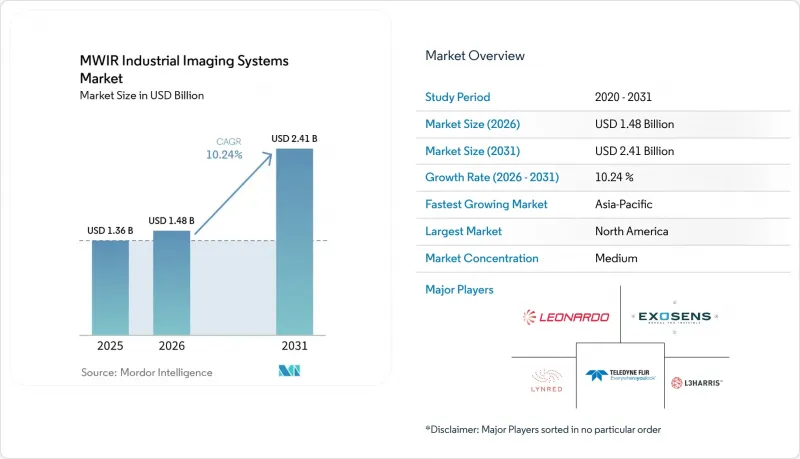
에 의하면, MWIR 산업용 이미징 시스템 시장 규모는 2025년에 13억 6,000만 달러로 평가되었고, 2026년 14억 8,000만 달러에서 2031년까지 24억 1,000만 달러에 이를 것으로 예측됩니다. 예측 기간(2026년-2031년) CAGR은 10.24%를 기록할 전망입니다.
세계 MWIR 산업용 이미징 시스템 시장 동향 및 인사이트
산업 자동화 및 예측 유지보수의 도입
산업 현장의 운영자들은 정기 점검에서 고장 예측 시스템과 연계된 지속적인 열화상 모니터링으로 전환하고 있습니다. 2026년 IEEE 연구에 따르면, 컨볼루션 신경망 및 재귀 신경망을 활용한 열화상 기술을 적용한 다중 모드 유지보수 기법에서 92%의 고장 감지 정확도가 보고되었습니다. 또한 이 연구에서는 이러한 워크플로우를 도입했을 때 유지보수 비용이 35% 절감되었다고 보고되었습니다. 이는 정기 점검 시에만 사용되는 것이 아니라, 생산 설비에 상시 설치된 상태로 사용할 수 있는 센서에 대한 수요를 뒷받침하는 것입니다. 따라서 MWIR 산업용 이미징 시스템 시장에서는 OEM(주문자 상표 제조업체)이 생산 라인에 통합할 수 있는 카메라 코어 및 모듈에 대한 관심이 높아지고 있습니다. 텔레다인-FLIR사는 2026년 2월, HOT MWIR 검출기를 탑재하고 산업용 연속 사용에 견딜 수 있는 27,000시간의 쿨러 수명을 갖춘 ‘A6450’을 발표했습니다.
국방 및 국경 감시 현대화
방위 분야 고객들은 감시, 대무인항공기 시스템 및 국경 경비 업무를 위해 더 소형화된 냉각식 MWIR 페이로드를 요구하고 있습니다. NATO 회원국의 2024년 국방비는 GDP의 2.2%에 달하며, 이는 첨단 감지 장비 조달 환경을 더욱 강화하는 요인이 되고 있습니다. MWIR 산업용 이미징 시스템 시장의 현재 업그레이드 주기에서는 구형 시스템보다 크기, 무게, 전력 소비가 적은 모듈이 선호되고 있습니다. 이를 통해 전술용 무인 항공기나 휴대용 기기에 도입이 가능해집니다. Type II 초격자 검출기의 소재 기술 발전은 더 높은 온도에서도 작동이 가능하게 함으로써 이러한 전환을 뒷받침하고 있습니다. 국방 분야 주도의 검출기 개발이 산업용 감시 용도로도 활용 가능해짐에 따라, MWIR 산업용 이미징 시스템 시장은 그 혜택을 누리게 될 것입니다.
냉각식 MWIR 시스템의 높은 초기 투자 비용 및 수명 주기 비용
MWIR 산업용 이미징 시스템 시장에서 냉각식 MWIR 장비는 동등한 비냉각식 LWIR 시스템에 비해 5-10배의 비용이 들기 때문에 비용을 중시하는 시설에서의 도입이 제한되고 있습니다. 극저온 냉각 장치, 광학계 및 판독 전자 장치가 초기 시스템 비용을 끌어올리고 있습니다. 또한, 스털링 사이클식 냉각 장치의 과거 정비 주기가 8,000-10,000시간이었던 점도 지속적인 운영 비용의 요인이 되고 있습니다. 새로운 HOT 시스템은 경제성을 향상시켰지만, 첨단 초점면 어레이에 대한 높은 가격 부담은 해소되지 않았습니다. 텔레다인-FLIR사는 자사의 A6450에 대해 쿨러 수명이 27,000시간이라고 보고하여, 유지보수 요건이 개선되고 있음을 보여주고 있습니다. MWIR 산업용 이미징 시스템 시장은 특히 동남아시아, 남미, 아프리카 등 설비 투자 예산이 제한적인 지역에서 여전히 제약을 받고 있습니다.
부문 분석
2025년, MWIR 산업용 이미징 시스템 시장에서 카메라가 46.38%를 차지했습니다. 산업 및 방위 분야 구매자들은 설치 및 운영이 간소화되기 때문에 대부분의 경우 완제품 카메라를 선호합니다. 카메라 코어 및 모듈은 2031년까지 제품별 가장 높은 연평균 성장률(CAGR)인 10.84%를 나타낼 것으로 예측됩니다. 자동화 장비 제조업체들은 로봇 셀, 생산 라인 및 무인 항공기의 페이로드에 이러한 부품을 채택하고 있습니다. 검출기 및 초점면 어레이는 인증된 InSb, HgCdTe 및 T2SL 장치를 제조할 수 있는 공급업체가 제한적이기 때문에 여전히 주요 업스트림 측면의 제약 요인으로 작용하고 있습니다. 이로 인해 확립된 검출기 제조 역량을 갖춘 공급업체는 MWIR 산업용 이미징 시스템 업계에서 중요한 위치를 차지하고 있습니다.
MWIR 산업용 이미징 시스템 시장의 광학 시스템 및 렌즈 어셈블리는 카메라나 검출기에 비해 단가는 낮지만, 그 공급 상황은 시스템의 비용과 납기에 영향을 미칩니다. 게르마늄 및 칼코게나이드 유리 조달에 있어, 카메라 제조업체는 공급망 집중화라는 위험에 노출될 가능성이 있습니다. 소프트웨어, 분석 기능 및 부속품은 매출액 기준으로 규모가 가장 작은 제품 카테고리입니다. 분석 기능을 통해 하드웨어 판매를 지속적인 서비스 관계로 전환할 수 있기 때문에 이러한 역할은 확대되고 있습니다. 또한 엣지 컴퓨팅을 통해 코어 모듈이 자율적인 검사 장치로 기능할 수도 있습니다. 이러한 변화로 인해 고객은 시스템의 영상 성능뿐만 아니라 데이터 처리 능력도 평가하게 되었습니다.
2025년 시점에서 극저온 냉각 시스템은 MWIR 산업용 이미징 시스템 시장 규모의 66.24%를 차지했습니다. 이 시스템의 낮은 잡음 등가 온도 차이(NETD)는 국방, 가스 이미징 및 까다로운 공정 모니터링 작업을 뒷받침하고 있습니다. HOT MWIR은 2031년까지 10.67%라는 가장 높은 기술 연평균 성장률(CAGR)을 나타낼 전망입니다. InAsSb 및 T2SL 소재를 통해 초점면 어레이는 130-150 K에서 작동할 수 있게 됩니다. 작동 온도가 높을수록 쿨러의 전력 수요, 장비 크기 및 유지보수 필요성을 줄일 수 있습니다. 이러한 특성 덕분에 HOT 제품은 여전히 기존 냉각 방식에 의한 성능이 요구되는 상황에서도 유용하게 활용될 수 있습니다.
2025년에 발표된 조사에 따르면, InAs/InAsSb T2SL 밴드 간 캐스케이드 광검출기는 고온 작동 환경에서 기존 HgCdTe 기술에 필적하는 MWIR 검출 감도를 발휘하는 것으로 밝혀졌습니다. 이 검증 결과는 검출기 공급업체 간의 소재 다양화를 촉진하는 요인이 됩니다. 비냉각 및 실온 MWIR는 감도 저하를 용인할 수 있는 용도에서는 여전히 소규모 범주에 머물러 있습니다. 그 미래는 콜로이드 양자점 및 기타 신흥 검출기 소재의 상용화 진전에 달려 있습니다. 기술의 조합에 따라, 성능이 극히 중요한 용도와 비용을 중시하는 용도는 앞으로도 계속 구분될 것입니다. 검출 임계값에 타협할 수 없는 MWIR 산업용 이미징 시스템 시장에서는 냉각형 및 HOT 플랫폼이 계속해서 중심적인 위치를 차지할 것입니다.
지역별 분석
2025년, 북미는 MWIR 산업용 이미징 시스템 시장 점유율의 36.19%를 차지했습니다. 북미의 MWIR 산업용 이미징 시스템 시장은 광범위한 석유 및 가스 인프라, 활발한 메탄 규제, 그리고 주요 국방용 센싱 수요가 결합되어 있습니다. 미국이 해당 지역 내 구매를 주도하는 한편, 캐나다는 오일샌드 사업에서 발생하는 수요를 뒷받침하고 있습니다. 멕시코는 자동차 및 전자기기 생산 분야에서 신흥 수요 기반을 형성하고 있습니다. EPA(미국 환경보호청)의 규제는 석유·천연가스 시설에서의 광학식 가스 이미징 활용에 대해 명확한 규정 준수 기준을 제시하고 있습니다.
아시아태평양은 2031년까지 11.12%라는 지역별 최고 연평균 성장률(CAGR)을 나타낼 전망입니다. 대만, 한국, 일본은 고감도 검사 및 계측 도구가 필요한 반도체 생산 능력을 확대되고 있습니다. 일본은 또한 정밀 제조 및 해상 감시 분야에서 이 기술의 활용을 추진하고 있습니다. 중국은 대규모 수요가 예상되는 시장이지만, 수출 규제로 인해 최고 성능의 냉각식 시스템에 대한 접근이 제한되고 있습니다. 인도는 국방 조달 및 발전 중인 반도체 생태계를 통해 수요를 견인하고 있습니다.
2025년 기준, 유럽의 중파장 적외선(MWIR) 산업용 이미징 시스템 시장은 지역별 규모에서 3위를 차지했습니다. 독일, 프랑스, 영국에서는 제조, 화학 처리 및 조달 프로그램을 통해 산업 및 국방 분야 수요를 뒷받침하고 있습니다. 프랑스에는 유럽의 카메라 제조업체 및 방산 업체에 초점면 어레이를 공급하는 Lynred사가 거점을 두고 있습니다. 중동에서는 액화천연가스(LNG) 및 업스트림 석유 시설에서 가스 이미징의 활용이 증가하고 있습니다. 남미는 브라질의 석유 및 가스 사업이 핵심을 이루고 있으며, 아르헨티나와 칠레가 화학 관련 수요를 보완하고 있습니다. 아프리카는 여전히 초기 단계에 있으며, 남아프리카공화국이 주요 산업 고객 기반을 형성하고 있습니다.
기타 혜택:
- 엑셀 형식 시장 예측(ME) 시트
- 3개월간의 애널리스트 지원
자주 묻는 질문
목차
제1장 서론
- 조사의 전제조건과 시장의 정의
- 조사 범위
제2장 조사 방법
제3장 주요 요약
제4장 시장 구도
- 시장 개요
- 시장 성장 촉진요인
- 시장 성장 억제요인
- 거시경제 요인이 시장에 미치는 영향
- 업계 밸류체인 분석
- 규제 상황
- 기술 전망
- Porter의 Five Forces 분석
제5장 시장 규모와 성장 예측
- 제품 유형별
- 기술별
- 용도별
- 최종사용자별
- 지역별
- 북미
- 미국
- 캐나다
- 멕시코
- 남미
- 브라질
- 아르헨티나
- 칠레
- 기타 남미 국가
- 유럽
- 독일
- 프랑스
- 영국
- 이탈리아
- 기타 유럽 국가
- 아시아태평양
- 중국
- 일본
- 인도
- 한국
- 기타 아시아태평양 국가
- 중동
- 사우디아라비아
- 아랍에미리트(UAE)
- 기타 중동 국가
- 아프리카
- 남아프리카공화국
- 나이지리아
- 이집트
- 기타 아프리카 국가
- 북미
제6장 경쟁 구도
- 시장 집중도
- 전략적 동향
- 시장 점유율 분석
- 기업 개요
- New Infrared Technologies S.L.
- IRCameras LLC
- InfraTec GmbH
- VIGO Photonics S.A.
- Xenics NV
- Sierra-Olympic Technologies, Inc.
- Princeton Infrared Technologies, Inc.
- Optotherm, Inc.
- Opgal Optronic Industries Ltd.
- Lynred S.A.S.
- Telops Inc.
- Hamamatsu Photonics K.K.
- HGH Infrared Systems
- AIM Infrarot-Module GmbH
- Leonardo S.p.A.
- L3Harris Technologies, Inc.
- BAE Systems plc
- RTX Corporation
- Teledyne Technologies Incorporated
제7장 시장 기회와 향후 전망
LSH 26.10.29According to Mordor Intelligence, the MWIR industrial imaging systems market size was valued at USD 1.36 billion in 2025 and estimated to expand from USD 1.48 billion in 2026 to reach USD 2.41 billion by 2031, at a CAGR of 10.24% during the forecast period (2026-2031).
Global MWIR Industrial Imaging Systems Market Trends and Insights
Industrial Automation and Predictive Maintenance Adoption
Industrial operators are shifting from scheduled checks to continuous thermal monitoring connected to fault prediction systems. A 2026 IEEE study reported 92% fault-detection accuracy for multimodal maintenance methods that used thermal imaging with convolutional and recurrent neural networks. The same study reported a 35% reduction in maintenance costs when these workflows were deployed. This supports demand for sensors that can remain installed on production equipment rather than being used only during periodic inspections. The MWIR industrial imaging systems market is therefore seeing greater interest in camera cores and modules that original equipment manufacturers can build into production lines. Teledyne FLIR introduced the A6450 in February 2026 with a HOT MWIR detector and a 27,000-hour cooler life for continuous industrial use.
Defense and Border Surveillance Modernization
Defense customers are seeking smaller cooled MWIR payloads for surveillance, counter-unmanned aerial systems, and border operations. NATO members averaged defense spending equal to 2.2% of GDP in 2024, supporting a stronger procurement setting for advanced sensing equipment. The current upgrade cycle in the MWIR industrial imaging systems market favors modules with lower size, weight, and power requirements than older systems. This enables deployment on tactical unmanned aircraft and portable equipment. Material advances in type-II superlattice detectors are supporting this transition because they can operate at higher temperatures. The MWIR industrial imaging systems market benefits when defense-led detector development also becomes available for industrial surveillance applications.
High Capital and Lifecycle Cost of Cooled MWIR Systems
Cooled MWIR equipment in the MWIR industrial imaging systems market costs 5-10 times more than comparable uncooled LWIR systems, which limits adoption in cost-sensitive facilities. Cryocoolers, optics, and readout electronics add to the initial system cost. Historical Stirling-cycle cooler refurbishment intervals of 8,000-10,000 hours have also added recurring operating expense. Newer HOT systems improve the economics but do not remove the premium for advanced focal plane arrays. Teledyne FLIR reported a 27,000-hour cooler life for its A6450, showing progress on maintenance requirements. The MWIR industrial imaging systems market remains constrained where capital budgets are lower, particularly in Southeast Asia, South America, and Africa.
Other drivers and restraints analyzed in the detailed report include:
- High-Temperature Process Inspection Requirements
- AI-Enabled Thermal Analytics and IIoT Integration
- Export Controls and Restricted Detector Supply
For complete list of drivers and restraints, kindly check the Table Of Contents.
Segment Analysis
Cameras accounted for 46.38% of the MWIR industrial imaging systems market in 2025. Buyers in industrial and defense settings often prefer a complete camera because it simplifies installation and operation. Camera cores and modules are projected to record the highest product CAGR of 10.84% through 2031. Automation equipment makers use these components in robotic cells, production lines, and unmanned aircraft payloads. Detectors and focal plane arrays remain a key upstream constraint because only a limited group of suppliers produces qualified InSb, HgCdTe, and T2SL devices. This gives suppliers with established detector capability an important position in the MWIR industrial imaging systems industry.
Optics and lens assemblies in the MWIR industrial imaging systems market have a lower unit value than cameras and detectors, but their supply affects system cost and delivery schedules. Germanium and chalcogenide glass sourcing can expose camera producers to concentrated supply chains. Software, analytics, and accessories represent the smallest product category by revenue. Their role is increasing because analytics can turn a hardware sale into a recurring service relationship. Edge computing also allows core modules to act as autonomous inspection devices. These changes encourage customers to evaluate a system's data capability alongside its imaging performance.
Cryogenically cooled systems held 66.24% of the MWIR industrial imaging systems market size in 2025. Their low noise-equivalent temperature difference supports defense, gas imaging, and demanding process monitoring tasks. HOT MWIR is projected to record the fastest technology CAGR of 10.67% through 2031. InAsSb and T2SL materials allow focal plane arrays to operate at 130-150 K. Higher operating temperatures can reduce cooler power demand, equipment size, and maintenance needs. These attributes make HOT products relevant where conventional cooled performance remains necessary.
Research published in 2025 found that InAs/InAsSb T2SL interband cascade photodetectors offered MWIR detectivity competitive with older HgCdTe technologies at high operating temperatures. This validation supports material diversification among detector suppliers. Uncooled and room-temperature MWIR remains a smaller category for applications that accept lower sensitivity. Its future depends on the commercial progress of colloidal quantum dots and other emerging detector materials. The technology mix will continue to separate performance-critical uses from cost-sensitive uses. Cooled and HOT platforms should remain central to the MWIR industrial imaging systems market where detection thresholds cannot be compromised.
Complete Report Scope:
- By Product Type
- Cameras
- Camera Cores and Modules
- Detectors and Focal Plane Arrays
- Optics and Lens Assemblies
- Software, Analytics, and Accessories
- By Technology
- Cryogenically Cooled MWIR (Standard Cooled)
- High-Operating-Temperature (HOT) MWIR
- Uncooled / Room-Temperature MWIR
- By Application
- Predictive Maintenance and Condition Monitoring
- Process Control and Quality Inspection
- Optical Gas Imaging and Leak Detection
- Electrical Inspection and Fault Localization
- Non-Destructive Testing and Materials Analysis
- Research, Development, and Metrology
- By End-User
- Manufacturing (General and Discrete, excluding Semiconductor and Electronics)
- Semiconductor and Electronics
- Oil and Gas
- Chemicals and Petrochemicals
- Power Generation and Utilities
- Aerospace and Defense
- Research Institutes and Universities
- Rest of Industrial End-Users
- By Geography
- North America
- United States
- Canada
- Mexico
- South America
- Brazil
- Argentina
- Chile
- Rest of South America
- Europe
- Germany
- France
- United Kingdom
- Italy
- Rest of Europe
- Asia-Pacific
- China
- Japan
- India
- South Korea
- Rest of Asia-Pacific
- Middle East
- Saudi Arabia
- United Arab Emirates
- Rest of Middle East
- Africa
- South Africa
- Nigeria
- Egypt
- Rest of Africa
- North America
Geography Analysis
North America held 36.19% of the MWIR industrial imaging systems market share in 2025. The North American MWIR industrial imaging systems market combines extensive oil and gas infrastructure, active methane regulation, and major defense sensing demand. The United States leads regional purchasing, while Canada supports demand from oil sands operations. Mexico adds an emerging base in automotive and electronics production. EPA rules provide a defined compliance setting for optical gas imaging use at oil and natural gas sites.
Asia-Pacific is projected to record the fastest regional CAGR of 11.12% through 2031. Taiwan, South Korea, and Japan are expanding semiconductor capabilities that require sensitive inspection and metrology tools. Japan also supports its use in precision manufacturing and maritime surveillance. China is a large volume opportunity, but export restrictions affect access to top-performance cooled systems. India adds demand through defense procurement and a developing semiconductor ecosystem.
The European MWIR industrial imaging systems market held the third-largest regional position in 2025. Germany, France, and the United Kingdom support industrial and defense demand through manufacturing, chemical processing, and procurement programs. France is home to Lynred, which supplies focal plane arrays to European camera makers and defense manufacturers. The Middle East is increasing gas imaging use in liquefied natural gas and upstream oil facilities. South America is anchored by Brazil's oil and gas operations, while Argentina and Chile add chemicals-related demand. Africa remains early stage, with South Africa forming its main industrial customer base.
- New Infrared Technologies S.L.
- IRCameras LLC
- InfraTec GmbH
- VIGO Photonics S.A.
- Xenics NV
- Sierra-Olympic Technologies, Inc.
- Princeton Infrared Technologies, Inc.
- Optotherm, Inc.
- Opgal Optronic Industries Ltd.
- Lynred S.A.S.
- Telops Inc.
- Hamamatsu Photonics K.K.
- HGH Infrared Systems
- AIM Infrarot-Module GmbH
- Leonardo S.p.A.
- L3Harris Technologies, Inc.
- BAE Systems plc
- RTX Corporation
- Teledyne Technologies Incorporated
Additional Benefits:
- The market estimate (ME) sheet in Excel format
- 3 months of analyst support
TABLE OF CONTENTS
1 INTRODUCTION
- 1.1 Study Assumptions and Market Definition
- 1.2 Scope of the Study
2 RESEARCH METHODOLOGY
3 EXECUTIVE SUMMARY
4 MARKET LANDSCAPE
- 4.1 Market Overview
- 4.2 Market Drivers
- 4.2.1 Industrial Automation and Predictive Maintenance Adoption
- 4.2.2 Defense and Border-Surveillance Modernization
- 4.2.3 High-Temperature Process Inspection Requirements
- 4.2.4 AI-Enabled Thermal Analytics and IIoT Integration
- 4.2.5 Inline MWIR Monitoring for Semiconductor and Power-Electronics Yield
- 4.2.6 Optical Gas Imaging for Methane and Process-Leak Compliance
- 4.3 Market Restraints
- 4.3.1 High Capital and Lifecycle Cost of Cooled MWIR Systems
- 4.3.2 Export Controls and Restricted Detector Supply
- 4.3.3 Cryocooler Reliability and Maintenance Burden
- 4.3.4 Limited Industrial Skills for Radiometric Data Interpretation
- 4.4 Impact of Macroeconomic Factors on the Market
- 4.5 Industry Value Chain Analysis
- 4.6 Regulatory Landscape
- 4.7 Technological Outlook
- 4.8 Porter's Five Forces Analysis
- 4.8.1 Bargaining Power of Suppliers
- 4.8.2 Bargaining Power of Buyers
- 4.8.3 Threat of New Entrants
- 4.8.4 Threat of Substitutes
- 4.8.5 Intensity of Competitive Rivalry
5 MARKET SIZE AND GROWTH FORECASTS (VALUE)
- 5.1 By Product Type
- 5.1.1 Cameras
- 5.1.2 Camera Cores and Modules
- 5.1.3 Detectors and Focal Plane Arrays
- 5.1.4 Optics and Lens Assemblies
- 5.1.5 Software, Analytics, and Accessories
- 5.2 By Technology
- 5.2.1 Cryogenically Cooled MWIR (Standard Cooled)
- 5.2.2 High-Operating-Temperature (HOT) MWIR
- 5.2.3 Uncooled / Room-Temperature MWIR
- 5.3 By Application
- 5.3.1 Predictive Maintenance and Condition Monitoring
- 5.3.2 Process Control and Quality Inspection
- 5.3.3 Optical Gas Imaging and Leak Detection
- 5.3.4 Electrical Inspection and Fault Localization
- 5.3.5 Non-Destructive Testing and Materials Analysis
- 5.3.6 Research, Development, and Metrology
- 5.4 By End-User
- 5.4.1 Manufacturing (General and Discrete, excluding Semiconductor and Electronics)
- 5.4.2 Semiconductor and Electronics
- 5.4.3 Oil and Gas
- 5.4.4 Chemicals and Petrochemicals
- 5.4.5 Power Generation and Utilities
- 5.4.6 Aerospace and Defense
- 5.4.7 Research Institutes and Universities
- 5.4.8 Rest of Industrial End-Users
- 5.5 By Geography
- 5.5.1 North America
- 5.5.1.1 United States
- 5.5.1.2 Canada
- 5.5.1.3 Mexico
- 5.5.2 South America
- 5.5.2.1 Brazil
- 5.5.2.2 Argentina
- 5.5.2.3 Chile
- 5.5.2.4 Rest of South America
- 5.5.3 Europe
- 5.5.3.1 Germany
- 5.5.3.2 France
- 5.5.3.3 United Kingdom
- 5.5.3.4 Italy
- 5.5.3.5 Rest of Europe
- 5.5.4 Asia-Pacific
- 5.5.4.1 China
- 5.5.4.2 Japan
- 5.5.4.3 India
- 5.5.4.4 South Korea
- 5.5.4.5 Rest of Asia-Pacific
- 5.5.5 Middle East
- 5.5.5.1 Saudi Arabia
- 5.5.5.2 United Arab Emirates
- 5.5.5.3 Rest of Middle East
- 5.5.6 Africa
- 5.5.6.1 South Africa
- 5.5.6.2 Nigeria
- 5.5.6.3 Egypt
- 5.5.6.4 Rest of Africa
- 5.5.1 North America
6 COMPETITIVE LANDSCAPE
- 6.1 Market Concentration
- 6.2 Strategic Moves
- 6.3 Market Share Analysis
- 6.4 Company Profiles (includes Global Level Overview, Market Level Overview, Core Segments, Financials as available, Strategic Information, Market Rank/Share, Products and Services, Recent Developments)
- 6.4.1 New Infrared Technologies S.L.
- 6.4.2 IRCameras LLC
- 6.4.3 InfraTec GmbH
- 6.4.4 VIGO Photonics S.A.
- 6.4.5 Xenics NV
- 6.4.6 Sierra-Olympic Technologies, Inc.
- 6.4.7 Princeton Infrared Technologies, Inc.
- 6.4.8 Optotherm, Inc.
- 6.4.9 Opgal Optronic Industries Ltd.
- 6.4.10 Lynred S.A.S.
- 6.4.11 Telops Inc.
- 6.4.12 Hamamatsu Photonics K.K.
- 6.4.13 HGH Infrared Systems
- 6.4.14 AIM Infrarot-Module GmbH
- 6.4.15 Leonardo S.p.A.
- 6.4.16 L3Harris Technologies, Inc.
- 6.4.17 BAE Systems plc
- 6.4.18 RTX Corporation
- 6.4.19 Teledyne Technologies Incorporated
7 MARKET OPPORTUNITIES AND FUTURE OUTLOOK
- 7.1 White-Space and Unmet-Need Assessment


