|
시장보고서
상품코드
2121235
열화상 시스템 : 시장 점유율 분석, 업계 동향과 통계, 성장 예측(2026-2031년)Thermal Imaging Systems - Market Share Analysis, Industry Trends & Statistics, Growth Forecasts (2026 - 2031) |
||||||
 Mordor Intelligence
Mordor Intelligence에 의하면, 열 영상 시스템 시장 규모는 2025년 57억 8,000만 달러에서 2026년에는 61억 9,000만 달러에 이르고, 2026-2031년 CAGR 7.06%로 성장을 지속하여 2031년에는 87억 1,000만 달러에 달할 것으로 예측됩니다.
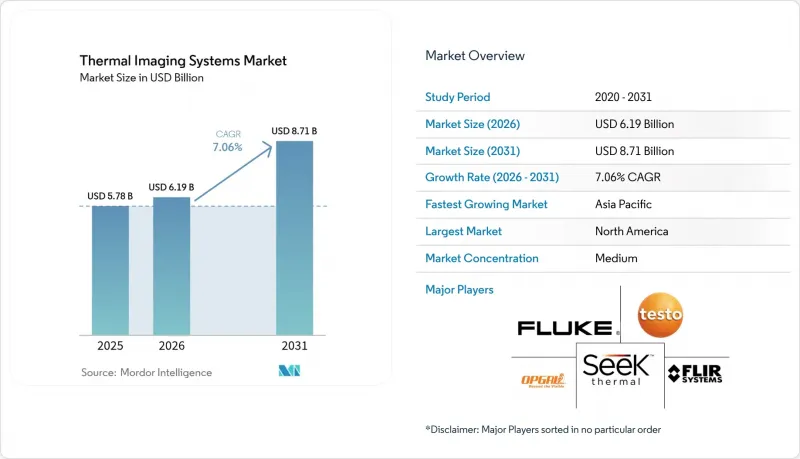
본 보고서는 용도별(보안·감시, 군 및 방위, 기타), 폼 팩터별(휴대용 이미징 장치, 고정 설치형, 기타),기술별(비냉각 LWIR, 냉각 MWIR, 기타), 구성 요소별(검출기/코어, 기타), 최종 사용자 산업별(국방·국토안보, 산업용, 기타), 지역별로 분류되어 있습니다. 시장 예측은 금액(달러)으로 표시되어 있습니다.
세계 열화상 시스템 시장 동향 및 인사이트
비냉각 마이크로볼로미터의 가격 하락
비냉각형 검출기의 비용 곡선은 지속적으로 하락하고 있으며, 국방 및 중공업 이외의 분야에서도 시장 기회가 확대되고 있습니다. 규모의 경제, 제조 공정의 간소화, 그리고 LightPath사와 같은 기업이 제공하는 칼코게나이드계 광학 소자의 대체 기술로 인해, 기존 문제였던 게르마늄 공급 병목 현상이 완화되고 있습니다. 스마트폰 OEM 업체들은 열화상 기능을 시험적으로 도입하고 있으며, 차량 운영 사업자들도 기업의 ESG 프로그램의 일환으로 열화상 검사를 사양 요건에 포함시키고 있습니다. 이러한 상용 분야로의 확산은 생이미지를 실행 가능한 인사이트력으로 변환하는 분석 소프트웨어의 가격 결정력을 강화하고 있습니다.
인도-태평양 지역의 국방 ISR 예산 확대
지역적 안보 경쟁이 장거리 감시 시스템 조달을 촉진하고 있습니다. 미국의 ‘태평양 억제 이니셔티브’에서는 첨단 센서에 99억 달러가 배정된 반면, 호주의 500억 호주 달러(347억 달러) 규모 방위 로드맵에서는 다중 스펙트럼 영상 플랫폼에 대한 자금이 확보되어 있습니다. 듀얼 밴드 FLIR 어레이를 지원하는 SBIR 보조금과 더불어, 이러한 프로젝트들은 검출기 파운드리 및 광학 시스템 공급업체들에게 향후 수년에 걸쳐 안정적인 수주 전망을 제공합니다.
수출 통제 규정(ITAR 및 EAR)
미국의 수출 규제 동향에 따라, 많은 이중용도 초점면 어레이 및 광학 키트에 대해 라이선스가 의무화되고 있으며, 이로 인해 판매 주기가 장기화되고 국제적인 수익 기회가 제한되고 있습니다. 최근 제안에 따르면, 지금까지 규제 대상에서 제외되었던 상용 이미저도 라이선스 대상에 포함하는 것이 검토되고 있으며, 이로 인해 OEM 기업들은 미국 외 지역공급망 현지화를 가속화할 수밖에 없는 상황입니다. 이러한 정책의 불확실성은 규정 준수 비용을 발생시키며, 특히 소규모 틈새 시장의 혁신 기업들에게 큰 부담이 되고 있습니다.
부문 분석
보안 및 감시 분야는 2025년 매출의 37.62%를 차지하며, 열화상 시스템 시장에서 주변 경비의 기초적인 역할을 뒷받침하고 있습니다. 국경 관리에 대한 지출 증가와 중요 인프라 강화로 인해 고정식 및 팬-틸트-줌(PTZ) 카메라의 조달이 지속되는 한편, AI를 활용한 분석 기술로 인해 운영자의 업무 부담이 경감되고 있습니다. 연평균 성장률(CAGR) 7.66%로 가장 빠르게 성장하고 있는 자동차용 ADAS(첨단 운전자 보조 시스템) 분야는 보행자 안전 및 자동 긴급 제동 관련 규제의 추진을 호재로 삼고 있습니다. 과거에는 적외선 기능을 옵션으로 지정하던 OEM의 설계 주기에서 현재는 소형 모듈이 대량 생산되는 등급에 탑재되면서 연간 출하 대수의 기반이 확대되고 있습니다.
공장이 NFPA-70B를 준수함에 따라 열화상 서비스 수요가 다양화되고 있으며, 정기적인 검사 수익이 발생하고 있습니다. 소방 기관은 최전선 대원들에게 열화상 단안경을 장비하고, 위성을 통한 핫스팟 경보를 활용하여 신속한 대응을 도모하고 있습니다. 스마트폰과 클립온형 마이크로볼로미터를 결합한 신흥 모바일 앱은 열화상 시스템 시장의 대중화 단계 도래를 시사하고 있습니다.
핸드헬드형 이미저는 2025년 매출의 45.78%를 차지하며, 예방 유지보수, 법 집행, 최초 대응자의 대응 등 폭넓은 용도에서의 범용성으로 인해 지지를 받고 있습니다. 배터리 구동의 편의성 덕분에, 특히 감지기의 해상도가 향상됨에 따라 상당한 교체 수요가 유지되고 있습니다. 한편, 통합형 OEM 모듈은 연평균 성장률(CAGR) 7.13%로 시장을 주도할 것으로 예상되며, 차량, 드론, 스마트 가전 분야의 열화상 시스템 시장 확대를 뒷받침하고 있습니다. 24시간 365일 감시가 필수적인 주변 경비 및 공정 감시 분야에서는 고정 설치형 솔루션이 여전히 필수적입니다.
군사 조달 분야에서는 크기, 무게, 전력 소비, 비용(SWaP-C)의 개선이 중시되고 있으며, 페이로드의 소형화를 도모하기 위해 독자적인 셔터리스 보정 기술과 엣지 AI의 도입이 진행되고 있습니다. 개발 중인 유연한 적외선 센서는 향후 웨어러블 기기에 적용될 것으로 기대되지만, 상용화에는 아직 몇 차례의 설계 개선이 필요합니다.
지역별 분석
북미는 2025년 지출의 41.02%를 차지하며 시장을 주도했습니다. 이는 미 육군의 3세대 FLIR 센서 1억 1,750만 달러 발주 등 국방 분야에 대한 예산 배분을 반영한 것입니다. NFPA-70B 규격 준수에 따라 산업 분야에서의 도입이 더욱 촉진되고 있으며, 자동차 업계의 Tier 1 공급업체들은 2027년형 모델을 위한 야간 투시 프로그램의 시범 운영을 진행하고 있습니다. CISA(미국 사이버보안·인프라보안청)의 사이버보안 지침이 공격에 대한 내성이 높은 펌웨어에 대한 프리미엄 수요를 견인하고 있으며, 이에 따라 미국에 기반을 둔 공급업체들은 가격 규율을 유지하고 있습니다.
일본, 한국, 인도, 호주가 ISR(정보·감시·정찰) 장비의 다양화와 차량 수출 확대를 추진하는 가운데, 아시아태평양은 8.08%라는 가장 높은 연평균 성장률(CAGR)을 나타낼 전망입니다. 2019년부터 2020년에 걸쳐 중국 열화상 시장 점유율이 15%에서 63%로 확대된 것은 해당국의 제조 규모가 크다는 사실을 여실히 보여줍니다. 국산 센서 생태계는 성숙해 가고 있지만, 수출 규제로 인해 최첨단 미국 기술에 대한 접근이 제한되고 있어 지역 내 연구 개발(R&D) 투자가 촉진되고 있습니다.
유럽은 방위용 옵토일렉트로닉스 수주와 자동차 안전 규제의 뒷받침을 받아 꾸준한 성장을 이루고 있습니다. 헨졸트(HENSOLDT)의 옵토일렉트로닉스 부문 매출이 34% 증가한 것은 견조한 조달 동향을 뒷받침합니다. 중동 및 아프리카에서는 주변 감시에 대한 견실한 수요가 나타나고 있으며, 텔레다인 FLIR사는 사우디아라비아에 멀티센서 포드를 출하하고 있습니다. 남미는 여전히 신흥 시장이지만, 산업용 유지보수 및 공공 안전 예산 확대로 인해 추가적인 성장이 예상됩니다.
기타 혜택:
- 엑셀 형식 시장 예측(ME) 시트
- 3개월간의 애널리스트 지원
자주 묻는 질문
목차
제1장 서론
제2장 조사 방법
제3장 주요 요약
제4장 시장 구도
제5장 시장 규모와 성장 예측
제6장 경쟁 구도
제7장 시장 기회와 향후 전망
LSH 26.09.08According to Mordor Intelligence, the thermal imaging systems market size is expected to grow from USD 5.78 billion in 2025 to USD 6.19 billion in 2026 and is forecast to reach USD 8.71 billion by 2031 at 7.06% CAGR over 2026-2031.
This report is Segmented by Application (Security and Surveillance, Military and Defense, and More), Form Factor (Hand-Held Imaging Devices, Fixed-Mount, and More), Technology (Uncooled LWIR, Cooled MWIR, and More), Component (Detectors/Cores, and More), End-User Industry (Defense and Homeland Security, Industrial, and More), and by Geography. The Market Forecasts are Provided in Terms of Value (USD).
Global Thermal Imaging Systems Market Trends and Insights
Falling Price of Uncooled Micro-Bolometers
Cost curves for uncooled detectors continue to decline, enlarging addressable opportunities beyond defense and heavy industry. Scale economies, simplified fabrication, and alternative chalcogenide optics from firms such as LightPath are mitigating historic germanium bottlenecks. Smartphone OEMs are piloting thermal add-ons, and fleet operators are specifying thermographic inspections under corporate ESG programs. The broader commercial reach strengthens pricing power for analytics software that converts raw images into actionable insights.
Growing Defense ISR Budgets in Indo-Pacific
Regional security competition is stimulating long-range surveillance procurements. The United States' Pacific Deterrence Initiative allocates USD 9.9 billion for advanced sensors, while Australia's AUD 50 billion (USD 34.7 billion) defense roadmap earmarks funds for multispectral imaging platforms. Combined with SBIR grants supporting dual-band FLIR arrays, the pipeline sustains multi-year volume visibility for detector foundries and optics suppliers.
Export-Control Regimes (ITAR & EAR)
Evolving US export rules mandate licenses for many dual-use focal-plane arrays and optics kits, elongating sales cycles and limiting addressable international revenue. Recent proposals would pull previously uncontrolled commercial imagers into license categories, prompting OEMs to accelerate non-US supply-chain localization. The policy uncertainty introduces compliance costs that particularly burden small-volume niche innovators.
Other drivers and restraints analyzed in the detailed report include:
- Mandatory NFPA-70B Thermography for Electrical Safety
- Vehicle OEM Push for Cost-Effective ADAS Night-Vision
- High Cap-Ex for Cooled MWIR Cameras
For complete list of drivers and restraints, kindly check the Table Of Contents.
Segment Analysis
Security and surveillance held 37.62% of 2025 revenue, reinforcing the foundational role of perimeter protection in the thermal imaging systems market. Increasing border-control spending and critical infrastructure hardening sustain procurement of fixed and pan-tilt-zoom cameras, while AI-driven analytics cut operator workload. Automotive ADAS, the fastest-growing application at a 7.66% CAGR, capitalizes on regulatory nudges for pedestrian safety and automated emergency braking. OEM design cycles that once specified infrared as optional are now embedding compact modules into higher-volume trims, broadening annual shipment baselines.
Demand diversification is evident in thermography services as factories comply with NFPA-70B, creating annuity-style inspection revenue. Firefighting agencies are equipping frontline responders with thermal monoculars, leveraging satellite-driven hotspot alerts for rapid deployment. Emerging mobile apps pairing smartphones with clip-on micro-bolometers signal the consumerization phase of the thermal imaging systems market.
Hand-held imagers captured 45.78% of 2025 revenue, favored for versatility across preventive maintenance, law enforcement, and first-responder scenarios. The convenience of battery-operated units sustains significant replacement demand, especially as detector resolution improves. Integrated OEM modules, however, are set to outpace at a 7.13% CAGR, underpinning the expansion of the thermal imaging systems market size inside vehicles, drones, and smart appliances. Fixed-mount solutions remain indispensable in perimeter security and process monitoring where 24/7 coverage is mandatory.
Military procurement emphasizes Size, Weight, Power, and Cost (SWaP-C) gains, driving proprietary shutterless calibration and edge AI to compress payload footprints. Flexible infrared sensors in development promise future wearables, although commercialization is still several design iterations away.
Complete Report Scope:
- By Application
- Security and Surveillance
- Military and Defense
- Thermography / Inspection
- Firefighting
- Personal Vision Systems
- Smartphones and Tablets
- Automotive ADAS
- Maritime and Aerospace
- By Form Factor
- Hand-held Imaging Devices
- Fixed-mount (Rotary / Non-rotary)
- Integrated OEM Modules
- By Technology
- Uncooled LWIR
- Cooled MWIR
- SWIR and Multispectral
- By Component
- Detectors / Cores
- Complete Cameras
- Optics and Lens Sets
- Software and Analytics
- By End-user Industry
- Defense and Homeland Security
- Industrial
- Commercial
- Medical
- Public Safety
- By Geography
- North America
- United States
- Canada
- Mexico
- South America
- Brazil
- Argentina
- Rest of South America
- Europe
- Germany
- United Kingdom
- France
- Italy
- Spain
- Russia
- Rest of Europe
- Asia Pacific
- China
- Japan
- South Korea
- India
- Australia and NZ
- ASEAN (Break-up)
- Rest of Asia Pacific
- Middle East and Africa
- Middle East
- Saudi Arabia
- UAE
- Turkey
- Rest of Middle East
- Africa
- South Africa
- Nigeria
- Rest of Africa
- Middle East
- North America
Geography Analysis
North America led with 41.02% of 2025 spending, reflecting defense allocations such as the US Army's USD 117.5 million order for third-generation FLIR sensors. NFPA-70B compliance further bolsters industrial uptake, and automotive Tier-1s are piloting night-vision programs for 2027 model years. Cybersecurity directives from CISA drive premium demand for hardened firmware, enabling US-based vendors to maintain pricing discipline.
Asia-Pacific is projected to log the highest 8.08% CAGR as Japan, South Korea, India, and Australia diversify ISR fleets and expand vehicle exports. China's share shift from 15% to 63% in thermography during 2019-2020 illustrates the manufacturing scale at play. Indigenous sensor ecosystems are maturing, yet export controls restrict access to state-of-the-art US technology, fueling regional R&D investment.
Europe posts steady growth, buoyed by defense optronics orders and automotive safety regulations. HENSOLDT's 34% revenue surge in its Optronics segment underscores resilient procurement. Middle East and Africa register firm demand for perimeter surveillance, with Teledyne FLIR shipping multi-sensor pods to Saudi Arabia. South America remains emergent, but industrial maintenance and public-safety budgets point to incremental upside.
- Teledyne FLIR
- Opgal Optronic Industries
- Fluke Corporation
- Seek Thermal
- Axis Communications
- Leonardo DRS
- Raytheon Technologies
- L3Harris Technologies
- Lockheed Martin
- Testo SE and Co. KGaA
- Bullard
- Hikmicro (Hikvision)
- Guide Sensmart
- Excelitas (Xenics)
- BAE Systems
- HT Italia
- Trijicon
- Zhejiang Dali
- Pelco
- Yantai IRay
Additional Benefits:
- The market estimate (ME) sheet in Excel format
- 3 months of analyst support
TABLE OF CONTENTS
1 INTRODUCTION
- 1.1 Study Assumptions and Market Definition
- 1.2 Scope of the Study
2 RESEARCH METHODOLOGY
3 EXECUTIVE SUMMARY
4 MARKET LANDSCAPE
- 4.1 Market Overview
- 4.2 Market Drivers
- 4.2.1 Falling price of uncooled micro-bolometers
- 4.2.2 Growing defense ISR budgets in Indo-Pacific
- 4.2.3 Mandatory NFPA-70B thermography for electrical safety
- 4.2.4 Vehicle OEM push for cost-effective ADAS night-vision
- 4.2.5 AI-enabled predictive maintenance in smart factories
- 4.2.6 Climate-driven wildfire monitoring demand
- 4.3 Market Restraints
- 4.3.1 Export-control regimes (ITAR and EAR)
- 4.3.2 High cap-ex for cooled MWIR cameras
- 4.3.3 Supply-chain choke points in germanium optics
- 4.3.4 Cyber-security risks in networked cameras
- 4.4 Value / Supply-Chain Analysis
- 4.5 Regulatory Landscape
- 4.6 Technological Outlook
- 4.7 Porter's Five Forces
- 4.7.1 Bargaining Power of Suppliers
- 4.7.2 Bargaining Power of Buyers
- 4.7.3 Threat of New Entrants
- 4.7.4 Intensity of Competitive Rivalry
- 4.7.5 Threat of Substitutes
- 4.8 Pricing Analysis (by Application and Technology)
5 MARKET SIZE AND GROWTH FORECASTS (VALUE)
- 5.1 By Application
- 5.1.1 Security and Surveillance
- 5.1.2 Military and Defense
- 5.1.3 Thermography / Inspection
- 5.1.4 Firefighting
- 5.1.5 Personal Vision Systems
- 5.1.6 Smartphones and Tablets
- 5.1.7 Automotive ADAS
- 5.1.8 Maritime and Aerospace
- 5.2 By Form Factor
- 5.2.1 Hand-held Imaging Devices
- 5.2.2 Fixed-mount (Rotary / Non-rotary)
- 5.2.3 Integrated OEM Modules
- 5.3 By Technology
- 5.3.1 Uncooled LWIR
- 5.3.2 Cooled MWIR
- 5.3.3 SWIR and Multispectral
- 5.4 By Component
- 5.4.1 Detectors / Cores
- 5.4.2 Complete Cameras
- 5.4.3 Optics and Lens Sets
- 5.4.4 Software and Analytics
- 5.5 By End-user Industry
- 5.5.1 Defense and Homeland Security
- 5.5.2 Industrial
- 5.5.3 Commercial
- 5.5.4 Medical
- 5.5.5 Public Safety
- 5.6 By Geography
- 5.6.1 North America
- 5.6.1.1 United States
- 5.6.1.2 Canada
- 5.6.1.3 Mexico
- 5.6.2 South America
- 5.6.2.1 Brazil
- 5.6.2.2 Argentina
- 5.6.2.3 Rest of South America
- 5.6.3 Europe
- 5.6.3.1 Germany
- 5.6.3.2 United Kingdom
- 5.6.3.3 France
- 5.6.3.4 Italy
- 5.6.3.5 Spain
- 5.6.3.6 Russia
- 5.6.3.7 Rest of Europe
- 5.6.4 Asia Pacific
- 5.6.4.1 China
- 5.6.4.2 Japan
- 5.6.4.3 South Korea
- 5.6.4.4 India
- 5.6.4.5 Australia and NZ
- 5.6.4.6 ASEAN (Break-up)
- 5.6.4.7 Rest of Asia Pacific
- 5.6.5 Middle East and Africa
- 5.6.5.1 Middle East
- 5.6.5.1.1 Saudi Arabia
- 5.6.5.1.2 UAE
- 5.6.5.1.3 Turkey
- 5.6.5.1.4 Rest of Middle East
- 5.6.5.2 Africa
- 5.6.5.2.1 South Africa
- 5.6.5.2.2 Nigeria
- 5.6.5.2.3 Rest of Africa
- 5.6.5.1 Middle East
- 5.6.1 North America
6 COMPETITIVE LANDSCAPE
- 6.1 Market Concentration
- 6.2 Strategic Moves
- 6.3 Market Share Analysis
- 6.4 Company Profiles (includes Global level Overview, Market level overview, Core Segments, Financials as available, Strategic Information, Market Rank/Share for key companies, Products and Services, and Recent Developments)
- 6.4.1 Teledyne FLIR
- 6.4.2 Opgal Optronic Industries
- 6.4.3 Fluke Corporation
- 6.4.4 Seek Thermal
- 6.4.5 Axis Communications
- 6.4.6 Leonardo DRS
- 6.4.7 Raytheon Technologies
- 6.4.8 L3Harris Technologies
- 6.4.9 Lockheed Martin
- 6.4.10 Testo SE and Co. KGaA
- 6.4.11 Bullard
- 6.4.12 Hikmicro (Hikvision)
- 6.4.13 Guide Sensmart
- 6.4.14 Excelitas (Xenics)
- 6.4.15 BAE Systems
- 6.4.16 HT Italia
- 6.4.17 Trijicon
- 6.4.18 Zhejiang Dali
- 6.4.19 Pelco
- 6.4.20 Yantai IRay
7 MARKET OPPORTUNITIES AND FUTURE OUTLOOK
- 7.1 White-space and Unmet-need Assessment