|
시장보고서
상품코드
2121430
제올라이트 분자체 : 시장 점유율 분석, 업계 동향과 통계, 성장 예측(2026-2031년)Zeolite Molecular Sieves - Market Share Analysis, Industry Trends & Statistics, Growth Forecasts (2026 - 2031) |
||||||
 Mordor Intelligence
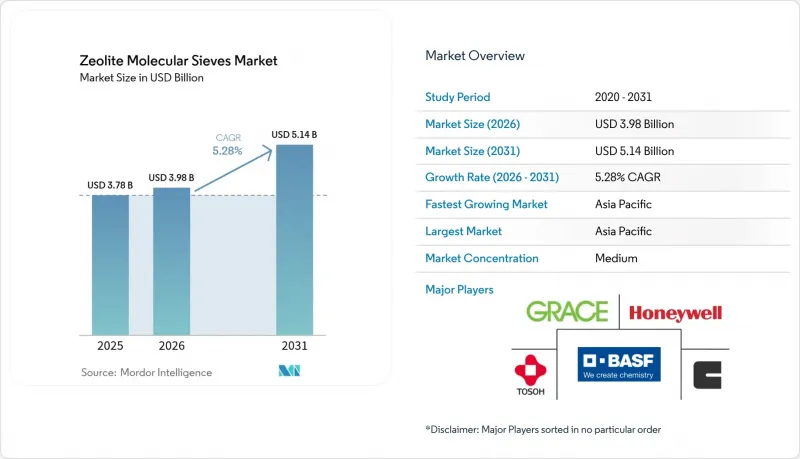
제올라이트 분자체 시장 규모는 2026년에 39억 8,000만 달러로 추정되며, 2025년 37억 8,000만 달러에서 확대되어 2031년에는 51억 4,000만 달러 달할 것으로 예측됩니다.
2026년부터 2031년까지 연평균 성장률(CAGR) 5.28%로 성장할 것으로 전망됩니다.
본 보고서는 원재료별(천연 제올라이트 및 합성 제올라이트), 최종사용자 산업별(세제, 석유화학·정제, 산업용 가스 생산, 폐기물·수처리, 공기 정화·HVAC, 농업·동물 사료, 기타 최종사용자 산업), 및 지역별(아시아태평양, 북미, 유럽, 남미, 중동 및 아프리카)로 분류되어 있습니다.
세계 제올라이트 분자체 시장의 동향 및 인사이트
세제 내 인산염 사용 금지로 인해 빌더가 제올라이트로 전환
세계 각국의 세제 규제에서는 부영양화 위험을 이유로 인산염 사용이 금지되고 있으며, 이에 따라 빌더 수요가 제올라이트 4A로 전환되고 있습니다. 유럽연합(EU)의 2017년 금지 조치로 인해 연간 250만 톤의 인산염 소비가 감소했으며, 현재는 분말 및 액체 제형 모두에서 그 약 60%가 제올라이트로 대체되고 있습니다. 북미의 유사한 규제에 더해, 인도와 브라질에서의 단계적 규제 도입으로 인해 예측 가능한 수요 증가세가 유지되고 있습니다. 규제에 의한 견인력에 더해 성능상의 이점까지 더해져, 제올라이트 4A는 탄산염보다 높은 칼슘 결합 능력을 보여 주며, 경수 지역에서도 세정 성능을 보장하고 있습니다. 다국적 세제 브랜드들은 전 세계 제품 라인업 전반에 제올라이트 기반 빌더를 도입하고 있으며, 기술적·상업적으로 이러한 추세가 역전될 가능성은 낮을 것으로 보입니다. 신흥국에서는 2027년까지 인산염 무첨가 규제가 확대될 전망이며, 이는 제올라이트 분자체 시장의 장기적인 수요 동향을 더욱 공고히 하고 있습니다.
석유화학 분야의 탈수·가스 정제 붐
중국, 인도, 사우디아라비아의 신규 에틸렌·프로필렌 복합 시설에 대한 500억 달러 이상의 투자로 인해, 크래킹 가스의 탈수 및 CO2를 ppm 수준까지 제거하는 3A 및 4A 분자 체에 대한 수요가 증가하고 있습니다. 전 세계 규모의 에틸렌 크래커 1기당 초기 충전 및 연간 보충을 통해 500-800톤의 분자 체가 소비됩니다. 북미의 셰일가스 확대가 이러한 추세를 가속화하고 있습니다. 이는 비전통적 원료에 더 높은 수분 및 산성 가스 함량이 포함되어 있기 때문입니다. 최근 합성 기술의 발전으로 물질 이동 특성이 향상된 더 큰 제올라이트 결정이 제조되게 되어, 재생에너지를 25% 절감하고 석유화학 기업의 라이프사이클 비용을 낮추고 있습니다. 그 결과, 제올라이트 분류 분자체 시장은 그린필드 프로젝트와 더 높은 순도 사양을 목표로 하는 개조 프로젝트로부터 추가 수요를 확보할 준비가 되어 있습니다.
세탁용 배합에 사용되는 효소 및 화학적 대체 물질
고급 세제 브랜드에서는 빌더의 투여량을 줄여도 동등한 오염 제거 효과를 발휘하는 프로테아제나 리파제 등의 효소를 점점 더 선호하여 채택하고 있으며, 액체 세제의 경우 제올라이트 함유량을 최대 20%까지 줄이고 있습니다. 폴리카르복실산염이나 포스폰산염 계열의 빌더는 농축 액체 속에 쉽게 분산되지만, 제올라이트는 불용성이기 때문에 가공 및 충진이 어려워집니다. 액체 세제는 선진국 시장에서 가장 빠르게 성장하는 카테고리이므로, 최상위 계층 부문에서는 제올라이트 사용량이 감소할 위험이 있습니다. 그러나 특히 신흥국 시장에서는 분말 세제나 저가 제품이 여전히 수질 경도 조절을 위해 제올라이트 4A에 의존하고 있어, 제올라이트 분자체 시장에 미치는 전반적인 영향은 완화되고 있습니다.
부문 분석
합성 제올라이트 A는 석유화학제품의 탈수 및 분리 작업에 적합한 기공 직경을 실현하는 정밀한 Si/Al 비율 제어를 통해 2025년에는 전 세계 판매량의 57.12%를 차지했습니다. 비용이 최적화된 수열법, 마이크로파 지원법 및 템플릿 프리 합성법을 통해 제품의 순도는 지속적으로 향상되었으며, 에너지 소비량은 35% 감소했습니다. 대조적으로, 천연 클리노프틸로라이트 및 몰데나이트 등급은 연평균 성장률(CAGR) 5.84%로 성장하고 있으며, 주요 용도는 결정의 완전성보다 성능 대 가격 비율이 중시되는 농업, 악취 제어 및 저압 수처리 분야입니다. 튀르키예와 불가리아의 천연 광상에서는 규격을 충족하기 위해 필요한 이온 교환 처리가 최소화되는 광석이 생산되어, 30-40%의 비용 우위를 제공하고 있습니다. EU의 ‘그린 딜’과 같은 규제적 요인도 비합성 광물을 뒷받침하며, 그 채택을 더욱 촉진하고 있습니다. 앞으로 합성 제올라이트는 고압 탈수 및 촉매 분야에서 우위를 유지하는 한편, 천연 제올라이트는 환경·농업 분야의 틈새 시장을 점점 더 개척하며, 제올라이트 등급별 분자 체 시장에서 상호 보완적인 성장 궤도를 열어갈 것으로 전망됩니다.
지역별 분석
아시아태평양은 2025년에 전 세계 매출의 37.12%를 차지하며 연평균 성장률(CAGR) 6.02%로 성장할 전망입니다. 중국은 에틸렌 크래커 및 석탄 화학 복합 시설에 대한 투자를 주도하고 있으며, 이들 시설 모두 탈수 용도로 수백 톤의 분자 체를 필요로 합니다. 아시아태평양에서는 생산 규모 확대, 환경 기준 강화, 그리고 대규모 소비자 기반이 맞물려 이 지역의 주도적 위치를 뒷받침하고 있습니다. 중국 저장성과 광둥성의 에틸렌 프로젝트에서는 수분을 1ppm 미만으로 제거하는 분자 체 탈수 장치가 필요한 반면, 현지 폐수 기준에 규정된 암모니아 배출 제한으로 인해 제올라이트를 이용한 3차 처리 시스템의 도입이 촉진되고 있습니다.
북미에서는 시장이 성숙 단계에 접어들었으나, 기술 집약적인 수요가 나타나고 있습니다. 텍사스주의 셰일가스 처리 플랜트에서는 극저온을 이용한 NGL 회수에 앞서 수분을 제거하기 위해 3A 분자 체를 도입하고 있으며, 더 높은 효율과 더 긴 충전층 수명을 추구하고 있습니다. EPA의 PFAS 배출 규제안에 따라, 1조 분의 1 수준에서 퍼플루오로알킬 화합물을 포집하는 고실리카 제올라이트의 시범 도입이 가속화되고 있으며, 이는 특수 제품 제조업체에게 새로운 수익원이 되고 있습니다.
유럽에서는 지속가능성과 순환 경제가 우선시되고 있습니다. 독일과 네덜란드의 플랜트에서는 플라이애시 유래 제올라이트를 상업적 규모로 실증하고 있으며, 미처리 광물 유래 제조 방식에 비해 매립 탄소량을 40% 줄이고 있습니다. 중동 및 아프리카에서는 석유화학 산업의 다각화와 물 부족을 기회로 삼고 있습니다.
사우디아라비아의 ‘비전 2030’에 따른 수지 생산능력은 원료 조제를 위한 대형 분자 체 타워에 의존하고 있습니다. 남아프리카의 광업 부문에서는 산성 광산 폐수 정화에 크리노프틸로라이트를 채택하고 있으며, 국내 천연 광상을 활용함으로써 수입 비용을 절감하고 있습니다.
이러한 지역적 동향은 전반적으로 제올라이트 분자체 시장의 지리적 범위가 확대되고 있음을 여실히 보여줍니다.
기타 혜택:
- 엑셀 형식의 시장 예측(ME) 시트
- 3개월간의 애널리스트 지원
목차
제1장 소개
제2장 조사 방법
제3장 주요 요약
제4장 시장 구도
제5장 시장 규모와 성장 예측
제6장 경쟁 구도
제7장 시장 기회와 향후 전망
KSMAccording to Mordor Intelligence, zeolite molecular sieves market size in 2026 is estimated at USD 3.98 billion, growing from 2025 value of USD 3.78 billion with 2031 projections showing USD 5.14 billion, growing at 5.28% CAGR over 2026-2031.
This report is Segmented by Raw Material (Natural Zeolite and Synthetic Zeolite), End-User Industry (Detergents, Petrochemical and Refining, Industrial Gas Production, Waste and Water Treatment, Air Purification and HVAC, and Agriculture and Animal Feed, Other End-User Industries), and Geography (Asia-Pacific, North America, Europe, South America, and Middle-East and Africa).
Global Zeolite Molecular Sieves Market Trends and Insights
Phosphate Bans in Detergents Shifting Builders to Zeolites
Global detergent regulations prohibit phosphates because of eutrophication risks, redirecting builder demand toward zeolite 4A. The European Union's 2017 ban eliminated 2.5 million tons of phosphate consumption annually, and zeolites now replace roughly 60% of that volume in both powder and liquid formulations. Similar mandates in North America, along with phased restrictions in India and Brazil, sustain predictable volume growth. Performance advantages compound the regulatory pull: zeolite 4A exhibits higher calcium-binding capacity than carbonates, securing wash performance in hard-water regions. Multinational detergent brands have embedded zeolite builders across their global portfolios, making a reversal technically and commercially unlikely. Emerging economies are poised to expand phosphate-free regulations through 2027, reinforcing the long-run demand trajectory for the zeolite molecular sieve market.
Petrochemical Dehydration and Gas-Purification Boom
Investment exceeding USD 50 billion in new ethylene and propylene complexes across China, India, and Saudi Arabia is elevating demand for 3A and 4A molecular sieves that dehydrate cracked gas and strip CO2 to parts-per-million levels. A single world-scale ethylene cracker consumes 500-800 tons of sieves in initial charging and annual top-ups. Shale-gas growth in North America accelerates the trend, because unconventional feedstocks carry higher moisture and acid-gas loads. Recent synthesis advances have produced larger zeolite crystals with enhanced mass-transfer characteristics, cutting regeneration energy by 25% and reducing lifecycle cost for petrochemical operators. Consequently, the zeolite molecular sieve market is poised to capture incremental offtake from greenfield projects and from revamps that target higher purity specifications.
Enzyme and Chemical Substitutes in Laundry Formulations
Premium detergent brands increasingly favor protease and lipase enzymes that deliver comparable soil removal at lower builder dosage, cutting zeolite content by up to 20% in liquid formats. Polycarboxylate and phosphonate builders disperse easily in concentrated liquids, where zeolite's insolubility complicates processing and packaging. As liquid detergents represent the fastest-growing category in developed markets, zeolite volumes risk erosion in the top-tier segment. Yet powder detergents and value-priced products, particularly in emerging economies, still depend on zeolite 4A for hardness control, mitigating the overall impact on the zeolite molecular sieve market.
Other drivers and restraints analyzed in the detailed report include:
- Stringent Wastewater Discharge Norms
- Hygiene-Driven Detergent Demand in Emerging Economies
- Volatile Alumina/Silica Feedstock Pricing
For complete list of drivers and restraints, kindly check the Table Of Contents.
Segment Analysis
Synthetic zeolite A captured 57.12% of global volume in 2025 thanks to precise Si/Al control that engineers pore size for petrochemical dehydration and separation tasks. Cost-optimized hydrothermal, microwave-assisted, and template-free syntheses continue to elevate product purity while trimming energy consumption by 35%. In contrast, natural clinoptilolite and mordenite grades are growing at 5.84% CAGR, primarily in agriculture, odor control, and low-pressure water treatment applications where the performance-to-price ratio outranks crystal perfection. Natural deposits in Turkey and Bulgaria deliver ore that requires minimal ion-exchange to reach specification, offering a 30-40% cost edge. Regulatory drivers such as the EU's Green Deal favor non-synthetic minerals, further stimulating adoption. Looking forward, synthetic grades maintain their hold in high-pressure dehydration and catalysis, but natural zeolites increasingly claim environmental and agricultural niches, carving a complementary growth lane within the zeolite molecular sieve market.
Complete Report Scope:
- By Raw Material
- Natural Zeolite
- Synthetic Zeolite
- By End-user Industry
- Detergents
- Petrochemical and Refining
- Industrial Gas Production
- Waste and Water Treatment
- Air Purification and HVAC
- Agriculture and Animal Feed
- Other End-user Industries
- By Geography
- Asia-Pacific
- China
- India
- Japan
- South Korea
- Rest of Asia-Pacific
- North America
- United States
- Canada
- Mexico
- Europe
- Germany
- United Kingdom
- France
- Italy
- Russia
- Rest of Europe
- South America
- Brazil
- Argentina
- Rest of South America
- Middle-East and Africa
- Saudi Arabia
- South Africa
- Rest of Middle-East Africa
- Asia-Pacific
Geography Analysis
Asia Pacific generated 37.12% of global sales in 2025 and is set to grow at a 6.02% CAGR. China spearheads investment in ethylene crackers and coal-to-chemicals complexes, each requiring hundreds of tons of molecular sieves for dehydration duty. Asia Pacific's convergence of production scale, tightening environmental norms, and large consumer bases drives the region's leadership. China's Zhejiang and Guangdong ethylene projects require molecular-sieve dehydration units that remove moisture to below 1 ppm, while local wastewater standards enforce ammonia limits that spur zeolite tertiary systems.
North America exhibits mature but technology-rich demand. Shale-gas processing plants in Texas deploy 3A molecular sieves to strip moisture before cryogenic NGL recovery, seeking higher efficiency and longer bed life. EPA PFAS discharge proposals accelerate trials of high-silica zeolites that capture perfluoro-alkyl compounds at parts-per-trillion levels, an emerging revenue stream for specialty producers.
Europe prioritizes sustainability and circularity. Plants in Germany and the Netherlands validate fly-ash-derived zeolites at commercial scale, delivering 40% embodied-carbon reduction relative to virgin mineral routes. Middle-East and Africa capitalize on petrochemical diversification and water scarcity.
Saudi Arabia's Vision 2030 resin capacities rely on large-format molecular-sieve towers for feedstock preparation. South Africa's mining sector adopts clinoptilolite for acid-mine drainage remediation, benefitting from domestic natural deposits that eliminate import costs.
Collectively, these regional developments underscore the expanding geographic canvas for the zeolite molecular sieve market.
- Arkema
- Axens
- BASF
- CLARIANT
- CWK Chemiewerk Bad Kostritz GmbH
- HengYe Inc.
- Honeywell International Inc.
- JIUZHOU CHEMICALS
- KMI Zeolite Inc.
- KNT Group
- KURARAY CO., LTD.
- Luoyang Jalon Micro-Nano New Material
- Sorbchem India Pvt Ltd.
- Tosoh Corporation
- W. R. Grace & Co.
- Zeochem
- Zeolyst International
Additional Benefits:
- The market estimate (ME) sheet in Excel format
- 3 months of analyst support
TABLE OF CONTENTS
1 Introduction
- 1.1 Study Assumptions and Market Definition
- 1.2 Scope of the Study
2 Research Methodology
3 Executive Summary
4 Market Landscape
- 4.1 Market Overview
- 4.2 Market Drivers
- 4.2.1 Phosphate Bans in Detergents Shifting Builders to Zeolites
- 4.2.2 Petrochemical Dehydration and Gas-Purification Boom
- 4.2.3 Stringent Wastewater Discharge Norms
- 4.2.4 Hygiene-Driven Detergent Demand in Emerging Economies
- 4.2.5 Bio-Refinery Shift Demanding Shape-Selective Catalysts
- 4.3 Market Restraints
- 4.3.1 Enzyme And Chemical Substitutes in Laundry Formulations
- 4.3.2 Volatile Alumina/Silica Feedstock Pricing
- 4.3.3 High Energy Footprint Questioned by ESG Investors
- 4.4 Value Chain Analysis
- 4.5 Porter's Five Forces
- 4.5.1 Bargaining Power of Suppliers
- 4.5.2 Bargaining Power of Buyers
- 4.5.3 Threat of New Entrants
- 4.5.4 Threat of Substitutes
- 4.5.5 Degree of Competition
5 Market Size and Growth Forecasts (Value)
- 5.1 By Raw Material
- 5.1.1 Natural Zeolite
- 5.1.2 Synthetic Zeolite
- 5.2 By End-user Industry
- 5.2.1 Detergents
- 5.2.2 Petrochemical and Refining
- 5.2.3 Industrial Gas Production
- 5.2.4 Waste and Water Treatment
- 5.2.5 Air Purification and HVAC
- 5.2.6 Agriculture and Animal Feed
- 5.2.7 Other End-user Industries
- 5.3 By Geography
- 5.3.1 Asia-Pacific
- 5.3.1.1 China
- 5.3.1.2 India
- 5.3.1.3 Japan
- 5.3.1.4 South Korea
- 5.3.1.5 Rest of Asia-Pacific
- 5.3.2 North America
- 5.3.2.1 United States
- 5.3.2.2 Canada
- 5.3.2.3 Mexico
- 5.3.3 Europe
- 5.3.3.1 Germany
- 5.3.3.2 United Kingdom
- 5.3.3.3 France
- 5.3.3.4 Italy
- 5.3.3.5 Russia
- 5.3.3.6 Rest of Europe
- 5.3.4 South America
- 5.3.4.1 Brazil
- 5.3.4.2 Argentina
- 5.3.4.3 Rest of South America
- 5.3.5 Middle-East and Africa
- 5.3.5.1 Saudi Arabia
- 5.3.5.2 South Africa
- 5.3.5.3 Rest of Middle-East Africa
- 5.3.1 Asia-Pacific
6 Competitive Landscape
- 6.1 Market Concentration
- 6.2 Strategic Moves
- 6.3 Market Share Analysis
- 6.4 Company Profiles (includes Global level Overview, Market level overview, Core Segments, Financials as available, Strategic Information, Market Rank/Share for key companies, Products and Services, and Recent Developments)
- 6.4.1 Arkema
- 6.4.2 Axens
- 6.4.3 BASF
- 6.4.4 CLARIANT
- 6.4.5 CWK Chemiewerk Bad Kostritz GmbH
- 6.4.6 HengYe Inc.
- 6.4.7 Honeywell International Inc.
- 6.4.8 JIUZHOU CHEMICALS
- 6.4.9 KMI Zeolite Inc.
- 6.4.10 KNT Group
- 6.4.11 KURARAY CO., LTD.
- 6.4.12 Luoyang Jalon Micro-Nano New Material
- 6.4.13 Sorbchem India Pvt Ltd.
- 6.4.14 Tosoh Corporation
- 6.4.15 W. R. Grace & Co.
- 6.4.16 Zeochem
- 6.4.17 Zeolyst International
7 Market Opportunities and Future Outlook
- 7.1 White-space and Unmet-need Assessmen
- 7.2 Increasing Demand for Using Green Technologies