

|
시장보고서
상품코드
2121440
중동 및 아프리카의 폴리우레탄 : 시장 점유율 분석, 업계 동향과 통계, 성장 예측(2026-2031년)Middle East And Africa Polyurethane - Market Share Analysis, Industry Trends & Statistics, Growth Forecasts (2026 - 2031) |
||||||
 Mordor Intelligence
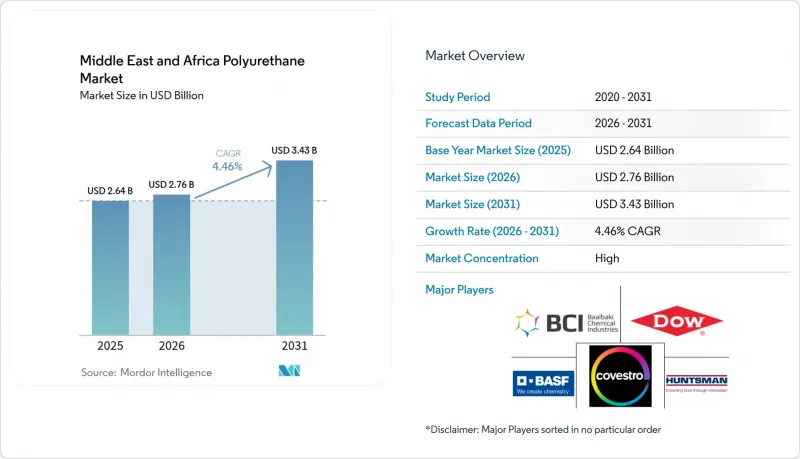
Mordor Intelligence에 의하면, 중동 및 아프리카의 폴리우레탄 시장 규모는 2025년에 26억 4,000만 달러로 평가되었고, 2026년 27억 6,000만 달러에서 2031년까지 34억 3,000만 달러에 이를 것으로 예측되며, 예측 기간(2026-2031년) CAGR은 4.46%를 기록할 전망입니다.
본 보고서는 용도별(발포체, 코팅, 접착제 및 실란트, 엘라스토머, 기타), 최종 사용자 산업별(건축 및 건설, 가구 및 침구, 자동차, 전자기기·가전, 기타),원재료(MDI, TDI, 폴리에테르 폴리올, 폴리에스터 폴리올, 기타), 지역(사우디아라비아, 아랍에미리트, 남아프리카공화국, 이집트, 쿠웨이트, 기타)별로 분류되어 있습니다.
중동 및 아프리카의 폴리우레탄 시장 동향 및 인사이트
GCC 지역의 인프라 주도 건설 붐
걸프 연안 국가들의 수십억 달러 규모 프로젝트 계획은 경질 발포체, 실란트 및 스프레이식 단열재에 대한 최대 수요 동력이 되고 있습니다. NEOM, 홍해 관광 회랑, 두바이 2040 도시 재생 계획과 같은 대규모 개발 프로젝트에서는 운영 시 배출량을 최소 50% 절감하는 건축 외피 솔루션이 요구되고 있습니다. 폴리우레탄 패널 및 스프레이 시스템은 장기간 사막 환경에 노출되어도 필요한 내열성과 방습성을 발휘합니다. 현장 설치형 모듈식 근로자 숙소 및 임시 물류 시설은 경질 폴리우레탄 코어를 포함한 프리팹 패널에 대한 수요를 연중 내내 끌어올리고 있습니다. 현지 조달률 의무화로 인해 이미 여러 국제 혼합 제조업체들은 사우디아라비아와 UAE 내에 혼합 공장을 건설하도록 장려받고 있으며, 이를 통해 리드 타임 단축과 수입 관세 감축이 도모되고 있습니다. 따라서 중동 및 아프리카의 폴리우레탄 시장은 탄화수소 이외의 분야로 다각화를 목표로 하는 해당 지역의 의지에서 직접적인 혜택을 받고 있습니다.
콜드체인 물류 및 단열재 수요 증가
식량 안보의 중요성이 높아지고 백신 배포 프로그램이 진행되는 가운데, 온도 관리형 창고, 태양광 발전식 냉장 키오스크, 단열 운송 컨테이너에 대한 투자가 가속화되고 있습니다. 사하라 이남 아프리카에서 발생하는 농산물 손실의 약 절반은 불충분한 냉각 인프라에서 기인합니다. 폴리우레탄 단열 패널과 상변화 저장 모듈을 갖춘 분산형 냉장실은 부패를 방지하고, 농가의 소득을 향상시키며, 기후 변화 적응을 위한 자금 조달 기준을 충족합니다. 아프리카의 스타트업 기업들은 2020년 이후 수천 대의 태양광 발전식 냉장 장치를 도입해 왔으며, 이는 경질 발포체 시장 규모가 확대될 수 있음을 시사합니다. 국제개발은행은 에너지 절약 효과를 극대화하기 위해 높은 R값을 가진 단열재의 사용을 표준으로 규정하고 있으며, 이로 인해 프로젝트 사양에서 폴리우레탄이 필수 요소가 되었습니다. 이러한 동향은 중동 및 아프리카의 폴리우레탄 시장의 장기적인 수요 전망을 공고히 하고 있습니다.
TDI/MDI에 대한 VOC 및 근로자 안전 기준 강화
미국 산업위생학회(ACGIH)는 TDI의 8시간 노출 한계치를 1 ppb로 하향 조정했습니다. 지역 내 공장들은 규제를 지속적으로 준수하기 위해 실시간 모니터링, 전용 환기 설비 및 생체 모니터링 프로그램이 필요합니다. 설비 투자로 인한 비용 증가는 규모의 경제 효과를 누릴 수 없는 중소규모 가공업체들에게 가장 큰 부담이 되어, 업계 재편을 가속화할 가능성이 있습니다. 다국적 기업들은 SDS(안전 데이터 시트) 개정 및 모노머 함량이 낮은 대체재 공급을 추진하고 있으나, 가격 상승은 피할 수 없습니다. 규제 준수를 위한 지출로 인해 중동 및 아프리카의 폴리우레탄 시장의 단기적인 이익률은 억제될 것으로 예측됩니다.
부문 분석
2025년에는 발포체가 매출의 59.28%를 차지하며, 단열재, 좌석재, 포장재의 기반으로서 그 입지를 확고히 다졌습니다. 경질 발포체는 지역 냉방 시스템 및 에너지 절약 건축 기준의 혜택을 가장 많이 받고 있는 반면, 연질 발포체는 자동차 및 가구 시장의 확대 흐름에 편승하고 있습니다. 지붕 보수 공사에서는 열 사이클 스트레스 하에서 이음매 없는 피복이 판재 제품보다 우수한 성능을 발휘하기 때문에 스프레이 폼의 사용이 증가하고 있습니다. 코팅 분야는 규모는 작지만, 선박용 부식 방지 계약 및 산업용 바닥 개보수를 배경으로 연평균 성장률(CAGR) 5.19%라는 견조한 성장세를 보이고 있습니다. 각 배합 제조업체들은 더욱 엄격해진 배출 규제를 충족하기 위해 VOC 제로 폴리우레탄 분산 기술을 도입하고 있습니다. 이러한 동향들이 맞물려 중동 및 아프리카의 폴리우레탄 시장의 매출 호조를 뒷받침하고 있습니다.
엘라스토머 화학의 발전으로 인해 내마모성이 요구되는 유전 파이프라인용 피그, 광산용 스크린, 컨베이어 벨트와 같은 틈새 시장이 개척되고 있습니다. 접착제 및 실란트는 모듈식 건설 기법의 보급으로 혜택을 받고 있으며, 습기 경화형 제품이 현장에서의 신속한 조립을 가능하게 하고 있습니다. ADNOC의 코베스트로 인수에 따른 수직 통합은 현지 가공업체를 위한 비용 최적화된 발포 시스템을 제공할 것으로 기대되며, 이는 중동 및 아프리카의 폴리우레탄 시장공급망 민첩성을 높이는 데 기여할 것입니다.
기타 혜택:
- 엑셀 형식 시장 예측(ME) 시트
- 3개월간의 애널리스트 지원
자주 묻는 질문
목차
제1장 서론
제2장 조사 방법
제3장 주요 요약
제4장 시장 구도
제5장 시장 규모와 성장 예측
제6장 경쟁 구도
제7장 시장 기회와 향후 전망
LSH 26.09.09According to Mordor Intelligence, the Middle East and Africa polyurethane market size was valued at USD 2.64 billion in 2025 and estimated to grow from USD 2.76 billion in 2026 to reach USD 3.43 billion by 2031, at a CAGR of 4.46% during the forecast period (2026-2031).
This report is Segmented by Application (Foams, Coatings, Adhesives and Sealants, Elastomers, Others), End-User Industry (Building and Construction, Furniture and Bedding, Automotive, Electronics and Appliances, and More), Raw Material (MDI, TDI, Polyether Polyols, Polyester Polyols, Others), and Geography (Saudi Arabia, United Arab Emirates, South Africa, Egypt, Kuwait, and More).
Middle East And Africa Polyurethane Market Trends and Insights
Infrastructure-Led Construction Boom in GCC
The Gulf's multibillion-dollar project pipeline is the single largest demand catalyst for rigid foams, sealants, and spray-applied insulation. Mega-developments such as NEOM, the Red Sea tourism corridor, and Dubai 2040 urban upgrades specify building-envelope solutions that cut operational emissions by at least 50%. Polyurethane panels and spray systems deliver the required thermal resistance and moisture control under prolonged desert exposure. Modular on-site worker housing and temporary logistics facilities add year-round volume for prefabricated panels containing rigid polyurethane cores. Mandatory local-content thresholds are already encouraging international formulators to build blending plants inside Saudi Arabia and the UAE, shortening lead times and lowering import tariffs. The Middle East and Africa polyurethane market therefore benefits directly from the region's determination to diversify beyond hydrocarbons.
Expansion of Cold-Chain Logistics and Insulation Demand
Rising food-security priorities and vaccine-distribution programs are accelerating investment in temperature-controlled warehouses, solar-powered refrigeration kiosks, and insulated shipping containers. Roughly half of produce losses in sub-Saharan Africa are linked to inadequate cooling infrastructure. Distributed cold rooms equipped with polyurethane-insulated panels and phase-change storage modules cut spoilage, enhance farmer incomes, and meet climate-adaptation funding criteria. African start-ups have deployed thousands of solar refrigeration units since 2020, illustrating the scalable addressable volume for rigid foams. International development banks routinely stipulate high-R-value insulation to maximize energy savings, locking polyurethane into project specifications. These trends reinforce long-run demand visibility for the Middle East and Africa polyurethane market.
Stricter VOC and Worker-Safety Limits on TDI/MDI
The American Conference of Governmental Industrial Hygienists has cut the 8-hour exposure limit for TDI to 1 ppb. Regional factories will need real-time monitoring, specialized ventilation, and biomonitoring programs to remain compliant. Capital upgrades weigh heaviest on small and mid-sized converters that lack scale economies, potentially accelerating consolidation. Multinationals are revising SDS documentation and offering lower-monomer alternatives, but pricing uplifts are unavoidable. Compliance spending is expected to temper near-term margins inside the Middle East and Africa polyurethane market.
Other drivers and restraints analyzed in the detailed report include:
- Automotive and EV Production Localization
- Growth in Regional Furniture and Mattress Manufacturing
- Reduced Energy Subsidies Inflating Processing Costs
For complete list of drivers and restraints, kindly check the Table Of Contents.
Segment Analysis
Foams generated 59.28% of revenue in 2025, cementing their role as the backbone of insulation, seating, and packaging. Rigid foams benefit most from district-cooling lines and energy-efficient building codes, while flexible foams ride the wave of automotive and furniture expansion. Spray foam usage is climbing in roof retrofits where seamless coverage outperforms board products under thermal-cycling stress. The coatings subsector, though smaller, is growing at a robust 5.19% CAGR on the back of marine anti-corrosion contracts and industrial floor refurbishments. Formulators are introducing zero-VOC polyurethane dispersion technologies to meet tighter emission caps. Collectively, these dynamics reinforce the revenue resilience of the Middle East and Africa polyurethane market.
Advances in elastomer chemistry are opening niches in oil-field pipeline pigs, mining screens, and conveyor belts that demand abrasion resistance. Adhesives and sealants profit from modular construction practices, with moisture-cured grades enabling rapid on-site assembly. Vertical integration by ADNOC after acquiring Covestro is expected to yield cost-optimized foam systems for local converters, enhancing supply-chain agility inside the Middle East and Africa polyurethane market.
Complete Report Scope:
- By Application
- Foams
- Rigid Foam
- Flexible Foam
- Spray Foam
- Coatings
- Adhesives and Sealants
- Elastomers
- Others
- Foams
- By End-user Industry
- Building and Construction
- Furniture and Bedding
- Automotive
- Electronics and Appliances
- Footwear
- Packaging
- Oil and Gas and Mining
- Others
- By Raw Material
- MDI
- TDI
- Polyether Polyols
- Polyester Polyols
- Others (Bio-based Polyols)
- By Geography
- Saudi Arabia
- United Arab Emirates
- South Africa
- Egypt
- Kuwait
- Qatar
- Morocco
- Rest of Middle-East and Africa
List of Companies Covered in this Report:
- BASF
- BCI Holding SA
- Covestro AG
- Dow
- Foamhouse
- Huntsman International LLC
- Kuwait Polyurethane Industries W.L.L.
- LANXESS
- Mitsui Chemicals, Inc.
- Pearl Polyurethane
- Perfect Rubber
- Recticel NV
- Royal Foam Products Ltd.
- SABIC
- SAFIC ALCAN
- Saudi Industrial Resins Limited
- Sika AG
- Synthomer plc
- Vitafoam Nigeria PLC
- Wanhua Chemical Group Co., Ltd.
- Woodbridge
Additional Benefits:
- The market estimate (ME) sheet in Excel format
- 3 months of analyst support
TABLE OF CONTENTS
1 Introduction
- 1.1 Study Assumptions and Market Definition
- 1.2 Scope of the Study
2 Research Methodology
3 Executive Summary
4 Market Landscape
- 4.1 Market Overview
- 4.2 Market Drivers
- 4.2.1 Infrastructure-led construction boom in GCC
- 4.2.2 Expansion of cold-chain logistics and insulation demand
- 4.2.3 Automotive and EV production localisation
- 4.2.4 Growth in regional furniture and mattress manufacturing
- 4.2.5 District-cooling mandates driving high-R-value panels
- 4.3 Market Restraints
- 4.3.1 Volatile isocyanate and polyol prices
- 4.3.2 Stricter VOC and worker-safety limits on TDI/MDI
- 4.3.3 Reduced energy subsidies inflating PU processing costs
- 4.4 Value Chain Analysis
- 4.5 Porter's Five Forces
- 4.5.1 Bargaining Power of Suppliers
- 4.5.2 Bargaining Power of Buyers
- 4.5.3 Threat of New Entrants
- 4.5.4 Threat of Substitutes
- 4.5.5 Degree of Competition
5 Market Size and Growth Forecasts (Value)
- 5.1 By Application
- 5.1.1 Foams
- 5.1.1.1 Rigid Foam
- 5.1.1.2 Flexible Foam
- 5.1.1.3 Spray Foam
- 5.1.2 Coatings
- 5.1.3 Adhesives and Sealants
- 5.1.4 Elastomers
- 5.1.5 Others
- 5.1.1 Foams
- 5.2 By End-user Industry
- 5.2.1 Building and Construction
- 5.2.2 Furniture and Bedding
- 5.2.3 Automotive
- 5.2.4 Electronics and Appliances
- 5.2.5 Footwear
- 5.2.6 Packaging
- 5.2.7 Oil and Gas and Mining
- 5.2.8 Others
- 5.3 By Raw Material
- 5.3.1 MDI
- 5.3.2 TDI
- 5.3.3 Polyether Polyols
- 5.3.4 Polyester Polyols
- 5.3.5 Others (Bio-based Polyols)
- 5.4 By Geography
- 5.4.1 Saudi Arabia
- 5.4.2 United Arab Emirates
- 5.4.3 South Africa
- 5.4.4 Egypt
- 5.4.5 Kuwait
- 5.4.6 Qatar
- 5.4.7 Morocco
- 5.4.8 Rest of Middle-East and Africa
6 Competitive Landscape
- 6.1 Market Concentration
- 6.2 Strategic Moves
- 6.3 Market Share**/Ranking Analysis
- 6.4 Company Profiles (includes Global level Overview, Market level overview, Core Segments, Financials as available, Strategic Information, Market Rank/Share for key companies, Products and Services, and Recent Developments)
- 6.4.1 BASF
- 6.4.2 BCI Holding SA
- 6.4.3 Covestro AG
- 6.4.4 Dow
- 6.4.5 Foamhouse
- 6.4.6 Huntsman International LLC
- 6.4.7 Kuwait Polyurethane Industries W.L.L.
- 6.4.8 LANXESS
- 6.4.9 Mitsui Chemicals, Inc.
- 6.4.10 Pearl Polyurethane
- 6.4.11 Perfect Rubber
- 6.4.12 Recticel NV
- 6.4.13 Royal Foam Products Ltd.
- 6.4.14 SABIC
- 6.4.15 SAFIC ALCAN
- 6.4.16 Saudi Industrial Resins Limited
- 6.4.17 Sika AG
- 6.4.18 Synthomer plc
- 6.4.19 Vitafoam Nigeria PLC
- 6.4.20 Wanhua Chemical Group Co., Ltd.
- 6.4.21 Woodbridge
7 Market Opportunities and Future Outlook
- 7.1 White-space and Unmet-Need Assessment


