

|
시장보고서
상품코드
2121451
커넥티드카 디바이스 : 시장 점유율 분석, 업계 동향과 통계, 성장 예측(2026-2031년)Connected Car Devices - Market Share Analysis, Industry Trends & Statistics, Growth Forecasts (2026 - 2031) |
||||||
 Mordor Intelligence
커넥티드카 디바이스 시장 규모는 2026년에 725억 2,000만 달러로 추정되며, 2025년 632억 7,000만 달러에서 확대되어 2031년에는 1,434억 7,000만 달러에 달할 것으로 예측됩니다.
2026년부터 2031년까지 연평균 성장률(CAGR) 14.62%로 성장할 것으로 전망됩니다.
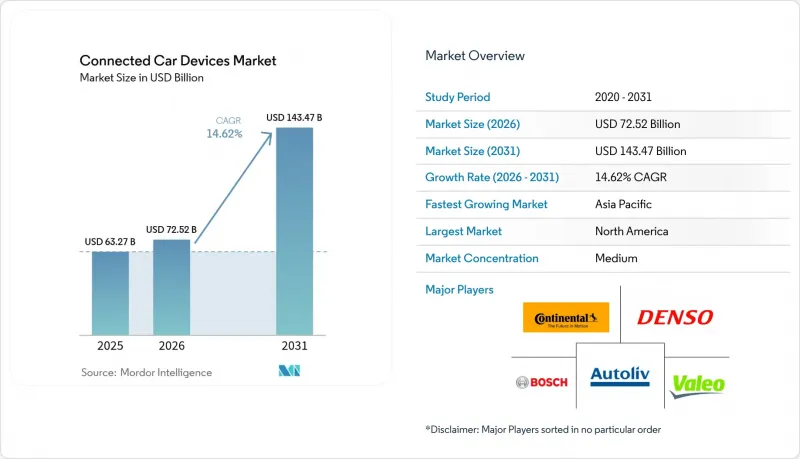
본 보고서는 최종사용자 유형(OEM 및 애프터마켓), 통신 유형(V2V, V2I 등), 제품 유형(운전 지원 시스템(DAS), 텔레매틱스 등), 연결 기술(임베디드형, 통합형 등), 차량 구동 방식(내연기관 및 전기), 그리고 지역별로 분류되어 있습니다. 시장 예측은 금액(달러) 기준으로 제시되어 있습니다.
세계 커넥티드카 디바이스 시장의 동향 및 인사이트
5G의 급속한 확산과 통신 사업자·OEM 간의 제휴
자동차용 5G 연결 서비스 제공 수익은 2027년까지 비약적으로 성장할 것으로 예측됩니다. 시스코와 TELUS는 이미 자동화 플랫폼을 통해 150만 대 이상의 5G 지원 차량에 서비스를 제공하고 있으며, 자율주행 기능에 필수적인 지연 시간을 거의 실시간 수준으로 단축하고 있습니다. 현재 파트너십을 통해 커넥티비티, 엣지 컴퓨팅, 개발자용 도구가 통합된 솔루션이 제공되고 있어, 각 OEM 업체들은 새로운 서비스를 보다 신속하게 출시할 수 있게 되었습니다. 이러한 제휴를 통해 통신 사업자가 단순한 대역폭 제공자에서 전략적 기술 파트너로 역할을 전환함에 따라, 공급업체 업계의 구도가 변화하고 있습니다. 그 결과 탄생하는 서비스 플랫폼은 프리미엄 인포테인먼트, 원격 진단, 고해상도 지도를 지원하며, 사용자 1인당 평균 수익(ARPU) 향상에 기여합니다.
E-Call 및 ADAS의 규제 의무화
미국 도로교통안전국(NHTSA)은 2029년 9월까지 모든 경차에 보행자 감지 기능이 탑재된 자동 긴급 제동 시스템의 장착을 의무화하고 있으며, 이에 따른 연간 규정 준수 비용은 3억 5,400만 달러,생애 전반에 걸친 편익은 58억 2,000만 달러를 초과할 것으로 예상됩니다. 유럽에서는 ‘일반 안전 규정’에 따라 e-Call 및 일련의 운전 지원 기능이 의무화되어 있는 반면, 중국에서는 베이징에 7,000기 이상의 5G-A 기지국을 설치하고, 차량·도로·클라우드를 연계한 실증 실험을 확대하고 있습니다. 이러한 규제로 인해 도입 일정에 대한 불확실성이 해소되었으며, 각 OEM사는 커넥티드 센서를 표준 사양으로 탑재하도록 권장받고 있습니다. 공급업체는 예측 가능한 생산량으로 인한 혜택을 누리고, 소비자는 사고율을 낮추는 보편적인 안전 기능을 누릴 수 있습니다.
사이버 보안 취약점 및 리콜
‘Pwn2Own Automotive 2024’ 대회에서 알파인의 인포테인먼트 장치 ‘Halo9’에 성공률 96%의 제로클릭 공격이 발견되어, 원격 침해가 얼마나 쉬운지 여실히 드러났습니다. 2023년에는 소프트웨어 관련 리콜이 3,000만 대 이상의 차량에 영향을 미쳤으며, NIST에 등록된 CVE-2023-6248 취약점으로 인해 일반적인 텔레매틱스 게이트웨이를 완전히 장악하는 것이 가능해졌습니다. 차량이 ‘달리는 데이터센터’로 변모함에 따라 공격 표면은 확대되고 있으며, 판매 후 패치 적용에 드는 비용과 평판 하락으로 인한 피해가 증가하고 있습니다. 규제 당국은 ‘보안 설계(Security by Design)’를 요구하며, 공급업체들에게 하드웨어 기반의 신뢰의 근원(Root of Trust) 통합, 안전한 무선 업데이트(OTA) 프레임워크, 그리고 지속적인 침투 테스트 실시를 촉구하고 있습니다.
부문 분석
2025년에는 OEM(자동차 제조사)의 탑재가 커넥티드카 디바이스 시장 점유율의 62.68%를 차지했습니다. 이는 출고 시 내장된 하드웨어가 차량 진단, 전력 관리, 보증 체계와 깊이 통합되어 있기 때문입니다. 자동차 제조사들은 e-Call 및 ADAS의 규제 요건을 준수하고, 무선 업그레이드를 효율화하며, 데이터에 대한 브랜드 관리를 강화하기 위해 조립 공정에서 모듈을 탑재하고 있습니다. 소프트웨어 정의 아키텍처에 대한 의존도가 높아지는 가운데, 각 OEM 업체들이 커넥티비티를 원격 기능 활성화나 예측 유지보수 같은 수익 창출형 서비스와 연계함으로써 이 채널의 주도적 위상은 확고해지고 있습니다.
한편, 보험사 및 차량 관리 업체들이 기존 차량을 사후 개조하는 추세가 확산됨에 따라 애프터마켓 공급업체들은 연평균 성장률(CAGR) 15.51%라는 높은 속도로 급속히 성장하고 있습니다. 플러그 앤 플레이 방식의 동글이나 유선 연결 방식의 블랙박스는 행동 기반 보험료 책정 및 자산 추적의 기반이 되는 실시간 이용 데이터를 제공합니다. HARMAN사의 ‘ready-upgrade’ 키트는 신속한 설치와 타 브랜드와의 호환성이 필요한 혼합 차량군을 위해 맞춤화된 솔루션의 좋은 예입니다. OEM의 지배력은 여전히 강력하지만, 가격에 민감한 개인 소유자 및 상업 운영자에 의한 병행 애프터마켓이 계속해서 시장을 견인하고 있어 커넥티드카 기기 시장에서 경쟁력 있는 다양성을 확보하고 있습니다.
차량 간 통신(V2V)은 도로변 장비가 없어도 충돌 경고를 제공할 수 있기 때문에 2025년에는 커넥티드카 기기 시장 매출의 39.05%를 차지했습니다. 성숙한 표준과 입증된 안전성 향상은, 특히 5성급 안전 등급을 목표로 하는 양산 모델에서 OEM 각사가 V2V를 우선적으로 채택하도록 뒷받침하고 있습니다. 또한, 상용 차량에서도 전방 충돌 경보를 통해 가동 중단 시간과 보험 비용을 절감할 수 있기 때문에 사후 장착이 급속히 확산되고 있습니다.
V2G(차량에서 전력망으로의 전력 공급) 기능은 재생에너지 비율이 높은 전력망을 안정화하기 위해 전력 사업자와 자동차 제조사가 제휴하고 있어, 2031년까지 연평균 성장률(CAGR) 14.92%를 기록할 것으로 예측됩니다. 커넥티비티와 결합된 양방향 충전기를 통해 전기자동차는 저장된 전력을 전력망에 공급할 수 있게 되어, 소유자 및 전력망 운영자에게 새로운 수익원을 제공합니다. V2I(차량 대 인프라) 및 V2P(차량 대 보행자) 분야의 성장은 스마트 시티 투자와 연동되어 있지만, 이는 보다 광범위한 공공 투자에 의존하고 있습니다. 장기적으로는 통합된 V2X 제품군이 모든 교통 수단을 융합하게 될 것이지만, 생태계가 성숙해가는 과정에서 V2V는 계속해서 그 기반을 유지할 것입니다.
지역별 분석
2025년, 북미는 커넥티드카 및 디바이스 시장의 38.26%를 차지했습니다. 이러한 확산은 ‘인프라 투자 및 고용법’에 따른 연방 정부의 자금 지원과 ADAS, 고해상도 인포테인먼트, 5G 핫스팟을 탑재한 프리미엄 SUV에 대한 소비자 수요에 의해 주도되고 있습니다. 미국 교통부와 5G Automotive Association의 지속적인 실증 실험이 C-V2X에 대한 신뢰를 높이는 한편, 엄격한 사이버 보안 및 개인정보 보호 규제가 조달 사양을 형성하고 있습니다. 캐나다와 멕시코는 통합된 공급망의 혜택을 누리고 있으며, 이를 통해 지역 OEM 공장은 커넥티드 모듈 및 소프트웨어 스택의 표준화가 가능해졌습니다. 이러한 요인들로 인해 북미 전역에서 건전한 차량 교체 주기와 애프터서비스 구독 모델이 유지되고 있습니다.
아시아태평양은 2031년까지 15.02%라는 가장 높은 연평균 성장률(CAGR)을 기록할 것으로 전망됩니다. 중국의 ‘차량·도로·클라우드’ 구상이 민관 투자를 뒷받침하고 있으며, 베이징시에서만 스마트 모빌리티를 위해 7,000개 이상의 5G-A 기지국이 설치되어 있습니다. 국내 브랜드들은 치열한 경쟁이 벌어지는 전기자동차 시장에서 차별화를 꾀하기 위해 커넥티비티 기능을 탑재하고 있는 반면, 지역 공급업체들은 이륜차 및 마이크로카를 대상으로 비용 최적화된 텔레매틱스 솔루션을 제공하고 있습니다. 일본과 한국은 반도체 제조 노하우와 조기 5G 구축을 활용하여 차세대 C-V2X의 사이드링크 기능 시험을 진행하고 있습니다. 인도에서는 안전 기준이 엄격해지고, 스마트폰에 익숙한 소비자들이 상시 연결형 인포테인먼트 시스템을 요구함에 따라 대규모 시장 기회가 부상하고 있지만, 가격에 대한 민감도로 인해 유선 연결형 솔루션도 여전히 중요한 위치를 차지하고 있습니다.
유럽에서는 e-Call 의무화 및 일반 안전 규정(GSR) 등 조화로운 규제 하에 꾸준한 성장세를 유지하고 있습니다. 독일, 영국, 프랑스가 도입을 주도하고 있으며, 고급차 브랜드가 프리미엄 등급에 커넥티비티 기능을 기본 사양으로 탑재하는 가운데, 중급 브랜드도 이를 따르고 있습니다. 에너지 효율 및 탄소 배출 감축 목표를 배경으로, 전기자동차 충전과 재생에너지 발전량을 연동시키는 ‘V2G(Vehicle-to-Grid)’ 시범 사업에 대한 관심이 높아지고 있습니다. 엄격한 데이터 주권 관련 법안이 클라우드 호스팅 선택에 영향을 미치며, 유럽에 거점을 둔 제공업체에 우위를 제공하고 있습니다. 사이버 보안 인증에 관한 EU 전역의 기준이 마련되고 있어, 국경을 초월한 형식 승인의 효율화가 도모되며, 커넥티드카 및 디바이스 시장을 더욱 활성화시킬 것으로 기대됩니다.
기타 혜택:
- 엑셀 형식의 시장 예측(ME) 시트
- 3개월간의 애널리스트 지원
자주 묻는 질문
목차
제1장 소개
제2장 조사 방법
제3장 주요 요약
제4장 시장 구도
제5장 시장 규모와 성장 예측
제6장 경쟁 구도
제7장 시장 기회와 향후 전망
KSM 26.09.03According to Mordor Intelligence, connected car devices market size in 2026 is estimated at USD 72.52 billion, growing from 2025 value of USD 63.27 billion with 2031 projections showing USD 143.47 billion, growing at 14.62% CAGR over 2026-2031.
This report is Segmented by End-User Type (OEM and Aftermarket), Communication Type (V2V, V2I, and More), Product Type (Driver Assistance System (DAS), Telematics, and More), Connectivity Technology (Embedded, Integrated, and More), Vehicle Propulsion Type (IC Engine and Electric), and Geography. The Market Forecasts are Provided in Terms of Value (USD).
Global Connected Car Devices Market Trends and Insights
Rapid 5G Roll-Out and Carrier-OEM Partnerships
Automotive 5G connections are forecast to grow exponentially in enablement revenues by 2027. Cisco and TELUS already provision more than 1.5 million 5G vehicles on automated platforms, cutting latency to near-real-time levels critical for autonomous features. Partnerships now bundle connectivity, edge computing, and developer tools into unified offerings that let OEMs launch new services faster. These alliances change the supplier landscape because carriers shift from bandwidth providers to strategic technology partners. The resulting service platforms underpin premium infotainment, remote diagnostics, and high-definition maps, supporting higher average revenue per user.
Mandatory E-Call and ADAS Regulations
The National Highway Traffic Safety Administration requires automatic emergency braking with pedestrian detection on all light vehicles by September 2029, carrying USD 354 million in annual compliance costs and lifetime benefits topping USD 5.82 billion. Europe enforces e-Call and a suite of driver-assistance functions under the General Safety Regulation, while China scales vehicle-road-cloud pilots with more than 7,000 5G-A base stations in Beijing. These mandates remove uncertainty around timelines, prompting OEMs to integrate connected sensors as standard equipment. Suppliers benefit from predictable volumes, and consumers gain universal safety features that lower accident rates.
Cyber-Security Vulnerabilities and Recalls
The Pwn2Own Automotive 2024 contest exposed a zero-click exploit in Alpine's Halo9 infotainment unit with a 96% success rate, highlighting the ease of remote compromise. Software-related recalls affected over 30 million vehicles in 2023, and the NIST-listed CVE-2023-6248 flaw enables full device takeover of popular telematics gateways. As vehicles become rolling data centres, their attack surface expands, raising the cost of post-sale patches and reputational damage. Regulators demand security-by-design, pushing suppliers to embed hardware root-of-trust, secure over-the-air frameworks, and continuous penetration testing.
Other drivers and restraints analyzed in the detailed report include:
- Subscription-Based Revenue Targets
- Edge AI Chips for In-Vehicle Inferencing
- High BOM Cost of Multi-Band V2X Modules
For complete list of drivers and restraints, kindly check the Table Of Contents.
Segment Analysis
OEM installations captured 62.68% of the connected car devices market share in 2025 because factory-fitted hardware integrates deeply with vehicle diagnostics, power management, and warranty frameworks. Automakers embed modules during assembly to ensure compliance with e-Call and ADAS mandates, streamline over-the-air upgrades, and bolster brand control over data. Growing reliance on software-defined architectures cements this channel's leadership as OEMs link connectivity to revenue-generating services such as remote feature activation and predictive maintenance.
However, aftermarket providers are expanding quickly, with a 15.51% CAGR, as insurers and fleet managers retrofit legacy assets. Plug-and-play dongles and hardwired black boxes supply real-time usage data that underpins behaviour-based premiums and asset tracking. HARMAN's ready-upgrade kits exemplify solutions tailored for mixed fleets needing installation speed and cross-brand compatibility. While OEM control remains strong, price-sensitive owners and commercial operators continue to drive a parallel aftermarket, ensuring competitive variety within the connected car devices market.
Vehicle-to-vehicle links represented 39.05% of the connected car devices market revenue share in 2025 because they deliver collision warnings without requiring roadside units. Mature standards and demonstrated safety gains encourage OEMs to adopt V2V first, particularly in high-volume models aiming for five-star safety ratings. Retrofits also proliferate in commercial fleets where forward-collision alerts cut downtime and insurance costs.
Vehicle-to-grid capability is projected to post a 14.92% CAGR to 2031 as energy utilities partner with automakers to stabilise renewable-heavy grids. Bidirectional chargers paired with connectivity let electric cars feed stored power back to the network, creating new revenue for owners and grid operators. Growth in vehicle-to-infrastructure and vehicle-to-pedestrian segments follows smart-city spending, yet these depend on broader public investment. Over time, integrated V2X suites will blend all modes, but V2V will remain the cornerstone while ecosystems mature around it.
Complete Report Scope:
- By End-User Type
- OEM
- Aftermarket
- By Communication Type
- V2V
- V2I
- V2P
- V2N
- V2G
- By Product Type
- Driver Assistance System (ADAS)
- Telematics
- In-Car Infotainment
- Cyber-security Hardware
- By Connectivity Technology
- Embedded
- Integrated
- Tethered
- DSRC
- C-V2X (4G/5G)
- By Vehicle Propulsion Type
- Internal-Combustion Engine Vehicles
- Electric Vehicles
- Battery Electric Vehicle
- Hybrid Electric Vehicle
- Fuel-cell Electric Vehicle
- Plug-in Hybrid Electric Vehicle
- By Geography
- North America
- United States
- Canada
- Rest of North America
- South America
- Brazil
- Argentina
- Rest of South America
- Europe
- Germany
- United Kingdom
- France
- Spain
- Italy
- Rest of Europe
- Asia-Pacific
- China
- Japan
- India
- South Korea
- Rest of Asia-Pacific
- Middle East and Africa
- United Arab Emirates
- Saudi Arabia
- South Africa
- Rest of Middle East and Africa
- North America
Geography Analysis
North America accounted for 38.26% of the connected car devices market share in 2025. Uptake is driven by federal funding under the Infrastructure Investment and Jobs Act and consumer appetite for premium SUVs brimming with ADAS, high-definition infotainment, and 5G hotspots. Ongoing pilots with the U.S. Department of Transportation and the 5G Automotive Association boost confidence in C-V2X, while tight cybersecurity and privacy rules shape procurement specifications. Canada and Mexico benefit from integrated supply chains, enabling regional OEM plants to standardise connected modules and software stacks. These factors sustain healthy replacement cycles and after-sales subscriptions across North America.
Asia-Pacific is on track for the fastest 15.02% CAGR to 2031. China's vehicle-road-cloud blueprint anchors public and private spending, with Beijing alone hosting more than 7,000 5G-A base stations for intelligent mobility. Domestic brands embed connectivity to differentiate in a crowded electric-vehicle arena, while regional suppliers deliver cost-optimised telematics for two-wheelers and microcars. Japan and South Korea leverage chip-making prowess and early 5G roll-outs to test next-generation C-V2X sidelink features. India emerges as a high-volume opportunity as safety norms tighten and smartphone-savvy buyers demand always-on infotainment, though price sensitivity keeps tethered solutions relevant.
Europe maintains steady momentum under harmonised regulations such as mandatory e-Call and the General Safety Regulation. Germany, the United Kingdom, and France lead adoption as luxury marques bundle connectivity into premium trim lines, and mid-range brands follow suit. Energy-efficiency and carbon-reduction goals drive interest in vehicle-to-grid pilots that align EV charging with renewable output. Strict data sovereignty laws influence cloud-hosting choices, giving European-based providers an edge. Pan-EU standards for cybersecurity certification are under development, promising to streamline cross-border homologation and further stimulate the connected car devices market.
- Continental AG
- Robert Bosch GmbH
- Denso Corporation
- ZF Friedrichshafen AG
- Harman International
- Valeo SA
- Magna International
- Panasonic Corp.
- Visteon Corp.
- Autoliv Inc.
- Infineon Technologies AG
- Autotalks Ltd.
- Qualcomm Inc.
- NXP Semiconductors
- NVIDIA Corp.
- Sierra Wireless
- Cisco Systems
- Huawei Technologies
- AT&T
- Verizon
- Vodafone Group
- Ericsson
- LG Electronics
- Telit
Additional Benefits:
- The market estimate (ME) sheet in Excel format
- 3 months of analyst support
TABLE OF CONTENTS
1 Introduction
- 1.1 Study Assumptions & Market Definition
- 1.2 Scope of the Study
2 Research Methodology
3 Executive Summary
4 Market Landscape
- 4.1 Market Overview
- 4.2 Market Drivers
- 4.2.1 Rapid 5G Roll-Out and Carrier-OEM Partnerships
- 4.2.2 Mandatory E-Call and ADAS Regulations in US, EU, CN
- 4.2.3 Subscription-Based Revenue Targets by OEMs
- 4.2.4 Edge AI Chips Enabling In-Vehicle Inferencing
- 4.2.5 Usage-Based-Insurance Driving Aftermarket Telematics
- 4.2.6 Cross-Industry App-Store Ecosystems
- 4.3 Market Restraints
- 4.3.1 Cyber-Security Vulnerabilities and Recalls
- 4.3.2 High BOM Cost of Multi-Band V2X Modules
- 4.3.3 Data-Cloud Egress Fees Eroding OEM Service Margins
- 4.3.4 Semiconductor Supply-Chain Fragility
- 4.4 Value / Supply-Chain Analysis
- 4.5 Regulatory Landscape
- 4.6 Technological Outlook
- 4.7 Porter's Five Forces Analysis
- 4.7.1 Threat of New Entrants
- 4.7.2 Bargaining Power of Buyers
- 4.7.3 Bargaining Power of Suppliers
- 4.7.4 Threat of Substitutes
- 4.7.5 Intensity of Rivalry
5 Market Size & Growth Forecasts (Value (USD))
- 5.1 By End-User Type
- 5.1.1 OEM
- 5.1.2 Aftermarket
- 5.2 By Communication Type
- 5.2.1 V2V
- 5.2.2 V2I
- 5.2.3 V2P
- 5.2.4 V2N
- 5.2.5 V2G
- 5.3 By Product Type
- 5.3.1 Driver Assistance System (ADAS)
- 5.3.2 Telematics
- 5.3.3 In-Car Infotainment
- 5.3.4 Cyber-security Hardware
- 5.4 By Connectivity Technology
- 5.4.1 Embedded
- 5.4.2 Integrated
- 5.4.3 Tethered
- 5.4.4 DSRC
- 5.4.5 C-V2X (4G/5G)
- 5.5 By Vehicle Propulsion Type
- 5.5.1 Internal-Combustion Engine Vehicles
- 5.5.2 Electric Vehicles
- 5.5.2.1 Battery Electric Vehicle
- 5.5.2.2 Hybrid Electric Vehicle
- 5.5.2.3 Fuel-cell Electric Vehicle
- 5.5.2.4 Plug-in Hybrid Electric Vehicle
- 5.6 By Geography
- 5.6.1 North America
- 5.6.1.1 United States
- 5.6.1.2 Canada
- 5.6.1.3 Rest of North America
- 5.6.2 South America
- 5.6.2.1 Brazil
- 5.6.2.2 Argentina
- 5.6.2.3 Rest of South America
- 5.6.3 Europe
- 5.6.3.1 Germany
- 5.6.3.2 United Kingdom
- 5.6.3.3 France
- 5.6.3.4 Spain
- 5.6.3.5 Italy
- 5.6.3.6 Rest of Europe
- 5.6.4 Asia-Pacific
- 5.6.4.1 China
- 5.6.4.2 Japan
- 5.6.4.3 India
- 5.6.4.4 South Korea
- 5.6.4.5 Rest of Asia-Pacific
- 5.6.5 Middle East and Africa
- 5.6.5.1 United Arab Emirates
- 5.6.5.2 Saudi Arabia
- 5.6.5.3 South Africa
- 5.6.5.4 Rest of Middle East and Africa
- 5.6.1 North America
6 Competitive Landscape
- 6.1 Market Concentration
- 6.2 Strategic Moves
- 6.3 Market Share Analysis
- 6.4 Company Profiles (includes Global Level Overview, Market Level Overview, Core Segments, Financials as Available, Strategic Information, Market Rank/Share for Key Companies, Products and Services, SWOT Analysis, and Recent Developments)
- 6.4.1 Continental AG
- 6.4.2 Robert Bosch GmbH
- 6.4.3 Denso Corporation
- 6.4.4 ZF Friedrichshafen AG
- 6.4.5 Harman International
- 6.4.6 Valeo SA
- 6.4.7 Magna International
- 6.4.8 Panasonic Corp.
- 6.4.9 Visteon Corp.
- 6.4.10 Autoliv Inc.
- 6.4.11 Infineon Technologies AG
- 6.4.12 Autotalks Ltd.
- 6.4.13 Qualcomm Inc.
- 6.4.14 NXP Semiconductors
- 6.4.15 NVIDIA Corp.
- 6.4.16 Sierra Wireless
- 6.4.17 Cisco Systems
- 6.4.18 Huawei Technologies
- 6.4.19 AT&T
- 6.4.20 Verizon
- 6.4.21 Vodafone Group
- 6.4.22 Ericsson
- 6.4.23 LG Electronics
- 6.4.24 Telit
7 Market Opportunities & Future Outlook
- 7.1 White-space & Unmet-need Assessment


