

|
시장보고서
상품코드
2121491
심전도(ECG) : 시장 점유율 분석, 업계 동향과 통계, 성장 예측(2026-2031년)Electrocardiograph (ECG) - Market Share Analysis, Industry Trends & Statistics, Growth Forecasts (2026 - 2031) |
||||||
 Mordor Intelligence
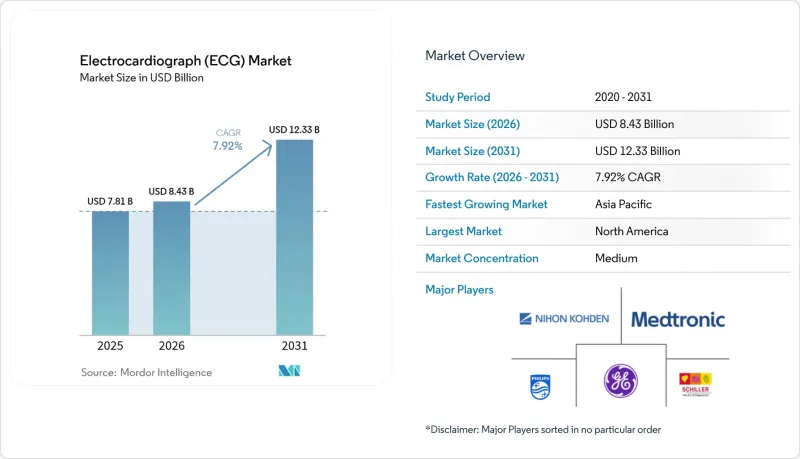
Mordor Intelligence에 의하면, 심전도(ECG) 시장 규모는 2025년에 78억 1,000만 달러, 2026년에 84억 3,000만 달러에 이르고, 2031년까지 123억 3,000만 달러에 이를 것으로 예측되며, 2026-2031년 CAGR 7.92%를 기록할 전망입니다.
본 보고서는 제품 유형(안정 시 심전도 시스템, 부하 심전도 시스템, 홀터 모니터, 이벤트 레코더 등), 리드 유형(단일 리드, 3-6리드 등), 최종 사용자(병원 및 진료소, 외래수술센터(ASC) 등), 기술(아날로그, 디지털/클라우드 연결형), 지역(북미, 유럽 등)별로 분류되어 있습니다. 시장 예측은 금액(달러) 기준으로 제시되어 있습니다.
전 세계 심전도(ECG) 시장 동향 및 인사이트
심혈관 질환 유병률 증가
2024년에는 허혈성 심장 질환과 뇌졸중으로 인해 1,790만 명이 사망할 것으로 예상되며, 2030년까지는 2,300만 명에 달할 것으로 예측되어 전 세계적으로 조기 발견에 대한 수요가 높아지고 있습니다. 인도의 국가 프로그램에서는 2025년에 지방 진료소를 순회하는 배터리 구동 장비를 사용하여 1억 5,000만 명의 성인을 선별 검사했습니다. 고용주와 보험사는 연간 1조 1,000억 달러에 달하는 경제적 부담을 인식하고 있으며, 이에 따라 보험 급여 지급 경향은 일회성 검사보다는 경과 관찰을 통한 심전도 모니터링을 우선시하는 방향으로 바뀌고 있습니다. 그 결과, 1차 진료 및 지역 의료 센터에서 휴대용 시스템의 도입 기반이 확대되고 있습니다.
AI 탑재 심전도 기기의 급속한 보급
2025년에 FDA 승인을 받은 14개의 AI-ECG 알고리즘은 머신러닝 기반 분석에 대한 규제 당국의 신뢰를 반영하고 있습니다. 메이요 클리닉의 플랫폼은 2025년에 이를 도입한 응급실에서 심근경색 진단까지 걸리는 시간을 18분 단축했습니다. 2025년 9월에 발표된 알고리즘 공정성 관련 지침 초안에서는 성별, 인종, 연령에 걸친 검증이 의무화되어 있어, 이로 인해 제품 출시가 지연될 가능성은 있지만 임상의들의 신뢰는 높아질 것입니다. 도시 지역의 병원들은 클라우드 인프라를 갖추고 있어 선제적으로 도입하고 있지만, 지방의 의료시설에서는 여전히 수동 판독에 의존하고 있습니다. 이에 대응하여 각 벤더들은 알고리즘을 오프라인에서 실행하는 엣지 프로세서를 탑재하여 해결하고 있습니다.
부문 분석
2025년에는 상시 착용형 시스템이 매출의 45.87%를 차지했으나, 새로운 CPT 코드로 인해 원격 모니터링의 경제적 매력이 높아지면서 웨어러블 단말기와 패치가 8.11%라는 가장 높은 연평균 성장률(CAGR)을 기록했습니다. 홀터 모니터는 Zio와 같이 14일간 사용 가능한 패치에 시장 점유율을 빼앗겼으며, Zio의 처방 건수는 2025년에 38% 증가했습니다. 스트레스 검사 시스템은 보험사들이 관상동맥 CT 혈관조영술이 진단 정확도가 더 높다고 인식하고 있어, 해당 검사와의 경쟁에 직면해 있습니다. 소프트웨어는 지속적인 수익을 창출하고 있으며, Philips의 클라우드 플랫폼은 FHIR을 활용해 Epic 및 Cerner와 연동하여 70% 이상의 매출 총이익률을 달성하고 있습니다.
웨어러블 기기의 물결이 조달 형태를 혁신하고 있습니다. 가전 대기업들이 최소한의 비용으로 단극형 기기를 공급하고 있기 때문에 의료기기 공급업체들은 다극형의 정확도와 분석 기능을 세트로 판매해야 하는 압박을 받고 있습니다. 심전도(ECG) 시장에서 소프트웨어 시장 규모는 이익률의 우위 덕분에 하드웨어보다 빠르게 확대될 것으로 예측됩니다. 병원에서는 급성기 트리아지를 위해 카트형 안정 시 측정 시스템을 유지하고 있지만, 외래 환자나 재택 환경에서는 경량 패치형 기기나 손목시계형 기기가 점점 더 선호되고 있습니다.
12-리드 모델은 진료 지침에서 여전히 진단의 골드 스탠다드로 간주되고 있기 때문에 2025년에도 심전도(ECG) 시장에서 49.98%의 점유율을 유지했습니다. 한편, 3-6 유도 기기는 신속한 설정과 휴대성을 중시하는 외래 진료 센터 수요에 부응하기 위해 연평균 성장률(CAGR) 8.43%로 성장하고 있습니다. 2025년에는 단일 유도 웨어러블 기기가 4,500만 대 판매되었으나, 공간 분해능이 제한적이어서 위양성률이 높아져 심혈관 내과로의 의뢰 체계에 부담을 주고 있습니다.
고도의 15/18채널 시스템은 여전히 학술 기관으로 한정되어 있습니다. GE사의 MAC 2000은 2만 5,000달러 이상이며, 전문가에 의한 설치가 필요합니다. 보험사가 추가 채널에 대한 비용을 보상하지 않기 때문에 보급률은 틈새 시장 수준에 머물러 있습니다. 외래 진료 증가에 따라 3-6도선형 심전도기(ECG) 시장 규모는 확대될 것이며, 12도선형 카트와의 격차는 좁혀질 전망입니다.
지역별 분석
아시아태평양은 중국과 인도에서의 대규모 검진 의무화, Mindray사와 EDAN사의 현지 생산, 그리고 블루투스 연결이 가능한 단일 전극형 기기를 지원하는 스마트폰의 보급을 배경으로, 2031년까지 연평균 성장률(CAGR)이 8.81%로 가장 높은 성장세를 기록하고 있습니다. 일본에서는 고령자 인구가 28.4%를 차지하여 재택 모니터링을 뒷받침하고 있으며, 한국에서는 심방세동에 대한 30일간의 모니터링이 보험 적용 대상입니다. 호주에서는 소프트웨어 승인까지 걸리는 기간이 절반으로 단축되어 벤처 자본을 통한 신규 진출기업을 유치하고 있습니다.
북미는 2025년에 매출의 45.3%를 차지했으나, 병원 내 보급률이 포화 상태에 가까워짐에 따라 성장이 둔화되고 있습니다. 그럼에도 불구하고 CPT 93264 덕분에 웨어러블 기기 공급업체에는 새로운 수요가 창출되고 있습니다. 캐나다는 주정부 예산 긴축으로 인해 뒤처지고 있으며, 멕시코에서는 연방 정부의 조달 협상이 장기화되고 있습니다. 유럽은 MDR(의료기기 규정)로 인한 병목 현상이 완화된 후 회복세를 보였습니다. 독일에서는 현재 심부전 환자를 대상으로 연간 4회의 가상 심장 진료에 대한 자금 지원이 이루어지고 있습니다.
중동 및 아프리카는 매출의 상당 부분을 차지하고 있으며, UAE의 등록 요건이 향후 수요를 뒷받침하고 있습니다. 남아프리카공화국은 정전으로 인한 혼란을 완화하기 위해 2025년에 5,000대의 휴대용 기기를 구매했습니다. 남미는 통화 변동으로 어려움을 겪고 있으며, 브라질 레알화 약세로 인해 수입 비용이 상승함에 따라 구매자들은 더 저렴한 모델로 눈을 돌리고 있습니다.
기타 혜택:
- 엑셀 형식 시장 예측(ME) 시트
- 3개월간의 애널리스트 지원
자주 묻는 질문
목차
제1장 서론
제2장 조사 방법
제3장 주요 요약
제4장 시장 구도
제5장 시장 규모와 성장 예측
제6장 경쟁 구도
제7장 시장 기회와 향후 전망
LSH 26.09.09According to Mordor Intelligence, the electrocardiograph (ECG) market size is projected to be USD 7.81 billion in 2025, USD 8.43 billion in 2026, and reach USD 12.33 billion by 2031, growing at a CAGR of 7.92% from 2026 to 2031.

This report is Segmented by Product Type (Resting ECG Systems, Stress ECG Systems, Holter Monitors, Event Recorders, and More), Lead Type (Single-Lead, 3-6 Lead, and More), End User (Hospitals & Clinics, Ambulatory Surgical Centers, and More), Technology (Analog, Digital/Cloud-connected), and Geography (North America, Europe, and More). The Market Forecasts are Provided in Terms of Value (USD).
Global Electrocardiograph (ECG) Market Trends and Insights
Rising Cardiovascular-Disease Prevalence
Ischemic heart disease and stroke caused 17.9 million deaths in 2024 and are projected to reach 23 million by 2030, raising demand for early detection worldwide . India's national program screened 150 million adults in 2025 with battery-operated devices that travel to rural clinics. Employers and payers recognize the USD 1.1 trillion annual economic burden, so reimbursement now favors longitudinal ECG monitoring instead of episodic testing. The result is a broader install base of portable systems in primary care and community centers.
Rapid Adoption of AI-Enabled ECG Devices
Fourteen AI-ECG algorithms cleared by the FDA in 2025 reflect regulator confidence in machine learning interpretation. Mayo Clinic's platform cut time-to-diagnosis for myocardial infarction by 18 minutes in emergency departments that adopted it in 2025. Draft guidance on algorithmic fairness issued in September 2025 now requires validation across sex, race, and age, likely delaying launches yet building clinician trust. Urban hospitals are first movers because they have cloud infrastructure, while rural sites rely on manual reads. Vendors reply by embedding edge processors that run algorithms offline.
Other drivers and restraints analyzed in the detailed report include:
- Accelerating Shift to Home & Remote Cardiac Monitoring
- Government-Funded Mass Screening Programs
- Fragmented Reimbursement in Emerging Markets
- Shortage of ECG-Trained Technicians
For complete list of drivers and restraints, kindly check the Table Of Contents.
Segment Analysis
Resting systems secured 45.87% of revenue in 2025, but wearables and patches posted the highest 8.11% CAGR as new CPT codes make remote monitoring financially attractive. Holter monitors lose share to 14-day patches such as Zio, which grew prescriptions 38% in 2025. Stress systems confront competition from coronary CT angiography because payers perceive a higher diagnostic yield. Software adds recurring revenue; Philips' cloud platform integrates with Epic and Cerner using FHIR, reaching gross margins above 70%.
The wearables wave is reshaping procurement: consumer-electronics giants supply single-lead devices at minimal cost, pushing medical vendors to bundle multi-lead fidelity and analytics. The Electrocardiograph (ECG) market size for software is projected to expand faster than hardware due to the margin advantages. Hospitals retain cart-based resting systems for acute triage, but outpatients and home settings increasingly favor lightweight patches and watches.
Twelve-lead models maintained 49.98% Electrocardiograph (ECG) market share in 2025 because guidelines still treat them as the diagnostic gold standard. Meanwhile, 3-6-lead devices rise at an 8.43% CAGR to serve ambulatory centers prioritizing rapid setup and portability. Single-lead wearables sold 45 million units in 2025; however, their limited spatial resolution yields higher false-positive rates, taxing cardiology referral systems.
Advanced 15/18-lead systems stay confined to academic centers: GE's MAC 2000 costs more than USD 25,000 and needs expert placement. As payers do not reimburse extra leads, penetration remains niche. The Electrocardiograph (ECG) market size for 3-6-lead devices should widen as outpatient procedures grow, narrowing the gap with 12-lead carts.
Complete Report Scope:
- By Product Type
- Resting ECG Systems
- Stress ECG Systems
- Holter Monitors
- Event Recorders
- Wearable / Patch ECG Devices
- ECG Management Software
- By Lead Type
- Single-Lead ECG
- 3-6 Lead ECG
- 12-Lead ECG
- Others
- By End User
- Hospitals & Clinics
- Ambulatory Surgical Centers
- Home Settings / Remote Patients
- Diagnostic Labs & Cardiac Centers
- By Technology
- Analog ECG Devices
- Digital / Cloud-connected ECG Devices
- By Geography
- North America
- United States
- Canada
- Mexico
- Europe
- Germany
- United Kingdom
- France
- Italy
- Spain
- Rest of Europe
- Asia-Pacific
- China
- India
- Japan
- South Korea
- Australia
- Rest of Asia-Pacific
- Middle East and Africa
- GCC
- South Africa
- Rest of Middle East and Africa
- South America
- Brazil
- Argentina
- Rest of South America
- North America
Geography Analysis
Asia-Pacific records the fastest 8.81% CAGR through 2031 on the back of mass-screening mandates in China and India, local manufacturing by Mindray and EDAN, and smartphone penetration that supports Bluetooth-paired single-lead devices. Japan's 28.4% senior population fuels home monitoring, while South Korea covers 30-day monitoring for atrial fibrillation. Australia halved software-approval timelines, enticing venture-backed entrants.
North America held 45.3% revenue in 2025, but growth moderates as hospital penetration nears saturation. CPT 93264 nevertheless channels fresh volume to wearable vendors. Canada trails because provincial budgets tighten, and Mexico's federal procurement lingers in negotiation. Europe rebounded after MDR bottlenecks eased; Germany now funds four virtual cardiology visits annually for heart-failure patients.
The Middle East & Africa account for a notable share of revenue; the UAE registry requirement anchors future demand. South Africa purchased 5,000 portable units in 2025 to mitigate power-outage disruptions. South America wrestles with currency volatility; Brazil's real depreciation raised import costs, steering buyers to lower-priced models.
- Abbott Laboratories
- AliveCor
- Apple
- BIOTRONIK
- BPL
- Cardiac Insight Inc.
- CardioComm Solutions
- Compumed Inc.
- EDAN Instruments
- Fukuda Denshi Co.
- GE Healthcare
- Baxter
- iRhythm Technologies
- Medtronic
- Mindray
- Nihon Kohden
- OMRON
- OSI Systems (Spacelabs)
- Koninklijke Philips
- Schiller
- Shenzhen Creative
Additional Benefits:
- The market estimate (ME) sheet in Excel format
- 3 months of analyst support
TABLE OF CONTENTS
1 Introduction
- 1.1 Study Assumptions & Market Definition
- 1.2 Scope of the Study
2 Research Methodology
3 Executive Summary
4 Market Landscape
- 4.1 Market Overview
- 4.2 Market Drivers
- 4.2.1 Rising Cardiovascular-Disease Prevalence
- 4.2.2 Rapid Adoption of AI-Enabled ECG Devices
- 4.2.3 Accelerating Shift to Home & Remote Cardiac Monitoring
- 4.2.4 Government-Funded Mass Screening Programs
- 4.2.5 Edge-Computing ECG Analytics in Emergency Vehicles
- 4.2.6 Sub-USD 99 Embedded Single-Lead ECG Modules for OEMS
- 4.3 Market Restraints
- 4.3.1 Fragmented Reimbursement in Emerging Markets
- 4.3.2 Shortage of ECG-Trained Technicians
- 4.3.3 Cyber-Security & Data-Privacy Risks in Cloud ECG Platforms
- 4.3.4 Algorithm Bias Impacting Accuracy for Women & Dark-Skin Populations
- 4.4 Supply-Chain Analysis
- 4.5 Regulatory Landscape
- 4.6 Technological Outlook
- 4.7 Porter's Five Forces
- 4.7.1 Threat of New Entrants
- 4.7.2 Bargaining Power of Suppliers
- 4.7.3 Bargaining Power of Buyers
- 4.7.4 Threat of Substitutes
- 4.7.5 Competitive Rivalry
5 Market Size & Growth Forecasts (Value, USD)
- 5.1 By Product Type
- 5.1.1 Resting ECG Systems
- 5.1.2 Stress ECG Systems
- 5.1.3 Holter Monitors
- 5.1.4 Event Recorders
- 5.1.5 Wearable / Patch ECG Devices
- 5.1.6 ECG Management Software
- 5.2 By Lead Type
- 5.2.1 Single-Lead ECG
- 5.2.2 3-6 Lead ECG
- 5.2.3 12-Lead ECG
- 5.2.4 Others
- 5.3 By End User
- 5.3.1 Hospitals & Clinics
- 5.3.2 Ambulatory Surgical Centers
- 5.3.3 Home Settings / Remote Patients
- 5.3.4 Diagnostic Labs & Cardiac Centers
- 5.4 By Technology
- 5.4.1 Analog ECG Devices
- 5.4.2 Digital / Cloud-connected ECG Devices
- 5.5 By Geography
- 5.5.1 North America
- 5.5.1.1 United States
- 5.5.1.2 Canada
- 5.5.1.3 Mexico
- 5.5.2 Europe
- 5.5.2.1 Germany
- 5.5.2.2 United Kingdom
- 5.5.2.3 France
- 5.5.2.4 Italy
- 5.5.2.5 Spain
- 5.5.2.6 Rest of Europe
- 5.5.3 Asia-Pacific
- 5.5.3.1 China
- 5.5.3.2 India
- 5.5.3.3 Japan
- 5.5.3.4 South Korea
- 5.5.3.5 Australia
- 5.5.3.6 Rest of Asia-Pacific
- 5.5.4 Middle East and Africa
- 5.5.4.1 GCC
- 5.5.4.2 South Africa
- 5.5.4.3 Rest of Middle East and Africa
- 5.5.5 South America
- 5.5.5.1 Brazil
- 5.5.5.2 Argentina
- 5.5.5.3 Rest of South America
- 5.5.1 North America
6 Competitive Landscape
- 6.1 Market Concentration
- 6.2 Market Share Analysis
- 6.3 Company Profiles (includes Global level Overview, Market level overview, Core Segments, Financials as available, Strategic Information, Market Rank/Share for key companies, Products & Services, and Recent Developments)
- 6.3.1 Abbott
- 6.3.2 AliveCor Inc.
- 6.3.3 Apple Inc.
- 6.3.4 Biotronik SE & Co. KG
- 6.3.5 BPL Medical Technologies
- 6.3.6 Cardiac Insight Inc.
- 6.3.7 CardioComm Solutions
- 6.3.8 Compumed Inc.
- 6.3.9 EDAN Instruments
- 6.3.10 Fukuda Denshi Co.
- 6.3.11 GE Healthcare
- 6.3.12 Baxter International Inc
- 6.3.13 iRhythm Technologies
- 6.3.14 Medtronic plc
- 6.3.15 Mindray Medical International
- 6.3.16 Nihon Kohden Corporation
- 6.3.17 Omron Healthcare
- 6.3.18 OSI Systems (Spacelabs)
- 6.3.19 Philips Healthcare
- 6.3.20 Schiller AG
- 6.3.21 Shenzhen Creative
7 Market Opportunities & Future Outlook
- 7.1 White-space & Unmet-Need Assessment


