

|
시장보고서
상품코드
2121532
데이터센터 냉각 : 시장 점유율 분석, 산업 동향 및 통계 데이터, 성장 예측(2026년-2032년)Data Center Cooling - Market Share Analysis, Industry Trends & Statistics, Growth Forecasts (2026 - 2032) |
||||||
 Mordor Intelligence
Mordor Intelligence에 의하면, 데이터센터 냉각 시장 규모는 2025년에 108억 달러로 평가되었고, 2026년 124억 1,000만 달러에서 2032년까지 285억 4,000만 달러에 이를 것으로 예측되며, 예측 기간(2026년-2032년) CAGR은 14.90%를 기록할 전망입니다.
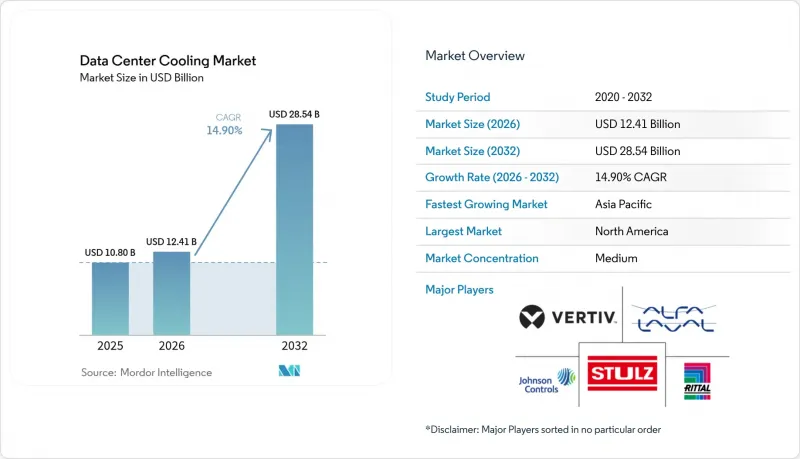
본 보고서는 냉각 기술(공기 냉각, 액체 냉각), 냉각 구성 요소(컴퓨터실용 에어 핸들러(CRAH/CRAC), 칠러·열교환 장치 등), 데이터센터 유형(하이퍼스케일, 엔터프라이즈, 코로케이션), 최종 사용자 산업(IT 및 통신, 소매업 및 소비재 등), 지역별로 분류되어 있습니다. 시장 예측은 금액(달러) 기준으로 제시되어 있습니다.
전 세계 데이터센터 냉각 시장 동향 및 인사이트력
AI 및 HPC 워크로드로 인한 열 밀도의 급증
GPU 고밀도 서버는 현재 랙당 200kW가 넘는 열을 방출하고 있으며, 이는 기존의 10kW 열 부하를 훨씬 초과하여 기존 CRAC 유닛의 효력을 상실시키고 있습니다. 그 결과, 직접 투 칩(DTC) 콜드 플레이트 및 완전 침지식 냉각 시스템은 특히 Meta와 Microsoft의 AI 클러스터에서 시범 단계에서 양산 단계로 전환되고 있습니다. 칩 제조업체들은 차세대 패키지에 액체 인터페이스 채널을 통합하고 있으며, 이로 인해 컴퓨팅용 실리콘과 시설 인프라 사이의 장벽이 점차 사라지고 있습니다. 동시에 규제 당국은 PUE를 1.3 미만으로 유지할 것을 요구하고 있어, 액체 냉각 기술에 유리한 이중 압박 환경이 조성되고 있습니다.
2선 도시에서의 하이퍼스케일 시설 확장
각 사업자들은 피닉스, 콜럼버스, 오사카에서 더 낮은 토지 비용과 청정 전력을 추구하고 있지만, 이러한 지역에서는 성숙한 전력 인프라가 갖추어지지 않은 경우가 많습니다. 그 결과, 프로젝트에서는 시운전 기간을 단축하고 주변 온도의 큰 변동에도 견딜 수 있는 모듈형 냉각기와 후면 도어형 열교환기가 채택되고 있습니다. 또한, 2선 도시의 기후는 자연 환기가 가능한 시간을 더 많이 확보할 수 있으므로, 이사회 차원의 설비 투자 승인을 좌우하는 수명 주기 비용 지표를 낮출 수 있습니다.
첨단 액체 냉각 기술의 설비 투자 비용(Cap-ex) 프리미엄
액침 탱크는 기존의 핫 아일 봉쇄 방식에 비해 60% 더 비싸며, 전용 유전체 유체의 가격은 리터당 5-7달러로, 2MW 미만의 사이트에서는 ROI 확보가 과제입니다. 그러나 30-40%의 에너지 절감 효과 덕분에 전기 요금이 높은 지역에서는 투자 회수 기간을 3년 미만으로 단축할 수 있습니다.
부문 분석
데이터센터 냉각 시장에서 액체 냉각 방식 시장 규모는 2026년에 59억 달러에 달하고, 2032년까지 153억 3,000만 달러를 돌파하며 연평균 성장률(CAGR) 17.25%로 성장할 전망입니다. 새로운 AI 랙에서는 직접 투 칩(Direct-to-Chip) 파이프라인이 주류를 이루고 있는 반면, 2상 침지 탱크는 암호화폐 해시 클러스터와 같은 틈새 워크로드에 채택되고 있습니다. 랙 밀도가 15kW 미만에 그치는 기업 환경에서는 공랭식 칠러나 CRAC 어레이가 여전히 일반적이지만, 규제로 인해 PUE 목표가 엄격해짐에 따라 그 점유율은 해마다 감소하고 있습니다. 각 벤더들은 프리 쿨링 기간을 연장하기 위해 글리콜 루프와 단열 패드를 결합한 하이브리드 쿨러로 이에 대응하고 있습니다.
후면 도어형 열교환기는 홀 전체의 랙 재배치를 원치 않는 운영 사업자에게 해결책이 됩니다. 열교환기 1대를 설치하기만 하면 바닥에 용접 공사를 하지 않고도 랙 용량을 12 kW에서 30 kW로 높일 수 있습니다. 한편, 마이크로 대류식 콜드 플레이트에 관한 특허는 350 W/cm²의 열유속 제거를 약속하고 있어, x86 서버의 주류 시장에 액체 냉각 기술이 진출할 것임을 예고합니다. 엣지 인클로저는 공장에서 밀봉된 냉각 모듈을 도입함으로써 현장 작업 부담을 대폭 줄여주며, 무인 운영이라는 요건에도 부합합니다.
CRAH(컴퓨터실용 에어 핸들러)는 여전히 지출의 30.60%를 차지하고 있지만, 그 CAGR은 3.75%에 그쳐 데이터센터 냉각 시장 전체에 비해 뒤처지고 있습니다. 대조적으로, 칠러 및 열교환기 유닛은 액체 냉각의 채택 확대에 따라 배관 수요가 증가함에 따라 15.70%의 연평균 성장률(CAGR)을 보일 것으로 전망됩니다. 펌프, 밸브, 이중화 매니폴드는 2026년에 19억 5,000만 달러 규모의 하위 시장을 형성하며, 직접 투 칩 루프(Direct-to-Chip Loop)의 보급으로 혜택을 볼 전망입니다. AI 기반 모니터링 소프트웨어는 가장 빠른 성장세를 보이고 있으며, 구글과 알리바바 캠퍼스에서는 팬 회전수(RPM)와 압축기 스테이징을 최적화하여 15-25%의 에너지 절감을 실현하고 있습니다. 하드웨어, 텔레메트리, 머신러닝 기반 제어를 융합한 통합형 제품군은 고가임에도 불구하고 정량화 가능한 운영 비용(OPEX) 절감을 실현하고 있어, 단독 콘솔보다 더 신속하게 CFO를 설득할 수 있습니다.
지역별 분석
북미에서는 2026년에 데이터센터 냉각 시장 규모가 93억 5,000만 달러를 기록했습니다. 이는 피닉스, 애틀랜타, 콜럼버스에 위치한 하이퍼스케일 캠퍼스가 커패시터 루프에 재생 처리된 폐수를 활용할 수 있는 액체 냉각기를 선호하여 도입하고 있는 것이 주된 원동력입니다. 여름 폭염이 장기화됨에 따라 자연 냉각이 가능한 기간이 단축되면서, 운영 사업자들은 내결함성을 높이기 위해 단열 트림 쿨러를 추가하고 있습니다.
아시아태평양은 2026년에 17억 3,000만 달러 시장 규모를 기록했으나, 연평균 성장률(CAGR) 17.85%를 기록하며 2032년까지 46억 4,000만 달러를 넘어설 것으로 예측됩니다. 싱가포르에서는 PUE를 1.3 미만으로 억제하는 것을 조건으로 신축 허가가 재개되었으며, 입찰은 해수 냉각 및 액체 침지 냉각 방식으로 전환되고 있습니다. 도쿄의 고밀도화 전략에서는 각 층에 직접 팽창 코일을 사용한 다층 홀을 쌓아 올리고 있는 반면, 뭄바이 해안 지역의 높은 습도로 인해 물 부족을 완화하는 하이브리드 유체 냉각기를 채택하는 프로젝트가 늘고 있습니다.
유럽에서는 2026년에 11억 4,000만 달러 규모 시장을 기록할 전망이며, 북유럽 국가들에서는 데이터센터의 배열수에서 250 MW에 달하는 지역 난방용 열을 회수하고 있습니다. 프랑크푸르트와 암스테르담에서는 현재 폐열 재활용 할당 기준이 도입되어, 조달 동향이 고품질 물 순환 시스템으로 향하고 있습니다. 중동 및 아프리카에서는 최고 기온이 50°C에 달하는 환경에 대처하기 위해 액체 냉각이 채택되고 있습니다. 두바이에서는 데이터센터에 병설된 태양광 발전소와 축열 탱크를 통해 칠러의 전력 소비를 17% 절감하고 있습니다. 라틴아메리카에서는 케레타로와 산티아고에서 새로운 건설이 진행 중이며, 야간의 시원한 외부 공기를 활용하여 낮의 고온에도 불구하고 PUE 1.2를 달성하는 간접 증발 냉각 모듈이 채택되고 있습니다.
기타 혜택:
- Excel 형식 시장 예측(ME) 시트
- 3개월간의 애널리스트 지원
자주 묻는 질문
목차
제1장 서론
제2장 분석 방법
제3장 주요 요약
제4장 시장 구도
제5장 현재 데이터센터 설치 면적에 관한 분석
제6장 시장 규모·성장률 예측(금액 기준, 10억 달러)
제7장 경쟁 구도
제8장 시장 기회와 향후 전망
제9장 투자 분석
LSH 26.09.02According to Mordor Intelligence, the data center cooling market size was valued at USD 10.80 billion in 2025 and estimated to grow from USD 12.41 billion in 2026 to reach USD 28.54 billion by 2032, at a CAGR of 14.90% during the forecast period (2026-2032).
This report is Segmented by Cooling Technology (Air-Based Cooling, Liquid-Based Cooling), Cooling Component (Computer-Room Air Handlers (CRAH/CRAC), Chillers and Heat-Exchanger Units, and More), Data Center Type (Hyperscale, Enterprise, Colocation), End-User Industry (IT and Telecom, Retail and Consumer Goods, and More), and Geography. The Market Forecasts are Provided in Terms of Value (USD).
Global Data Center Cooling Market Trends and Insights
AI and HPC workload heat-density surge
GPU-dense servers now dissipate beyond 200 kW per rack, dwarfing legacy 10 kW envelopes and rendering conventional CRAC units ineffective. Direct-to-chip cold plates and full-immersion baths have therefore moved from pilots to production floors, particularly inside Meta and Microsoft AI clusters. Chipmakers embed liquid interface channels in next-generation packages, eroding the barrier between compute silicon and facility infrastructure Regulatory bodies simultaneously push PUE below 1.3, creating a dual-pressure environment that favors liquid technologies.
Hyperscale footprint expansion in secondary metros
Operators chase lower land costs and cleaner power in Phoenix, Columbus and Osaka, but those locations often lack mature utility infrastructure. As a result, projects specify modular chillers and rear-door heat exchangers that shorten commissioning cycles and tolerate wide ambient swings. Secondary-city climates also grant more free-air hours, lowering lifecycle cost metrics that drive board-level cap-ex approvals.
Cap-ex premium of advanced liquid technologies
Immersion tanks cost 60% more than traditional hot-aisle containment, and specialized dielectric fluids range USD 5-7 per liter, challenging ROI in sites below 2 MW. Nevertheless, energy savings of 30-40% compress payback to under three years in high-electricity-tariff regions.
Other drivers and restraints analyzed in the detailed report include:
- Mandatory PUE / GHG disclosure regulations
- Global heat-wave frequency raising cooling demand
- Retrofit complexity in legacy white-spaces
For complete list of drivers and restraints, kindly check the Table Of Contents.
Segment Analysis
The data center cooling market size for liquid methods reached USD 5.90 billion in 2026 and will eclipse USD 15.33 billion by 2032, advancing at 17.25% CAGR. Direct-to-chip pipelines dominate new AI racks, while dual-phase immersion tubs claim niche workloads such as crypto hashing clusters. Air-based chiller and CRAC arrays remain common in enterprise environments where rack densities linger below 15 kW, yet their share declines annually as regulations squeeze PUE targets. Vendors counter with hybrid coolers marrying glycol loops and adiabatic pads to extend free-cooling seasons.
Rear-door heat exchangers bridge the gap for operators unwilling to re-rack entire halls; a single exchanger lifts rack capacity from 12 kW to 30 kW without floor welding. Meanwhile, patents on microconvective cold plates promise 350 W/cm2 heat flux removal, foreshadowing liquid's march into mainstream x86 servers. Edge enclosures import factory-sealed coolant modules to slash on-site labor, aligning with unmanned operation mandates.
Computer-room air handlers still account for 30.60% of spend, but their 3.75% CAGR lags the overall data center cooling market. Conversely, chillers and heat-exchanger units will log 15.70% CAGR as liquid adoption expands pipework demand. Pumps, valves and redundancy manifolds form a USD 1.95 billion submarket in 2026, benefitting from direct-to-chip loop proliferation. AI-driven supervisory software posts the fastest growth, trimming fan RPM and compressor staging to save 15-25% energy at Google and Alibaba campuses. Integrated suites that blend hardware, telemetry and machine-learning controls command premium pricing yet deliver quantifiable OPEX reduction, convincing CFOs faster than standalone consoles.
Complete Report Scope:
- By Cooling Technology
- Air-based Cooling
- Chiller and Economizer
- CRAH (Computer-Room Air Handler)
- Cooling Tower (Direct, Indirect, Two-Stage)
- Other Air-based Cooling Technologies
- Liquid-based Cooling
- Immersion Cooling
- Direct-to-Chip Cooling
- Rear-Door Heat Exchanger
- Air-based Cooling
- By Cooling Component
- Computer-Room Air Handlers (CRAH/CRAC)
- Chillers and Heat-Exchanger Units
- Cooling Towers and Dry Coolers
- Pumps and Valves
- Control and Monitoring Software
- By Data Center Type
- Hyperscale (Owned and Leased)
- Enterprise (On-Premise)
- Colocation
- By End-user Industry
- IT and Telecom
- Retail and Consumer Goods
- Healthcare
- Media and Entertainment
- Federal and Institutional Agencies
- Other End users
- By Geography
- North America
- United States
- Canada
- Mexico
- South America
- Brazil
- Argentina
- Chile
- Rest of South America
- Europe
- Germany
- United Kingdom
- France
- Rest of Europe
- Asia-Pacific
- China
- India
- Japan
- Rest of Asia-Pacific
- Middle East and Africa
- Middle East
- Africa
- North America
Geography Analysis
North America recorded USD 9.35 billion of data center cooling market size in 2026, driven by hyperscale campuses in Phoenix, Atlanta and Columbus that favor liquid chillers able to exploit reclaimed wastewater for condenser loops. Extended summer heat waves shorten free-air windows, prompting operators to add adiabatic trim coolers for resilience.
Asia-Pacific contributed USD 1.73 billion in 2026 but will surpass USD 4.64 billion by 2032 on an 17.85% CAGR. Singapore reinstated new-build permits contingent on sub-1.3 PUE targets, steering bids toward seawater and liquid immersions. Tokyo's densification strategy stacks multi-story halls using direct-expansion coils for each floor, while Mumbai's coastal humidity inclines projects toward hybrid fluid coolers that mitigate water scarcity.
Europe generated USD 1.14 billion in 2026, with Nordic states extracting 250 MW of district-heating value from data center exhaust water. Frankfurt and Amsterdam now impose waste-heat-reuse quotas, nudging procurements toward high-grade water loops. Middle East and Africa adopt liquid cooling to battle 50 °C ambient peaks; Dubai's collocated solar farm plus thermal-storage tank trims chiller electricity by 17%. Latin America saw emergent builds in Queretaro and Santiago, where cooler night air favors indirect evaporative modules that achieve 1.2 PUE despite high daytime highs.
List of Companies Covered in this Report:
- Vertiv
- Schneider Electric
- Stulz
- Rittal
- Johnson Controls
- Alfa Laval
- Fujitsu General
- Hitachi
- CoolIT Systems
- LiquidStack
- Asetek
- Asperitas
- Chilldyne
- Mikros Technologies
- Kaori Heat Treatment
- Lenovo
- Nortek Air Solutions
- Delta Electronics
- Munters
- Airedale (Modine)
- Black Box (Chatsworth Prod.)
- Submer
- GRC (Green Revolution Cooling)
- Coolcentric
- Starline
Additional Benefits:
- The market estimate (ME) sheet in Excel format
- 3 months of analyst support
TABLE OF CONTENTS
1 INTRODUCTION
- 1.1 Study Assumptions and Market Definition
- 1.2 Scope of the Study
2 RESEARCH METHODOLOGY
3 EXECUTIVE SUMMARY
4 MARKET LANDSCAPE
- 4.1 Market Overview
- 4.2 Market Drivers
- 4.2.1 AI and HPC workload heat-density surge
- 4.2.2 Hyperscale footprint expansion in secondary metros
- 4.2.3 Mandatory PUE / GHG disclosure regulations
- 4.2.4 Global heat-wave frequency raising cooling demand
- 4.2.5 Monetisation of waste heat via district-energy loops
- 4.2.6 Tax-incentivised edge build-outs in rural grids
- 4.3 Market Restraints
- 4.3.1 Cap-ex premium of advanced liquid technologies
- 4.3.2 Retrofit complexity in legacy white-spaces
- 4.3.3 Limited supply of low-GWP refrigerants
- 4.3.4 Warranty-risk from non-standard immersion fluids
- 4.4 Key Cost Considerations for Cooling
- 4.4.1 Analysis of Key Cost Overheads Related to DC Operations (Cooling Focus)
- 4.4.2 Comparative Study of Cooling Technologies (Design Complexity, PUE, Pros/Cons, Weather Utilization)
- 4.4.3 Key Innovations and Developments in Data Center Cooling
- 4.4.4 Key Energy-Efficiency Practices Adopted in Data Centers
- 4.5 Value / Supply-Chain Analysis
- 4.6 Regulatory Landscape
- 4.7 Technological Outlook
5 ANALYSIS OF CURRENT DATA CENTER FOOTPRINT
- 5.1 Analysis of IT Load Capacity (MW) and Area footprint (Sq. Ft.) of Data Centers (for the period of 2019-2031)
- 5.2 Analysis of the major Data Center Hotspots
- 5.3 Analysis of Major Upcoming Hyperscale Facilities
6 MARKET SIZE and GROWTH FORECASTS (VALUE, USD BN)
- 6.1 By Cooling Technology
- 6.1.1 Air-based Cooling
- 6.1.1.1 Chiller and Economizer
- 6.1.1.2 CRAH (Computer-Room Air Handler)
- 6.1.1.3 Cooling Tower (Direct, Indirect, Two-Stage)
- 6.1.1.4 Other Air-based Cooling Technologies
- 6.1.2 Liquid-based Cooling
- 6.1.2.1 Immersion Cooling
- 6.1.2.2 Direct-to-Chip Cooling
- 6.1.2.3 Rear-Door Heat Exchanger
- 6.1.1 Air-based Cooling
- 6.2 By Cooling Component
- 6.2.1 Computer-Room Air Handlers (CRAH/CRAC)
- 6.2.2 Chillers and Heat-Exchanger Units
- 6.2.3 Cooling Towers and Dry Coolers
- 6.2.4 Pumps and Valves
- 6.2.5 Control and Monitoring Software
- 6.3 By Data Center Type
- 6.3.1 Hyperscale (Owned and Leased)
- 6.3.2 Enterprise (On-Premise)
- 6.3.3 Colocation
- 6.4 By End-user Industry
- 6.4.1 IT and Telecom
- 6.4.2 Retail and Consumer Goods
- 6.4.3 Healthcare
- 6.4.4 Media and Entertainment
- 6.4.5 Federal and Institutional Agencies
- 6.4.6 Other End users
- 6.5 By Geography
- 6.5.1 North America
- 6.5.1.1 United States
- 6.5.1.2 Canada
- 6.5.1.3 Mexico
- 6.5.2 South America
- 6.5.2.1 Brazil
- 6.5.2.2 Argentina
- 6.5.2.3 Chile
- 6.5.2.4 Rest of South America
- 6.5.3 Europe
- 6.5.3.1 Germany
- 6.5.3.2 United Kingdom
- 6.5.3.3 France
- 6.5.3.4 Rest of Europe
- 6.5.4 Asia-Pacific
- 6.5.4.1 China
- 6.5.4.2 India
- 6.5.4.3 Japan
- 6.5.4.4 Rest of Asia-Pacific
- 6.5.5 Middle East and Africa
- 6.5.5.1 Middle East
- 6.5.5.2 Africa
- 6.5.1 North America
7 COMPETITIVE LANDSCAPE
- 7.1 Market Share Analysis
- 7.2 Company Profiles (includes Global level Overview, Market level overview, Core Segments, Financials as available, Strategic Information, Market Rank/Share for key companies, Products and Services, and Recent Developments)
- 7.2.1 Vertiv
- 7.2.2 Schneider Electric
- 7.2.3 Stulz
- 7.2.4 Rittal
- 7.2.5 Johnson Controls
- 7.2.6 Alfa Laval
- 7.2.7 Fujitsu General
- 7.2.8 Hitachi
- 7.2.9 CoolIT Systems
- 7.2.10 LiquidStack
- 7.2.11 Asetek
- 7.2.12 Asperitas
- 7.2.13 Chilldyne
- 7.2.14 Mikros Technologies
- 7.2.15 Kaori Heat Treatment
- 7.2.16 Lenovo
- 7.2.17 Nortek Air Solutions
- 7.2.18 Delta Electronics
- 7.2.19 Munters
- 7.2.20 Airedale (Modine)
- 7.2.21 Black Box (Chatsworth Prod.)
- 7.2.22 Submer
- 7.2.23 GRC (Green Revolution Cooling)
- 7.2.24 Coolcentric
- 7.2.25 Starline


