

|
시장보고서
상품코드
2121725
마케팅 자동화 소프트웨어 시장 : 시장 점유율 분석, 업계 동향과 통계, 성장 예측(2026-2031년)ing Automation Software Market - Market Share Analysis, Industry Trends & Statistics, Growth Forecasts (2026 - 2031) |
||||||
 Mordor Intelligence
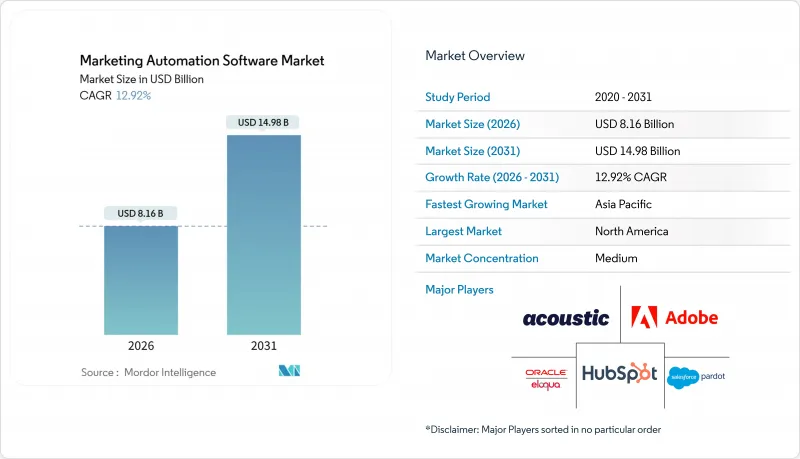
에 의하면, 마케팅 자동화 소프트웨어 시장 규모는 2026년에 81억 6,000만 달러에 이르고, 2031년까지 149억 8,000만 달러에 이를 것으로 예측되며, 예측 기간에는 CAGR 12.92%를 기록할 전망입니다.
본 보고서는 구성 요소(소프트웨어 및 서비스), 배포 방식(클라우드 기반·On-Premise), 조직 규모(대기업·중소기업), 용도(캠페인 관리, 이메일 마케팅, 기타), 최종 사용자 산업(헬스케어, 제조업, 정부, 교육, 기타), 지역별로 분류되어 있습니다. 시장 예측은 금액(달러) 단위로 제시되어 있습니다.
세계 마케팅 자동화 소프트웨어 시장 동향 및 인사이트
AI를 활용한 하이퍼 퍼소나라이제이션을 통한 캠페인 ROI 향상
핵심 플랫폼 내의 생성 모델과 예측 모델은 현재 행동 데이터, 거래 데이터, 컨텍스트 데이터를 통합하여 잠재 고객 한 명 한 명에게 맞춤화된 컨텐츠를 제공합니다. 어도비가 2025년에 실시한 경영진 설문조사에 따르면, 마케터의 65%가 AI를 주요 수익원으로 꼽고 있지만, 완전한 ROI를 실현하고 있는 비율은 12%에 그치고 있어, 벤더들이 사전 학습된 산업별 모델을 사용하여 대응하고 있는 성숙도 격차가 부각되고 있습니다. Salesforce Einstein은 2024년 금융 서비스 산업 사용자를 대상으로 실시한 파일럿 프로젝트에서 수동 세분화에 소요되는 시간을 40% 단축하여, 팀이 데이터 처리에 소비하던 시간을 전략 수립에 할애할 수 있도록 했습니다. 맥킨지의 2025년 벤치마크 조사에 따르면, 규칙 기반 코호트와 비교하여 AI 기반 개인화를 도입한 브랜드의 매출이 10-15% 향상된 것으로 보고되었습니다. 앱 및 IoT 기기에서 스트리밍되는 데이터를 통해 이제는 밀리초 단위로 아웃리치가 트리거되어, 기존의 매일 이루어지던 배치 처리 주기를 대체하고 있습니다. 데이터 파이프라인이 안정화됨에 따라 전환율 향상은 더욱 가속화될 것으로 예상되며, AI 모듈에 대한 장기적인 투자가 정착될 것으로 보입니다.
생성형 AI를 통한 컨텐츠 자동화가 가져오는 크리에이티브 사이클 타임 단축
마케팅 스위트에 통합된 대규모 언어 모델 덕분에 자산 제작에 소요되는 시간이 몇 주에서 몇 시간으로 단축되었습니다. HubSpot Breeze AI는 2025년 출시 기간 동안 초기 도입 기업에서 컨텐츠 제작 시간을 최대 70% 단축했습니다. Jasper AI는 2024년에 10억 단어 이상의 마케팅 카피를 생성하여, 가입자의 A/B 테스트 반복 주기를 30-40% 가속화했습니다. 사내에 크리에이티브 인력을 보유하지 않은 중견 기업의 팀은 AI가 생성한 초안을 기반으로 활용하고 있지만, 브랜드 목소리의 일관성을 확보하기 위해서는 여전히 사람의 확인이 필요합니다. 보스턴 컨설팅 그룹(BCG)의 조사에 따르면, AI를 활용한 캠페인의 38%에서 어조를 통일하기 위해 추가 편집이 필요하며, 이로 인해 속도 향상 효과가 일부 상쇄되는 것으로 나타났습니다. 현재 각 벤더사는 자체 라이브러리를 활용해 모델을 미세 조정함으로써 일관성을 높이고 수정 주기를 단축하고 있습니다.
중공업 부문에서 다중 벤더형 마테크 스택 통합에 따른 오버헤드
제조업체들은 ERP, CRM, 분석, 컨텐츠 관리에 걸쳐 15-30개에 달하는 서로 다른 시스템을 운영하는 경우가 많습니다. PwC의 조사에 따르면, 이러한 도구를 연동하기 위한 맞춤형 미들웨어는 마테크 예산의 최대 30%를 소모하며, 복잡한 환경에서는 5%를 초과하는 데이터 오류를 유발하고 있습니다. 스키마 불일치는 입력 데이터의 불일치가 추천 품질을 저하시키기 때문에 AI 모델의 성능을 약화시킵니다. 또한 통합 작업은 캠페인 혁신에 투입된 투자를 압박하고, 신규 라이선스의 투자 회수 기간을 지연시킵니다. 광범위한 커넥터 라이브러리를 갖춘 기존 제품군은 여전히 우위를 점하고 있지만, 높은 전환 비용으로 인해 후발 도입 기업들의 마케팅 자동화 소프트웨어 시장 진입이 저해되고 있습니다.
부문 분석
서비스 부문은 마케팅 자동화 소프트웨어 시장 규모에서 차지하는 비중을 확대하고 있으며, 기업들이 통합 및 운영 관리를 외부에 위탁함에 따라 2026년부터 2031년까지 연평균 성장률(CAGR) 13.28%로 성장하고 있습니다. 서비스에는 컨설팅, 도입, 지속적인 캠페인 실행이 포함되며, 대부분의 경우 성과 기반 계약 형태로 제공됩니다. 2025년 시점에서도 소프트웨어는 여전히 매출의 73.59%를 차지하며 SaaS(Software-as-a-Service) 구독의 우위를 반영하고 있지만, 아키텍처가 점점 더 복잡해짐에 따라 추가 지출은 공인 파트너 쪽으로 이동하고 있습니다. 예를 들어, Salesforce의 전문 서비스 수주 잔액은 2024년 4분기에 32억 달러에 달하여, 데이터 클라우드 및 마케팅 클라우드 도입에 대한 높은 수요를 입증하고 있습니다. 현재 부티크형 대행사는 HIPAA 준수 워크플로우와 PSD2 준수 캠페인을 전문으로 하며, 범용 벤더가 사내에서 대응할 수 없는 산업별 세밀한 요구 사항을 충족시키고 있습니다.
플랫폼 벤더들은 매출총이익률을 유지하기 위해 사내에서 서비스를 구축하기보다는 파트너 생태계를 확대되고 있습니다. 어도비는 고객이 Firefly의 생성형 AI 기능을 활용할 수 있도록 지원함으로써 2024 회계연도에 컨설팅 매출을 18% 증가시켰습니다. 한편, 액센츄어(Accenture)는 마케팅 기술 부문에서 서비스 매출이 25-35% 성장했다고 보고했습니다. 최종 사용자는 외부 전문가를 기술 부족에 대한 대비책으로 간주하고 있으며, 서비스 제공업체가 일상 업무에 깊이 통합됨에 따라 이러한 추세가 고객 유지율을 높이고 있습니다.
2025년에는 클라우드 기반 모델이 82.14%의 점유율을 차지하며 주류가 될 것으로 예상되며, 2031년까지 연평균 성장률(CAGR) 13.39%를 기록하며 성장 경쟁을 주도할 것으로 전망됩니다. 탄력적인 확장성을 통해 자본 비용을 들이지 않고도 성수기의 트래픽에 대응할 수 있습니다. 이러한 능력은 2025년 연말 연시 프로모션에서 입증되었으며, 여러 소매업체가 트래픽 제한 없이 전송 트래픽량을 3배로 늘리는 데 성공했습니다. On-Premise는 에어갭을 통한 보안이 요구되는 규제가 엄격한 환경에서는 여전히 자리 잡고 있지만, 이러한 부문조차도 관리 권한을 유지하면서 AI 모듈을 활용할 수 있는 프라이빗 클라우드 옵션을 시범적으로 도입하고 있습니다. 마이크로소프트는 Azure 기반의 소버린 클라우드 리전을 통해 주권 요구 사항을 충족함으로써, 공공 부문 고객이 국경을 넘는 데이터 노출 없이 Copilot 기능을 이용할 수 있도록 하고 있습니다.
기능 제공 속도 측면에서도 클라우드가 우위에 있습니다. 벤더는 매주 릴리스를 추진하며, 보안 태세를 강화하고, 사전 구축된 API 커넥터를 대규모로 제공할 수 있기 때문입니다. Klaviyo는 2024년에 생성형 컨텐츠 추천 기능을 몇 주 만에 고객 기반에 배포한 반면, On-Premise 경쟁사들은 수개월에 달하는 업그레이드 주기에 직면해 있었습니다. 그 결과, 많은 조직은 핵심 데이터 시스템의 현대화를 추진하는 동안 온프레미를 과도기적인 전략으로 간주하고 있습니다.
지역별 분석
북미는 벤더의 집중과 수십 년에 걸친 디지털 마케팅의 성숙도로 인해 2025년 매출의 42.38%를 차지했지만, 보급률이 포화 상태에 가까워짐에 따라 신규 고객 증가세는 둔화되고 있습니다. 2024년 말까지 Salesforce의 고객 수는 15만 개사, HubSpot은 20만 5,000개사를 돌파할 것으로 예상되며, 기존 벤더들은 업셀 기회를 발굴하고 마이크로 SMB 부문으로의 확장을 모색해야할 것입니다. 캐나다에서는 이민자에 의한 기술 산업의 확대와 넉넉한 연구개발 세액 공제가 가격 및 고객 지원 측면에서 적극적으로 경쟁하는 신흥 벤더들을 육성하고 있습니다. 니어쇼어링의 혜택을 받는 멕시코 제조업체들은 B2B 자동화 잠재 고객층을 확대하고 있지만, 언어 현지화 및 결제 인프라 구축에는 추가적인 개선이 필요합니다.
아시아태평양은 인도의 중소기업 디지털화, 중국의 데이터 주권을 배경으로 한 엔터프라이즈 클라우드로의 전환, 동남아시아의 모바일 우선 소비자 습관에 힘입어 연평균 성장률(CAGR) 13.96%로 가장 빠르게 성장하고 있는 지역입니다. ‘디지털 인디아’ 정책에 따른 루피화 가격 책정 및 보조금 제도를 통해 SaaS 도입 비용이 최대 25% 절감되었으며, 그 결과 초소규모 기업을 대상으로 한 마케팅 자동화 소프트웨어 시장이 확대되었습니다. 중국에서는 시장이 양극화되어 있어, 다국적 벤더가 외국계 기업에 서비스를 제공하는 한편, 알리바바 클라우드와 텐센트 클라우드는 국내 호스팅 서비스를 제공함으로써 국내 틈새 시장을 독점하고 있습니다. 일본은 여전히 신중한 태도를 유지하고 있지만, 핀테크 및 전자상거래 혁신 기업들이 AWS나 Azure의 로컬 존을 기반으로 한 클라우드 네이티브 제품군을 채택함에 따라 상황은 변화하고 있습니다. 호주는 미국과 동등한 성숙도 지표를 보이고 있지만, 동남아시아에서는 언어 및 규제상의 세분화로 인해 막대한 현지화 투자가 필요합니다.
유럽에서는 GDPR(EU 개인정보보호규정)의 엄격한 시행이 장벽이 되는 한편, 경쟁 우위도 창출하고 있습니다. 특히 자동차, 은행, 소매 산업에서 견고한 동의 관리 기능을 갖춘 플랫폼이 기업의 신뢰를 얻고 있습니다. 남유럽과 동유럽에서는 매출액 대비 IT 지출 비중이 서유럽 국가들에 비해 30-40% 낮아 도입 속도가 제한되고 있습니다. PwC 조사에서 드러난 마케팅 테크놀로지스트 인력 부족(23%)은 도입 비용을 상승시키고, 매니지드 서비스 모델에 대한 수요를 높이고 있습니다. 중동의 도입은 각국의 디지털 아젠다에 따라 아랍에미리트와 사우디아라비아에 집중되어 있으나, 주요 도시권 외 지역의 중소기업(SMB)에서의 도입은 여전히 제한적입니다. 아프리카의 초기 시장은 주로 남아프리카공화국과 이집트로 한정되어 있습니다. 이는 중동 및 아프리카의 다른 지역에서는 통신 환경과 결제 인프라가 아직 성숙 단계에 있기 때문입니다. 라틴아메리카에서는 브라질과 아르헨티나가 주도적인 역할을 하고 있지만, 통화 변동으로 인해 달러 기준 가격 책정이 복잡해지고 있습니다. 다중 통화 청구 서비스를 제공하는 벤더들은 도입 장벽을 낮추고 시장 점유율을 확대되고 있습니다.
기타 혜택
- 엑셀 형식 시장 예측(ME) 시트
- 3개월간의 애널리스트 지원
자주 묻는 질문
목차
제1장 서론
제2장 조사 방법
제3장 주요 요약
제4장 시장 구도
제5장 시장 규모와 성장 예측
제6장 경쟁 구도
제7장 시장 기회와 향후 전망
LSH 26.09.02According to Mordor Intelligence, the marketing automation software market size stands at USD 8.16 billion in 2026 and is projected to reach USD 14.98 billion by 2031, advancing at a 12.92% CAGR over the forecast period.
This report is Segmented by Component (Software, and Services), Deployment (Cloud-Based, and On-Premise), Organization Size (Large Enterprises, and Small and Medium Enterprises), Application (Campaign Management, Email Marketing, and More), End-User Vertical (Healthcare, Manufacturing, Government, Education, and More), and Geography. The Market Forecasts are Provided in Terms of Value (USD).
Global Marketing Automation Software Market Trends and Insights
AI-Powered Hyper-Personalization Boosting Campaign ROI
Generative and predictive models inside core platforms now merge behavioral, transactional, and contextual data to tailor content to each prospect. Adobe's 2025 executive survey showed that 65% of marketers rank AI as their primary revenue lever, yet only 12% have unlocked full ROI, underscoring a maturity gap that vendors address with pre-trained vertical models. Salesforce Einstein reduced manual segmentation time by 40% in a 2024 pilot for financial services users, allowing teams to shift hours from data work toward strategy. McKinsey's 2025 benchmarking reported a 10-15% revenue uplift for brands running AI-driven personalization compared with rules-based cohorts. Streaming data from apps and IoT devices now triggers outreach within milliseconds, replacing daily batch cycles. As data pipelines harden, conversion lift is expected to rise further, anchoring long-term spending on AI modules.
Generative AI Content Automation Reducing Creative Cycle Time
Large language models embedded in marketing suites compress asset production from weeks to hours. HubSpot Breeze AI trimmed content creation times by up to 70% for early adopters during 2025 rollouts. Jasper AI generated more than 1 billion words of marketing copy in 2024, enabling 30-40% faster A/B test iterations for subscribers. Mid-market teams without in-house creative talent lean on AI drafts as scaffolds, while brand-voice variance still demands human review. Boston Consulting Group found that 38% of AI-assisted campaigns required additional editing to align tone, partly offsetting the speed gains. Vendors now fine-tune models on proprietary libraries to improve consistency and reduce rework cycles.
Multi-Vendor MarTech Stack Integration Overheads in Heavy-Industry Manufacturing
Manufacturers often run 15-30 disparate systems spanning ERP, CRM, analytics, and content management. PwC found that custom middleware to bridge these tools consumes up to 30% of MarTech budgets and introduces data errors exceeding 5% in complex environments. Schema mismatches weaken AI models because inconsistent inputs degrade the quality of recommendations. Integration work also diverts capital away from campaign innovation, slowing payback periods for new licenses. Incumbent suites with broad connector libraries retain an edge, yet high switching costs deter late adopters from entering the marketing automation software market.
Other drivers and restraints analyzed in the detailed report include:
- Integration of Composable CDPs with CRM Suites
- Increase in SMB-First Cloud Adoption Surge Across Emerging Asia
- Mid-Market Talent Shortage in Marketing Operations Across EMEA
For complete list of drivers and restraints, kindly check the Table Of Contents.
Segment Analysis
The services segment accounts for a growing share of the marketing automation software market size, advancing at a 13.28% CAGR from 2026-2031 as enterprises outsource integration and managed operations. Services include consulting, implementation, and ongoing campaign execution, often bundled in outcome-based contracts. Software still accounted for 73.59% of revenue in 2025, reflecting SaaS subscription dominance, yet rising architectural complexity is tilting incremental spend toward certified partners. For example, Salesforce's professional services backlog hit USD 3.2 billion in Q4 2024, underscoring demand for Data Cloud and Marketing Cloud rollouts. Boutique agencies now specialize in HIPAA-compliant workflows or PSD2-aligned campaigns, addressing vertical nuances that generic vendors cannot cover internally.
Platform vendors amplify partner ecosystems rather than building services in-house to protect gross margins. Adobe added 18% consulting revenue in fiscal 2024 by helping clients operationalize Firefly generative AI features, while Accenture reported 25-35% services growth in its marketing technology practice. End-users view external specialists as insurance against skill shortages, a dynamic that reinforces stickiness because service providers embed themselves deeply in day-to-day operations.
In 2025, cloud-based models dominated with an 82.14% share and are projected to lead the growth race, boasting a 13.39% CAGR through 2031. Elastic scalability supports peak-season traffic without capital overhead, a capability demonstrated during the 2025 holiday promotions, when several retailers tripled outbound volume without throttling. On-premise persists in heavily regulated environments that demand air-gapped security, yet even these sectors experiment with private cloud options that preserve control while unlocking AI modules. Microsoft addresses sovereignty needs with Azure-based sovereign cloud regions, allowing public-sector clients to tap Copilot features without cross-border data exposure.
Feature velocity favors cloud because vendors can push weekly releases, enhance security posture, and deliver pre-built API connectors at scale. Klaviyo rolled out generative content recommendations to its customer base within weeks in 2024, whereas on-premise rivals faced months-long upgrade cycles. Consequently, many organizations treat on-premise as a transitional strategy while modernizing core data systems.
Complete Report Scope:
- By Component
- Software
- Services
- By Deployment
- Cloud-Based
- On-Premise
- By Organization Size
- Large Enterprises
- Small and Medium Enterprises
- By Application
- Campaign Management
- Email Marketing
- Lead Management
- Analytics and Reporting
- Social Media Marketing
- Mobile Marketing
- Inbound Marketing
- Sales Enablement
- Other Applications
- By End-User Vertical
- Banking, financial services and insurance (BFSI)
- Retail and E-Commerce
- IT and Telecom
- Healthcare
- Manufacturing
- Media and Entertainment
- Government
- Education
- Other End-User Verticals
- By Geography
- North America
- United States
- Canada
- Mexico
- Europe
- Germany
- United Kingdom
- France
- Spain
- Rest of Europe
- Asia-Pacific
- China
- Japan
- India
- South Korea
- Australia
- Rest of Asia-Pacific
- Middle East and Africa
- Middle East
- Saudi Arabia
- United Arab Emirates
- Rest of Middle East
- Africa
- South Africa
- Egypt
- Rest of Africa
- Middle East
- South America
- Brazil
- Argentina
- Rest of South America
- North America
Geography Analysis
North America accounted for 42.38% of revenue in 2025, thanks to vendor concentration and decades of digital marketing maturity, yet new customer growth is slowing as penetration nears saturation. Salesforce exceeded 150,000 customers, and HubSpot crossed 205,000 by late 2024, pushing incumbents to mine for upsell opportunities and to expand into the micro-SMB tier. Canada's immigration-led tech expansion and generous R&D tax credits nurture challenger vendors that compete aggressively on price and customer support. Mexican manufacturers benefiting from nearshoring enlarge the prospect pool for B2B automation, although language localization and payment rails need refinement.
Asia-Pacific is the fastest-growing region, with a 13.96% CAGR, fueled by India's SMB digitization, China's data-sovereignty-driven enterprise cloud migration, and Southeast Asia's mobile-first consumer habits. Rupee-denominated pricing and subsidized credits under Digital India reduced SaaS adoption costs by up to 25%, thereby expanding the market for marketing automation software among microenterprises. China's bifurcated landscape sees multinational vendors serving foreign-invested firms, while Alibaba Cloud and Tencent Cloud dominate domestic niches by offering in-country hosting. Japan remains cautious but is shifting as fintech and e-commerce disruptors adopt cloud-native suites backed by AWS and Azure local zones. Australia mirrors U.S. maturity metrics, whereas Southeast Asia's linguistic and regulatory fragmentation requires heavy localization investment.
Europe's stricter GDPR enforcement creates both barriers and moats. Platforms with robust consent management win enterprise trust, particularly in automotive, banking, and retail. Southern and Eastern Europe trail Western peers by 30-40% in IT spend as a share of revenue, limiting the pace of adoption. A 23% talent gap among marketing technologists, documented by PwC, elevates implementation costs and favors managed-service models. Middle East deployments are concentrated in the United Arab Emirates and Saudi Arabia under national digital agendas, though SMB adoption outside major urban centers remains modest. Africa's early market is confined largely to South Africa and Egypt because connectivity and payment infrastructure elsewhere are still maturing. Latin America is led by Brazil and Argentina, where currency volatility complicates USD pricing; vendors offering multi-currency billing reduce friction and gain share.
- HubSpot Inc.
- Adobe Systems Inc.
- Oracle Corporation
- Acoustic L.P.
- Salesforce Inc.
- Microsoft Corporation
- IBM Corporation
- ActiveCampaign LLC
- Klaviyo Inc.
- Act-On Software
- SAP SE
- SugarCRM Inc.
- Zoho Corporation Private Limited
- Intuit Inc.
- Infusion Software, Inc.
- Omnisend, LLC
- Thryv Holdings
- Oracle NetSuite Inc.
- Braze Inc.
Additional Benefits:
- The market estimate (ME) sheet in Excel format
- 3 months of analyst support
TABLE OF CONTENTS
1 INTRODUCTION
- 1.1 Study Assumptions and Market Definition
- 1.2 Scope of the Study
2 RESEARCH METHODOLOGY
3 EXECUTIVE SUMMARY
4 MARKET LANDSCAPE
- 4.1 Market Overview
- 4.2 Market Drivers
- 4.2.1 Increase in SMB-First Cloud Adoption Surge Across Emerging Asia
- 4.2.2 AI-Powered Hyper-Personalization Boosting Campaign ROI
- 4.2.3 Integration of Composable CDPs with CRM Suites
- 4.2.4 Compliance-Led Omnichannel Expansion in BFSI
- 4.2.5 Generative AI Content Automation Reducing Creative Cycle Time
- 4.2.6 Zero-Party Data Collection Mandates Post-Cookie Deprecation
- 4.3 Market Restraints
- 4.3.1 Multi-Vendor MarTech Stack Integration Overheads in Heavy-Industry Manufacturing
- 4.3.2 Mid-Market Talent Shortage in Marketing Operations Across EMEA
- 4.3.3 SaaS Subscription Fatigue Driving Higher Tool Churn in SMBs
- 4.3.4 Increasing Privacy Sandbox Restrictions Curtailing Third-Party Data Targeting
- 4.4 Industry Value Chain Analysis
- 4.5 Regulatory Landscape
- 4.6 Technological Outlook
- 4.7 Impact of Macroeconomic Factors on the Market
- 4.8 Impact of Digital-Transformation Shift and CRM Convergence
- 4.9 Porter's Five Forces Analysis
- 4.9.1 Threat of New Entrants
- 4.9.2 Bargaining Power of Buyers
- 4.9.3 Bargaining Power of Suppliers
- 4.9.4 Threat of Substitutes
- 4.9.5 Intensity of Competitive Rivalry
5 MARKET SIZE AND GROWTH FORECASTS (VALUE)
- 5.1 By Component
- 5.1.1 Software
- 5.1.2 Services
- 5.2 By Deployment
- 5.2.1 Cloud-Based
- 5.2.2 On-Premise
- 5.3 By Organization Size
- 5.3.1 Large Enterprises
- 5.3.2 Small and Medium Enterprises
- 5.4 By Application
- 5.4.1 Campaign Management
- 5.4.2 Email Marketing
- 5.4.3 Lead Management
- 5.4.4 Analytics and Reporting
- 5.4.5 Social Media Marketing
- 5.4.6 Mobile Marketing
- 5.4.7 Inbound Marketing
- 5.4.8 Sales Enablement
- 5.4.9 Other Applications
- 5.5 By End-User Vertical
- 5.5.1 Banking, financial services and insurance (BFSI)
- 5.5.2 Retail and E-Commerce
- 5.5.3 IT and Telecom
- 5.5.4 Healthcare
- 5.5.5 Manufacturing
- 5.5.6 Media and Entertainment
- 5.5.7 Government
- 5.5.8 Education
- 5.5.9 Other End-User Verticals
- 5.6 By Geography
- 5.6.1 North America
- 5.6.1.1 United States
- 5.6.1.2 Canada
- 5.6.1.3 Mexico
- 5.6.2 Europe
- 5.6.2.1 Germany
- 5.6.2.2 United Kingdom
- 5.6.2.3 France
- 5.6.2.4 Spain
- 5.6.2.5 Rest of Europe
- 5.6.3 Asia-Pacific
- 5.6.3.1 China
- 5.6.3.2 Japan
- 5.6.3.3 India
- 5.6.3.4 South Korea
- 5.6.3.5 Australia
- 5.6.3.6 Rest of Asia-Pacific
- 5.6.4 Middle East and Africa
- 5.6.4.1 Middle East
- 5.6.4.1.1 Saudi Arabia
- 5.6.4.1.2 United Arab Emirates
- 5.6.4.1.3 Rest of Middle East
- 5.6.4.2 Africa
- 5.6.4.2.1 South Africa
- 5.6.4.2.2 Egypt
- 5.6.4.2.3 Rest of Africa
- 5.6.4.1 Middle East
- 5.6.5 South America
- 5.6.5.1 Brazil
- 5.6.5.2 Argentina
- 5.6.5.3 Rest of South America
- 5.6.1 North America
6 COMPETITIVE LANDSCAPE
- 6.1 Market Concentration
- 6.2 Strategic Moves
- 6.3 Market Share Analysis
- 6.4 Vendor Positioning Analysis
- 6.5 Company Profiles (includes Global Level Overview, Market Level Overview, Core Segments, Financials as Available, Strategic Information, Market Rank/Share for Key Companies, Products and Services, and Recent Developments)
- 6.5.1 HubSpot Inc.
- 6.5.2 Adobe Systems Inc.
- 6.5.3 Oracle Corporation
- 6.5.4 Acoustic L.P.
- 6.5.5 Salesforce Inc.
- 6.5.6 Microsoft Corporation
- 6.5.7 IBM Corporation
- 6.5.8 ActiveCampaign LLC
- 6.5.9 Klaviyo Inc.
- 6.5.10 Act-On Software
- 6.5.11 SAP SE
- 6.5.12 SugarCRM Inc.
- 6.5.13 Zoho Corporation Private Limited
- 6.5.14 Intuit Inc.
- 6.5.15 Infusion Software, Inc.
- 6.5.16 Omnisend, LLC
- 6.5.17 Thryv Holdings
- 6.5.18 Oracle NetSuite Inc.
- 6.5.19 Braze Inc.
7 MARKET OPPORTUNITIES AND FUTURE OUTLOOK
- 7.1 White-Space and Unmet-Need Assessment


