

|
시장보고서
상품코드
2132664
네트워크 자동화 시장 예측(-2032년) : 네트워크 자동화 유형별(오케스트레이션 자동화, 프로비저닝 자동화, 스크립트 구동형 네트워크 자동화, AI 구동형 네트워크 자동화, IBN 자동화, 네트워크 보안 자동화)Network Automation Market by Network Automation Type (Orchestration Automation, Provisioning Automation, Script-driven Network Automation, AI-driven Network Automation, IBN Automation, Network Security Automation) - Global Forecast to 2032 |
||||||

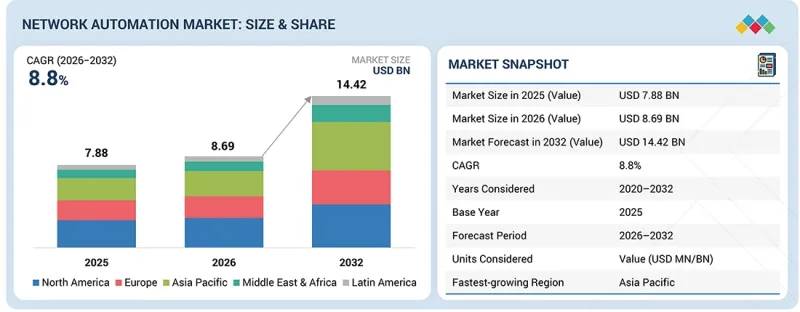
세계의 네트워크 자동화 시장 규모는 2026년 86억 9,000만 달러에서 2032년에는 144억 2,000만 달러로 성장하며, 예측 기간 중 CAGR은 8.8%에 달할 전망입니다.
이 시장의 성장을 주도하고 있는 것은 현대 네트워크 인프라의 규모 확대와 다양화입니다. 기업은 점점 더 복잡해지는 운영 프레임워크를 통해 데이터센터, 지사 환경, 클라우드 리소스, 분산형 엔드포인트를 관리해야 합니다. 네트워크 운영 팀은 구성의 일관성을 유지하면서 서비스를 보다 신속하게 프로비저닝해야 합니다. 따라서 자동화는 반복적인 작업의 표준화, 변경 작업의 연계 및 조정, 운영상의 의존성 감소를 실현하는 수단으로서 그 중요성이 커지고 있습니다.
| 조사 범위 | |
|---|---|
| 조사 대상 기간 | 2020-2032년 |
| 기준연도 | 2025년 |
| 예측 기간 | 2026-2032년 |
| 단위 | 달러 |
| 부문 | 제공, 네트워크 자동화 유형, 네트워크 유형, 최종사용자, 지역 |
| 대상 지역 | 북미, 유럽, 아시아태평양, 중동 및 아프리카, 라틴아메리카 |
소프트웨어 정의 네트워크(SDN), 네트워크 오케스트레이션, API, IAC(Infrastructure as Code)의 도입 확대에 따라 조직은 네트워크 운영을 보다 광범위한 IT 워크플로우와 통합할 수 있게 되었습니다. 동시에 클라우드 네이티브 애플리케이션, 엣지 인프라, 고성능 컴퓨팅 환경의 도입이 증가함에 따라 변화하는 워크로드에 동적에 대응할 수 있는 네트워크에 대한 수요가 높아지고 있습니다. AI 지원형 네트워크 운영 또한 이상 탐지, 예측 유지보수, 자동 문제 해결, 폐쇄 루프형 복구를 가능하게 함으로써 자동화의 범위를 확대하고 있습니다.
반면, 레거시 인프라 현대화에 따른 복잡성, 이기종 네트워크 환경 간의 통합 요구 사항, 도입 비용, 전문적인 자동화 기술을 갖춘 인력 확보와 같은 요인으로 인해 도입이 제한될 가능성이 있습니다. 이러한 요인들은 기업이 자동화에 대한 투자를 어떻게 우선순위를 정하고, 보다 집중적이고 프로그래밍 가능하며 자율적인 네트워크 운영으로 전환해 나갈지에 영향을 미치고 있습니다.
제공 형태별로는 소프트웨어 부문이 예측 기간 중 가장 큰 시장 점유율을 차지할 것으로 전망됩니다.
네트워크 구성, 오케스트레이션, 모니터링, 최적화를 통합적으로 제어할 수 있는 플랫폼의 도입이 진행되고 있으므로 소프트웨어는 네트워크 자동화 시장에서 가장 큰 점유율을 차지할 것으로 예상됩니다. 자동화 소프트웨어를 통해 네트워크 팀은 디바이스 수준에서의 수동 개입에 지나치게 의존하지 않고도 재현 가능한 워크플로를 생성하고, 정책을 일관되게 적용하며, 멀티벤더 인프라 전반에 걸쳐 운영을 조정할 수 있게 됩니다.
또한 자동화 플랫폼과 클라우드 관리, 가시성, IT 서비스 관리, DevOps 환경과의 통합이 진행됨에 따라 그 역할은 기존의 구성 관리의 범위를 넘어 확대되고 있습니다. 또한 AI 지원 기능을 통해 소프트웨어 플랫폼은 지능형 이벤트 분석, 예측적 인사이트, 자동화된 복구를 지원할 수 있게 되어 네트워크 운영의 대응력을 향상시키고 있습니다.
또한 프로그래밍 가능한 인프라와 API 기반 네트워크 관리의 도입이 확산되고 있는 점도, 이종 네트워크 리소스와 운영 시스템을 연결할 수 있는 소프트웨어에 대한 수요를 더욱 부추기고 있습니다. 기업이 네트워크의 민첩성을 높이는 동시에 운영의 복잡성을 줄이려고 노력하는 가운데, 소프트웨어 플랫폼은 자동화된 네트워크 관리 전략의 핵심 구성 요소로 자리 잡고 있습니다.
네트워크 유형별로 보면 예측 기간 중 클라우드 부문이 가장 높은 연평균 성장률(CAGR)을 기록할 것으로 예상됩니다.
기업이 애플리케이션과 워크로드를 퍼블릭 클라우드, 프라이빗 클라우드, 하이브리드 환경으로 분산시키는 움직임이 확대됨에 따라 클라우드 부문은 가장 높은 성장률을 보일 것으로 예상됩니다. 이러한 환경 간의 연결을 관리하기 위해서는 네트워크 리소스를 애플리케이션 요구 사항과 변화하는 워크로드에 지속적으로 맞추기 위해 더욱 정교한 오케스트레이션이 필요합니다. 자동화를 통해 기업은 클라우드 네트워크 리소스의 프로비저닝, 정책 관리, 연결 설정, 분산 환경 간의 변경 조정을 보다 신속하고 일관되게 수행할 수 있습니다. 멀티클라우드 전략의 확대에 따라 서로 다른 클라우드 플랫폼과 네트워크 아키텍처를 아우르며 운영 가능한 통합된 가시성과 자동화된 워크플로우에 대한 수요가 더욱 높아지고 있습니다. 또한 클라우드 네이티브 오케스트레이션 툴 및 애플리케이션 배포 파이프라인과의 통합을 통해 네트워크 운영이 컴퓨팅 및 애플리케이션 수명주기과 더욱 긴밀하게 연계되고 있습니다. 기업이 역동적인 클라우드 환경을 도입해 나가는 가운데, 네트워크 프로비저닝 및 정책 적용을 자동화하는 능력이 클라우드 네트워킹 분야의 중요한 성장 요인이 될 것으로 예상됩니다.
이 보고서에서는 전 세계 네트워크 자동화 시장을 조사하여, 시장 개요, 시장 성장에 영향을 미치는 다양한 요인에 대한 분석, 기술 및 특허 동향, 법규제 환경, 사례 연구, 시장 규모 추이 및 전망, 각종 분류·지역/주요 국가별 상세 분석, 경쟁 구도, 주요 기업 개요 등을 정리하여 전해드립니다.
자주 묻는 질문
목차
제1장 서론
제2장 개요
제3장 주요 인사이트
제4장 시장 개요
제5장 업계 동향
제6장 기술의 진보, AI의 영향, 특허, 혁신, 향후 응용
제7장 규제 상황
제8장 고객 상황과 구매 행동
제9장 네트워크 자동화 시장 : 제공 제품별
제10장 네트워크 자동화 시장 : 네트워크 자동화 유형별
제11장 네트워크 자동화 시장 : 네트워크 유형별
제12장 네트워크 자동화 시장 : 최종사용자별
제13장 네트워크 자동화 시장 : 지역별
제14장 경쟁 구도
제15장 기업 개요
제16장 조사 방법
제17장 부록
KSA 26.10.01The global network automation market will grow from USD 8.69 billion in 2026 to USD 14.42 billion by 2032, at a compound annual growth rate (CAGR) of 8.8% during the forecast period. The market is being propelled by the increasing scale and heterogeneity of modern network infrastructure, where enterprises must manage data centers, branch environments, cloud resources, and distributed endpoints through increasingly complex operational frameworks. As network teams face pressure to provision services faster while maintaining configuration consistency, automation is gaining importance as a means of standardizing repetitive tasks, coordinating changes, and reducing operational dependencies.
| Scope of the Report | |
|---|---|
| Years Considered for the Study | 2020-2032 |
| Base Year | 2025 |
| Forecast Period | 2026-2032 |
| Units Considered | USD Million/Billion |
| Segments | Offering, Network Automation Type, Network Type, End User and Region |
| Regions covered | North America, Europe, Asia Pacific, Middle East & Africa, Latin America |
The growing adoption of software-defined networking, network orchestration, APIs, and infrastructure-as-code is further enabling organizations to integrate network operations with broader IT workflows. At the same time, the increasing deployment of cloud-native applications, edge infrastructure, and high-performance computing environments is creating demand for networks capable of responding dynamically to changing workloads. AI-assisted network operations are also expanding the scope of automation by enabling anomaly detection, predictive maintenance, automated troubleshooting, and closed-loop remediation. However, adoption can be constrained by the complexity of modernizing legacy infrastructure, integration requirements across heterogeneous network environments, implementation costs, and the availability of personnel with specialized automation skills. These factors are influencing how enterprises prioritize automation investments and transition toward more centralized, programmable, and autonomous network operations.
Based on offering, the software segment is expected to hold the largest market share during the forecast period.
Software is expected to account for the largest share of the network automation market as organizations increasingly adopt platforms that provide centralized control over network configuration, orchestration, monitoring, and optimization. Automation software enables network teams to create repeatable workflows, apply policies consistently, and coordinate operations across multi-vendor infrastructure without relying extensively on manual device-level intervention. The growing integration of automation platforms with cloud management, observability, IT service management, and DevOps environments is expanding their role beyond traditional configuration management. In addition, AI-enabled capabilities are allowing software platforms to support intelligent event analysis, predictive insights, and automated remediation, improving the responsiveness of network operations. The increasing adoption of programmable infrastructure and API-based network management is further supporting demand for software that can connect disparate network resources and operational systems. As enterprises seek to improve network agility while controlling operational complexity, software platforms are becoming a core component of automated network management strategies.
Based on network type, the cloud networks segment is expected to grow at the highest CAGR during the forecast period.
Cloud networks are expected to experience the fastest growth as enterprises increasingly distribute applications and workloads across public cloud, private cloud, and hybrid environments. Managing connectivity across these environments requires greater levels of orchestration to ensure that network resources remain aligned with application requirements and changing workloads. Automation enables organizations to provision cloud network resources, manage policies, configure connectivity, and coordinate changes across distributed environments with greater speed and consistency. The expansion of multi-cloud strategies is further increasing the need for centralized visibility and automated workflows that can operate across different cloud platforms and network architectures. Integration with cloud-native orchestration tools and application deployment pipelines is also enabling network operations to become more closely connected with compute and application lifecycles. As enterprises continue to adopt dynamic cloud environments, the ability to automate network provisioning and policy enforcement is expected to make cloud networking a significant growth area within the market.
Asia Pacific is expected to grow at the highest CAGR during the forecast period.
Asia Pacific is expected to register the highest growth in the network automation market as enterprises and service providers across the region accelerate infrastructure modernization and digital transformation initiatives. Increasing investments in cloud infrastructure, data centers, telecommunications networks, and distributed computing environments are creating a broader requirement for automated network management. The rapid expansion of enterprise connectivity and the growing scale of digital services are also increasing the operational burden associated with manually configuring and maintaining network infrastructure. Organizations are therefore adopting software-driven approaches to improve provisioning speed, network visibility, and resource utilization. In addition, the development of advanced data center infrastructure and the expansion of edge computing are creating new use cases for programmable and automated networks. Service providers are also increasingly focused on improving operational efficiency and accelerating the deployment of network services across large-scale infrastructure. As organizations across the region move toward cloud-centric and software-defined environments, increasing investments in network modernization are expected to support the rapid adoption of network automation solutions throughout Asia Pacific.
Breakdown of primaries
We interviewed Chief Executive Officers (CEOs), directors of innovation and technology, system integrators, and executives from several significant network automation market companies.
- By Company: Tier I: 35%, Tier II: 40%, and Tier III: 25%
- By Designation: C-Level Executives: 40%, Director Level: 25%, and Others: 35%
- By Region: North America: 25%, Europe: 35%, Asia Pacific: 30%, Rest of World: 10%
Some of the significant network automation vendors are Cisco (US), IBM (US), HPE (US), Huawei (China), Broadcom (US), Arista Networks (US), Nokia (Finland), Ericsson (Sweden), Extreme Networks (US), Fujitsu (Japan).
Research coverage:
The market report covered the network automation market across segments. We estimated the market size and growth potential for many segments based on offering, network automation type, network type, end user, and region. It contains a thorough competitive analysis of the major market participants, information about their businesses, essential observations about their product offerings, current trends, and critical market strategies.
Reasons to buy this report:
With information on the most accurate revenue estimates for the whole network automation industry and its subsegments, the research will benefit market leaders and recent newcomers. Stakeholders will benefit from this report's increased understanding of the competitive environment, which will help them better position their companies and develop go-to-market strategies. The research offers information on the main market drivers, constraints, opportunities, and challenges, as well as aids players in understanding the pulse of the industry.
The report provides insights on the following pointers:
Analysis of key drivers (Rising network complexity & scale, need for operational efficiency & cost reduction, and security & compliance requirements), restraints (High initial investment & integration challenges, and lack of skilled workforce), opportunities (Integration of AI and ML in network automation to drive autonomous networks, 5G & edge computing expansion, and cloud-native & multi-vendor interoperability), and challenges (Security risks of automated networks, and vendor lock-in & interoperability issues).
- Product Development/Innovation: Comprehensive analysis of emerging technologies, R&D initiatives, and new service and product introductions in the network automation market
- Market Development: In-depth details regarding profitable markets: the paper examines the global network automation market
- Market Diversification: Comprehensive details regarding recent advancements, investments, unexplored regions, new goods and services, and the network automation market
- Competitive Assessment: Thorough analysis of the market shares, expansion plans, platforms, and service portfolios of the top competitors in the network automation industry, such as Cisco (US), IBM (US), HPE (US), Huawei (China), Broadcom (US), Arista Networks (US), Nokia (Finland), Ericsson (Sweden), Extreme Networks (US), Fujitsu (Japan), NetBrain Technologies (US), Gluware (US), SolarWinds (US), Riverbed (US), Forward Networks (US), Palo Alto Networks (US), Aviz Networks (US), Itential (US), BackBox (US), Flock9 (Netherlands), Anuta Networks (US), Versa Networks (US), Infoblox (US), Auvik Networks (Canada), Arrcus (US), BlueCat (Canada), and Stardust Systems (US)
TABLE OF CONTENTS
1 INTRODUCTION
- 1.1 STUDY OBJECTIVES
- 1.2 MARKET DEFINITION
- 1.3 STUDY SCOPE
- 1.3.1 MARKET SEGMENTATION
- 1.3.2 INCLUSIONS AND EXCLUSIONS
- 1.3.3 YEARS CONSIDERED
- 1.4 CURRENCY CONSIDERED
- 1.5 STAKEHOLDERS
- 1.6 SUMMARY OF CHANGES
2 EXECUTIVE SUMMARY
- 2.1 MARKET HIGHLIGHTS AND KEY INSIGHTS
- 2.2 KEY MARKET PARTICIPANTS: MAPPING OF STRATEGIC DEVELOPMENTS
- 2.3 DISRUPTIVE TRENDS IN NETWORK AUTOMATION MARKET
- 2.4 REGIONAL SNAPSHOT: MARKET SIZE, GROWTH RATE, AND FORECAST
3 PREMIUM INSIGHTS
- 3.1 ATTRACTIVE OPPORTUNITIES FOR PLAYERS IN NETWORK AUTOMATION MARKET
- 3.2 NETWORK AUTOMATION MARKET, BY OFFERING, 2026
- 3.3 NETWORK AUTOMATION MARKET, BY END USER, 2026
- 3.4 NETWORK AUTOMATION MARKET, BY NETWORK AUTOMATION TYPE, 2026
- 3.5 NETWORK AUTOMATION MARKET, BY NETWORK TYPE, 2026
- 3.6 NETWORK AUTOMATION MARKET, BY ENTERPRISE, 2026
- 3.7 NORTH AMERICA: NETWORK AUTOMATION MARKET, BY TOP 3 NETWORK TYPES & COUNTRY, 2026
- 3.8 ASIA PACIFIC: NETWORK AUTOMATION MARKET, BY TOP 3 NETWORK TYPES & COUNTRIES, 2026
4 MARKET OVERVIEW
- 4.1 INTRODUCTION
- 4.2 MARKET DYNAMICS
- 4.2.1 DRIVERS
- 4.2.1.1 Rising network complexity & scale
- 4.2.1.2 Need for operational efficiency & cost reduction
- 4.2.1.3 Security & compliance requirements
- 4.2.1.4 Expansion of AI infrastructure & high-performance data center networks
- 4.2.2 RESTRAINTS
- 4.2.2.1 High initial investment & integration challenges
- 4.2.2.2 Lack of skilled workforce
- 4.2.2.3 Data quality & automation readiness constraints
- 4.2.3 OPPORTUNITIES
- 4.2.3.1 Integration of AI and ML in network automation
- 4.2.3.2 5G rollout & edge computing expansion
- 4.2.3.3 Cloud-native & API-driven network automation
- 4.2.3.4 Expansion of closed-loop & intent-based network operations
- 4.2.4 CHALLENGES
- 4.2.4.1 Security risks of automated networks
- 4.2.4.2 Vendor lock-in & interoperability issues
- 4.2.1 DRIVERS
- 4.3 INTERCONNECTED MARKETS AND CROSS-SECTOR OPPORTUNITIES
- 4.3.1 INTERCONNECTED MARKETS
- 4.3.2 CROSS-SECTOR OPPORTUNITIES
- 4.4 STRATEGIC MOVES BY TIER-1/2/3 PLAYERS
5 INDUSTRY TRENDS
- 5.1 PORTER'S FIVE FORCES ANALYSIS
- 5.1.1 THREAT OF NEW ENTRANTS
- 5.1.2 THREAT OF SUBSTITUTES
- 5.1.3 BARGAINING POWER OF SUPPLIERS
- 5.1.4 BARGAINING POWER OF BUYERS
- 5.1.5 INTENSITY OF COMPETITIVE RIVALRY
- 5.2 MACROECONOMIC OUTLOOK
- 5.2.1 INTRODUCTION
- 5.2.2 GDP TRENDS AND FORECAST
- 5.2.3 TRENDS IN NETWORK AUTOMATION MARKET
- 5.3 SUPPLY CHAIN ANALYSIS
- 5.3.1 TECHNOLOGY & INFRASTRUCTURE PROVIDERS
- 5.3.2 SOFTWARE & PLATFORM PROVIDERS
- 5.3.3 INTEGRATION & SERVICE PROVIDERS
- 5.3.4 END USERS
- 5.4 ECOSYSTEM ANALYSIS
- 5.5 PRICING ANALYSIS
- 5.5.1 INDICATIVE PRICING OF NETWORK AUTOMATION OFFERINGS, 2025
- 5.5.2 INDICATIVE PRICING OF NETWORK AUTOMATION SOFTWARE, BY NETWORK SCALE, 2025
- 5.6 KEY CONFERENCES AND EVENTS, 2026-2027
- 5.7 TRENDS/DISRUPTIONS IMPACTING CUSTOMER BUSINESS
- 5.8 INVESTMENT AND FUNDING SCENARIO
- 5.9 CASE STUDY ANALYSIS
- 5.9.1 LEADING FINANCIAL FIRM AUTOMATES APPLICATION SERVICES WITH CISCO ACI AND AVI NETWORKS
- 5.9.2 HARRY REID INTERNATIONAL AIRPORT ACHIEVES SEAMLESS CONNECTIVITY AND OPERATIONAL INSIGHTS WITH HPE ARUBA NETWORKING
- 5.9.3 VODAFONE GROUP CREATES NIMBLE SERVICE INNOVATION PLATFORM WITH VMWARE NFV
- 5.9.4 IBM CIO ORGANIZATION OPTIMIZES MULTI-TENANT ENVIRONMENT WITH TURBONOMIC AUTOMATION
- 5.9.5 ARCELIK MODERNIZES MANUFACTURING WITH HIGH-PERFORMANCE NOKIA PRIVATE 5G NETWORK
- 5.9.6 FINANCIAL SERVICES COMPANY ACHIEVES CLOUD TRANSFORMATION WITH ARISTA'S CONVERGED CLOUD FABRIC
- 5.10 IMPACT OF 2025 US TARIFF - NETWORK AUTOMATION MARKET
- 5.10.1 INTRODUCTION
- 5.10.2 IMPACT OF 2025 US TARIFF ON NETWORK AUTOMATION MARKET
- 5.10.3 KEY TARIFF RATES
- 5.10.4 PRICE IMPACT ANALYSIS
- 5.10.4.1 Strategic shifts and emerging trends
- 5.10.5 IMPACT ON COUNTRIES/REGIONS
- 5.10.5.1 US
- 5.10.5.2 China
- 5.10.5.3 Europe
- 5.10.5.4 Asia Pacific (excluding China)
- 5.10.6 IMPACT ON END-USER INDUSTRIES
- 5.10.6.1 Banking, financial services, and insurance (BFSI)
- 5.10.6.2 Healthcare and life sciences
- 5.10.6.3 Retail and e-commerce
- 5.10.6.4 Telecom and technology
- 5.10.6.5 Government and public sector
- 5.10.6.6 Manufacturing and industrial
6 TECHNOLOGICAL ADVANCEMENTS, AI-DRIVEN IMPACT, PATENTS, INNOVATIONS, AND FUTURE APPLICATIONS
- 6.1 KEY TECHNOLOGIES
- 6.1.1 SOFTWARE-DEFINED NETWORKING (SDN)
- 6.1.2 NETWORK FUNCTION VIRTUALIZATION (NFV)
- 6.1.3 INTENT-BASED NETWORKING (IBN)
- 6.1.4 ARTIFICIAL INTELLIGENCE (AI) & MACHINE LEARNING (ML)
- 6.2 ADJACENT TECHNOLOGIES
- 6.2.1 CLOUD COMPUTING
- 6.2.2 5G
- 6.2.3 NETWORK MONITORING & OBSERVABILITY
- 6.3 COMPLEMENTARY TECHNOLOGIES
- 6.3.1 DIGITAL TWIN
- 6.3.2 ROBOTIC PROCESS AUTOMATION (RPA)
- 6.4 TECHNOLOGY ROADMAP
- 6.4.1 SHORT-TERM (2026-2027)
- 6.4.2 MID-TERM (2028-2029)
- 6.4.3 LONG-TERM (2030+)
- 6.5 PATENT ANALYSIS
- 6.6 IMPACT OF AI/GEN AI ON NETWORK AUTOMATION MARKET
- 6.6.1 TOP USE CASES AND MARKET POTENTIAL
- 6.6.2 CASE STUDIES OF AI IMPLEMENTATION IN NETWORK AUTOMATION MARKET
- 6.6.3 INTERCONNECTED ADJACENT ECOSYSTEM AND IMPACT ON MARKET PLAYERS
- 6.6.4 CLIENTS' READINESS TO ADOPT GENERATIVE AI IN NETWORK AUTOMATION MARKET
7 REGULATORY LANDSCAPE
- 7.1 REGIONAL REGULATIONS AND COMPLIANCE
- 7.1.1 REGULATORY BODIES, GOVERNMENT AGENCIES, AND OTHER ORGANIZATIONS
- 7.1.2 KEY REGULATIONS
- 7.1.2.1 North America
- 7.1.2.1.1 US
- 7.1.2.1.2 Canada
- 7.1.2.2 Europe
- 7.1.2.3 Asia Pacific
- 7.1.2.3.1 South Korea
- 7.1.2.3.2 China
- 7.1.2.3.3 India
- 7.1.2.4 Middle East & Africa
- 7.1.2.4.1 UAE
- 7.1.2.4.2 KSA
- 7.1.2.5 Latin America
- 7.1.2.5.1 Brazil
- 7.1.2.5.2 Mexico
- 7.1.2.1 North America
- 7.1.3 INDUSTRY STANDARDS
8 CUSTOMER LANDSCAPE AND BUYER BEHAVIOR
- 8.1 DECISION-MAKING PROCESS
- 8.2 KEY STAKEHOLDERS INVOLVED IN BUYING PROCESS AND THEIR EVALUATION CRITERIA
- 8.2.1 KEY STAKEHOLDERS IN BUYING PROCESS
- 8.2.2 BUYING CRITERIA
- 8.3 ADOPTION BARRIERS AND INTERNAL CHALLENGES
- 8.4 UNMET NEEDS OF VARIOUS END-USE INDUSTRIES
9 NETWORK AUTOMATION MARKET, BY OFFERING
- 9.1 INTRODUCTION
- 9.1.1 OFFERING: MARKET DRIVERS
- 9.2 SOFTWARE
- 9.2.1 ENABLING PROGRAMMABLE AND INTELLIGENT NETWORK OPERATIONS
- 9.3 SERVICES
- 9.3.1 PROFESSIONAL SERVICES
- 9.3.1.1 Enabling strategic implementation and integration of network automation
- 9.3.1.2 Advisory & consulting
- 9.3.1.3 Deployment & integration
- 9.3.1.4 Training & support
- 9.3.2 MANAGED SERVICES
- 9.3.2.1 Ensuring continuous optimization and reliable network operations
- 9.3.1 PROFESSIONAL SERVICES
10 NETWORK AUTOMATION MARKET, BY NETWORK AUTOMATION TYPE
- 10.1 INTRODUCTION
- 10.1.1 NETWORK AUTOMATION TYPE: MARKET DRIVERS
- 10.2 ORCHESTRATION AUTOMATION
- 10.2.1 COORDINATING NETWORK WORKFLOWS AND RESOURCES TO SIMPLIFY OPERATIONS ACROSS COMPLEX ENVIRONMENTS
- 10.3 PROVISIONING AUTOMATION
- 10.3.1 ACCELERATING NETWORK RESOURCE DEPLOYMENT AND CONFIGURATION TO IMPROVE OPERATIONAL CONSISTENCY
- 10.4 SCRIPT-DRIVEN NETWORK AUTOMATION
- 10.4.1 ENABLING FLEXIBLE, TASK-SPECIFIC AUTOMATION THROUGH PROGRAMMABLE NETWORK WORKFLOWS
- 10.5 AI-DRIVEN NETWORK AUTOMATION
- 10.5.1 APPLYING AI AND ANALYTICS TO ENABLE PREDICTIVE, ADAPTIVE, AND INCREASINGLY AUTONOMOUS NETWORK OPERATIONS
- 10.6 INTENT-BASED NETWORK AUTOMATION
- 10.6.1 TRANSLATING HIGH-LEVEL OPERATIONAL REQUIREMENTS INTO DYNAMIC NETWORK POLICIES
- 10.7 NETWORK SECURITY AUTOMATION
- 10.7.1 AUTOMATING SECURITY POLICIES, THREAT RESPONSE, AND NETWORK PROTECTION TO IMPROVE RESILIENCE
- 10.8 OTHER NETWORK AUTOMATION TYPES
11 NETWORK AUTOMATION MARKET, BY NETWORK TYPE
- 11.1 INTRODUCTION
- 11.1.1 NETWORK TYPE: MARKET DRIVERS
- 11.2 DATA CENTER NETWORKS
- 11.2.1 AUTOMATING DATA CENTER OPERATIONS TO SUPPORT DYNAMIC WORKLOADS AND SCALABLE INFRASTRUCTURE
- 11.3 CLOUD NETWORKS
- 11.3.1 AUTOMATING CONNECTIVITY AND RESOURCE MANAGEMENT ACROSS DYNAMIC CLOUD ENVIRONMENTS
- 11.4 WIRELESS NETWORKS
- 11.4.1 AUTOMATING WIRELESS OPERATIONS TO IMPROVE PERFORMANCE AND CONNECTIVITY AT SCALE
- 11.5 SOFTWARE-DEFINED WIDE AREA NETWORKS (SD-WAN)
- 11.5.1 DISTRIBUTED WAN OPERATIONS THROUGH CENTRALIZED POLICY AND TRAFFIC MANAGEMENT
- 11.6 CAMPUS NETWORKS
- 11.6.1 ENTERPRISE CAMPUS MANAGEMENT THROUGH AUTOMATED PROVISIONING AND POLICY CONTROL
- 11.7 OTHER NETWORK TYPES
12 NETWORK AUTOMATION MARKET, BY END USER
- 12.1 INTRODUCTION
- 12.1.1 END USER: MARKET DRIVERS
- 12.2 SERVICE PROVIDERS
- 12.2.1 AUTOMATING LARGE-SCALE NETWORK OPERATIONS TO IMPROVE SERVICE AGILITY AND RESOURCE UTILIZATION
- 12.3 ENTERPRISES
- 12.3.1 MODERNIZING DISTRIBUTED NETWORK INFRASTRUCTURE THROUGH AUTOMATION
- 12.3.2 BFSI
- 12.3.3 HEALTHCARE
- 12.3.4 RETAIL & E-COMMERCE
- 12.3.5 MANUFACTURING
- 12.3.6 GOVERNMENT & DEFENSE
- 12.3.7 ENERGY & UTILITIES
- 12.3.8 OTHER ENTERPRISES
13 NETWORK AUTOMATION MARKET, BY REGION
- 13.1 INTRODUCTION
- 13.2 NORTH AMERICA
- 13.2.1 US
- 13.2.1.1 AI infrastructure and autonomous operations reshape enterprise networking
- 13.2.2 CANADA
- 13.2.2.1 Growing adoption of cloud-based and AI-assisted NetOps
- 13.2.1 US
- 13.3 EUROPE
- 13.3.1 UK
- 13.3.1.1 Moving network automation toward autonomous enterprise operations
- 13.3.2 GERMANY
- 13.3.2.1 Industrial complexity pushing automation deeper into network operations
- 13.3.3 FRANCE
- 13.3.3.1 Digital infrastructure expansion increasing need for coordinated network management
- 13.3.4 ITALY
- 13.3.4.1 Accelerating network automation for digital future to drive market
- 13.3.5 REST OF EUROPE
- 13.3.1 UK
- 13.4 ASIA PACIFIC
- 13.4.1 CHINA
- 13.4.1.1 Large-scale telecom operations accelerating closed-loop network automation
- 13.4.2 JAPAN
- 13.4.2.1 Automation extending from network operations to infrastructure deployment
- 13.4.3 INDIA
- 13.4.3.1 Large and diverse telecom infrastructure increasing demand for centralized automation
- 13.4.4 REST OF ASIA PACIFIC
- 13.4.1 CHINA
- 13.5 MIDDLE EAST & AFRICA
- 13.5.1 UAE
- 13.5.1.1 Strong digital infrastructure supporting advanced network automation adoption
- 13.5.2 KSA
- 13.5.2.1 Digital infrastructure investments creating demand for network orchestration
- 13.5.3 SOUTH AFRICA
- 13.5.3.1 Network reliability and operational continuity driving automation adoption
- 13.5.4 REST OF MIDDLE EAST & AFRICA
- 13.5.1 UAE
- 13.6 LATIN AMERICA
- 13.6.1 BRAZIL
- 13.6.1.1 Data center and telecom modernization supporting network automation
- 13.6.2 MEXICO
- 13.6.2.1 Backbone modernization creating foundation for automated network management
- 13.6.3 REST OF LATIN AMERICA
- 13.6.1 BRAZIL
14 COMPETITIVE LANDSCAPE
- 14.1 INTRODUCTION
- 14.2 KEY PLAYER COMPETITIVE STRATEGIES/RIGHT TO WIN, 2023-2026
- 14.2.1 OVERVIEW OF STRATEGIES ADOPTED BY KEY NETWORK AUTOMATION PLAYERS
- 14.3 REVENUE ANALYSIS, 2021-2025
- 14.4 MARKET SHARE ANALYSIS, 2025
- 14.5 BRAND/PRODUCT COMPARISON
- 14.6 COMPANY EVALUATION MATRIX: KEY PLAYERS, 2025
- 14.6.1 STARS
- 14.6.2 EMERGING LEADERS
- 14.6.3 PERVASIVE PLAYERS
- 14.6.4 PARTICIPANTS
- 14.6.5 COMPANY FOOTPRINT: KEY PLAYERS, 2025
- 14.6.5.1 Company footprint
- 14.6.5.2 Region footprint
- 14.6.5.3 Offering footprint
- 14.6.5.4 Network type footprint
- 14.7 COMPANY EVALUATION MATRIX: STARTUPS/SMES, 2025
- 14.7.1 PROGRESSIVE COMPANIES
- 14.7.2 RESPONSIVE COMPANIES
- 14.7.3 DYNAMIC COMPANIES
- 14.7.4 STARTING BLOCKS
- 14.7.5 COMPETITIVE BENCHMARKING: STARTUPS/SMES, 2025
- 14.7.5.1 Detailed list of key startups/SMEs
- 14.7.5.2 Competitive benchmarking of key startups/SMEs
- 14.8 COMPANY VALUATION AND FINANCIAL METRICS
- 14.9 COMPETITIVE SCENARIO
- 14.9.1 PRODUCT LAUNCHES
- 14.9.2 DEALS
15 COMPANY PROFILES
- 15.1 KEY PLAYERS
- 15.1.1 CISCO
- 15.1.1.1 Business overview
- 15.1.1.2 Products/Solutions/Services offered
- 15.1.1.3 Recent developments
- 15.1.1.3.1 Product launches/enhancements
- 15.1.1.3.2 Deals
- 15.1.1.4 MnM view
- 15.1.1.4.1 Key strengths
- 15.1.1.4.2 Strategic choices
- 15.1.1.4.3 Weaknesses and competitive threats
- 15.1.2 HPE
- 15.1.2.1 Business overview
- 15.1.2.2 Products/Solutions/Services offered
- 15.1.2.3 Recent developments
- 15.1.2.3.1 Product launches/enhancements
- 15.1.2.3.2 Deals
- 15.1.2.4 MnM view
- 15.1.2.4.1 Key strengths
- 15.1.2.4.2 Strategic choices
- 15.1.2.4.3 Weaknesses and competitive threats
- 15.1.3 IBM
- 15.1.3.1 Business overview
- 15.1.3.2 Products/Solutions/Services offered
- 15.1.3.3 Recent developments
- 15.1.3.3.1 Product launches/enhancements
- 15.1.3.3.2 Deals
- 15.1.3.4 MnM view
- 15.1.3.4.1 Key strengths
- 15.1.3.4.2 Strategic choices
- 15.1.3.4.3 Weaknesses and competitive threats
- 15.1.4 HUAWEI
- 15.1.4.1 Business overview
- 15.1.4.2 Products/Solutions/Services offered
- 15.1.4.3 Recent developments
- 15.1.4.3.1 Product launches/enhancements
- 15.1.4.3.2 Deals
- 15.1.4.4 MnM view
- 15.1.4.4.1 Key strengths
- 15.1.4.4.2 Strategic choices
- 15.1.4.4.3 Weaknesses and competitive threats
- 15.1.5 NOKIA
- 15.1.5.1 Business overview
- 15.1.5.2 Products/Solutions/Services offered
- 15.1.5.3 Recent developments
- 15.1.5.3.1 Product launches/enhancements
- 15.1.5.3.2 Deals
- 15.1.5.4 MnM view
- 15.1.5.4.1 Key strengths
- 15.1.5.4.2 Strategic choices
- 15.1.5.4.3 Weaknesses and competitive threats
- 15.1.6 BROADCOM
- 15.1.6.1 Business overview
- 15.1.6.2 Products/Solutions/Services offered
- 15.1.6.3 Recent developments
- 15.1.6.3.1 Product launches/enhancements
- 15.1.6.3.2 Deals
- 15.1.7 ARISTA NETWORKS
- 15.1.7.1 Business overview
- 15.1.7.2 Products/Solutions/Services offered
- 15.1.7.3 Recent developments
- 15.1.7.3.1 Product launches/enhancements
- 15.1.7.3.2 Deals
- 15.1.8 ERICSSON
- 15.1.8.1 Business overview
- 15.1.8.2 Products/Solutions/Services offered
- 15.1.8.3 Recent developments
- 15.1.8.3.1 Product launches/enhancements
- 15.1.8.3.2 Deals
- 15.1.9 EXTREME NETWORKS
- 15.1.9.1 Business overview
- 15.1.9.2 Products/Solutions/Services offered
- 15.1.9.3 Recent developments
- 15.1.9.3.1 Product launches/enhancements
- 15.1.9.3.2 Deals
- 15.1.10 FUJITSU
- 15.1.10.1 Business overview
- 15.1.10.2 Products/Solutions/Services offered
- 15.1.10.3 Recent developments
- 15.1.10.3.1 Deals
- 15.1.1 CISCO
- 15.2 OTHER PLAYERS
- 15.2.1 NETBRAIN TECHNOLOGIES
- 15.2.2 GLUWARE
- 15.2.3 SOLARWINDS
- 15.2.4 RIVERBED
- 15.2.5 FORWARD NETWORKS
- 15.2.6 PALO ALTO NETWORKS
- 15.3 STARTUPS/SMES
- 15.3.1 AVIZ NETWORKS
- 15.3.2 ITENTIAL
- 15.3.3 BACKBOX
- 15.3.4 FLOCK9
- 15.3.5 ANUTA NETWORKS
- 15.3.6 VERSA NETWORKS
- 15.3.7 INFOBLOX
- 15.3.8 AUVIK NETWORKS
- 15.3.9 ARRCUS
- 15.3.10 BLUECAT
- 15.3.11 STARDUST SYSTEMS
16 RESEARCH METHODOLOGY
- 16.1 RESEARCH DATA
- 16.1.1 SECONDARY DATA
- 16.1.1.1 Secondary sources
- 16.1.2 PRIMARY DATA
- 16.1.2.1 Breakup of primary profiles
- 16.1.2.2 Primary sources
- 16.1.2.3 Key industry insights
- 16.1.1 SECONDARY DATA
- 16.2 MARKET SIZE ESTIMATION
- 16.2.1 BOTTOM-UP APPROACH
- 16.2.2 TOP-DOWN APPROACH
- 16.3 MARKET BREAKUP AND DATA TRIANGULATION
- 16.4 MARKET FORECAST
- 16.5 RESEARCH ASSUMPTIONS
- 16.6 RESEARCH LIMITATIONS
17 APPENDIX
- 17.1 DISCUSSION GUIDE
- 17.2 KNOWLEDGESTORE: MARKETSANDMARKETS' SUBSCRIPTION PORTAL
- 17.3 CUSTOMIZATION OPTIONS
- 17.4 RELATED REPORTS
- 17.5 AUTHOR DETAILS


