|
시장보고서
상품코드
2121765
천연 섬유 강화 복합재료 : 시장 점유율 분석, 업계 동향과 통계, 성장 예측(2025-2031년)Natural Fiber Reinforced Composites - Market Share Analysis, Industry Trends & Statistics, Growth Forecasts (2025 - 2031) |
||||||
 Mordor Intelligence
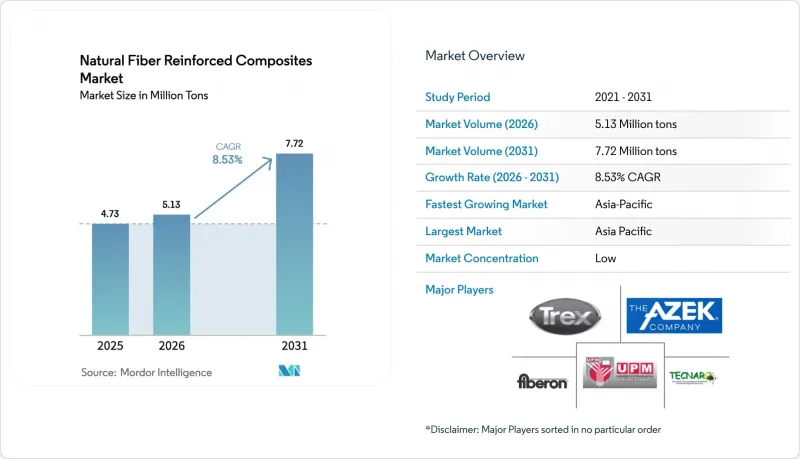
Mordor Intelligence에 따르면 천연 섬유 강화 복합재료 시장 규모는 2025년 473만 톤에서 2026년에는 513만 톤으로 확대하며, 2026-2031년에 CAGR 8.53%로 추이하며, 2031년에는 772만 톤에 달할 것으로 예측됩니다.
이 보고서는 섬유(목재·비목재), 폴리머 매트릭스(열경화성 수지, 열가소성 수지, 바이오 기반 폴리머), 가공 기술(사출성형, 압축 성형, 풀트루전, 기타), 최종사용자 산업(자동차, 항공우주, 선박, 기타),지역(아시아태평양, 북미, 유럽, 기타)별로 분류되어 있습니다. 시장 예측은 톤 기준으로 제시되어 있습니다.
세계 천연 섬유 강화 복합재료 시장의 동향 및 인사이트
자동차 재활용 가능성 목표에 대한 법적 규제 압력
2024년부터 시행되고 있는 개정된 EU 폐차 지침에 따라 자동차 제조사는 질량 기준으로 85%의 재활용률을 달성해야 할 의무가 있으며, 이를 위반한 차량 1대당 500유로의 벌금이 부과됩니다. 이에 따라 도어 모듈에서 아마나 대마로 즉시 대체하는 움직임이 촉진되고 있습니다. 이에 이어 중국 공업정보화부는 2030년까지 국내 브랜드에 90%의 재활용 가능성을 의무화하는 규정을 제정했으며, 린넨 섬유로 만든 배터리 케이스의 시범 조달이 시작되었습니다. 캘리포니아주가 부품 자료에 수명 주기 탄소 점수를 부여하고, 버진 폴리프로필렌에 비해 내재된 CO₂가 60% 적은 바이오 기반 화합물의 조달을 장려하고 있으며, OEM 각사는 간접적인 압박을 느끼고 있습니다. BMW는 2025년 아마 공급을 확보하고 규제상의 제재를 피하기 위해 Bcomp와 장기 인수 계약을 체결했습니다. 법규의 기한이 다가옴에 따라 천연 섬유 강화 복합재료 시장은 3개 대륙에 걸쳐 수요가 주도되고 있습니다.
EV 플랫폼에서의 경량화 급속한 확산
배터리식 전기자동차는 주행 거리를 감소시키는 200kg의 추가 중량을 싣고 있습니다. 유리섬유를 대마 복합재로 대체함으로써 시트 등받이와 트렁크 선반의 무게를 15% 줄일 수 있으며, 이를 통해 1kg의 경량화당 약 0.3km의 주행 거리 연장과 차량당 15달러의 배터리 비용 절감으로 이어집니다. 2025년 실험실 테스트에서 대마-PP 복합재는 인장 강도 85MPa, 굽힘 탄성률 6.5GPa를 달성하여, 유리섬유와의 성능 격차가 좁혀졌음이 입증되었습니다. 테슬라는 향후 출시 예정인 ‘모델 2’에서 천연 섬유 부품의 사용을 비용 절감 수단으로 삼고 있으며, 유럽의 고급 브랜드에 국한되지 않는 대중화 추세를 시사하고 있습니다. 중국의 스타트업 기업인 NIO와 XPeng은 아마를 사용한 도어 패널 프로그램을 2027년 양산에 적용하기 위한 검증 단계로 진행 중이며, 이는 전기자동차 관련 수요가 전 세계에서 확대되고 있음을 지원하고 있습니다. 이러한 움직임에 힘입어, 구동계 성능이 가솔린 차량 수준에 도달할 시기를 앞당기며 천연 섬유 강화 복합재료 시장으로의 침투가 가속화되고 있습니다.
흡습에 의한 치수 불안정화
천연 섬유는 상대 습도 85%의 환경에서 8%-12%의 수분을 흡수하여 부품이 팽창하고 매트릭스와의 결합 강도가 저하됩니다. 2차 폴리우레탄 코팅이나 폴리에틸렌 공압출 가공을 실시하면 제조 비용이 1kg당 0.40-0.60달러 증가하지만, 아세틸화 처리를 실시하면 흡습률은 4%로 억제될 수 있는 반면, 섬유 가격은 25% 상승합니다. 2025년 ORNL의 연구에 따르면 대마·PP 패널은 습도 95%의 환경에 1,000시간 노출된 후 굽힘 강도가 15% 저하되는 것으로 나타났습니다. 선박 용도는 여전히 수선상의 캐빈 모듈로 제한되어 있으며, 자동차 외장 차체로의 통합은 다층 배리어 및 하이브리드 유리 스킨이 보편화될 때까지 연기되고 있습니다. 이러한 제약으로 인해 습기에 노출되는 용도에서의 천연 섬유 강화 복합재료 시장의 확산이 둔화되고 있습니다.
부문 분석
목재 섬유는 원료 비용이 저렴하고 데크 자재의 공급망이 확립되어 있으며, 2025년에는 천연 섬유 강화 복합재료 시장에서 42.94%의 점유율을 차지했습니다. 비목재 껍질 섬유는 BMW와 볼보가 기존보다 25% 얇으면서도 충돌 강성을 충족하는 아마로 만든 도어 패널을 채택함에 따라 2031년까지 연평균 성장률(CAGR) 9.45%를 기록할 전망입니다. 캐나다와 미국의 대마 껍질 제거 처리 능력은 2024-2026년 사이에 4배로 확대되어 자동차 프로그램への 공급이 확보되었습니다. 유럽의 프로젝트에서는 케나프나 황마를 시트 쉘에 혼합하여 1kg당 기계적 효율을 향상시키고 있습니다.
이와 병행하여, 면 솜은 전기자동차(EV) 실내용 방음 매트에 활용되고 있으며, 브라질에서는 바나나 섬유와 사이잘 삼이 트렁크 라이너 생산을 지원하고 있습니다. Bcomp의 ‘ampliTex’ 아마 직물은 일반 목분보다 40% 높은 프리미엄 가격이 책정되는 반구조용 항공우주 패널을 실현하여, 공급업체의 밸류체인내 위상 제고를 지원하고 있습니다. 탄소 감축 기준이 엄격해짐에 따라 OEM 각사는 CO₂ 배출량 대비 강성 비율이 가장 높은 섬유를 우선적으로 선택하게 되었으며, 천연 섬유 강화 복합재료 시장의 미래 성장은 고급 인피 섬유 쪽으로 기울고 있습니다.
2025년 생산량의 55.82%를 열가소성 수지가 차지하고 있는데, 이는 폴리프로필렌이 170°C의 성형 온도 범위를 지원하기 때문입니다. 기계적 재활용 루프를 통해 사출성형된 실내 트림의 수명 주기 비용이 절감되고 있습니다. 그러나 바이오 기반 폴리머에 대한 수요는 연평균 성장률(CAGR) 9.21%로 증가하고 있습니다. 네이처웍스(NatureWorks)사의 ‘인지오(Ingeo)’ PLA는 태국에서의 생산 확대로 인해 1kg당 비용이 2.20달러까지 낮아져, 가전제품 외장재에 ABS와 동등한 비용으로 PLA와 아마 혼합재를 사용할 수 있게 되었습니다. 열경화성 수지는 재활용 문제가 있음에도 불구하고 수지 전사 성형(RTM)을 통해 높은 유리 전이 온도를 확보할 수 있는 풍력 터빈의 스퍼나 선박의 선체에서 여전히 중요한 역할을 하고 있습니다. 또한 소나무 가루를 배합한 폴리염화비닐(PVC)은 엄격한 방화 기준을 충족하는 창틀 보강재로 사용되어 할로겐계 난연제 사용을 피하고 있습니다. 전반적으로 수지의 용도 분화는 각 최종 시장의 요구를 반영하고 있습니다. 자동차 산업에서는 재생 PP 혼합이 추진되고 있으며, 건설 산업에서는 PVC 목재 복합재가 선호되고, 재생 가능 에너지 산업에서는 에폭시 수지와 인피 섬유의 하이브리드 소재로의 전환이 진행되고 있습니다.
지역별 분석
아시아태평양은 2025년에 천연 섬유 강화 복합재료 시장의 42.25%를 차지할 것으로 보이며, 중국의 재활용 의무화 및 인도의 주택 개보수 붐을 배경으로 2031년까지 연평균 성장률(CAGR) 9.10%를 기록할 전망입니다. 이 지역의 천연 섬유 강화 복합재료 시장 규모는 2031년까지 350만 톤을 넘어설 전망입니다. 중국 공업정보화부(MIIT)의 규제에 따라 배터리 케이스용 늑피 섬유 트림이 중시되는 한편, 우후 하오샹(Wuhu Haoxuan)사의 신설된 1만 5,000톤 압출 라인은 도시 지역 보도용 데크 자재를 공급하고 있습니다. 동남아시아의 공장에서는 코코넛 섬유와 바나나 섬유를 톤당 300달러 이하의 원료 비용으로 가공하고 있으며, 압출 성형 프로파일의 가격 경쟁력은 비닐 사이딩에 필적하는 수준입니다.
유럽은 생산량 면에서는 2위이지만, 혁신 면에서는 주도적인 입지를 차지하고 있습니다. 독일의 한 공급업체는 초임계 CO₂ 처리를 도입하여 아마의 강성을 33% 향상시킴으로써, 반구조용 시트 프레임의 실현을 가능하게 하고 있습니다. 영국의 BREEAM 제도나 프랑스의 RE2020 기준에서는 바이오 기반 외벽 자재에 탄소 포인트가 부여되므로 건축가들은 목질 섬유 PVC 클래딩을 채택하고 있습니다. 북유럽의 제재소에서는 임업 부산물을 폴리프로필렌 ‘포르미(Formi)’ 혼합 소재로 전환하여 순환형 루프를 강화하고 있습니다.
북미에서는 재생 톱밥과 사용 후 필름을 활용하고 있습니다. Trex는 원료의 95%를 폐기물에서 조달하며, 2025년에는 매출 총이익률을 38%로 향상시킬 전망입니다. USMCA(미국·멕시코·캐나다 협정) 규정에 따라 지역 밀착형 공급망이 촉진되고 있으며, 멕시코의 1차 공급업체는 디트로이트의 자동차 제조사를 위해 천연 섬유로 만든 트렁크 라이너를 성형하고 있습니다. 남미에는 바가스, 바나나, 사이잘 등 풍부한 원료 자원이 있지만, 컴파운딩 능력의 한계로 인해 국내에서의 활용에는 한계가 있습니다.
중동 및 아프리카에서는 여전히 모색 단계에 있습니다. 아랍에미리트에서는 LEED 플래티넘 인증을 획득한 고층 빌딩에 대추야자 섬유를 심재로 한 패널을 사용하는 프로젝트가 진행되고 있지만, 광범위한 공급 물류는 아직 초기 단계에 있습니다. 이러한 지역별 동향은 규제적 압력과 원료의 확보 가능성이 천연 섬유 강화 복합재료 시장의 미래상을 형성하고 있음을 보여줍니다.
기타 혜택
- 엑셀 형식의 시장 예측(ME) 시트
- 3개월간의 애널리스트 지원
자주 묻는 질문
목차
제1장 서론
제2장 조사 방법
제3장 개요
제4장 시장 구도
제5장 시장 규모와 성장 예측
제6장 경쟁 구도
제7장 시장 기회와 향후 전망
KSA 26.09.03According to Mordor Intelligence, the natural fiber reinforced composites market size is expected to grow from 4.73 Million tons in 2025 to 5.13 Million tons in 2026 and is forecast to reach 7.72 Million tons by 2031 at 8.53% CAGR over 2026-2031.
This report is Segmented by Fiber (Wood and Non-Wood), Polymer Matrix (Thermosets, Thermoplastics, and Bio-Based Polymers), Processing Technology (Injection Molding, Compression Molding, Pultrusion, and More), End-User Industry (Automotive, Aerospace, Marine, and More), and Geography (Asia-Pacific, North America, Europe, and More). Market Forecasts are Provided in Terms of Volume (Tons).
Global Natural Fiber Reinforced Composites Market Trends and Insights
Legislative Pressure for Vehicle Recyclability Targets
The updated EU End-of-Life Vehicle Directive active since 2024 obliges automakers to achieve 85% mass recyclability or face fines of EUR 500 per non-compliant car, stimulating immediate substitutions toward flax and hemp door modules. China's Ministry of Industry and Information Technology followed with a 90% recyclability rule for domestic brands by 2030, triggering pilot procurement of bast-fiber battery enclosures. OEMs feel indirect pressure because California assigns lifecycle carbon scores to part dossiers, tilting sourcing toward bio-based compounds with 60% lower embodied CO2 than virgin polypropylene. BMW secured a long-term offtake contract with Bcomp in 2025 to guarantee flax supply and avoid regulatory penalties. As legislative deadlines converge, the natural fiber reinforced composites market experiences embedded demand pull across three continents.
Rapid Adoption of Lightweighting in EV Platforms
Battery-electric cars carry 200 kg extra mass that erodes driving range; substituting glass fiber with hemp composite trims 15% weight from seat backs and parcel shelves, translating to roughly 0.3 km additional range per kilogram saved and USD 15 battery savings per car. Laboratory tests in 2025 showed hemp-PP compounds achieving 85 MPa tensile strength and 6.5 GPa flexural modulus, closing the performance gap with glass fiber. Tesla flagged natural fiber parts as a cost-down lever for its forthcoming Model 2, indicating diffusion beyond premium European marques. Chinese start-ups NIO and XPeng have moved flax door-panel programs into validation for 2027 production, underscoring the global scope of EV-linked pull. These moves accelerate penetration in the natural fiber reinforced composites market ahead of drivetrain parity timelines.
Moisture Absorption Causing Dimensional Instability
Natural fibers absorb 8%-12% water at 85% relative humidity, swelling parts and weakening matrix bonds. Secondary polyurethane coatings or poly-ethylene co-extrusion add USD 0.40-0.60 per kg to manufacturing costs, while acetylation cuts moisture uptake to 4% but inflates fiber prices by 25%. A 2025 ORNL study showed 15% flexural-strength loss after 1,000 h exposure to 95% humidity for hemp-PP panels. Marine uses remain confined to above-waterline cabin modules, and automotive exterior-body integration is delayed until multilayer barriers or hybrid glass skins become routine. This constraint slows adoption in the natural fiber reinforced composites market for moisture-exposed applications.
Other drivers and restraints analyzed in the detailed report include:
- Advancements in High-Throughput Injection and Compression Molding Lines
- Shift Toward Green-Building Certifications in Construction Materials
- Limited Thermal Stability Restricting High-Temperature Processing
For complete list of drivers and restraints, kindly check the Table Of Contents.
Segment Analysis
Wood fiber captured 42.94% natural fiber reinforced composites market share in 2025 owing to its low feedstock cost and established decking supply chains. Non-wood bast fibers will post a 9.45% CAGR through 2031 as BMW and Volvo integrate flax door panels that are 25% thinner yet meet crash stiffness. Hemp decortication capacity in Canada and the U.S. quadrupled between 2024 and 2026, ensuring supply for automotive programs. European projects also blend kenaf and jute into seat shells, raising mechanical efficiency per kilogram.
In parallel, cotton waste feeds sound-insulation mats for EV cabins, and banana and sisal fibers support trunk-liner production in Brazil. Bcomp's ampliTex woven flax unlocks semi-structural aerospace panels that carry 40% premiums over commodity wood flour, nudging suppliers up the value chain. As carbon-reduction metrics grow stricter, OEMs favor fibers that deliver the highest stiffness-to-CO2 ratio, tilting future growth toward premium bast fibers within the natural fiber reinforced composites market.
Thermoplastics comprised 55.82% of the 2025 volume, driven by polypropylene's compatibility with 170 °C molding windows. Mechanical recycling loops lower lifecycle costs for injection-molded interior trims. However, bio-based polymer demand is rising at a 9.21% CAGR. NatureWorks' Ingeo PLA cost fell to USD 2.20 per kg after its Thai expansion, enabling PLA-flax blends in consumer electronics casings at cost parity with ABS. Thermosets stay relevant for wind-turbine spars and marine hulls where resin-transfer molding locks in high glass-transition temperatures, despite recycling obstacles. Polyvinyl chloride with pine flour reinforces window profiles for stringent fire codes, sidestepping halogenated flame retardants. Overall, divergent resin paths reflect end-market needs: automotive pushes recycled PP blends, construction prefers PVC wood composites, and renewable-energy players shift toward epoxy bast-fiber hybrids.
Complete Report Scope:
- By Fiber
- Wood Fiber Composites
- Non-wood Fiber Composites
- Cotton
- Flax
- Kenaf
- Hemp
- Other Non-wood Fibers (Jute, Sisal, Abaca, Coir, PALF, Banana)
- By Polymer Matrix
- Thermosets
- Thermoplastics
- Polyethylene
- Polypropylene
- Polyvinyl Chloride
- High-performance Thermoplastics (PC, PA, PBT)
- Bio-based Polymers (PLA, PHAs, PBS)
- By Processing Technology
- Injection Molding
- Compression Molding
- Pultrusion
- Resin Transfer Molding / VARTM
- Additive Manufacturing (3-D printing with NFC pellets)
- By End-user Industry
- Automotive and Transportation
- Aerospace (Non-critical)
- Marine
- Building and Construction
- Electrical and Electronics
- Sports and Leisure Goods
- Renewable Energy (Wind-turbine components)
- By Geography
- Asia-Pacific
- China
- India
- Japan
- South Korea
- Malaysia
- Thailand
- Indonesia
- Vietnam
- Rest of Asia-Pacific
- North America
- United States
- Canada
- Mexico
- Europe
- Germany
- United Kingdom
- France
- Italy
- Spain
- Nordic Countries
- Turkey
- Russia
- Rest of Europe
- South America
- Brazil
- Argentina
- Colombia
- Rest of South America
- Middle East and Africa
- Saudi Arabia
- Qatar
- United Arab Emirates
- Nigeria
- Egypt
- South Africa
- Rest of Middle East and Africa
- Asia-Pacific
Geography Analysis
Asia-Pacific held 42.25% natural fiber reinforced composites market share in 2025, pacing at 9.10% CAGR through 2031 on the back of Chinese recyclability mandates and India's home-upgrade wave. The region's natural fiber reinforced composites market size will surpass 3.5 million tons by 2031. China's MIIT rules elevate bast-fiber trims for battery enclosures, while Wuhu Haoxuan's new 15,000 t extrusion line supplies decking for municipal walkways. Southeast Asian plants process coconut and banana fibers at sub-USD 300 t feeds, making extruded profiles cost-competitive with vinyl siding.
Europe ranks second in volume yet leads innovation. Germany's suppliers operate supercritical-CO2 treatment to raise flax stiffness 33%, enabling semi-structural seat frames. The U.K.'s BREEAM regime and France's RE2020 code award carbon points for bio-based facades, pushing architects toward wood-fiber PVC cladding. Nordic mills divert forestry by-products into polypropylene Formi blends, tightening circular loops.
North America leverages reclaimed sawdust and post-consumer film. Trex harvests 95% waste inputs, improving gross margins to 38% in 2025. USMCA rules foster regionalized supply chains; Mexican tier-1s mold natural-fiber trunk liners for Detroit automakers. South America sits on abundant bagasse, banana, and sisal feedstocks, yet limited compounding capacity caps domestic conversion.
Middle East and Africa remain exploratory; UAE projects use date-palm fiber core panels in LEED Platinum towers, but broad supply logistics are nascent. These regional dynamics show that regulatory pressure and raw material availability shape the natural fiber reinforced composites market trajectory.
- Amorim Cork Solutions S.A.
- Bcomp Ltd.
- Beologic NV
- BPREG Composites
- Fiberon
- FKuR
- FlexForm Technologies
- Green Dot Bioplastics Inc.
- GreenGran BN
- JELU-WERK J. Ehrler GmbH and Co. KG
- Lingrove Inc.
- Plasthill Oy
- Procotex
- TECNARO GmbH
- Trex Company, Inc.
- UPM
- Wuhu Haoxuan Wood Plastic Composite Co.,Ltd
Additional Benefits:
- The market estimate (ME) sheet in Excel format
- 3 months of analyst support
TABLE OF CONTENTS
1 Introduction
- 1.1 Study Assumptions and Market Definition
- 1.2 Scope of the Study
2 Research Methodology
3 Executive Summary
4 Market Landscape
- 4.1 Market Overview
- 4.2 Market Drivers
- 4.2.1 Legislative pressure for vehicle recyclability targets
- 4.2.2 Rapid adoption of lightweighting in EV platforms
- 4.2.3 Advancements in high-throughput injection and compression molding lines
- 4.2.4 Shift toward green-building certifications in construction materials
- 4.2.5 Emergence of super-critical CO2 fiber-modification lines enabling semi-structural parts
- 4.3 Market Restraints
- 4.3.1 Moisture absorption causing dimensional instability
- 4.3.2 Limited thermal stability restricting high-temperature processing
- 4.3.3 Rising biodigestion demand competing for lignocellulosic feedstock
- 4.4 Value Chain Analysis
- 4.5 Porter's Five Forces
- 4.5.1 Bargaining Power of Suppliers
- 4.5.2 Bargaining Power of Buyers
- 4.5.3 Threat of New Entrants
- 4.5.4 Threat of Substitute Products
- 4.5.5 Degree of Competition
5 Market Size and Growth Forecasts (Volume)
- 5.1 By Fiber
- 5.1.1 Wood Fiber Composites
- 5.1.2 Non-wood Fiber Composites
- 5.1.2.1 Cotton
- 5.1.2.2 Flax
- 5.1.2.3 Kenaf
- 5.1.2.4 Hemp
- 5.1.2.5 Other Non-wood Fibers (Jute, Sisal, Abaca, Coir, PALF, Banana)
- 5.2 By Polymer Matrix
- 5.2.1 Thermosets
- 5.2.2 Thermoplastics
- 5.2.2.1 Polyethylene
- 5.2.2.2 Polypropylene
- 5.2.2.3 Polyvinyl Chloride
- 5.2.2.4 High-performance Thermoplastics (PC, PA, PBT)
- 5.2.3 Bio-based Polymers (PLA, PHAs, PBS)
- 5.3 By Processing Technology
- 5.3.1 Injection Molding
- 5.3.2 Compression Molding
- 5.3.3 Pultrusion
- 5.3.4 Resin Transfer Molding / VARTM
- 5.3.5 Additive Manufacturing (3-D printing with NFC pellets)
- 5.4 By End-user Industry
- 5.4.1 Automotive and Transportation
- 5.4.2 Aerospace (Non-critical)
- 5.4.3 Marine
- 5.4.4 Building and Construction
- 5.4.5 Electrical and Electronics
- 5.4.6 Sports and Leisure Goods
- 5.4.7 Renewable Energy (Wind-turbine components)
- 5.5 By Geography
- 5.5.1 Asia-Pacific
- 5.5.1.1 China
- 5.5.1.2 India
- 5.5.1.3 Japan
- 5.5.1.4 South Korea
- 5.5.1.5 Malaysia
- 5.5.1.6 Thailand
- 5.5.1.7 Indonesia
- 5.5.1.8 Vietnam
- 5.5.1.9 Rest of Asia-Pacific
- 5.5.2 North America
- 5.5.2.1 United States
- 5.5.2.2 Canada
- 5.5.2.3 Mexico
- 5.5.3 Europe
- 5.5.3.1 Germany
- 5.5.3.2 United Kingdom
- 5.5.3.3 France
- 5.5.3.4 Italy
- 5.5.3.5 Spain
- 5.5.3.6 Nordic Countries
- 5.5.3.7 Turkey
- 5.5.3.8 Russia
- 5.5.3.9 Rest of Europe
- 5.5.4 South America
- 5.5.4.1 Brazil
- 5.5.4.2 Argentina
- 5.5.4.3 Colombia
- 5.5.4.4 Rest of South America
- 5.5.5 Middle East and Africa
- 5.5.5.1 Saudi Arabia
- 5.5.5.2 Qatar
- 5.5.5.3 United Arab Emirates
- 5.5.5.4 Nigeria
- 5.5.5.5 Egypt
- 5.5.5.6 South Africa
- 5.5.5.7 Rest of Middle East and Africa
- 5.5.1 Asia-Pacific
6 Competitive Landscape
- 6.1 Market Concentration
- 6.2 Strategic Moves
- 6.3 Market Share(%)/Ranking Analysis
- 6.4 Company Profiles (includes Global level Overview, Market level overview, Core Segments, Financials, Strategic Information, Market Rank/Share, Products and Services, Recent Developments)
- 6.4.1 Amorim Cork Solutions S.A.
- 6.4.2 Bcomp Ltd.
- 6.4.3 Beologic NV
- 6.4.4 BPREG Composites
- 6.4.5 Fiberon
- 6.4.6 FKuR
- 6.4.7 FlexForm Technologies
- 6.4.8 Green Dot Bioplastics Inc.
- 6.4.9 GreenGran BN
- 6.4.10 JELU-WERK J. Ehrler GmbH and Co. KG
- 6.4.11 Lingrove Inc.
- 6.4.12 Plasthill Oy
- 6.4.13 Procotex
- 6.4.14 TECNARO GmbH
- 6.4.15 Trex Company, Inc.
- 6.4.16 UPM
- 6.4.17 Wuhu Haoxuan Wood Plastic Composite Co.,Ltd
7 Market Opportunities and Future Outlook
- 7.1 White-space and Unmet-need Assessment
- 7.2 Growing Product and Technological Innovations