|
시장보고서
상품코드
2122366
탄소섬유 강화 열가소성(CFRTP) 복합재료 : 시장 점유율 분석, 업계 동향과 통계, 성장 예측(2026-2031년)Carbon Fiber Reinforced Thermoplastic (CFRTP) Composite - Market Share Analysis, Industry Trends & Statistics, Growth Forecasts (2026 - 2031) |
||||||
 Mordor Intelligence
Mordor Intelligence에 의하면, 2026년 탄소섬유 강화 열가소성(CFRTP) 복합재료 시장 규모는 250.56킬로톤으로 추정되며, 2025년 231.14 킬로톤에서 2031년에는 374.96 킬로톤에 이를 것으로 예측됩니다.
2026-2031년 연평균 성장률(CAGR)은 8.40%를 나타낼 것으로 전망됩니다.
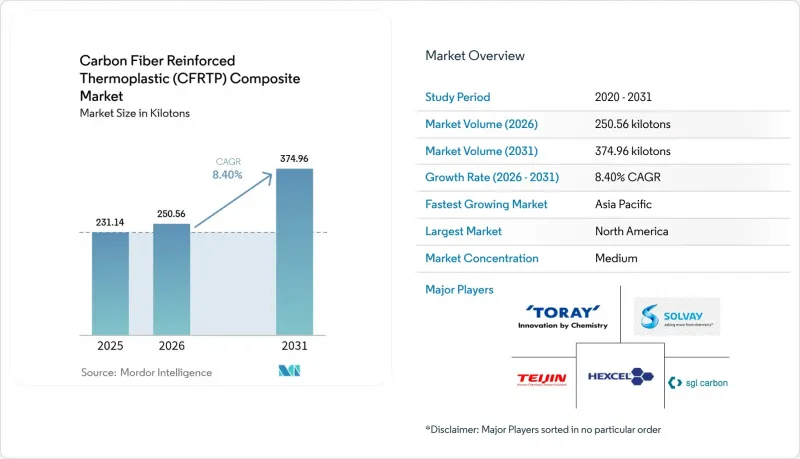
본 보고서는 원료별(PAN계, 피치계, 기타), 수지별(PEEK, PU, 기타), 제조 공정별(압축 성형, 자동 섬유 배열(AFP)·테이프 적층, 기타), 최종 사용자 산업별(항공우주 및 방위, 자동차, 기타),지역별(아시아태평양, 북미, 기타)로 분류되어 있습니다. 시장 예측은 킬로톤 단위로 표시되어 있습니다.
세계 탄소섬유 강화 열가소성(CFRTP) 복합재료 시장 동향 및 인사이트
경량 전기차(EV) 구조물에 대한 수요 급증
각 자동차 제조업체는 주행 거리 연장 및 충전 시간 단축을 위해 배터리 인클로저, 차체 패널, 섀시 부품에 탄소섬유 강화 열가소성 복합재료의 사용을 확대되고 있습니다. 이 소재의 가역적인 용융 특성은 사용 후 제품의 재활용을 가능하게 하여, 현재 중국 및 유럽연합(EU)에서 추진되고 있는 순환 경제의 규칙에 부합합니다. 또한, 손상된 부품을 교체하는 대신 재가열하여 다시 성형할 수 있으므로, 차량 운영 사업자에게는 수리가 용이해진다는 장점이 있습니다. 테슬라가 휴머노이드 로봇에 탄소섬유 복합재료를 채택한 것은 자동차 이외의 분야에서의 범용성을 부각시키며, 여러 모빌리티 플랫폼으로의 확산을 시사하고 있습니다. 중국에서는 2024년에 6만 9,000톤의 탄소섬유가 소비될 것으로 예상되며, 아시아 내 수요 기반이 확대되고 있음을 엿볼 수 있습니다.
민간 항공기 생산 확대 가속화
각 항공기 제조업체들은 737 MAX와 787 드림라이너의 생산 목표 증대에 대응하기 위해 공급망 재구성을 추진하고 있으며, 연료 소비를 줄이는 2차 구조 부재에 대한 복합재료 수요가 지속되고 있습니다. 헥셀(Hexel)사는 매출이 감소했음에도 불구하고, 2025년 1분기 실적 보고서에서 경량 열가소성 플라스틱 솔루션에 대한 투자를 재확인했습니다. 항공기의 ‘모어 일렉트릭화’로의 전환은 매트릭스가 배선을 절연하고 제빙 히터를 통합할 수 있기 때문에 열가소성 플라스틱의 채택을 촉진하고 있습니다. ThermoPlastic Composites Research Center(TPRC)의 유럽 내 노력은 대량 생산 부품의 인증을 가속화하여 설계부터 운항 개시까지의 기간을 단축하고 있습니다. 금속에 비해 뛰어난 내피로성으로 정비 주기가 연장된다는 점은 코로나19로 인한 혼란을 겪은 후 항공사들로부터 높이 평가받고 있는 장점입니다.
높은 초기 투자 비용 및 제조 비용
오토클레이브, 압축 프레스, 자동 섬유 배치 셀은 라인당 3,000만 달러를 초과하는 경우도 있어, 가격에 민감한 부문으로의 진입을 가로막고 채택 속도를 둔화시키고 있습니다. SGL Carbon은 2024년 탄소섬유 부문 매출이 35.2% 감소했다고 보고했으며, 수요 변동으로 인해 고정비가 높은 자산이 충분히 활용되지 못하고 있는 점을 그 이유로 꼽았습니다. 림릭 대학에서 검증된 ‘플라즈마+마이크로파 가열’ 기술은 에너지 소비를 최대 70% 절감하지만, 실용화까지는 아직 수년이 소요될 전망입니다. 원료가 되는 섬유는 여전히 알루미늄이나 강철보다 비싸기 때문에 복합재료는 이코노미 클래스 차량에는 채택되지 않고 있습니다. 생산량이 증가하여 금형의 상각이 가능해진 후에야 비로소 수익성이 향상되므로, 각 OEM 업체들은 하류 수요가 확실해질 때까지 도입을 주저하고 있습니다.
부문 분석
PAN 계열 등급은 2025년 생산량의 77.35%를 차지하고 있으며, 이는 확립된 생산 라인과 항공우주 부문에서의 실적을 뒷받침합니다. 높은 인장 탄성률 덕분에 설계자는 안전 여유를 확보하면서 구조 중량을 줄일 수 있습니다. PAN 계열 등급의 탄소섬유 강화 열가소성 복합재료 시장 규모는 기존 기업들이 처리 능력 향상을 위해 연속 생산 라인을 개조함에 따라 연평균 성장률(CAGR) 7.76%라는 안정적인 속도로 확대될 것으로 예측됩니다. 비용 효율적인 재가열 사이클을 통해 스크랩률이 개선되어 플랜트의 경제성이 향상됩니다.
재생 섬유를 포함한 기타 원료는 최종 사용자가 순환형 조달 목표를 채택함에 따라 원료 중 가장 높은 9.42%의 연평균 성장률(CAGR)을 기록하고 있습니다. 재생 섬유는 현재 버진 소재의 인장 강도의 93.6%를 유지하고 있어, 2차 하중 채널로의 적용 범위가 확대되고 있습니다. Syensqo와 Trillium이 연구를 진행 중인 바이오 유래 아크릴로니트릴은 보다 친환경적인 원료로의 장기적인 전환을 시사하고 있습니다. 틈새 시장인 피치 계열 등급은 금속과 같은 전도성을 가지고 있어 배터리 팩의 열 관리에 활용되고 있습니다. 수량은 적지만, 프리미엄 가격 책정이 공급 제약을 상쇄하여 매력적인 이익률을 유지하고 있습니다.
PEEK는 250°C의 연속 사용 온도와 화학적 불활성이라는 특성으로 인해 2025년에는 34.25%의 점유율을 확보하며, 연평균 성장률(CAGR) 9.61%로 성장을 주도하고 있습니다. 탄소섬유 강화 열가소성 복합재료 시장 점유율 우위는 특히 제트 엔진이나 해양 플랫폼 등 가연성 및 발연 독성에 관한 규제가 엄격한 부문에서 더욱 강화되고 있습니다. 의료기기로의 용도 확대로 수익원이 다각화되어 부문 간 위험이 분산되고 있습니다.
비용 효율을 중시하는 부문에서는 최고 사용 온도를 희생하고 가격을 우선시한 PU, PES 또는 PEI가 채택되고 있습니다. 이러한 수지는 작동 부하가 중간 정도인 내장 패널이나 가전제품에 사용됩니다. 현재 연구 개발이 진행 중인 바이오 PEI는 기계적 특성을 저해하지 않으면서 지속가능성이라는 차별화 요소를 제공할 가능성이 있습니다. 또한, 수지 배합 제조업체들은 전도성을 높이기 위해 나노 필러를 배합하고 있으며, 이는 항공우주 시스템에서의 통합형 제빙층 개발을 촉진하고 있습니다.
지역별 분석
북미는 2025년에 35.78%의 점유율을 차지할 것으로 예상되며, 미국의 항공우주 및 방위 산업을 핵심으로 하고 캐나다의 MRO(유지보수·수리·정비) 거점에 의해 뒷받침되고 있습니다. Toray Industries Inc., Heccel, Solvay가 현지 거점을 구축함으로써 리드 타임이 단축되고, 지정학적 위험으로부터 프로그램을 보호하고 있습니다. ‘인플레이션 억제법’에 따른 정부 보조금은 국내 수소 탱크 생산을 촉진하고, 하류 부문 수요를 확대시키고 있습니다.
아시아태평양은 2031년까지 연평균 성장률(CAGR) 8.98%로 가장 높은 성장률을 기록하고 있습니다. 중국은 전기차 생산을 확대하고 있으며, 현재 킬로톤 규모의 탄소섬유 생산 라인을 다수 보유하고 있어 기존 수입 의존도를 낮추고 있습니다. 일본의 선도 기업인 Toray Industries Inc.와 Teijin Ltd는 지역 내 풍력 발전 및 해양 프로젝트에 대응하기 위해 생산 능력을 두 배로 늘리고 있습니다. 한국은 전자 분야의 노하우를 활용하여 EMI 차폐용 복합 소재를 5G 인프라에 통합하고 있습니다.
유럽에서는 견조한 수요와 새로운 규제상의 역풍이 교차하고 있습니다. 독일 자동차 산업은 여전히 최대의 부문 소비처이지만, 다가오는 재활용 규제로 인해 열가소성 수지로의 대체가 가속화되고 있습니다. 네덜란드의 ‘열가소성 복합재료 연구센터’는 OEM과 공급업체를 아우르는 연구개발(R&D) 협력의 거점 역할을 하고 있습니다. 북유럽의 풍력 발전에 대한 투자와 프랑스의 항공우주 클러스터가 일반 산업 수요의 부진을 상쇄하고 있습니다.
기타 혜택
- 엑셀 형식 시장 예측(ME) 시트
- 3개월간의 애널리스트 지원
자주 묻는 질문
목차
제1장 서론
제2장 조사 방법
제3장 주요 요약
제4장 시장 구도
제5장 시장 규모와 성장 예측
제6장 경쟁 구도
제7장 시장 기회와 향후 전망
LSH 26.09.04According to Mordor Intelligence, carbon fiber reinforced thermoplastic composite market size in 2026 is estimated at 250.56 kilotons, growing from 2025 value of 231.14 kilotons with 2031 projections showing 374.96 kilotons, growing at 8.40% CAGR over 2026-2031.
This report is Segmented by Raw Material (PAN-Based, Pitch-Based, and More), Resin (PEEK, PU, and More), Manufacturing Process (Compression Molding, AFP/Tape Laying, and More), End-User Industry (Aerospace and Defense, Automotive, and More), and Geography (Asia-Pacific, North America, and More). The Market Forecasts are Provided in Terms of Volume (Kilotons).
Global Carbon Fiber Reinforced Thermoplastic (CFRTP) Composite Market Trends and Insights
Surging Demand for Lightweight EV Structures
Automakers increase carbon fiber thermoplastic use in battery enclosures, body panels, and chassis members to extend driving range and cut charging time. The material's reversible melt behavior supports end-of-life recycling, satisfying circular-economy rules now unfolding in China and the European Union. Fleet operators benefit from easier repair because damaged parts can be reheated and reshaped instead of replaced. Tesla's application of carbon fiber composites in its humanoid robot underscores versatility beyond vehicles, suggesting spillover into multiple mobility platforms. China consumed 69,000 metric tons of carbon fiber in 2024, evidence of a deepening Asian demand base.
Accelerating Commercial Aircraft Production Ramp-ups
Airframe OEMs are rebuilding supply chains to meet higher 737 MAX and 787 Dreamliner output targets, sustaining composite demand for secondary structures that cut fuel burn. Hexcel reaffirmed investment in lightweight thermoplastic solutions in its Q1 2025 earnings report, despite lower top-line sales. The shift to more-electric aircraft fosters thermoplastic adoption because the matrix insulates wiring and integrates anti-icing heaters. European initiatives under the ThermoPlastic Composites Research Center (TPRC) accelerate certification of large-volume parts, shortening design-to-flight timelines. Superior fatigue resistance over metals lengthens service intervals, an advantage keenly valued by airlines after COVID-19 disruptions.
High Initial Investment and Manufacturing Cost
Autoclaves, compression presses, and automated fiber placement cells can top USD 30 million per line, curbing entry and slowing adoption in price-sensitive segments. SGL Carbon reported a 35.2% sales drop in its Carbon Fibers unit in 2024, citing demand swings that leave high fixed-cost assets under-utilized. Plasma + microwave heating demonstrated at the University of Limerick cuts energy up to 70%, yet commercial readiness remains several years out. Raw fiber remains costlier than aluminum or steel, keeping composites out of economy-class vehicles. Economics improve only when volumes amortize tooling, thus OEMs hesitate until downstream demand is locked.
Other drivers and restraints analyzed in the detailed report include:
- Stringent Global Emission and Recyclability Mandates
- Rapid Scale-up of Hydrogen Pressure-Vessel Programs
- Limited Large-scale Thermoforming Press Capacity
For complete list of drivers and restraints, kindly check the Table Of Contents.
Segment Analysis
PAN-based grades delivered 77.35% of 2025 volume, underlining their entrenched production lines and aerospace heritage. High tensile modulus lets designers trim structural weight while meeting safety margins. The carbon fiber reinforced thermoplastic composite market size for PAN-based grades is projected to expand at a stable 7.76% CAGR as incumbents retrofit continuous lines for higher throughput. Cost-effective reheat cycles improve scrap rates, enhancing plant economics.
Other Raw Materials, including recycled fiber, register a 9.42% CAGR-the highest within raw materials-as end-users adopt circular procurement goals. Recycled fiber now retains 93.6% of virgin tensile strength, widening suitability for secondary load paths. Bio-sourced acrylonitrile under study by Syensqo and Trillium signals a longer-term pivot to greener feedstocks. Niche pitch-based grades serve thermal management in battery packs because of metal-like conductivity. Though volume small, premium pricing balances supply constraint, keeping margins attractive.
PEEK secured 34.25% 2025 share and leads growth at 9.61% CAGR thanks to 250 °C continuous-use temperature and chemical inertness. The carbon fiber reinforced thermoplastic composite market share advantage strengthens where flammability and smoke toxicity rules are strict, notably in jet engines and offshore platforms. Medical device usage diversifies revenue, spreading risk across sectors.
Cost-focused segments rely on PU, PES, or PEI which trade peak temperature for price. These resins feed interior panels and consumer electronics where operating loads are moderate. Bio-based PEI under exploration could add a sustainability differentiator without forfeiting mechanical properties. Resin formulators also blend nano-fillers to enhance conductivity, fostering integrated de-icing layers in aerospace systems.
Complete Report Scope:
- By Raw Material
- Polyacrylonitrile (PAN)-based Carbon Fiber Reinforced Composites (CFRTP)
- Pitch-based Carbon Fiber Reinforced Composites (CFRTP)
- Other Raw Materials (Recycled Carbon Fibers, etc.)
- By Resin
- Polyether Ether Ketone (PEEK)
- Polyurethane (PU)
- PolyetherSulfone (PES)
- Polyetherimide (PEI)
- Others (Polyamide, Polycarbonate, etc.)
- By Manufacturing Process
- Compression and Stamp Moulding
- Automated Fibre Placement / Tape Laying
- Injection and Over-Moulding
- Additive Manufacturing (Carbon Fiber-filled filaments)
- By End-user Industry
- Aerospace and Defence
- Automotive
- Construction
- Electrical and Electronics
- Wind Turbines
- Marine
- Sporting Equipments
- Other End-user Industries (Healthcare, etc.)
- By Geography
- Asia-Pacific
- China
- Japan
- India
- South Korea
- ASEAN Countries
- Rest of Asia-Pacific
- North America
- United States
- Canada
- Mexico
- Europe
- Germany
- United Kingdom
- France
- Italy
- Spain
- Russia
- NORDIC Countries
- Rest of Europe
- South America
- Brazil
- Argentina
- Rest of South America
- Middle-East and Africa
- Saudi Arabia
- South Africa
- Rest of Middle-East and Africa
- Asia-Pacific
Geography Analysis
North America held 35.78% share in 2025, anchored by the United States' aerospace and defence complex and supported by Canada's MRO hubs. Local presence of Toray, Hexcel, and Solvay shortens lead times, safeguarding programs against geopolitical risk. Government grants under the Inflation Reduction Act encourage domestic hydrogen tank production, widening downstream pull.
Asia-Pacific posts the fastest 8.98% CAGR to 2031. China scales electric-vehicle output and now hosts multiple kiloton-scale carbon fiber lines, reducing earlier import dependence. Japanese pioneers Toray and Teijin double capacity to serve regional wind and marine projects. South Korea leverages electronics know-how to integrate EMI-shielding composites into 5G infrastructure.
Europe mixes strong demand with new regulatory headwinds. Germany's auto base remains the largest segment consumer, but looming recyclability rules fast-track thermoplastic substitution. The ThermoPlastic Composites Research Center in the Netherlands anchors R&D alliances across OEMs and suppliers. Nordic wind investments and French aerospace clusters offset softness in general industrial demand.
- Arkema
- ARRIS Composites, Inc.
- Avient Corporation
- BASF
- Celanese Corporation
- DuPont
- Gurit Services AG, Zurich
- Hexcel Corporation
- Markforged
- Mitsubishi Chemical Corporation
- Quickstep
- SABIC
- SGL Carbon
- Syensqo
- Teijin Limited
- Toray Industries Inc.
- Victrex plc
Additional Benefits:
- The market estimate (ME) sheet in Excel format
- 3 months of analyst support
TABLE OF CONTENTS
1 Introduction
- 1.1 Study Assumptions and Market Definition
- 1.2 Scope of the Study
2 Research Methodology
3 Executive Summary
4 Market Landscape
- 4.1 Market Overview
- 4.2 Market Drivers
- 4.2.1 Surging demand for lightweight EV structures
- 4.2.2 Accelerating commercial aircraft production ramp-ups
- 4.2.3 Stringent global emission and recyclability mandates
- 4.2.4 Incresaing usage in the construction sector
- 4.2.5 Rapid scale-up of hydrogen pressure-vessel programs
- 4.3 Market Restraints
- 4.3.1 High initial investment and manufacturing cost
- 4.3.2 Limited large-scale thermoforming press capacity
- 4.3.3 Supply-chain weaponisation risk in aerospace
- 4.4 Value Chain Analysis
- 4.5 Porter's Five Forces
- 4.5.1 Bargaining Power of Suppliers
- 4.5.2 Bargaining Power of Buyers
- 4.5.3 Threat of New Entrants
- 4.5.4 Threat of Substitutes
- 4.5.5 Competitive Rivalry
5 Market Size and Growth Forecasts (Volume)
- 5.1 By Raw Material
- 5.1.1 Polyacrylonitrile (PAN)-based Carbon Fiber Reinforced Composites (CFRTP)
- 5.1.2 Pitch-based Carbon Fiber Reinforced Composites (CFRTP)
- 5.1.3 Other Raw Materials (Recycled Carbon Fibers, etc.)
- 5.2 By Resin
- 5.2.1 Polyether Ether Ketone (PEEK)
- 5.2.2 Polyurethane (PU)
- 5.2.3 PolyetherSulfone (PES)
- 5.2.4 Polyetherimide (PEI)
- 5.2.5 Others (Polyamide, Polycarbonate, etc.)
- 5.3 By Manufacturing Process
- 5.3.1 Compression and Stamp Moulding
- 5.3.2 Automated Fibre Placement / Tape Laying
- 5.3.3 Injection and Over-Moulding
- 5.3.4 Additive Manufacturing (Carbon Fiber-filled filaments)
- 5.4 By End-user Industry
- 5.4.1 Aerospace and Defence
- 5.4.2 Automotive
- 5.4.3 Construction
- 5.4.4 Electrical and Electronics
- 5.4.5 Wind Turbines
- 5.4.6 Marine
- 5.4.7 Sporting Equipments
- 5.4.8 Other End-user Industries (Healthcare, etc.)
- 5.5 By Geography
- 5.5.1 Asia-Pacific
- 5.5.1.1 China
- 5.5.1.2 Japan
- 5.5.1.3 India
- 5.5.1.4 South Korea
- 5.5.1.5 ASEAN Countries
- 5.5.1.6 Rest of Asia-Pacific
- 5.5.2 North America
- 5.5.2.1 United States
- 5.5.2.2 Canada
- 5.5.2.3 Mexico
- 5.5.3 Europe
- 5.5.3.1 Germany
- 5.5.3.2 United Kingdom
- 5.5.3.3 France
- 5.5.3.4 Italy
- 5.5.3.5 Spain
- 5.5.3.6 Russia
- 5.5.3.7 NORDIC Countries
- 5.5.3.8 Rest of Europe
- 5.5.4 South America
- 5.5.4.1 Brazil
- 5.5.4.2 Argentina
- 5.5.4.3 Rest of South America
- 5.5.5 Middle-East and Africa
- 5.5.5.1 Saudi Arabia
- 5.5.5.2 South Africa
- 5.5.5.3 Rest of Middle-East and Africa
- 5.5.1 Asia-Pacific
6 Competitive Landscape
- 6.1 Market Concentration
- 6.2 Strategic Moves
- 6.3 Market Share (%)/Ranking Analysis
- 6.4 Company Profiles (includes Global level Overview, Market level overview, Core Segments, Financials as available, Strategic Information, Market Rank/Share for key companies, Products and Services, and Recent Developments)
- 6.4.1 Arkema
- 6.4.2 ARRIS Composites, Inc.
- 6.4.3 Avient Corporation
- 6.4.4 BASF
- 6.4.5 Celanese Corporation
- 6.4.6 DuPont
- 6.4.7 Gurit Services AG, Zurich
- 6.4.8 Hexcel Corporation
- 6.4.9 Markforged
- 6.4.10 Mitsubishi Chemical Corporation
- 6.4.11 Quickstep
- 6.4.12 SABIC
- 6.4.13 SGL Carbon
- 6.4.14 Syensqo
- 6.4.15 Teijin Limited
- 6.4.16 Toray Industries Inc.
- 6.4.17 Victrex plc
7 Market Opportunities and Future Outlook
- 7.1 White-space and Unmet-need Assessment