|
시장보고서
상품코드
2122571
섬유 강화 복합재료 : 시장 점유율 분석, 업계 동향 및 통계, 성장 예측(2026-2031년)Fiber Reinforced Composites - Market Share Analysis, Industry Trends & Statistics, Growth Forecasts (2026 - 2031) |
||||||
 Mordor Intelligence
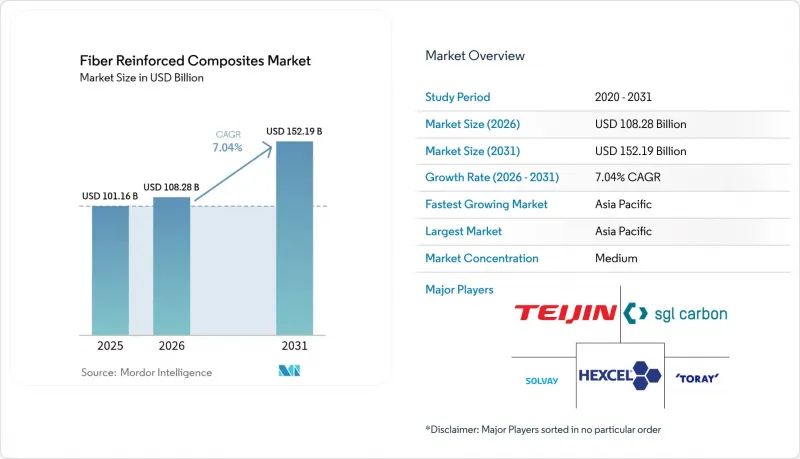
Mordor Intelligence에 의하면, 섬유 강화 복합재료 시장 규모는 2025년에 1,011억 6,000만 달러로 평가되었습니다. 2026년 1,082억 8,000만 달러에서 2031년까지 1,521억 9,000만 달러에 이를 것으로 예상되며, 예측 기간(2026-2031년) CAGR은 7.04%를 나타낼 전망입니다.

본 보고서에서는 업계를 섬유 유형(탄소섬유, 유리섬유 등), 매트릭스(폴리머 매트릭스 복합재료, 금속 매트릭스 복합재료 등), 제조 공정(풀트라지션, 필라멘트 와인딩 등), 최종 사용자 산업(항공우주 및 방위, 자동차 등),및 지역(아시아태평양, 북미 등)별로 분류하고 있습니다. 시장 전망은 금액(달러) 기준으로 제시되어 있습니다.
세계의 섬유 강화 복합재료 시장 동향 및 인사이트
항공우주 분야의 복합재료 수요 증가
상용 프로그램에서는 연료 소비량을 15-20% 절감하기 위해 복합재료 사용률을 50%로 하는 것을 목표로 하고 있으며, eVTOL(전기 수직 이착륙기) 설계에서는 그 비율을 더욱 높이는 방향으로 나아가고 있습니다. Heksell사의 상업용 항공우주 부문 매출은 와이드바디 항공기 생산 대수 증가에 따라 2024년에 21.3% 증가했으나, 공급망의 긴축으로 인해 단기적인 납품에 제약이 발생하고 있습니다. NASA의 HiCAM 프로젝트는 열경화성 및 열가소성 수지 제동체의 생산률을 획기적으로 높이는 것을 목표로 하고 있으며, 이는 구조적 수요 증가를 시사합니다. 액화 수소 추진용 풀 컴포지트 극저온 탱크에 대한 병행 연구 개발은 섬유 강화 복합재료 시장에 새로운 하위 부문을 개척하고 있습니다. 이러한 변화들이 결합되어 항공우주 분야는 중기적인 성장의 원동력으로서 확고한 입지를 다지고 있습니다.
풍력 터빈 블레이드의 대형화
블레이드 길이는 현재 100미터를 초과하여, 중량 증가 없이 강성을 유지하기 위한 탄소섬유 스퍼 캡이 요구되고 있습니다. 미국의 ‘Big Adaptive Rotor’ 프로젝트는 이러한 추세를 뒷받침하고 있으며, 한편 천연섬유와 합성 섬유의 하이브리드 블렌드는 수명 주기 전반에 걸친 지속가능성을 향상시키고 있습니다. 다우(Dow)사의 새로운 폴리우레탄-카본 인발 성형 라인은 인라인 경화율 90%를 달성하여 초대형 적층재의 생산성을 향상시키고 있습니다. 전 세계 설비 용량은 2030년까지 981 GW에 달할 것으로 예측되지만, 사용 후 블레이드의 재활용은 여전히 해결되지 않은 과제이며, 순환 경제에서의 혁신이 요구되고 있습니다.
원자재 및 가공 비용의 고가
에너지 집약적인 탄화 공정이 투입 비용 상승을 초래하고 있지만, 맨체스터 대학교가 개발한 리그닌계 전구체를 통해 비용을 3-5배 절감할 가능성이 있습니다. 기존 AFP 시스템의 가격은 300만-600만 달러이지만, 모듈식 임대 모델을 통해 진입 장벽이 낮아졌습니다. SGL 카본의 섬유 부문 매출이 35.2% 감소한 것은 변동이 심한 원자재 가격에 대한 민감도가 높음을 보여줍니다. 훨씬 적은 에너지로 제조할 수 있는 재생 탄소섬유는 기계적 특성을 유지하면서 이러한 압박을 어느 정도 완화할 수 있습니다.
부문별 분석
2025년에는 건설, 자동차, 풍력 발전 분야의 비용 효율성과 견고한 공급망에 힘입어 유리 섬유가 61.22%의 점유율로 시장을 독점했습니다. 점유율은 작지만, 탄소섬유는 항공우주 및 고성능 자동차 산업 수요 증가에 힘입어 2031년까지 연평균 성장률(CAGR) 7.86%를 나타낼 것으로 예측됩니다. 내충격성과 열안정성으로 알려진 아라미드 섬유는 주로 보호 장비나 항공우주 부품에 사용됩니다. 비용은 높지만, 붕소 섬유는 특수한 항공우주 용도로 활용되고 있습니다. 합성 섬유와 천연섬유를 결합한 하이브리드 복합재를 통해 천연섬유의 채택이 확대되고 있으며, 성능을 유지하면서 환경적 이점을 제공합니다. 예를 들어, 풍력 터빈 블레이드에는 대나무나 사이잘 섬유가 사용되고 있습니다.
제조 기술의 발전으로 섬유 생산의 경제성이 변화하고 있습니다. ‘CARBOWAVE’ 프로젝트에서는 마이크로파를 이용한 탄소섬유 제조 기술이 도입되어, 에너지 소비를 최대 70% 절감함으로써 비용 구조와 환경에 미치는 영향에 변화를 가져올 가능성을 내포하고 있습니다. 사우디아라비아는 항공우주, 자동차, 건설 분야에서의 용도를 염두에 두고, 그래핀을 풍부하게 함유한 탄소섬유를 생산하는 세계 최초의 산업 규모 시설을 설립했으며, 2030년까지 16억 달러 이상의 수익을 기대하고 있습니다. 현무암 섬유는 천연섬유 복합재료에 비해 뛰어난 기계적 특성과 내환경성을 갖추고 있어, 지속 가능한 대체 재료로 부상하고 있습니다. 또한, 탄소섬유에 비해 비용 면에서 우위를 점하고 있어, 가혹한 환경 하에서 내구성이 요구되는 해상 풍력 발전 용도에 적합합니다.
2025년에는 폴리머 계열이 매출의 69.78%를 차지한 반면, 금속 매트릭스 계열은 연평균 성장률(CAGR) 7.31%를 달성할 것으로 전망되어, 섬유 강화 복합재료 시장, 특히 항공우주 분야의 열 관리 용도에서 그 중요성이 지속적으로 높아지고 있음이 부각되고 있습니다. GE가 개발한 세라믹 매트릭스 복합재료는 제트 엔진의 작동 온도를 높여 연료 효율을 최대 20%까지 개선합니다. 또한, 카본-카본 소재는 초음속 재진입이나 핵융합로에 노출되는 부품에 필수적이며, 2,000°C에서의 내구성이 요구됩니다.
폴리카보네이트, PEKK, PEEK 등의 고속 사이클 열가소성 수지는 재활용 가능성과 1분 이내의 프레스 성형이 가능하다는 점에서 주목받고 있습니다. 코베스트로(Covestro)는 소비자용 전자기기 분야를 겨냥한 연속 섬유 폴리카보네이트 패널을 발표했습니다. 또한, NREL은 생산 비용 효율성을 유지하면서 석유화학계 수지에 비해 온실가스 배출량을 40% 감축하는 바이오 에폭시 수지의 실증에 성공했습니다. 미쓰비시 화학도 1,500°C의 온도를 견딜 수 있는 세라믹 복합 소재를 개발하여 JAXA의 발사 로켓 사양을 충족하는 동시에, 방위 및 우주 분야에서 새로운 수익 기회를 창출하고 있습니다.
지역별 분석
아시아태평양은 2025년 매출의 40.46%를 차지했으며 연평균 성장률(CAGR) 8.16%를 나타낼 것으로 예측되며, 섬유 강화 복합재료 시장이 계속해서 이 지역을 거점으로 자리매김할 것으로 확실시되고 있습니다. 중국의 HRC는 창수(常熟)에 3,380만 달러를 투자하여 열경화성 및 열가소성 부품의 양산 체제를 확대했습니다. 한편, 인도의 Kineco Exel은 고아 거점을 통해 Vestas사에 인발 성형된 탄소섬유 판을 공급하고 있습니다. 대만의 Swancor는 해상 프로젝트용 수지 플레이트의 현지 조달을 실현하여 지역 밸류체인을 심화하고 있습니다.
북미에서는 견고한 항공우주 산업 기반과 연비 규제를 활용해 수요를 유지하고 있습니다. GKN 에어로스페이스(GKN Aerospace)는 멕시코 치와와주에서의 조립 능력을 두 배로 늘리고, 걸프스트림(Gulfstream) 및 혼다젯(HondaJet)의 프로그램에 대응하기 위해 200명의 일자리를 창출했습니다. 사프란(Safran)은 케레타로에서 LEAP 엔진의 생산 능력을 확대하며, 복합재료 제조 거점으로서 멕시코의 부상을 부각시켰습니다. MIT 연구진은 탄소나노튜브를 활용한 ‘나노 스티칭’ 기술을 개발하여 층간 전단 강도를 62% 향상시켰으며, 추가적인 경량화 가능성을 시사했습니다. 유럽에서는 재활용 의무화와 저탄소 소재 혁신이 추진되고 있습니다. ‘클린 스카이 2 FRAMES’ 프로젝트에서는 PEEK 및 PEKK 재질의 주익 외판에 대한 크세논 플래시 램프를 이용한 AFP 가열 기술의 유효성이 입증되었습니다. 한편, 스트라타(Strata)와 솔베이(Solvay)는 UAE의 알 아인에 보잉 777X용 부품을 제조하는 중동·북아프리카(MENA) 지역 최초의 프리프레그 공장을 개설했습니다. 2024년, 브라질의 복합재료 매출액은 5.6% 증가한 5억 6,000만 달러에 달하여 남미 전역의 잠재적인 성장 가능성을 시사하고 있습니다.
기타 혜택 :
- 엑셀 형식 시장 예측(ME) 시트
- 3개월간의 애널리스트 지원
자주 묻는 질문
목차
제1장 서론
제2장 조사 방법
제3장 주요 요약
제4장 시장 구도
제5장 시장 규모 및 성장 예측
제6장 경쟁 구도
제7장 시장 기회 및 향후 전망
KTH 26.09.08According to Mordor Intelligence, the fiber reinforced composites market size was valued at USD 101.16 billion in 2025 and estimated to grow from USD 108.28 billion in 2026 to reach USD 152.19 billion by 2031, at a CAGR of 7.04% during the forecast period (2026-2031).
This report Segments the Industry by Fiber Type (Carbon Fibers, Glass Fibers and More), Matrix (Polymer Matrix Composites, Metal Matrix Composites, and More), Manufacturing Process (Pultrusion, Filament Winding, and More), End-User Industry (Aerospace and Defense, Automotive, and More) and Geography (Asia-Pacific, North America, and More). The Market Forecasts are Provided in Terms of Value (USD).
Global Fiber Reinforced Composites Market Trends and Insights
Growing Aerospace Composite Demand
Commercial programmes target 50% composite content to secure 15-20% fuel-burn reductions, and eVTOL designs push that ratio even higher. Hexcel's commercial aerospace revenue jumped 21.3% in 2024 on wide-body build rates, yet supply chain tightness tempers near-term deliveries. NASA's HiCAM effort aims to multiply output rates for thermoset and thermoplastic fuselages, signaling a structural demand uplift. Parallel R&D on fully composite cryogenic tanks for liquid-hydrogen propulsion opens new sub-segments for the fiber reinforced composites market. Together, these shifts cement aerospace as a medium-term growth catalyst.
Wind-Turbine Blade Length Upsizing
Blade lengths now exceed 100 meters, demanding carbon spar caps to retain stiffness without weight penalties. The U.S. Big Adaptive Rotor project underscores this trajectory, while hybrid natural-synthetic fibre blends improve lifecycle sustainability. New polyurethane-carbon pultrusion lines from Dow achieve 90% in-line cure, boosting throughput for oversized laminates. Global capacity is forecast to reach 981 GW by 2030, yet recycling end-of-life blades remains unresolved, inviting circular-economy innovation.
High Raw-Material & Processing Costs
Energy-intensive carbonisation drives elevated input costs, although lignin-based precursors from the University of Manchester suggest 3-5 X savings potential. Traditional AFP systems list at USD 3-6 million, but modular leasing models lower the entry barrier. SGL Carbon's 35.2% sales drop in fiber units shows sensitivity to volatile commodity pricing. Recycled carbon fibre, requiring far less energy, can relieve some pressure while preserving mechanical properties.
Other drivers and restraints analyzed in the detailed report include:
- Automotive Lightweighting Mandates
- Infrastructure Rehab with FRP Rebar
- Difficulties in Recycling
For complete list of drivers and restraints, kindly check the Table Of Contents.
Segment Analysis
In 2025, glass fibers dominated the market with a 61.22% share, driven by cost efficiencies and robust supply chains in the construction, automotive, and wind energy sectors. While holding a smaller share, carbon fibers are projected to grow at a CAGR of 7.86% through 2031, supported by increasing demand in the aerospace and high-performance automotive industries. Aramid fibers, known for their impact resistance and thermal stability, are primarily used in protective equipment and aerospace components. Despite their higher costs, Boron fibers are utilized in specialized aerospace applications. The adoption of natural fibers is increasing through hybrid composites that combine synthetic and natural fibers, offering environmental benefits while maintaining performance. For example, bamboo and sisal fibers are used in wind turbine blades.
Advancements in manufacturing are transforming fiber production economics. The CARBOWAVE project has introduced microwave-assisted carbon fiber production, reducing energy consumption by up to 70%, potentially altering cost structures and environmental impacts. Saudi Arabia has established the first industrial-scale facility for graphene-enriched carbon fiber production, targeting aerospace, automotive, and construction applications, with projected revenues exceeding USD 1.6 billion by 2030. Basalt fibers are emerging as a sustainable alternative, offering superior mechanical properties and environmental resistance compared to natural fiber composites. Additionally, their cost advantages over carbon fibers make them suitable for offshore wind applications requiring durability in harsh environments.
In 2025, polymer systems accounted for 69.78% of the revenue, while metal matrix options are projected to achieve a 7.31% CAGR, highlighting their sustained importance in the fiber-reinforced composites market, particularly for aerospace thermal-management applications. Ceramic matrix composites developed by GE enhance jet engine operating temperatures, improving fuel efficiency by up to 20%. Additionally, carbon-carbon materials are critical for components exposed to hypersonic re-entry and fusion reactors, where endurance at 2,000 °C is essential.
Rapid-cycle thermoplastics, such as polycarbonate, PEKK, and PEEK, are gaining traction due to their recyclability and capability for one-minute press molding. Covestro has introduced continuous-fiber polycarbonate panels targeting the consumer electronics sector. Furthermore, NREL has demonstrated a bio-based epoxy that reduces greenhouse gas emissions by 40% compared to petrochemical-based resins while maintaining production cost efficiency. Mitsubishi Chemical has also developed a ceramic composite capable of withstanding temperatures of 1,500 °C, meeting JAXA specifications for launch vehicles and creating new revenue opportunities in the defense and space sectors.
Complete Report Scope:
- By Fiber Type
- Carbon Fibers
- Glass Fibers
- Aramid Fibers
- Boron Fibers
- Other Fiber Types (Basalt Fibers, Natural Fibers, etc.)
- By Matrix
- Polymer Matrix Composites
- Metal Matrix Composites
- Ceramic Composites
- Carbon-Carbon Composites
- Hybrid Composites
- By Manufacturing Process
- Lay-Up (Hand/Spray)
- Filament Winding
- Pultrusion
- Resin Transfer Molding
- Automated Fiber Placement & Tape Laying
- Compression & Injection Molding
- 3D Printing / Additive Manufacturing
- By End-user Industry
- Aerospace & Defense
- Automotive
- Wind Energy
- Building & Construction
- Electrical & Electronics
- Sporting Goods
- Other End-user Industries (Marine, Oil and Gas, etc.)
- By Geography (Value)
- Asia-Pacific
- China
- Japan
- India
- South Korea
- ASEAN Countries
- Rest of Asia-Pacific
- North America
- United States
- Canada
- Mexico
- Europe
- Germany
- United Kingdom
- France
- Italy
- Rest of Europe
- South America
- Brazil
- Argentina
- Rest of South America
- Middle East
- Saudi Arabia
- South Africa
- Middle-East and Africa
- Asia-Pacific
Geography Analysis
Asia-Pacific generated 40.46% of 2025 sales and is set to post an 8.16% CAGR, ensuring that the fiber reinforced composites market remains anchored in the region. China's HRC invested USD 33.8 million in Changshu to expand serial thermoset and thermoplastic part output, while India's Kineco Exel now supplies pultruded carbon planks to Vestas from its Goa site. Taiwan's Swancor has localised resin plate supply for offshore projects, deepening the regional value chain.
North America leverages an entrenched aerospace base and fuel-economy regulation to maintain demand. GKN Aerospace doubled assembly capacity in Chihuahua, Mexico, adding 200 jobs to serve Gulfstream and HondaJet programmes. Safran expanded LEAP engine capacity in Queretaro, underscoring Mexico's rise as a composites manufacturing node. MIT researchers developed "nanostitching" with carbon nanotubes, lifting interlaminar shear by 62% and hinting at further light-weighting gains. Europe champions recycling mandates and low-carbon material innovation. The Clean Sky 2 FRAMES project validated xenon flashlamp AFP heating for PEEK and PEKK wingskins, while Strata and Solvay opened the first MENA prepreg plant for Boeing 777X parts in Al Ain, UAE. Brazil's composites turnover rose 5.6% to USD 560 million in 2024, pointing to latent growth potential across South America.
- Avient Corporation
- Covestro AG
- Hexcel Corporation
- Huntsman Corporation
- Mitsubishi Chemical Corporation
- Owens Corning
- Plasan
- SABIC
- SGL Carbon
- Solvay
- Teijin Limited
- Toray Industries Inc.
- TPI Composites
Additional Benefits:
- The market estimate (ME) sheet in Excel format
- 3 months of analyst support
TABLE OF CONTENTS
1 Introduction
- 1.1 Study Assumptions
- 1.2 Scope of the Study
2 Research Methodology
3 Executive Summary
4 Market Landscape
- 4.1 Market Overview
- 4.2 Market Drivers
- 4.2.1 Growing aerospace composite demand
- 4.2.2 Wind-turbine blade length upsizing
- 4.2.3 Automotive lightweighting mandates
- 4.2.4 Infrastructure rehab with FRP rebar
- 4.2.5 Rapid-layup thermoplastic UD tape lines
- 4.2.6 Carbon-capture derived acrylonitrile feedstock
- 4.3 Market Restraints
- 4.3.1 High raw-material & processing costs
- 4.3.2 Difficulties in Recycling
- 4.3.3 Performance defects due to wate absorption and low fire resistance
- 4.4 Value Chain Analysis
- 4.5 Porter's Five Forces
- 4.5.1 Bargaining Power of Suppliers
- 4.5.2 Bargaining Power of Buyers
- 4.5.3 Threat of New Entrants
- 4.5.4 Threat of Substitutes
- 4.5.5 Degree of Competition
5 Market Size & Growth Forecasts (Value)
- 5.1 By Fiber Type
- 5.1.1 Carbon Fibers
- 5.1.2 Glass Fibers
- 5.1.3 Aramid Fibers
- 5.1.4 Boron Fibers
- 5.1.5 Other Fiber Types (Basalt Fibers, Natural Fibers, etc.)
- 5.2 By Matrix
- 5.2.1 Polymer Matrix Composites
- 5.2.2 Metal Matrix Composites
- 5.2.3 Ceramic Composites
- 5.2.4 Carbon-Carbon Composites
- 5.2.5 Hybrid Composites
- 5.3 By Manufacturing Process
- 5.3.1 Lay-Up (Hand/Spray)
- 5.3.2 Filament Winding
- 5.3.3 Pultrusion
- 5.3.4 Resin Transfer Molding
- 5.3.5 Automated Fiber Placement & Tape Laying
- 5.3.6 Compression & Injection Molding
- 5.3.7 3D Printing / Additive Manufacturing
- 5.4 By End-user Industry
- 5.4.1 Aerospace & Defense
- 5.4.2 Automotive
- 5.4.3 Wind Energy
- 5.4.4 Building & Construction
- 5.4.5 Electrical & Electronics
- 5.4.6 Sporting Goods
- 5.4.7 Other End-user Industries (Marine, Oil and Gas, etc.)
- 5.5 By Geography (Value)
- 5.5.1 Asia-Pacific
- 5.5.1.1 China
- 5.5.1.2 Japan
- 5.5.1.3 India
- 5.5.1.4 South Korea
- 5.5.1.5 ASEAN Countries
- 5.5.1.6 Rest of Asia-Pacific
- 5.5.2 North America
- 5.5.2.1 United States
- 5.5.2.2 Canada
- 5.5.2.3 Mexico
- 5.5.3 Europe
- 5.5.3.1 Germany
- 5.5.3.2 United Kingdom
- 5.5.3.3 France
- 5.5.3.4 Italy
- 5.5.3.5 Rest of Europe
- 5.5.4 South America
- 5.5.4.1 Brazil
- 5.5.4.2 Argentina
- 5.5.4.3 Rest of South America
- 5.5.5 Middle East
- 5.5.5.1 Saudi Arabia
- 5.5.5.2 South Africa
- 5.5.5.3 Middle-East and Africa
- 5.5.1 Asia-Pacific
6 Competitive Landscape
- 6.1 Market Concentration
- 6.2 Strategic Moves
- 6.3 Market Share(%)/Ranking Analysis
- 6.4 Company Profiles (includes Global level Overview, Market level overview, Core Segments, Financials as available, Strategic Information, Market Rank/Share for key companies, Products & Services, and Recent Developments)
- 6.4.1 Avient Corporation
- 6.4.2 Covestro AG
- 6.4.3 Hexcel Corporation
- 6.4.4 Huntsman Corporation
- 6.4.5 Mitsubishi Chemical Corporation
- 6.4.6 Owens Corning
- 6.4.7 Plasan
- 6.4.8 SABIC
- 6.4.9 SGL Carbon
- 6.4.10 Solvay
- 6.4.11 Teijin Limited
- 6.4.12 Toray Industries Inc.
- 6.4.13 TPI Composites
7 Market Opportunities & Future Outlook
- 7.1 White-space & Unmet-need Assessment
- 7.2 Growing Innovation on Bio-based Resin Systems