

|
시장보고서
상품코드
2121847
액세스 제어 : 시장 점유율 분석, 업계 동향과 통계, 성장 예측(2026-2031년)Access Control - Market Share Analysis, Industry Trends & Statistics, Growth Forecasts (2026 - 2031) |
||||||
 Mordor Intelligence
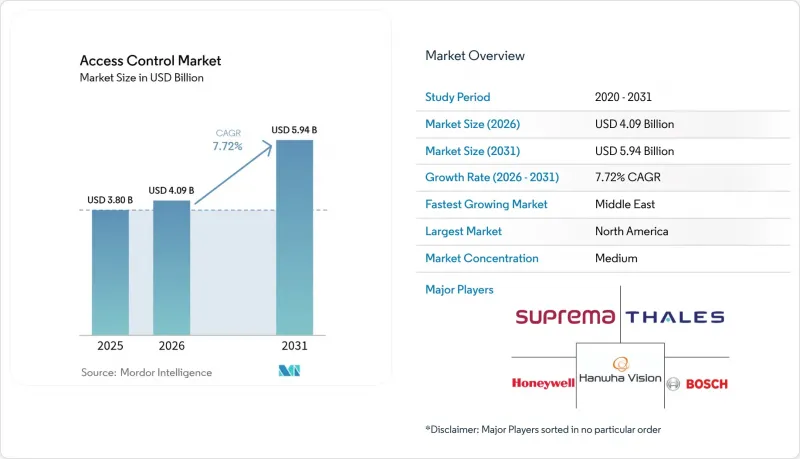
Mordor Intelligence에 따르면 2026년의 액세스 제어 시장의 규모는 40억 9,000만 달러로 추정되고 있으며, 2025년 38억 달러에서 확대하며, 2031년에는 59억 4,000만 달러에 달할 것으로 예측됩니다.
2026-2031년 동안 연평균 성장률(CAGR) 7.72%로 성장할 것으로 전망됩니다.
이 보고서는 구성 요소(하드웨어, 소프트웨어, 서비스), ACaaS(Access-Control-as-a-Service)의 도입 형태(호스팅형, 관리형, 하이브리드형), 인증 방식(단일 요소 인증, 다중 요소 인증, 모바일 인증 정보), 연결 기술(RFID/NFC, 스마트 카드, 블루투스 LE, UWB), 최종사용자 산업(상업용 건물, 산업·제조, 정부·공공 부문, 기타), 지역별로 분류되어 있습니다. 시장 예측은 금액(달러) 기준으로 제시되어 있습니다.
전 세계 접근 제어 시장의 동향 및 인사이트
GDPR이 적용되는 EU 데이터센터의 전자 접근에 관한 규제상 의무
2024년 10월에 발효되는 NIS2 지침에서는 모든 물리적 출입구에 대해 다중 요소 인증 및 변조 방지 기능을 갖춘 감사 추적이 의무화되어 있습니다. 데이터센터 운영 사업자는 암호화 및 지속적인 모니터링에 관한 조항을 충족하기 위해 기존 카드 방식에서 생체 인증 및 모바일 인증 정보로의 전환을 가속화하고 있습니다. 벤더의 공급망에 대한 면밀한 검토로 조달 기준이 높아짐에 따라 수요는 자동화된 규정 준수 보고 기능을 제공하는 플랫폼으로 이동하고 있습니다. NIS2와 GDPR의 시너지 효과로 인해 개인 데이터를 보호하면서 물리적 보안을 확보하는 통합 솔루션에 대한 수요가 증가하고 있으며, 접근 제어 시장 전체의 업데이트 예산이 증가하고 있습니다.
북미 기업용 부동산에서의 비접촉식 모바일 인증 정보 보급
상업용 부동산 소유주는 물리적 접촉 없이 개찰구, 엘리베이터, 사무실 문을 열 수 있는 Apple Wallet 및 Google Pay 인증 정보를 발급하고 있습니다. 원격 프로비저닝을 통해 배지 발급 비용이 절감되고 유연한 좌석 배치 정책이 지원됩니다. 암호화된 무선 업데이트를 통해 시설 관리 팀은 분실된 스마트폰을 즉시 무효화할 수 있으며, 보안을 강화하는 동시에 입주자의 편의성을 향상시킵니다. 이 솔루션은 기존 스마트폰 인프라와 호환되므로 카드 프린터 유지비가 필요 없어 비즈니스상 이점이 더욱 커집니다. 신속한 도입 주기는 운영 효율을 현저히 향상시켜, 접근 제어 시장의 성장세를 더욱 가속화하고 있습니다.
EU내 클라우드 배포에 따른 사이버 보안 규정 준수 비용(NIS2)
클라우드 호스팅형 접근 제어 플랫폼은 NIS2 요건을 충족하기 위해 지속적인 위협 모니터링, 안전한 코드 서명, 문서화된 개발 파이프라인을 추가해야 하며, 이로 인해 공급업체의 운영 비용이 15-20% 증가합니다. 소규모 공급업체들은 감사 비용과 침투 테스트 비용을 감당하는 데 어려움을 겪고 있으며, 구매자들이 인증된 인프라를 갖춘 글로벌 브랜드로 몰리면서 업계 재편이 진행되고 있습니다. 일부 EU 기업은 업그레이드를 미루고 갱신 주기를 연장하고 있으며, 액세스 제어 시장의 성장 전망은 다소 둔화되고 있습니다.
부문 분석
2025년 매출에서 하드웨어가 61.45%의 점유율을 차지하며 1위를 차지했습니다. 이는 물리적 도입 환경에서 전자 잠금 장치, 컨트롤러, 생체인식 리더기가 필수적임을 반영합니다. 대학의 개보수 공사만 보더라도, 캠퍼스가 모바일 지원 인프라로 전환됨에 따라 자물쇠의 교체 주기가 크게 앞당겨졌습니다. 핸즈프리 출입을 가능하게 하는 초광대역(UWB) 모듈의 부양에 힘입어, 전자 잠금 장치는 대수 기준으로 가장 빠른 성장세를 기록했습니다. 높은 신뢰성의 인증이 요구되는 연구실이나 약국에서는 생체인식 멀티 센서 리더의 도입이 확대되었습니다.
소프트웨어 부문은 2031년까지 연평균 성장률(CAGR) 8.78%로 성장하고 있으며, 관리 콘솔에 예측 분석 및 AI를 활용한 이상 탐지 기능이 추가되고 있습니다. 클라우드 제어 플레인을 통해 분산된 거점이 통합되어, 실시간 정책 적용 및 자동화된 규정 준수 감사가 가능해집니다. 대시보드내 영상 및 접근 제어의 통합으로 조사 능력이 강화되는 한편, 오픈 API는 생태계 발전을 촉진하고 있습니다. 통합 서비스 및 정기적인 지원 계약을 통해 파트너의 수익이 확대되고 있으며, 매니지드 서비스는 접근 제어 산업에서 견고한 지속적 수입원으로서의 입지를 확고히 하고 있습니다.
호스팅형 ACaaS는 서버 소유보다 예측 가능한 구독 모델을 선호하는 중소기업의 수요에 힘입어 2025년 도입 건수의 51.60%를 차지했습니다. 온프레미스형 솔루션과 동등한 기능에 더해 자동 갱신 기능을 통해 인력이 부족한 IT 부서의 기술적 부담이 경감됩니다. 세심하게 설계된 테넌트 포털은 코워킹 브랜드가 수천 명의 회원을 동적으로 관리하는 데 도움이 되며, 출입 통제 시장에서 고객 충성도를 높이고 있습니다.
하이브리드 ACaaS는 연평균 성장률(CAGR) 8.35%로 가장 빠르게 성장하는 모델이며, 규제 대상 기업을 위해 클라우드 오케스트레이션과 로컬 엣지 스토리지 간의 균형을 맞추고 있습니다. 병원의 경우, 네트워크 장애시 기밀성이 높은 로그를 온사이트 어플라이언스로 전송하고, 연결이 복구되는 대로 분석을 위해 클라우드와 동기화합니다. 매니지드 ACaaS는 맞춤형 통합이 필요한 복잡한 멀티벤더 환경에서 틈새 시장 지위를 유지하고 있지만, 플랫폼은 더 광범위한 접근 제어 시장에서 모든 부문에서 확장 가능한 셀프 서비스형 모델로 꾸준히 수렴하고 있습니다.
지역별 분석
북미는 기업 캠퍼스, 대학, 병원의 대규모 현대화를 배경으로 2025년 매출 점유율 38.30%를 유지했습니다. 켄터키 대학의 9,000개 문에 달하는 시스템 갱신 등 미국 고등교육 기관의 개보수 사례는 접근 제어와 출석 분석을 융합한 모바일 지원 플랫폼이 캠퍼스 전체에 널리 채택되고 있음을 보여줍니다. 캐나다의 스마트 빌딩에 대한 우대 조치와 멕시코의 국경을 넘는 물류 시설이 추가적인 수요를 창출하고 있습니다. UWB 및 생체인식 관련 스타트업 기업에 대한 벤처 투자를 통해 이 지역은 출입 통제 시장의 기술 혁신 최전선을 유지하고 있습니다.
중동은 국가 주도의 스마트 시티 구상과 보안을 최우선으로 하는 규제 체계에 힘입어 2031년 연평균 성장률(CAGR)이 9.22%로 가장 빠르게 성장하는 지역입니다. 아랍에미리트와 사우디아라비아에서는 물리적 신분증을 대체하는 얼굴 인식, 홍채 인식, 지문 인식 시스템의 대규모 도입이 진행되고 있는 반면, 카타르와 오만에서는 출입 통제를 전국 규모의 IoT 지휘 센터에 통합하고 있습니다. 현지 시스템 통합사업자들은 글로벌 벤더의 SDK를 활용하여 시장 현지화를 가속화하는 지역 특화 솔루션을 구축하고 있습니다.
유럽에서는 엄격한 개인정보 보호 법규가 있음에도 불구하고 꾸준한 성장이 나타나고 있습니다. NIS2와 EU AI법에서는 생체 인증 이용에 대해 명시적인 동의와 투명성을 요구하고 있습니다. 이에 대응하여 각 조직은 기밀성이 높은 생체 인증 템플릿을 유럽 지역 내에 보관할 수 있도록 하이브리드형 ACaaS 도입을 추진하고 있습니다. 독일, 프랑스, 영국에서는 벤더 종속을 피하기 위해 개방형 프로토콜 시스템을 우선시하고 있으며, 북유럽 사업자들은 지속가능하고 저전력 소비가 가능한 리더 개발을 주도하고 있습니다. 동유럽의 교통 허브에서는 카드식 개찰기를 모바일 인증 및 영상 인증 기반의 출입 시스템으로 업데이트하고 있으며, 이 모든 것이 접근 제어 시장의 매출 확대에 기여하고 있습니다.
기타 혜택
- 엑셀 형식의 시장 예측(ME) 시트
- 3개월간의 애널리스트 지원
자주 묻는 질문
목차
제1장 서론
제2장 조사 방법
제3장 개요
제4장 시장 구도
제5장 시장 규모와 성장 예측
제6장 경쟁 구도
제7장 시장 기회와 향후 전망
KSA 26.09.03According to Mordor Intelligence, the access control market size in 2026 is estimated at USD 4.09 billion, growing from 2025 value of USD 3.80 billion with 2031 projections showing USD 5.94 billion, growing at 7.72% CAGR over 2026-2031.
This report is Segmented by Component (Hardware, Software, Services), Acaas Deployment (Hosted, Managed, Hybrid), Authentication Method (Single-Factor, Multi-Factor, Mobile Credential), Connectivity Technology (RFID/NFC, Smart Cards, Bluetooth LE, UWB), End-User Vertical (Commercial, Industrial, Government, and More), and by Geography. The Market Forecasts are Provided in Terms of Value (USD).
Global Access Control Market Trends and Insights
Regulatory Mandates for Electronic Access in GDPR-Sensitive EU Data Centers
The NIS2 directive, effective October 2024, requires multi-factor authentication and tamper-resistant audit trails across every physical entry point. Data-center operators are accelerating migration from legacy cards to biometric or mobile credentials to meet encryption and continuous-monitoring clauses. Vendor supply-chain scrutiny raises procurement thresholds, steering demand toward platforms offering automated compliance reporting. Synergies between NIS2 and GDPR are creating a premium for unified solutions that protect personal data while enforcing physical security, lifting overall replacement budgets across the access control market.
Contactless Mobile Credential Uptake in North American Corporate Real-Estate
Commercial landlords are issuing Apple Wallet and Google Pay credentials that unlock turnstiles, elevators and suites without physical interaction. Remote provisioning cuts badge issuance costs and supports flexible seating policies. Encrypted over-the-air updates let facility teams deactivate lost phones instantly, tightening security while enhancing tenant experience. The solution's compatibility with existing smartphone infrastructure eliminates card-printer overheads, strengthening its business case. Fast deployment cycles translate into visible gains in operational efficiency, reinforcing momentum for the access control market.
Cyber-Security Compliance Costs for EU Cloud Deployments (NIS2)
Cloud-hosted access platforms must add continuous threat-monitoring, secure code-signing and documented development pipelines to satisfy NIS2, lifting vendor operating costs by 15-20%. Small providers struggle to absorb audit fees and penetration-test expenses, triggering consolidation as buyers gravitate toward global brands with certified infrastructure. Some EU enterprises defer upgrades, stretching the replacement cycle, which marginally tempers the access control market growth outlook.
Other drivers and restraints analyzed in the detailed report include:
- Smart-City and Critical-Infrastructure Programs Boosting Biometrics in the Middle East
- Expansion of APAC Co-working Spaces Driving Cloud-Based ACaaS
- Secure MCU Chip Shortages Affecting Reader Shipments
For complete list of drivers and restraints, kindly check the Table Of Contents.
Segment Analysis
Hardware led 2025 revenue with 61.45% share, reflecting the essential need for electronic locks, controllers and biometric readers in physical deployments. University retrofits alone drove substantial lock refresh cycles as campuses shifted to mobile-ready infrastructure. Electronic locks posted the fastest unit growth, powered by ultra-wideband modules that enable hands-free entry. Biometric multi-sensor readers gained traction in laboratories and pharmacies demanding high-assurance verification.
Software is growing at 8.78% CAGR to 2031, adding predictive analytics and AI-driven anomaly detection to management consoles. Cloud control planes unify disparate sites, allowing real-time policy pushes and automated compliance audits. Video-access convergence within dashboards strengthens investigative capabilities, while open APIs invite ecosystem development. Integration services and recurring support contracts widen partner revenue, positioning managed services as a resilient annuity layer within the access control industry.
Hosted ACaaS controlled 51.60% of 2025 deployments, driven by SMEs favoring predictable subscriptions over server ownership. Feature parity with on-prem solutions, plus automatic updates, reduces the skills burden for lean IT departments. Granular tenant portals help co-working brands manage thousands of members dynamically, deepening customer loyalty within the access control market.
Hybrid ACaaS is the fastest-growing model at 8.35% CAGR, balancing cloud orchestration with local edge storage for regulated entities. Hospitals route sensitive logs to on-site appliances during network outages, then synchronize to the cloud for analytics once connectivity returns. Managed ACaaS retains a niche for complex, multi-vendor estates needing bespoke integrations, but platforms are steadily converging toward self-service paradigms that scale across sectors in the wider access control market.
Complete Report Scope:
- By Component
- Hardware
- Card / Proximity / Smart-card Readers
- Biometric Readers (Fingerprint, Face, Iris, Multimodal)
- Electronic Locks (Magnetic, Electric Strike, Deadbolt, Wireless Smart Lock)
- Controllers and Panels
- Software
- Access Control Management Suites
- Video Management Integration Plug-ins
- Services
- Installation and Integration
- Support and Maintenance
- Hardware
- By Access Control-as-a-Service (Deployment)
- Hosted ACaaS
- Managed ACaaS
- Hybrid ACaaS
- By Authentication Method
- Single-Factor Authentication
- Multi-Factor Authentication
- Mobile Credential / Bluetooth LE
- By Connectivity Technology
- RFID / NFC
- Smart Cards (125 kHz, 13.56 MHz)
- Bluetooth Low Energy
- Ultra-Wideband (UWB)
- By End-User Vertical
- Commercial Buildings
- Industrial and Manufacturing
- Government and Public Sector
- Transport and Logistics
- Healthcare Facilities
- Military and Defense Installations
- Residential and Smart Homes
- By Geography
- North America
- United States
- Canada
- Mexico
- South America
- Brazil
- Argentina
- Rest of South America
- Europe
- United Kingdom
- Germany
- France
- Italy
- Spain
- Rest of Europe
- Asia-Pacific
- China
- Japan
- India
- South Korea
- ASEAN
- Australia
- New Zealand
- Rest of Asia-Pacific
- Middle East and Africa
- Middle East
- GCC
- Turkey
- Israel
- Rest of Middle East
- Africa
- South Africa
- Nigeria
- Egypt
- Rest of Africa
- Middle East
- North America
Geography Analysis
North America maintained 38.30% 2025 revenue share underpinned by large-scale modernizations in corporate campuses, universities and hospitals. US higher-education retrofits, such as the University of Kentucky's 9,000-door conversion, illustrate campus-wide embrace of mobile-ready platforms that blend access control with attendance analytics. Canada's smart-building incentives and Mexico's cross-border logistics facilities add incremental demand. Venture investment in UWB and biometric startups keeps the region at the forefront of technology innovation within the access control market.
The Middle East is the fastest-growing territory at 9.22% CAGR through 2031, lifted by sovereign smart-city agendas and security-first regulatory frameworks. UAE and Saudi Arabia demonstrate large-scale rollouts of facial, iris and fingerprint systems that replace physical IDs, while Qatar and Oman embed access control into nationwide IoT command centers. Local integrators build on global vendor SDKs, creating region-specific solutions that accelerate market localization.
Europe exhibits steady growth despite stringent privacy legislation. NIS2 and the EU AI Act require explicit consent and transparency for biometric use. Organizations respond by adopting hybrid ACaaS so that sensitive biometric templates remain on European soil. Germany, France and the UK prioritize open-protocol systems to avoid vendor lock-in, while Nordic operators pioneer sustainable, low-power readers. Eastern European transport hubs upgrade card-based barriers with mobile and video-verified entry, all contributing to incremental access control market revenue.
- ASSA ABLOY AB
- Johnson Controls International plc (Tyco)
- Honeywell International Inc.
- Dormakaba Holding AG
- Allegion plc
- Bosch Security Systems Inc.
- Thales Group (Gemalto)
- Suprema Inc.
- Hanwha Vision Co. Ltd.
- Schneider Electric SE
- NEC Corporation
- Idemia Group
- Nedap N.V.
- Axis Communications AB
- Panasonic Connect Co. Ltd.
- Brivo Systems LLC
- Identiv Inc.
- Salto Systems S.L.
- Siemens Smart Infrastructure
- Genetec Inc.
Additional Benefits:
- The market estimate (ME) sheet in Excel format
- 3 months of analyst support
TABLE OF CONTENTS
1 INTRODUCTION
- 1.1 Study Assumptions and Market Definition
- 1.2 Scope of the Study
2 RESEARCH METHODOLOGY
3 EXECUTIVE SUMMARY
4 MARKET LANDSCAPE
- 4.1 Market Overview
- 4.2 Market Drivers
- 4.2.1 Regulatory Mandates for Electronic Access in GDPR-Sensitive EU Data Centers
- 4.2.2 Contactless Mobile Credential Uptake in North American Corporate Real-Estate
- 4.2.3 Smart-City and Critical-Infrastructure Programs Boosting Biometrics in the Middle East
- 4.2.4 Expansion of APAC Co-working Spaces Driving Cloud-Based ACaaS
- 4.2.5 IP Video Access Control Convergence Upgrades at European Transport Hubs
- 4.2.6 Retrofit Demand from Ageing Key-Card Systems in US Higher-Education
- 4.3 Market Restraints
- 4.3.1 Cyber-Security Compliance Costs for EU Cloud Deployments (NIS2)
- 4.3.2 Secure MCU Chip Shortages Affecting Reader Shipments
- 4.3.3 Privacy Pushback on Facial Recognition in US and EU States
- 4.3.4 SME Budget Constraints in South America
- 4.4 Supply-Chain Analysis
- 4.5 Technological Snapshot (Evolution, RFID vs NFC, Key Trends)
- 4.6 Regulatory and Technological Outlook
- 4.7 Porter's Five Forces
- 4.7.1 Bargaining Power of Suppliers
- 4.7.2 Bargaining Power of Buyers
- 4.7.3 Threat of New Entrants
- 4.7.4 Intensity of Competitive Rivalry
- 4.7.5 Threat of Substitutes
- 4.8 Investment and Funding Analysis
5 MARKET SIZE AND GROWTH FORECASTS (VALUE)
- 5.1 By Component
- 5.1.1 Hardware
- 5.1.1.1 Card / Proximity / Smart-card Readers
- 5.1.1.2 Biometric Readers (Fingerprint, Face, Iris, Multimodal)
- 5.1.1.3 Electronic Locks (Magnetic, Electric Strike, Deadbolt, Wireless Smart Lock)
- 5.1.1.4 Controllers and Panels
- 5.1.2 Software
- 5.1.2.1 Access Control Management Suites
- 5.1.2.2 Video Management Integration Plug-ins
- 5.1.3 Services
- 5.1.3.1 Installation and Integration
- 5.1.3.2 Support and Maintenance
- 5.1.1 Hardware
- 5.2 By Access Control-as-a-Service (Deployment)
- 5.2.1 Hosted ACaaS
- 5.2.2 Managed ACaaS
- 5.2.3 Hybrid ACaaS
- 5.3 By Authentication Method
- 5.3.1 Single-Factor Authentication
- 5.3.2 Multi-Factor Authentication
- 5.3.3 Mobile Credential / Bluetooth LE
- 5.4 By Connectivity Technology
- 5.4.1 RFID / NFC
- 5.4.2 Smart Cards (125 kHz, 13.56 MHz)
- 5.4.3 Bluetooth Low Energy
- 5.4.4 Ultra-Wideband (UWB)
- 5.5 By End-User Vertical
- 5.5.1 Commercial Buildings
- 5.5.2 Industrial and Manufacturing
- 5.5.3 Government and Public Sector
- 5.5.4 Transport and Logistics
- 5.5.5 Healthcare Facilities
- 5.5.6 Military and Defense Installations
- 5.5.7 Residential and Smart Homes
- 5.6 By Geography
- 5.6.1 North America
- 5.6.1.1 United States
- 5.6.1.2 Canada
- 5.6.1.3 Mexico
- 5.6.2 South America
- 5.6.2.1 Brazil
- 5.6.2.2 Argentina
- 5.6.2.3 Rest of South America
- 5.6.3 Europe
- 5.6.3.1 United Kingdom
- 5.6.3.2 Germany
- 5.6.3.3 France
- 5.6.3.4 Italy
- 5.6.3.5 Spain
- 5.6.3.6 Rest of Europe
- 5.6.4 Asia-Pacific
- 5.6.4.1 China
- 5.6.4.2 Japan
- 5.6.4.3 India
- 5.6.4.4 South Korea
- 5.6.4.5 ASEAN
- 5.6.4.6 Australia
- 5.6.4.7 New Zealand
- 5.6.4.8 Rest of Asia-Pacific
- 5.6.5 Middle East and Africa
- 5.6.5.1 Middle East
- 5.6.5.1.1 GCC
- 5.6.5.1.2 Turkey
- 5.6.5.1.3 Israel
- 5.6.5.1.4 Rest of Middle East
- 5.6.5.2 Africa
- 5.6.5.2.1 South Africa
- 5.6.5.2.2 Nigeria
- 5.6.5.2.3 Egypt
- 5.6.5.2.4 Rest of Africa
- 5.6.5.1 Middle East
- 5.6.1 North America
6 COMPETITIVE LANDSCAPE
- 6.1 Market Concentration
- 6.2 Strategic Moves (MandA, Partnerships, Product Launches)
- 6.3 Market Share Analysis
- 6.4 Company Profiles {(includes Global level Overview, Market level overview, Core Segments, Financials as available, Strategic Information, Market Rank/Share for key companies, Products and Services, and Recent Developments)}
- 6.4.1 ASSA ABLOY AB
- 6.4.2 Johnson Controls International plc (Tyco)
- 6.4.3 Honeywell International Inc.
- 6.4.4 Dormakaba Holding AG
- 6.4.5 Allegion plc
- 6.4.6 Bosch Security Systems Inc.
- 6.4.7 Thales Group (Gemalto)
- 6.4.8 Suprema Inc.
- 6.4.9 Hanwha Vision Co. Ltd.
- 6.4.10 Schneider Electric SE
- 6.4.11 NEC Corporation
- 6.4.12 Idemia Group
- 6.4.13 Nedap N.V.
- 6.4.14 Axis Communications AB
- 6.4.15 Panasonic Connect Co. Ltd.
- 6.4.16 Brivo Systems LLC
- 6.4.17 Identiv Inc.
- 6.4.18 Salto Systems S.L.
- 6.4.19 Siemens Smart Infrastructure
- 6.4.20 Genetec Inc.
7 MARKET OPPORTUNITIES AND FUTURE OUTLOOK
- 7.1 White-Space and Unmet-Need Assessment


