

|
시장보고서
상품코드
2121879
이유식 포장 시장 : 시장 점유율 분석, 업계 동향 및 통계, 성장 예측(2026-2031년)Baby Food Packaging - Market Share Analysis, Industry Trends & Statistics, Growth Forecasts (2026 - 2031) |
||||||
 Mordor Intelligence
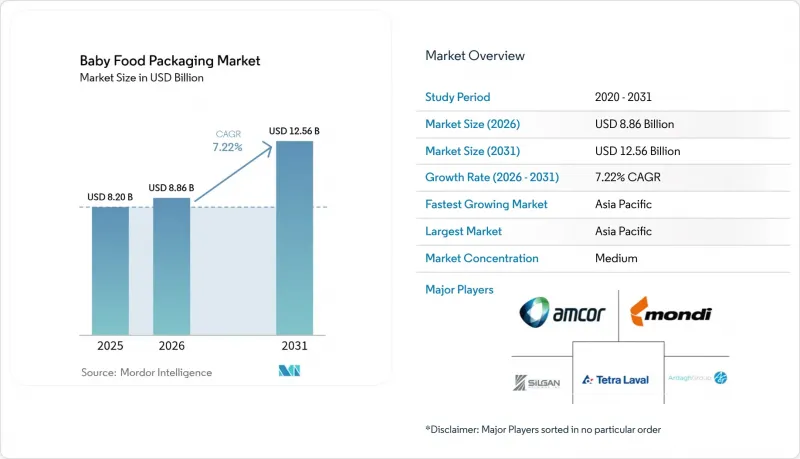
Mordor Intelligence에 의하면, 이유식 포장 시장 규모는 2025년에 82억 달러로 평가되었고, 2026년 88억 6,000만 달러에서 2031년까지 125억 6,000만 달러에 이를 것으로 추정되며, 예측 기간(2026-2031년) CAGR은 7.22%를 나타낼 전망입니다.
본 보고서는 소재별(플라스틱, 판지, 금속, 유리, 바이오플라스틱), 포장 유형별(병, 카톤, 항아리, 파우치, 백 인 박스), 제품별(액상 분유, 건조 이유식, 분유, 조리된 이유식, 유아용 스낵), 지역별로 분류되어 있습니다. 시장 전망은 금액(달러) 기준으로 제시되어 있습니다.
세계의 이유식 포장 시장 동향 및 인사이트
편의성을 중시한 이유식 파우치의 보급
가볍고 재밀봉이 가능한 파우치는 보호자들이 휴대성과 분량 조절을 중요시하기 때문에 도시 지역 시장에서 외출 시 수유 및 식사를 위한 대표적인 형태로 자리 잡았습니다. 2024년에 출시된 SIG Combibloc사의 ‘Prime 55’ 인라인 무균 충전 시스템은 주입구 장착과 무균 충전을 한 공정으로 완료하여, 생산 라인의 복잡성과 제3자에 의한 멸균 공정을 줄여줍니다. 2025년 유럽의 여러 컨버터가 채택한 IMA Group의 ‘FillShape’ 장치는 진열대의 눈에 잘 띄는 위치에 진열할 수 있는 직립형 파우치를 구현합니다. 일본과 한국의 소매 체인에서는 2025년 파우치 매출이 두 자릿수 성장률을 기록했습니다. 이는 한부모 가정이나 조부모가 조리 시간을 최소화할 수 있는 형태를 선호했기 때문입니다. 또한 온라인 소매업체들도 파우치를 선호하고 있습니다. 유리병에 비해 가벼워 운송 비용을 절감할 수 있고, 파손으로 인한 클레임도 줄어들기 때문입니다.
시간 절약형 포장을 원하는 도시 지역의 맞벌이 가구
중국 국가통계국의 기록에 따르면, 2025년에는 영유아를 둔 도시 가구의 68%가 맞벌이 가구로, 2020년의 54%에서 증가했습니다. 시간적 제약으로 인해 소비자들은 냉장 보관이 필요 없는 상온 보관 가능한 파우치나 카톤을 선호하는 추세이며, 특히 콜드체인 인프라가 미비한 2·3급 도시에서 이러한 경향이 두드러집니다. 테트라팩은 이러한 수요에 부응하기 위해 2025년 인도에서 트위스트 캡이 달린 200밀리리터 무균 카톤을 출시했습니다. 2025년에 도시화율이 85%를 넘고, 2023년 이후 슈퍼마켓에서 이유식 파우치의 보급률이 2배로 증가한 브라질과 멕시코에서도 비슷한 추세가 나타납니다. 동남아시아에서는 파우치 제품이 병에 담긴 제품에 비해 15-20% 비싸지만, 소비자들이 이 형태를 편리함과 연관 짓고 있기 때문에 판매 회전율은 여전히 높은 수준을 유지하고 있습니다.
플라스틱의 지속가능성을 둘러싼 반발과 법적 규제
프랑스에서는 2024년, 버진 플라스틱에 대해 1kg당 0.50유로의 세금이 부과되어 파우치용 수지 비용이 8-12% 상승했습니다. 2025년에 도입된 영국의 EPR(생산자 책임 확대) 제도에서는 재활용이 불가능한 라미네이트 소재에 대해 1톤당 최대 1,000파운드의 추가 요금이 부과되고 있습니다. 독일과 네덜란드의 소매업체들은 단일 소재 솔루션을 채택하지 않은 이유식 브랜드의 판매를 중단하기 시작했으며, 2025년 유럽환경청(EEB)의 조사에 따르면 보호자의 72%가 섬유나 유리를 원료로 한 포장에 대해 10%의 할증료를 지불할 의사가 있는 것으로 나타났습니다. 이러한 추세로 인해 비용 및 중량 측면의 단점이 있음에도 불구하고, 종이 상자, 재활용 가능한 파우치, 유리병으로의 전환이 가속화되고 있습니다.
부문 분석
2025년 매출액 중 플라스틱이 43.87%를 차지했지만, EPR(확대 생산자 책임) 제도에서 높은 섬유 회수율을 입증할 수 있는 소재가 우대받기 때문에 판지는 8.21%의 성장률이 예상되며, 이는 소재 중 가장 높은 수치입니다. 테트라팩(Tetra Pak)의 카톤은 유럽의 제지 공장에서 이미 90%의 재활용률을 달성하여 EPR 요금 감면 대상이 되고 있습니다. 한편, SIG 콤비블록(Combi-Block)의 식물 유래 폴리머 배리어는 화석 유래 성분의 함량을 더욱 낮추고 있습니다. 판지를 사용한 이유식 포장 시장은 특히 지자체별 분리수거 인프라가 잘 갖춰진 지역에서 이러한 성장세를 반영할 것으로 예측됩니다.
가공업체들은 산성 퓨레에 대해 판지에 충분한 내습성을 부여하는 수성 코팅 및 플라즈마 증착 배리어에 대한 시험을 계속하고 있습니다. 금속 캔은 프리미엄 레토르트 제품을 위한 틈새 시장으로서의 지위를 유지하고 있지만, BPA 프리 코팅으로 인한 가격 압박에 직면해 있습니다. 유리는 ‘순도’라는 이미지를 유지하고 있지만, 전자상거래에서는 무게와 파손 위험이라는 단점이 있습니다. 바이오플라스틱은 퇴비화가 가능하다는 점이 매력적이지만, 폴리에틸렌보다 40-60% 비싸고 광범위한 수거 시스템이 정비되어 있지 않아 이유식 포장 시장에 미치는 즉각적인 영향은 제한적입니다.
지역별 분석
아시아태평양은 2025년 매출의 42.52%를 차지했으며, 8.14%의 성장률이 예상되어 지역별로는 가장 높은 성장률을 기록할 전망입니다. 중국의 주요 전자상거래 기업들은 QR 코드를 통한 추적 시스템을 도입하여, 제품의 진품성에 대한 부모들의 신뢰를 강화하고 있습니다. 인도의 2선 도시에서는 정부의 콜드체인 프로그램 덕분에 라스트 마일 신뢰성이 향상되어 두 자릿수 성장을 기록하고 있습니다. 일본이나 한국 등 성숙한 시장에서는 고급 유리병 판매가 견조한 추세를 보이는 반면, 인도네시아, 태국, 베트남에서는 상온 물류에 대응한 파우치가 주류를 이루고 있습니다.
북미는 시장 규모에서 2위를 차지하고 있으며, 엄격한 규제 감독과 유기농 식품 표시의 보급이 이를 뒷받침하고 있습니다. 집에서 직접 만드는 이유식 트렌드가 힘을 얻으면서 성장은 둔화되고 있습니다. 부모들은 카운터탑형 블렌더나 재사용 가능한 실리콘 파우치에 투자하고 있어, 포장된 퓨레에 대한 수요가 감소하고 있습니다. 캐나다는 미국의 안전 기준을 따르고 있지만, 여기에 더해 이중 언어 표시 요건이 부과되고 있습니다. 멕시코에서는 주요 도시의 슈퍼마켓 체인이 영유아용 식품의 품목 구색을 확대함에 따라 파우치 채택이 급속히 진행되고 있습니다.
유럽에서는 엄격한 지속가능성 규제와 높은 유기농 제품 보급률이 공존하고 있습니다. 독일, 프랑스, 영국에서는 EPR(확대 생산자 책임) 비용을 억제하기 위해 단일 소재 파우치를 우선적으로 사용하고 있지만, 이탈리아와 스페인에서는 여전히 투명한 유리병이 선호되고 있습니다. 동유럽 국가들에서는 소득 증가에 따라 1회 분량이 조정된 파우치로 전환이 진행되고 있습니다. 브라질과 아르헨티나를 필두로 한 남미에서는 냉장 시설이 부족한 도시 지역에서 파우치 제품을 주축으로 한 시장 확대가 관찰됩니다. 또한 중동 및 아프리카에서는 주재원과 중산층 증가에 따라 서유럽식 식습관이 확산되고 있습니다.
기타 혜택 :
- 엑셀 형식 시장 예측(ME) 시트
- 3개월간의 애널리스트 지원
자주 묻는 질문
목차
제1장 서론
제2장 조사 방법
제3장 주요 요약
제4장 시장 구도
제5장 시장 규모 및 성장 예측
제6장 경쟁 구도
제7장 시장 기회 및 향후 전망
AJY 26.09.09According to Mordor Intelligence, the baby food packaging market size was valued at USD 8.20 billion in 2025 and is estimated to grow from USD 8.86 billion in 2026 to reach USD 12.56 billion by 2031, at a CAGR of 7.22% during the forecast period (2026-2031).

This report is Segmented by Material (Plastic, Paperboard, Metal, Glass, and Bioplastics), Package Type (Bottles, Cartons, Jars, Pouches, and Bag-In-Box), Product (Liquid Milk Formula, Dried Baby Food, Powder Milk Formula, Prepared Baby Food, and Baby Snacks), and by Geography. The Market Forecasts are Provided in Terms of Value (USD).
Global Baby Food Packaging Market Trends and Insights
Convenience-Driven Adoption Of Baby Food Pouches
Lightweight, resealable pouches have become the default format for on-the-go feeding in urban markets because caregivers value portability and portion control. SIG Combibloc's Prime 55 in-line aseptic system, launched in 2024, combines spout attachment and sterile filling in one pass, trimming line complexity and third-party sterilization steps. IMA Group's FillShape equipment, adopted by several European converters in 2025, enables upright-shaped pouches that command front-of-shelf visibility. Retail chains in Japan and South Korea reported double-digit growth in pouch sales in 2025 as single-parent families and grandparents sought formats that minimize preparation time. Online retailers also favor pouches because lower weight reduces freight costs and breakage claims versus glass jars.
Urban Dual-Income Households Demanding Time-Saving Formats
China's National Bureau of Statistics recorded that 68% of urban households with infants had two working parents in 2025, up from 54% in 2020. The time squeeze is steering shoppers toward ambient-stable pouches and cartons that need no refrigeration, especially in tier-2 and tier-3 cities where cold-chain gaps persist. Tetra Pak debuted a 200-milliliter aseptic carton with a twist cap in India in 2025 to meet this need. Similar behavior is emerging in Brazil and Mexico, where urbanization rates topped 85% in 2025, and supermarket penetration of baby food pouches doubled since 2023. Although pouch units carry a 15-20% price premium over jars in Southeast Asia, velocity remains higher because shoppers equate the format with convenience
Plastics Sustainability Backlash And Legislation
France imposed a EUR 0.50 per kilogram tax on virgin plastic in 2024, lifting pouch resin costs by 8-12%. The United Kingdom's EPR scheme, launched in 2025, levies surcharges of up to GBP 1,000 per tonne on non-recyclable laminates. German and Dutch retailers have begun delisting baby-food brands that lack mono-material solutions, and a 2025 European Environmental Bureau survey found that 72% of parents are willing to pay a 10% premium for fiber- or glass-based packaging. These dynamics accelerate the shift to paperboard cartons, recyclable pouches, and glass jars despite cost and weight downsides.
Other drivers and restraints analyzed in the detailed report include:
- Stricter Infant-Safety Regulations Expanding Premium Packaging
- Aseptic Spouted-Pouch Filling Lines Gaining Ground
- BPA/Chemicals Compliance Cost Pressures
For complete list of drivers and restraints, kindly check the Table Of Contents.
Segment Analysis
Plastic captured 43.87% of 2025 revenue, yet paperboard is forecast to expand at 8.21%, the highest among materials, as EPR schemes reward substrates that can demonstrate high fiber recovery rates. Tetra Pak cartons already achieve 90% recyclability in European mills, qualifying for reduced EPR fees, while SIG Combibloc's plant-based polymer barrier further lowers fossil content. The baby food packaging market for paperboard is projected to reflect this momentum, especially in regions with mature municipal sorting infrastructure.
Converters continue to trial water-based coatings and plasma-deposited barriers that give paperboard sufficient moisture resistance for acidic purees. Metal cans remain a niche for premium retort products but face price erosion from BPA-free coatings. Glass maintains a purity halo but suffers weight and breakage penalties in e-commerce. Bioplastics, though attractive for their compostability claims, cost 40-60% more than polyethylene and lack widespread collection systems, limiting their immediate impact on the baby food packaging market.
Complete Report Scope:
- By Material
- Plastic
- Paperboard
- Metal
- Glass
- Bioplastics
- By Package Type
- Bottles
- Cartons
- Jars
- Pouches
- Bag-in-Box
- By Product
- Liquid Milk Formula
- Dried Baby Food
- Powder Milk Formula
- Prepared Baby Food
- Baby Snacks
- By Geography
- North America
- United States
- Canada
- Mexico
- South America
- Brazil
- Argentina
- Rest of South America
- Europe
- Germany
- United Kingdom
- France
- Italy
- Spain
- Rest of Europe
- Asia-Pacific
- China
- Japan
- India
- South Korea
- Southeast Asia
- Rest of Asia-Pacific
- Middle East
- Saudi Arabia
- United Arab Emirates
- Turkey
- Rest of Middle East
- Africa
- South Africa
- Nigeria
- Egypt
- Rest of Africa
- North America
Geography Analysis
Asia-Pacific accounted for 42.52% of 2025 revenue and is projected to expand at 8.14%, the fastest regional pace. E-commerce majors in China have embraced QR-code traceability, reinforcing parent confidence in authenticity. India's tier-2 cities post double-digit growth as government cold-chain programs improve last-mile reliability. Mature markets such as Japan and South Korea sustain premium glass-jar sales, whereas Indonesia, Thailand, and Vietnam lean on pouches compatible with ambient logistics.
North America ranks second in size, underpinned by stringent regulatory oversight and widespread organic labeling. Growth moderates as a do-it-yourself baby-food movement gains traction: parents invest in countertop blenders and reusable silicone pouches, trimming demand for packaged purees. Canada mirrors U.S. safety rules but layers bilingual labeling requirements; Mexico chalks up brisk pouch adoption as supermarket chains widen infant-nutrition assortments in major cities.
Europe balances tough sustainability mandates with high organic penetration. Germany, France, and the United Kingdom prioritize mono-material pouches to curb EPR fees, while Italy and Spain still favor transparent glass jars. Eastern European countries transition toward portion-controlled pouches as incomes rise. South America, led by Brazil and Argentina, is witnessing pouch-driven expansion in urban hubs with patchy refrigeration, and the Middle East and Africa are following Western feeding habits as expatriate populations and middle classes grow.
- Amcor PLC
- Tetra Laval Group
- Mondi Group
- Ardagh Group
- Silgan Holdings Inc.
- Sonoco Products Company
- Winpak Ltd
- DS Smith PLC
- SIG Combibloc Group
- Cheer Pack North America
- Gualapack Group
- Scholle IPN
- UFlex Ltd
- ProAmpac LLC
- Huhtamaki Oyj
- AptarGroup Inc.
- Plastipak Packaging Inc.
- Crown Holdings Inc.
- Sealed Air Corp.
Additional Benefits:
- The market estimate (ME) sheet in Excel format
- 3 months of analyst support
TABLE OF CONTENTS
1 INTRODUCTION
- 1.1 Study Assumptions and Market Definition
- 1.2 Scope of the Study
2 RESEARCH METHODOLOGY
3 EXECUTIVE SUMMARY
4 MARKET LANDSCAPE
- 4.1 Market Overview
- 4.2 Market Drivers
- 4.2.1 Convenience-Driven Adoption Of Baby Food Pouches
- 4.2.2 Urban Dual-Income Households Demanding Time-Saving Formats
- 4.2.3 Stricter Infant-Safety Regulations Expanding Premium Packaging
- 4.2.4 Aseptic Spouted-Pouch Filling Lines Gaining Ground
- 4.2.5 Extended-Producer-Responsibility Incentives For Recyclability
- 4.2.6 Ai-Led Personalised-Nutrition Pack Design Innovations
- 4.3 Market Restraints
- 4.3.1 Plastics Sustainability Backlash And Legislation
- 4.3.2 Bpa/Chemicals Compliance Cost Pressures
- 4.3.3 Supply Bottlenecks Of Pharma-Grade Spout Resins
- 4.3.4 DIY Baby-Food Trend Reducing Packaged Demand
- 4.4 Supply-Chain Analysis
- 4.5 Regulatory Landscape
- 4.6 Technological Outlook
- 4.7 Porter's Five Forces
- 4.7.1 Threat of New Entrants
- 4.7.2 Bargaining Power of Buyers
- 4.7.3 Bargaining Power of Suppliers
- 4.7.4 Threat of Substitute Products
- 4.7.5 Intensity of Competitive Rivalry
- 4.8 Assesment of Macroeconomic Factors on the Market
5 MARKET SIZE AND GROWTH FORECASTS (VALUE)
- 5.1 By Material
- 5.1.1 Plastic
- 5.1.2 Paperboard
- 5.1.3 Metal
- 5.1.4 Glass
- 5.1.5 Bioplastics
- 5.2 By Package Type
- 5.2.1 Bottles
- 5.2.2 Cartons
- 5.2.3 Jars
- 5.2.4 Pouches
- 5.2.5 Bag-in-Box
- 5.3 By Product
- 5.3.1 Liquid Milk Formula
- 5.3.2 Dried Baby Food
- 5.3.3 Powder Milk Formula
- 5.3.4 Prepared Baby Food
- 5.3.5 Baby Snacks
- 5.4 By Geography
- 5.4.1 North America
- 5.4.1.1 United States
- 5.4.1.2 Canada
- 5.4.1.3 Mexico
- 5.4.2 South America
- 5.4.2.1 Brazil
- 5.4.2.2 Argentina
- 5.4.2.3 Rest of South America
- 5.4.3 Europe
- 5.4.3.1 Germany
- 5.4.3.2 United Kingdom
- 5.4.3.3 France
- 5.4.3.4 Italy
- 5.4.3.5 Spain
- 5.4.3.6 Rest of Europe
- 5.4.4 Asia-Pacific
- 5.4.4.1 China
- 5.4.4.2 Japan
- 5.4.4.3 India
- 5.4.4.4 South Korea
- 5.4.4.5 Southeast Asia
- 5.4.4.6 Rest of Asia-Pacific
- 5.4.5 Middle East
- 5.4.5.1 Saudi Arabia
- 5.4.5.2 United Arab Emirates
- 5.4.5.3 Turkey
- 5.4.5.4 Rest of Middle East
- 5.4.6 Africa
- 5.4.6.1 South Africa
- 5.4.6.2 Nigeria
- 5.4.6.3 Egypt
- 5.4.6.4 Rest of Africa
- 5.4.1 North America
6 COMPETITIVE LANDSCAPE
- 6.1 Market Concentration
- 6.2 Strategic Moves
- 6.3 Market Share Analysis
- 6.4 Company Profiles (includes Global level Overview, Market level overview, Core Segments, Financials as available, Strategic Information, Market Rank/Share for key companies, Products and Services, and Recent Developments)
- 6.4.1 Amcor PLC
- 6.4.2 Tetra Laval Group
- 6.4.3 Mondi Group
- 6.4.4 Ardagh Group
- 6.4.5 Silgan Holdings Inc.
- 6.4.6 Sonoco Products Company
- 6.4.7 Winpak Ltd
- 6.4.8 DS Smith PLC
- 6.4.9 SIG Combibloc Group
- 6.4.10 Cheer Pack North America
- 6.4.11 Gualapack Group
- 6.4.12 Scholle IPN
- 6.4.13 UFlex Ltd
- 6.4.14 ProAmpac LLC
- 6.4.15 Huhtamaki Oyj
- 6.4.16 AptarGroup Inc.
- 6.4.17 Plastipak Packaging Inc.
- 6.4.18 Crown Holdings Inc.
- 6.4.19 Sealed Air Corp.
7 MARKET OPPORTUNITIES AND FUTURE OUTLOOK
- 7.1 White-space and Unmet-need Assessment


