

|
시장보고서
상품코드
2125715
이유식 유리 포장 시장 : 시장 점유율 분석, 업계 동향 및 통계, 성장 예측(2026-2031년)Baby Food Glass Packaging - Market Share Analysis, Industry Trends & Statistics, Growth Forecasts (2026 - 2031) |
||||||
 Mordor Intelligence
Mordor Intelligence에 의하면, 이유식 유리 포장 시장 규모는 2025년에 187억 7,000만 달러로 평가되었고, 2026년 194억 8,000만 달러에서 2031년까지 234억 4,000만 달러에 이를 것으로 예측되며, 예측 기간(2026-2031년) CAGR은 3.77%를 나타낼 전망입니다.
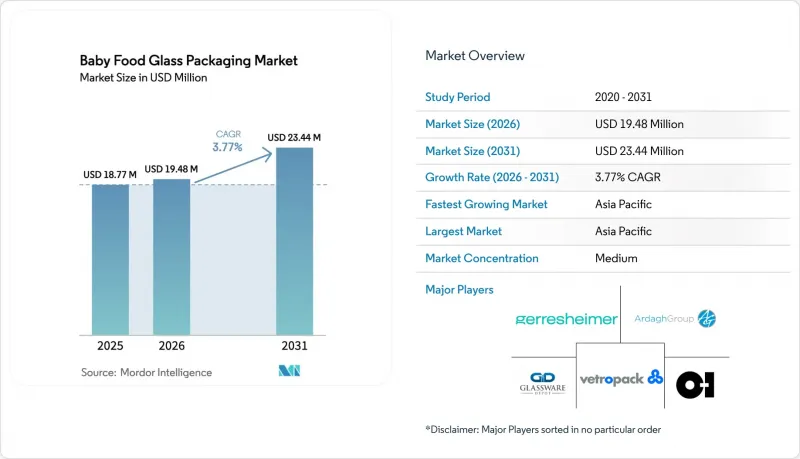
본 보고서는 용도별(유아용 퓨레, 시리얼·스낵, 음료·주스, 기타), 용기 유형별(유리병(저), 젖병·수유용 유리병, 유리컵·포션팟), 캡 유형별(금속 뚜껑, 복합 소재 캡, 플라스틱 캡, 그린 캡, 기타), 유통 채널별(오프라인 소매, 전자상거래·DTC), 지역별로 분류되어 있습니다. 시장 전망은 금액(달러) 기준으로 제시되어 있습니다.
세계의 이유식 유리 포장 시장 동향 및 인사이트
유기농·천연 재료로 만든 유아식 수요 증가
부모들이 합성 첨가물이 포함되지 않은 제품을 신뢰함에 따라 유기농 유아식 제품 라인업은 급속히 확대되고 있습니다. 각 브랜드는 영양소와 향을 보존하기 위한 가장 안전한 장벽으로 유리를 꼽고 있습니다. 거버(Gerber)사는 프리미엄 이미지를 강화하기 위해 이미 유기농 제품 라인업을 탄소 중립 유리병으로 전환하고 있습니다. 미국 식품의약국(FDA)은 유아용 조제분유 포장에 대한 엄격한 안전성 심사를 중시하고 있으며, 이러한 입장은 당연히 비활성 유리 표면에 유리하게 작용하고 있습니다. 벤처 캐피털의 지원을 받는 혁신적인 기업들도 이에 발맞추고 있으며, ‘원스 어폰 어 팜(Once Upon a Farm)’은 품질 유지에 중점을 둔 포장 형태로 제공되는 콜드 프레스 혼합 제품의 확대를 위해 5,200만 달러를 조달했습니다. 이러한 추세는 현재 유기농 인증을 위해 기꺼이 높은 가격을 지불하는 중국 대도시권의 부모들에게도 확산되고 있습니다. 이러한 요인들이 맞물려 각 매장에서 유기농 제품의 SKU가 증가함에 따라 이유식 유리 포장 시장도 확대되고 있습니다.
건강과 안전에 대한 인식으로 인해 보호자들이 플라스틱보다 유리를 선호하는 경향
소비자 조사에 따르면, 신생아 부모의 최대 70%가 영유아용 식품 용기로서 유리병을 다른 어떤 소재보다 신뢰하는 것으로 나타났습니다. EU가 2025년 초에 BPA 전면 금지를 확정함에 따라 이러한 신뢰감은 더욱 높아졌습니다. 브랜드와 소매업체들도 이러한 추세를 강조하고 있으며, ‘Mason Bottle’은 밀레니얼 세대 가족을 대상으로 ‘무해한 유리 수유 솔루션’을 적극적으로 판매하고 있습니다. 건강에 대한 관심이 높아짐에 따라 제조업체들은 프로모션을 제한하면서도 가격 프리미엄을 유지하고 있습니다. 이러한 신뢰는 단순한 브랜딩이 아닌 소재 자체의 특성에서 비롯된 것이기 때문에 연질 파우치가 이 가격 차이를 메우기 어렵고, 장기적인 수요에 대한 호재가 더욱 강해지고 있습니다.
플라스틱에 비해 높은 유리의 비용과 무게
모래, 소다회, 석회를 용융하는 데는 극도로 높은 온도가 필요하기 때문에 유리 공장은 폴리머 압출 성형 업체보다 더 높은 에너지 비용을 부담하고 있습니다. 유리 용기는 동급의 라미네이트 파우치에 비해 4-6배의 무게가 나가며, 출하되는 칼로리당 운송비와 이산화탄소 배출량을 증가시키고 있습니다. 동남아시아의 가격 민감성으로 인해 현지 브랜드들은 주둥이가 달린 파우치를 채택하는 경향이 있으며, 이미 유아식 포장 시장의 30% 이상을 차지하고 있습니다. 에너지 가격 급등으로 인해 2024년 미국 유리 산업의 생산자 물가지수는 4.5% 상승하여 가공업체의 이익률을 압박하고 있습니다. 연료 할증료가 인하되지 않는 한, 이러한 불리한 요인은 프리미엄 SKU를 제외한 시장 진출을 제한할 것입니다.
부문 분석
2025년, 유아용 퓨레는 유아식 유리 포장 시장 규모의 41.85%를 차지했으며, 이는 유아의 첫 이유식으로서의 역할을 반영합니다. 모든 지역에서 안정적인 수요가 있으며, 부모들은 색상, 향, 미량 영양소를 보존하기 위해 유리병을 신뢰하고 있습니다. 또한 제품 개발자들은 핫 필(hot fill) 및 레토르트(retort) 처리에 대한 내성 덕분에 방부제 사용량을 줄일 수 있다는 점에서 유리를 높이 평가했습니다. 그러나 2031년까지 연평균 성장률(CAGR) 5.04%를 기록하며 음료 및 주스 부문이 가장 빠르게 성장하고 있습니다. 콜드 프레스 방식으로 제조된 과일 블렌드와 프로바이오틱스가 함유된 스무디에 대한 수요 증가가 이러한 상승세를 주도하고 있으며, 투명한 병이 선명한 색감을 돋보이게 하여 소셜 미디어에서 큰 반향을 일으키고 있습니다. Beech-Nut의 프리바이오틱스 음료 라인은 유리 용기가 새로운 액상 영양 식품의 출시를 어떻게 뒷받침하고 있는지 보여줍니다.
음료 제조업체들은 첨가물 없이 신선한 맛을 유지하기 위한 유리의 산소 차단성을 중시하고 있으며, 이것이 프리미엄 가격의 근거가 되고 있습니다. 한편, 시리얼 및 스낵류는 유리가 충족시키는 장기 보존의 필요성에 힘입어 꾸준한 성장을 유지하고 있습니다. 치료용 제제 등 특수한 ‘기타’ 제품은 엄격한 안전 기준이 요구되기 때문에 가장 높은 단가를 자랑합니다. 카테고리를 불문하고, 용량 조정이라는 추세에 따라 브랜드들은 더 작은 용량의 SKU로 전환하고 있으며, 기존의 4온스 병을 넘어선 용량 구성이 점차 다양해지고 있습니다. 이러한 변화들이 맞물리면서, 영유아용 영양식품 시장 전체가 확대되는 가운데에서도 이유식 유리 포장 시장은 견조한 추세를 보이고 있습니다.
유리병은 퓨레, 시리얼, 스낵 등 어떤 제품에도 적합한 높은 범용성 덕분에 2025년에는 이유식 유리 포장 시장에서 58.15%의 점유율을 차지했습니다. 표준 목 형태는 고속 메탈 러그식 캡핑기와 쉽게 연동될 수 있어 비용 관리에 기여하고 있습니다. 시장 점유율은 그리 크지 않지만, 성장세가 두드러지는 유리컵과 포션팟은 2031년까지 연평균 성장률(CAGR) 4.65%를 나타낼 것으로 예측되며, 이는 폐기물을 최소화하고 외출 시 수유를 간편하게 하고자 하는 보호자들의 요구에 부응하는 것입니다. WeeSprout의 눈금이 표시된 보관 용기와 같은 디자인은 측정 정확도와 냉동실에서 전자레인지로 직접 옮겨도 견딜 수 있는 내구성을 겸비하고 있습니다.
젖병은 특히 폴리카보네이트 재질의 젖병을 피하는 부모층을 중심으로, 프리미엄 포지셔닝과 안전성을 강조하는 스토리에 힘입어 계속해서 틈새 시장을 형성하고 있습니다. 개발자들은 현재 강도를 확보하면서도 무게를 줄이기 위해, 얇은 두께의 용기 형태나 내부 엠보싱 가공을 검토하고 있습니다. 포션 팟에 대한 수요가 증가함에 따라, 유리 제조업체들은 멀티 캐비티 구성이 가능한 협구 IS 성형기에 대한 투자를 진행하고 있으며, 이 이유식 유리 포장 산업 부문에서 혁신이 활발하게 이어지고 있습니다.
지역별 분석
아시아태평양은 2025년에 총 가치의 32.05%를 차지했으며, 2031년까지 연평균 성장률(CAGR) 4.44%로 성장을 주도할 전망입니다. 중국에서는 국내 제조업체의 진입이 증가하고 있음에도 불구하고, 수입 유아식 브랜드가 여전히 국내 카테고리 지출의 60%를 차지하고 있으며, 이는 도시 가구에서 가격보다 신뢰성과 포장 품질을 더 중요시하고 있음을 보여줍니다. 인도에서도 가처분 소득 증가에 따라 유사한 경향이 나타나고 있으며, 1급 도시의 현대식 소매점 진열대에서는 유리병에 담긴 제품의 구색이 늘어나고 있습니다. 한편, 일본에서는 고령화가 진행되는 인구 구조에도 불구하고, 죽용 전자레인지용 병과 같은 혁신적인 제품을 통해 프리미엄 상품의 매출이 유지되고 있습니다. 지역 공급업체들은 도시의 재활용 할당량을 충족하기 위해 사용 후 유리 파편 조달을 확대하고 있으며, 이는 이유식 유리 포장 시장공급 안정을 뒷받침하고 있습니다.
북미와 유럽에서는 절대적인 성장률이 둔화되고 있지만, 여전히 프리미엄 시장의 중요한 거점 역할을 하고 있습니다. 2030년까지 모든 포장재를 재활용 가능하게 하겠다는 목표와 BPA 금지를 규정한 EU의 새로운 규제로 인해, 유리는 위험이 가장 낮은 선택지로서의 입지를 공고히 하고 있습니다. 미국에서는 유리 포장 협회(Glass Packaging Institute)의 소비자 인식 제고 활동이 순도 및 맛에 관한 브랜드 메시지를 뒷받침하고 있습니다. 소매업체들은 유아용품 매장에서 ‘플라스틱 프리 존’을 강조하고 있으며, 이는 저가 라인에서 파우치 제품의 판매량이 증가하는 상황에서도 유리 제품 시장 점유율 확대에 기여하고 있습니다.
기타 혜택
- 엑셀 형식 시장 예측(ME) 시트
- 3개월간의 애널리스트 지원
자주 묻는 질문
목차
제1장 서론
제2장 조사 방법
제3장 주요 요약
제4장 시장 구도
제5장 시장 규모 및 성장 예측
제6장 경쟁 구도
제7장 시장 기회 및 향후 전망
AJY 26.09.15According to Mordor Intelligence, the baby food glass packaging market size was valued at USD 18.77 billion in 2025 and estimated to grow from USD 19.48 billion in 2026 to reach USD 23.44 billion by 2031, at a CAGR of 3.77% during the forecast period (2026-2031).

This report is Segmented by Application (Baby Purees, Cereals and Snacks, Drinks and Juices, Others), Container Type (Glass Jars, Glass Bottles, Glass Cups/Portion Pots), Closure Type (Metal Lids, Composite Closures, Plastic Caps, Green and Others), Distribution Channel (Offline Retail, E-Commerce and DTC), and by Geography. The Market Forecasts are Provided in Terms of Value (USD).
Global Baby Food Glass Packaging Market Trends and Insights
Rising demand for organic and natural baby foods
Organic baby food lines expand quickly because parents trust products free of synthetic additives. Brands position glass as the safest barrier to preserve nutrients and aromas. Gerber has already shifted its Organic range toward carbon-neutral glass jars to strengthen premium cues. The U.S. FDA emphasizes rigorous safety review of packaging intended for infant formula, a stance that naturally favors inert glass surfaces. Venture-backed disruptors follow suit; Once Upon a Farm earmarked USD 52 million to scale cold-pressed blends packed in integrity-focused formats. Momentum is now spreading to China's metropolitan parents who willingly pay more for organic certification. These combined forces lift the baby food glass packaging market as organic SKUs multiply across aisles.
Parental preference for glass over plastics for health-safety perception
Consumer surveys show up to 70% of new parents trust glass jars more than any alternative for baby nutrition.Confidence jumped after the EU confirmed a complete BPA ban in early 2025. Brands and retailers underline this narrative; Mason Bottle actively markets "non-toxic glass feeding solutions" to millennial families. Health-driven sentiment lets manufacturers maintain a price premium while limiting promotions. Because such trust stems from intrinsic material properties rather than branding alone, the differential is hard for flexible pouches to erode, reinforcing a long-term demand tailwind.
Higher cost and weight of glass versus plastics
Melting sand, soda ash and limestone requires extreme temperatures, so glass plants face higher energy bills than polymer extruders. Glass containers weigh 4-6 times more than equivalent laminate pouches, inflating freight spend and carbon emissions per shipped calorie. Price sensitivity in Southeast Asia pushes local brands toward spouted pouches that already command more than 30% of baby food packaging volume. Energy inflation lifted the U.S. glass industry Producer Price Index by 4.5% in 2024, squeezing converters' margins. Unless fuel surcharges retreat, this disadvantage limits penetration outside premium SKUs.
Other drivers and restraints analyzed in the detailed report include:
- Premiumization and brand differentiation through glass packaging
- Government recycling and circular-economy mandates
- Glass supply-chain disruptions and furnace downtime risk
For complete list of drivers and restraints, kindly check the Table Of Contents.
Segment Analysis
In 2025, baby purees held 41.85% of the baby food glass packaging market size, reflecting their role as first weaning meals for infants. Stable demand comes from every region, and parents trust jars to guard color, aroma and micronutrients. Formulators also appreciate glass for hot-fill and retort tolerance, reducing preservatives. However, drinks and juices are rising fastest at a 5.04% CAGR to 2031. Thirst for cold-pressed fruit blends and probiotic smoothies drives this upswing, with transparent jars showcasing vibrant hues that resonate on social media. Beech-Nut's prebiotic beverage line illustrates how glass underpins new liquid nutriment launches.
Beverage producers prize glass's oxygen barrier to uphold fresh taste without additives, underpinning premium price tags. Meanwhile cereals and snacks keep steady momentum, supported by extended shelf life needs that glass fulfills. Specialized "others" such as therapeutic formulations fetch the highest unit prices thanks to stringent safety expectations. Across categories, portion control trends nudge brands toward smaller SKUs, subtly diversifying volume beyond the traditional 4-ounce jar. These shifts collectively reinforce the baby food glass packaging market even as broader infant nutrition formats expand.
Glass jars captured 58.15% of baby food glass packaging market share in 2025 as their versatility suits purees, cereals and snacks alike. Standard neck finishes integrate easily with high-speed metal-lug cappers, aiding cost control. Less dominant but faster-growing glass cups / portion pots clock a 4.65% CAGR by 2031, aligning with parents' wish to minimize waste and simplify on-the-go feeding. Designs like WeeSprout's graduated storage pots blend measurement precision with freezer-to-microwave resilience.
Nursing bottles remain a niche driven by premium positioning and safety narratives, especially among parents avoiding polycarbonate feeders. Developers now explore slim-wall jar geometries and internal embossing to shave weight while safeguarding strength. The momentum toward portion pots encourages glassmakers to invest in narrow-neck IS machines capable of multiple cavity configurations, keeping innovation vibrant inside this baby food glass packaging industry segment.
Complete Report Scope:
- By Application
- Baby Purees
- Cereals and Snacks
- Drinks and Juices
- Others
- By Container Type
- Glass Jars
- Glass Bottles (Nursing/Feeding)
- Glass Cups / Portion Pots
- By Closure Type
- Metal Lids
- Composite Closures
- Plastic Caps
- Green and Others
- By Distribution Channel
- Offline Retail
- E-commerce and DTC
- By Geography
- North America
- United States
- Canada
- South America
- Brazil
- Argentina
- Rest of South America
- Europe
- Germany
- United Kingdom
- France
- Spain
- Italy
- Russia
- Rest of Europe
- Asia-Pacific
- China
- Japan
- India
- Australia and New Zealand
- South Korea
- Rest of Asia-Pacific
- Middle East and Africa
- Middle East
- Saudi Arabia
- United Arab Emirates
- Turkey
- Rest of Middle East
- Africa
- South Africa
- Nigeria
- Egypt
- Rest of Africa
- Middle East
- North America
Geography Analysis
Asia-Pacific held 32.05% of total value in 2025 and leads growth with a 4.44% CAGR to 2031. China's imported baby food brands still account for 60% of local category spending despite rising domestic entrants, a sign that trust and packaging quality trump price among urban households. India mirrors this pattern as disposable incomes climb; glass jar SKUs gain presence on modern-trade shelves in Tier-I cities. Meanwhile Japan's mature demographic sustains premium sales through innovation such as microwavable jars for rice porridge. Regional suppliers increasingly source post-consumer cullet to meet city recycling quotas, anchoring supply stability for the baby food glass packaging market.
North America and Europe post slower absolute growth yet remain essential premium bastions. The forthcoming EU rule that all packaging must be recyclable by 2030 coupled with its BPA ban cements glass as the lowest-risk option. U.S. consumer education from the Glass Packaging Institute supports brand messaging around purity and taste. Retailers emphasize plastic-free zones in baby aisles, amplifying share of wallet for glass even when pouch volumes expand in value lines.
- O-I Glass Inc.
- Ardagh Group S.A.
- Gerresheimer AG
- Vetropack Holding Ltd
- Verallia SA
- Heinz-Glas GmbH
- BA Glass B.V.
- Stoelzle Glass Group
- Bormioli Rocco SpA
- Piramal Glass Pvt Ltd
- AGI Glaspac
- Hindusthan National Glass and Inds. Ltd
- Toyo Glass Co. Ltd
- Nihon Yamamura Glass Co. Ltd
- SGD Pharma (SGD SA)
- Shandong Pharmaceutical Glass Co. Ltd
- Glassware Depot
- Pigeon Corporation
- Mayborn Group Ltd (Tommee Tippee)
- Evenflo Feeding Inc.
- Sundelight Infant Products Ltd
- Cospak (Orora Packaging)
Additional Benefits:
- The market estimate (ME) sheet in Excel format
- 3 months of analyst support
TABLE OF CONTENTS
1 INTRODUCTION
- 1.1 Study Assumptions and Market Definition
- 1.2 Scope of the Study
2 RESEARCH METHODOLOGY
3 EXECUTIVE SUMMARY
4 MARKET LANDSCAPE
- 4.1 Market Overview
- 4.2 Market Drivers
- 4.2.1 Rising demand for organic and natural baby foods
- 4.2.2 Parental preference for glass over plastics for health-safety perception
- 4.2.3 Premiumization and brand differentiation through glass packaging
- 4.2.4 Government recycling and circular-economy mandates
- 4.2.5 Refill-in-store and container-deposit pilots for reusable glass jars
- 4.2.6 DTC baby-food start-ups needing temperature-stable tempered glass
- 4.3 Market Restraints
- 4.3.1 Higher cost and weight of glass versus plastics
- 4.3.2 Glass supply-chain disruptions and furnace downtime risk
- 4.3.3 Rapid uptake of retortable pouches in emerging economies
- 4.3.4 Lightweight-packaging rules favoring plastic-glass laminates
- 4.4 Supply-Chain Analysis
- 4.5 Regulatory Landscape
- 4.6 Technological Outlook
- 4.7 Sustainability and Convenience Trends
- 4.8 Porter's Five Forces Analysis
- 4.8.1 Bargaining Power of Suppliers
- 4.8.2 Bargaining Power of Buyers
- 4.8.3 Threat of New Entrants
- 4.8.4 Threat of Substitutes
- 4.8.5 Competitive Rivalry
5 MARKET SIZE AND GROWTH FORECASTS (VALUE)
- 5.1 By Application
- 5.1.1 Baby Purees
- 5.1.2 Cereals and Snacks
- 5.1.3 Drinks and Juices
- 5.1.4 Others
- 5.2 By Container Type
- 5.2.1 Glass Jars
- 5.2.2 Glass Bottles (Nursing/Feeding)
- 5.2.3 Glass Cups / Portion Pots
- 5.3 By Closure Type
- 5.3.1 Metal Lids
- 5.3.2 Composite Closures
- 5.3.3 Plastic Caps
- 5.3.4 Green and Others
- 5.4 By Distribution Channel
- 5.4.1 Offline Retail
- 5.4.2 E-commerce and DTC
- 5.5 By Geography
- 5.5.1 North America
- 5.5.1.1 United States
- 5.5.1.2 Canada
- 5.5.2 South America
- 5.5.2.1 Brazil
- 5.5.2.2 Argentina
- 5.5.2.3 Rest of South America
- 5.5.3 Europe
- 5.5.3.1 Germany
- 5.5.3.2 United Kingdom
- 5.5.3.3 France
- 5.5.3.4 Spain
- 5.5.3.5 Italy
- 5.5.3.6 Russia
- 5.5.3.7 Rest of Europe
- 5.5.4 Asia-Pacific
- 5.5.4.1 China
- 5.5.4.2 Japan
- 5.5.4.3 India
- 5.5.4.4 Australia and New Zealand
- 5.5.4.5 South Korea
- 5.5.4.6 Rest of Asia-Pacific
- 5.5.5 Middle East and Africa
- 5.5.5.1 Middle East
- 5.5.5.1.1 Saudi Arabia
- 5.5.5.1.2 United Arab Emirates
- 5.5.5.1.3 Turkey
- 5.5.5.1.4 Rest of Middle East
- 5.5.5.2 Africa
- 5.5.5.2.1 South Africa
- 5.5.5.2.2 Nigeria
- 5.5.5.2.3 Egypt
- 5.5.5.2.4 Rest of Africa
- 5.5.5.1 Middle East
- 5.5.1 North America
6 COMPETITIVE LANDSCAPE
- 6.1 Market Concentration
- 6.2 Strategic Moves and Recent Developments
- 6.3 Market Share Analysis
- 6.4 Company Profiles (includes Global level Overview, Market level overview, Core Segments, Financials as available, Strategic Information, Market Rank/Share for key companies, Products and Services, and Recent Developments)
- 6.4.1 O-I Glass Inc.
- 6.4.2 Ardagh Group S.A.
- 6.4.3 Gerresheimer AG
- 6.4.4 Vetropack Holding Ltd
- 6.4.5 Verallia SA
- 6.4.6 Heinz-Glas GmbH
- 6.4.7 BA Glass B.V.
- 6.4.8 Stoelzle Glass Group
- 6.4.9 Bormioli Rocco SpA
- 6.4.10 Piramal Glass Pvt Ltd
- 6.4.11 AGI Glaspac
- 6.4.12 Hindusthan National Glass and Inds. Ltd
- 6.4.13 Toyo Glass Co. Ltd
- 6.4.14 Nihon Yamamura Glass Co. Ltd
- 6.4.15 SGD Pharma (SGD SA)
- 6.4.16 Shandong Pharmaceutical Glass Co. Ltd
- 6.4.17 Glassware Depot
- 6.4.18 Pigeon Corporation
- 6.4.19 Mayborn Group Ltd (Tommee Tippee)
- 6.4.20 Evenflo Feeding Inc.
- 6.4.21 Sundelight Infant Products Ltd
- 6.4.22 Cospak (Orora Packaging)
7 MARKET OPPORTUNITIES AND FUTURE OUTLOOK
- 7.1 White-space and Unmet-need Assessment


