

|
시장보고서
상품코드
2121886
아시아태평양의 이유식 포장 : 시장 점유율 분석, 업계 동향 및 통계, 성장 예측(2026-2031년)APAC Baby Food Packaging - Market Share Analysis, Industry Trends & Statistics, Growth Forecasts (2026 - 2031) |
||||||
 Mordor Intelligence
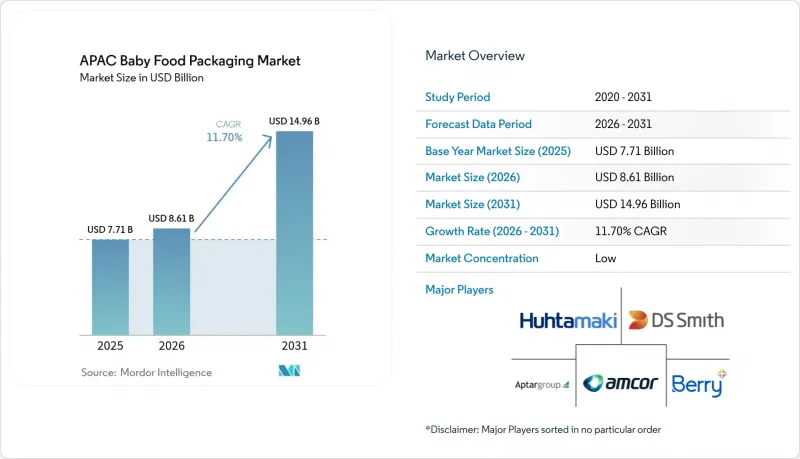
Mordor Intelligence에 의하면, 아시아태평양(APAC)의 이유식 포장 시장 규모는 2025년 77억 1,000만 달러로 평가되었고, 2026년에는 86억 1,000만 달러로 추정되고, 2026-2031년 CAGR 11.70%로 성장을 지속할 전망이며, 2031년에는 149억 6,000만 달러에 이를 것으로 예측됩니다.
본 보고서는 소재별(플라스틱, 판지, 금속, 유리, 바이오플라스틱), 포장 유형별(병, 금속 캔, 카톤 등), 제품 유형별(건조 이유식, 액상 분유, 분말 분유 등), 연령대별(0-6개월, 6-12개월, 1-2세, 2-3세), 판매 채널별(슈퍼마켓 및 하이퍼마켓, 편의점 등) 및 지역별로 분류되어 있습니다.
APAC의 이유식 포장 시장 동향 및 인사이트
포장된 이유식 및 유아용 분유에 대한 수요 증가
2024년, 중국의 유아용 분유 시장은 견조한 성장세를 유지했으며, 해외 브랜드는 8%의 매출 성장을 기록했고, 슈퍼 프리미엄 부문이 37%의 시장 점유율을 확보했습니다. 아시아태평양의 도시권 보호자들은 안전성, 장기 보존성, 우수한 영양가가 보장된 제품을 선호하는 경향이 있으며, 이는 다층 배리어 필름 및 고급 마감 처리에 대한 수요를 촉진하고 있습니다. 세대 간 자산 이전을 통해 밀레니얼 세대의 구매력이 확대되고 있으며, 이들은 수제 대체품보다 편의성과 높은 품질을 중시하는 경향이 있습니다. 도시와 농촌 간의 격차는 여전히 남아 있지만, 대도시권은 수요가 집중되는 고밀도 클러스터로 자리 잡고 있습니다.
증가하는 도시 지역의 맞벌이 가구
맞벌이 가구는 바쁜 일상생활을 뒷받침해 주는 포장을 중요하게 생각합니다. 주입구가 달린 파우치는 외출 시 수유를 가능하게 하고, 다시 밀봉하기 쉬우며, 오염도 적어 보호자들의 기대에 부응합니다. 한국과 싱가포르에서는 경제력 향상에 따라 프리미엄급이며 용량이 조절된 패키지의 보급이 가속화되고 있으며, 베트남과 인도네시아에서도 여성의 노동 참여율 상승에 따라 유사한 동향이 나타나기 시작했습니다. 이에 따라 각 브랜드는 인체공학에 기반한 형태, 부드러운 촉감의 라미네이트, 한 손으로 열 수 있는 퀵 오픈식 밀봉 등을 우선적으로 채택하고 있습니다.
일회용 플라스틱에 대한 엄격한 규제
인도에서는 많은 경질 용기 카테고리에서 2025년까지 30%의 재생재 함유율이 의무화되어 있어, 연구 개발 및 인증 주기의 가속화가 시급합니다. 제조업체들은 인증된 PCR 수지의 조달 비용 증가에 더해, 용출물 및 냄새와 관련된 더욱 엄격한 규격에 직면해 있습니다. 싱가포르와 인도네시아에서도 유사한 조치가 취해지고 있어, 서로 다른 규정 준수 기한을 충족해야 하는 다국적 기업공급망에 있어 상황은 더욱 복잡해지고 있습니다.
부문 분석
2025년, 아시아태평양(APAC) 지역의 이유식 포장 시장에서 플라스틱은 매출 점유율의 46.15%를 차지하며 시장을 독점했습니다. 그러나 태국의 투자 촉진 정책과 다국적 브랜드들의 탄소 중립 공약에 힘입어, 바이오플라스틱은 2031년까지 연평균 성장률(CAGR) 17.85%로 성장할 전망입니다. NatureWorks와 SKC의 생산 능력 확대로 인해 석유 유래 폴리머와의 비용 격차가 줄어들면서, APAC 지역의 이유식 포장 시장에서 바이오플라스틱 시장 규모가 가장 빠르게 확대될 것으로 예측됩니다. 태국과 베트남의 정부 보조금으로 투자 장벽이 낮아지는 한편, 가공성이 향상됨에 따라 바이오 유래 PLA 및 PBAT 필름은 기존 연포장재와 동등한 내열성과 밀봉 강도를 구현할 수 있게 되었습니다.
가격에 대한 민감성이 여전히 일부 신흥국 시장의 보급을 제한하고 있지만, 프리미엄 브랜드나 유기농 이유식 브랜드에서는 퇴비화 가능한 포장을 브랜드 스토리의 일환으로 활용하고 있습니다. 유리 용기는 고급 선물 시장에서 여전히 중요한 위치를 차지하고 있지만, 그 무게와 깨지기 쉬운 특성 때문에 전자상거래에서의 경쟁력은 떨어지고 있습니다. 금속 캔에 대한 수요는 더 가벼운 배리어 라미네이트 소재로의 전환에 따라 감소 추세를 보이고 있습니다. 판지는 많은 경우 바이오 배리어 코팅과 결합되어 프리미엄 2차 포장재로서 틈새 시장을 유지하고 있습니다.
2025년, 파우치는 아시아태평양(APAC) 지역의 이유식 포장 시장에서 32.55%의 점유율을 차지했습니다. 유아들이 스스로 먹을 수 있도록 설계된 주입구가 있는 디자인에 힘입어 연평균 성장률(CAGR) 15.35%로 확대될 것으로 예측됩니다. 따라서 아시아태평양의 이유식 포장 시장에서 파우치 시장 규모는 경질 용기보다 빠르게 확대되고 있습니다. 병은 즉석 분유에 여전히 중요하지만, SIG나 테트라의 시스템은 현재 탄소 발자국 감소를 내세우는 단일 소재의 연포장재와 경쟁하고 있습니다. 금속 캔은 무게로 인한 단점 때문에 진열 매력이 떨어지고 있으며, 클럽 스토어에서는 동등한 차단 성능을 갖춘 피팅이 적용된 스탠드업 파우치로 대체되고 있습니다.
각 제조업체는 팩의 물류적 이점을 높이 평가했습니다. 팩은 입고 화물량과 창고 공간을 줄일 수 있기 때문입니다. 소매업체의 경우, 소비자들이 경량 포장을 선호하게 되면서 진열대 밀도가 높아지고 판매율도 향상되고 있습니다. 인도네시아와 필리핀에서는 지속가능성에 대한 우려보다 일회용 제품의 가격 부담이 덜하다는 점이 우선시되므로, 소형 파우치는 여전히 비용 대비 효과가 높은 선택지로 남아 있습니다. 고급 유기농 퓨레에는 여전히 유리병이 사용되고 있지만, 유리병보다 가벼운 PET 병으로의 전환이 진행되고 있습니다.
기타 이점 :
- 엑셀 형식 시장 예측(ME) 시트
- 3개월간의 애널리스트 지원
자주 묻는 질문
목차
제1장 서론
제2장 조사 방법
제3장 주요 요약
제4장 시장 구도
제5장 시장 규모 및 성장 예측
제6장 경쟁 구도
제7장 시장 기회 및 향후 전망
AJY 26.09.09According to Mordor Intelligence, the APAC baby food packaging market size is expected to grow from USD 7.71 billion in 2025 to USD 8.61 billion in 2026 and is forecast to reach USD 14.96 billion by 2031 at 11.70% CAGR over 2026-2031.

This report is Segmented by Material (Plastic, Paperboard, Metal, Glass, Bioplastics), Package Type (Bottles, Metal Cans, Cartons, and More), Product (Dried Baby Food, Liquid Milk Formula, Powder Milk Formula and More), Age Group (0-6 Months, 6-12 Months, 1-2 Years, 2-3 Years), Distribution Channel (Supermarkets/Hypermarkets, Convenience Stores and More), and Geography.
APAC Baby Food Packaging Market Trends and Insights
Growing demand for packaged baby food and infant formula
China's infant formula segment stayed resilient in 2024 as foreign brands logged 8% sales growth, with the super-premium tier securing 37% share. Parents in urban APAC favor products that guarantee safety, extended shelf life and superior nutrition, prompting demand for multi-layer barrier films and premium finishes. Generational wealth transfer brings millennial purchasing power that privileges convenience and perceived quality over homemade alternatives. Urban-rural divides remain, yet metropolitan centers have become high-density demand clusters.
Rising dual-income urban households
Households with two earners value packaging that supports hectic routines. Spouted pouches enable on-the-go feeding, easy resealability and reduced mess, aligning with parental expectations. Affluence in South Korea and Singapore accelerates adoption of premium, portion-controlled packs, while Vietnam and Indonesia are beginning to mirror the trend as female labor participation rises. Brands are therefore prioritizing ergonomic shapes, soft-touch laminates and quick-open closures suitable for one-hand use.
Stringent bans on single-use plastics
India mandates 30% recycled content by 2025 in many rigid categories, forcing accelerated R&D and qualification cycles. Producers face added costs for certified PCR resin and tighter specifications on migration and odor. Parallel measures in Singapore and Indonesia add complexity for multinational supply chains that must juggle differing compliance deadlines.
Other drivers and restraints analyzed in the detailed report include:
- Expansion of organised retail and e-commerce
- Brand-led shift toward convenience pouch formats
- Volatility in food-grade resin pricing
For complete list of drivers and restraints, kindly check the Table Of Contents.
Segment Analysis
Plastic dominated the APAC baby food packaging market in 2025 with 46.15% revenue share. Bioplastics, however, are charting an 17.85% CAGR to 2031, supported by Thailand's pro-investment regime and multinational brand pledges on carbon neutrality. The APAC baby food packaging market size for bioplastics is expected to grow the fastest as capacity from NatureWorks and SKC reduces cost differentials with petro-based polymers. Government subsidies in Thailand and Vietnam lower capital thresholds, while improved processability allows bio-based PLA and PBAT films to match heat resistance and sealing integrity of conventional flexibles.
Price sensitivity still limits uptake in several emerging economies, yet premium and organic baby food brands are using compostable packs as a brand story. Glass maintains relevance in luxury gifting, yet its weight and fragility reduce competitiveness in e-commerce. Metal can demand is retreating in favor of lighter barrier laminates. Paperboard, often coupled with bio-barrier coatings, retains a niche for premium secondary packs.
Pouches held 32.55% share of the APAC baby food packaging market in 2025. They are forecast to expand at 15.35% CAGR, propelled by spouted designs that support independent toddler feeding. The APAC baby food packaging market size for pouches is therefore widening more quickly than rigid formats. Bottles stay important for ready-to-drink formula, but SIG and Tetra systems now compete with mono-material flexibles that claim lower carbon footprints. Metal cans are losing shelf appeal due to weight penalties and are being displaced in club stores by stand-up pouches with fitments that offer similar barrier levels.
Manufacturers appreciate the logistics benefits of pouches, which reduce inbound freight volumes and warehouse space. Retailers gain faced-up shelf density and improved sell-through as consumers embrace the lighter format. Sachets remain a cost-effective option in Indonesia and the Philippines, where single-use affordability trumps sustainability concerns. Jars persist for premium organic purees but are trending toward lightweight PET rather than glass.
Complete Report Scope:
- By Material
- Plastic
- Paperboard
- Metal
- Glass
- Bioplastics
- By Package Type
- Bottles
- Metal Cans
- Cartons
- Jars
- Others
- By Product
- Dried Baby Food
- Liquid Milk Formula
- Powder Milk Formula
- Snacks and Finger Foods
- Others
- By Age Group
- 0-6 Months
- 6-12 Months
- 1-2 Years
- 2-3 Years
- By Distribution Channel
- Supermarkets / Hypermarkets
- Convenience Stores
- Pharmacies and Drugstores
- Online Retail
- Others
- By Country
- China
- India
- Japan
- South Korea
- Indonesia
- Thailand
- Malaysia
- Rest of Asia-Pacific
List of Companies Covered in this Report:
- Amcor PLC
- Huhtamaki Oyj
- Berry Global Inc.
- Aptar Group Inc.
- Winpak Ltd.
- Tetra Laval
- Constantia Flexibles
- Uflex Ltd.
- DS Smith Plc
- Ball Corporation
- Mondi Group
- SIG Combibloc
- Sealed Air Corp.
- Toyo Seikan Group
- Sonoco Products Co.
- Gualapack SpA
- ProAmpac LLC
- Takigawa Corporation
- Visy Industries
- Nihon Yamamura Glass Co.
- Shenzhen Beauty Star Co.
Additional Benefits:
- The market estimate (ME) sheet in Excel format
- 3 months of analyst support
TABLE OF CONTENTS
1 INTRODUCTION
- 1.1 Study Assumptions and Market Definition
- 1.2 Scope of the Study
2 RESEARCH METHODOLOGY
3 EXECUTIVE SUMMARY
4 MARKET LANDSCAPE
- 4.1 Market Overview
- 4.2 Market Drivers
- 4.2.1 Growing demand for packaged baby food and infant formula
- 4.2.2 Rising dual-income urban households
- 4.2.3 Expansion of organised retail and e-commerce
- 4.2.4 Brand-led shift toward convenience pouch formats
- 4.2.5 Government subsidies for bio-based packaging lines
- 4.2.6 OEM investment in in-house flexible converting capacity
- 4.3 Market Restraints
- 4.3.1 Stringent bans on single-use plastics
- 4.3.2 Volatility in food-grade resin pricing
- 4.3.3 Cultural preference for home-cooked baby food
- 4.3.4 Recycling-infrastructure gaps across emerging SE-Asian economies
- 4.4 Sustainability Trends
- 4.5 Regulatory Landscape
- 4.6 Technological Outlook
- 4.7 Porter's Five Forces Analysis
- 4.7.1 Threat of New Entrants
- 4.7.2 Bargaining Power of Buyers
- 4.7.3 Bargaining Power of Suppliers
- 4.7.4 Threat of Substitutes
- 4.7.5 Competitive Rivalry
- 4.8 Investment Analysis
5 MARKET SIZE AND GROWTH FORECASTS (VALUE)
- 5.1 By Material
- 5.1.1 Plastic
- 5.1.2 Paperboard
- 5.1.3 Metal
- 5.1.4 Glass
- 5.1.5 Bioplastics
- 5.2 By Package Type
- 5.2.1 Bottles
- 5.2.2 Metal Cans
- 5.2.3 Cartons
- 5.2.4 Jars
- 5.2.5 Others
- 5.3 By Product
- 5.3.1 Dried Baby Food
- 5.3.2 Liquid Milk Formula
- 5.3.3 Powder Milk Formula
- 5.3.4 Snacks and Finger Foods
- 5.3.5 Others
- 5.4 By Age Group
- 5.4.1 0-6 Months
- 5.4.2 6-12 Months
- 5.4.3 1-2 Years
- 5.4.4 2-3 Years
- 5.5 By Distribution Channel
- 5.5.1 Supermarkets / Hypermarkets
- 5.5.2 Convenience Stores
- 5.5.3 Pharmacies and Drugstores
- 5.5.4 Online Retail
- 5.5.5 Others
- 5.6 By Country
- 5.6.1 China
- 5.6.2 India
- 5.6.3 Japan
- 5.6.4 South Korea
- 5.6.5 Indonesia
- 5.6.6 Thailand
- 5.6.7 Malaysia
- 5.6.8 Rest of Asia-Pacific
6 COMPETITIVE LANDSCAPE
- 6.1 Market Concentration
- 6.2 Strategic Moves
- 6.3 Market Share Analysis
- 6.4 Company Profiles (includes Global-level Overview, Market-level overview, Core Segments, Financials as available, Strategic Information, Market Rank/Share, Products and Services, Recent Developments)
- 6.4.1 Amcor PLC
- 6.4.2 Huhtamaki Oyj
- 6.4.3 Berry Global Inc.
- 6.4.4 Aptar Group Inc.
- 6.4.5 Winpak Ltd.
- 6.4.6 Tetra Laval
- 6.4.7 Constantia Flexibles
- 6.4.8 Uflex Ltd.
- 6.4.9 DS Smith Plc
- 6.4.10 Ball Corporation
- 6.4.11 Mondi Group
- 6.4.12 SIG Combibloc
- 6.4.13 Sealed Air Corp.
- 6.4.14 Toyo Seikan Group
- 6.4.15 Sonoco Products Co.
- 6.4.16 Gualapack SpA
- 6.4.17 ProAmpac LLC
- 6.4.18 Takigawa Corporation
- 6.4.19 Visy Industries
- 6.4.20 Nihon Yamamura Glass Co.
- 6.4.21 Shenzhen Beauty Star Co.
7 MARKET OPPORTUNITIES AND FUTURE OUTLOOK
- 7.1 White-space and Unmet-need Assessment


