|
시장보고서
상품코드
2121882
북미의 계면활성제 시장 : 시장 점유율 분석, 업계 동향 및 통계, 성장 예측(2026-2031년)North America Surfactants - Market Share Analysis, Industry Trends & Statistics, Growth Forecasts (2026 - 2031) |
||||||
 Mordor Intelligence
Mordor Intelligence에 의하면, 2026년 북미의 계면활성제 시장 규모는 146억 7,000만 달러로 추정되고, 2025년 141억 5,000만 달러에서 확대해, 2031년에는 175억 6,000만 달러에 이를 것으로 예측됩니다.
2026-2031년 연평균 성장률(CAGR)은 3.67%를 나타낼 것으로 전망됩니다.
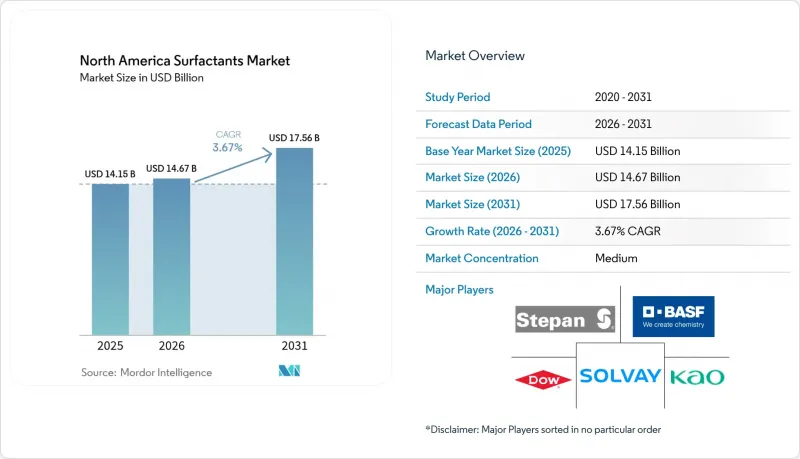
본 보고서에서는 업계를 유형별(음이온성 계면활성제, 양이온성 계면활성제, 비이온성 계면활성제, 양성이온성 계면활성제 등), 원산지별(합성 계면활성제, 바이오 계면활성제), 용도별(가정용 비누 및 세제, 퍼스널케어, 윤활유·연료 첨가제 등), 지역별(미국, 캐나다 등)로 분류하고 있습니다.
북미의 계면활성제 시장 동향 및 인사이트
가정용 및 퍼스널케어 제품 배합에서 바이오계 계면활성제로의 전환이 가속화되고 있습니다.
각 브랜드 소유 기업들은 공급업체 평가 기준에 바이오 함유량의 최저 기준을 포함시키고 있으며, 이에 따라 석유 유래 시스템과 재생 가능 시스템 간에 기존에 존재하던 비용 격차가 줄어들고 있습니다. 에보닉(Evonik)은 알킬 폴리글루코사이드 수요에 대응하기 위해 바이오 숙신산 생산 라인을 가동했습니다. 한편, 쿠로다(Kuroda)의 아틀라스 포인트(Atlas Point) 공장에서는 미국 농무부(USDA)의 ‘BioPreferred’ 인증을 획득하기 위해 100% 바이오 유래 알코올 에톡실레이트를 시장에 출시했습니다. 캘리포니아주와 뉴욕주의 노닐페놀 에톡실레이트 사용 금지 조치로 인해, 제형 개발자들은 향후 규제에 선제적으로 대응하고 있으며, 이러한 전환이 가속화되고 있습니다. 미국 환경보호청(EPA)이 2024년 8월에 발표한 ‘Safer Choice’ 개정안에서는 카멜리나 등 비식용 작물을 원료로 한 제품에 추가 점수가 부여되며, 팜 커널 오일 사용을 피하도록 권장하고 있습니다. 이러한 조치들이 맞물리면서, 세정력 목표를 저해하지 않으면서 북미 계면활성제 시장에서 재생 가능 원료로의 전환이 가속화되고 있습니다.
포스트 코로나 시대의 I&I 및 기관용 청소 시장의 성장
병원, 레스토랑, 사무실 건물에서는 팬데믹 이후 청소 빈도를 높이는 것이 표준 업무 절차로 정착되어, 소독제 및 바닥 세제에 사용되는 계면활성제 수요가 영구적으로 증가했습니다. 4급 암모늄 화합물의 사용을 자제하도록 촉구하는 주 정부의 규제로 인해, 구매자들은 헹굼이 쉽고 잔류물에 대한 우려가 적은 음이온계 및 비이온계 혼합 제품으로 전환하고 있습니다. 파일럿 케미컬(Pilot Chemical)과 이노스펙(Inospec)은 운송 중량을 줄이고 지속가능성 목표도 충족하는 희석된 농축액을 제공함으로써 시장 점유율을 확대되고 있습니다. 2024년에는 사무실 입주율이 안정되고, 청소 예산이 팬데믹 이전 수준으로 회복됨에 따라 기관용 수요가 증가했습니다. 이러한 변화들이 맞물리면서, 2027년까지 I&I용 계면활성제의 성장률은 가정용 케어 제품의 평균을 상회할 것으로 전망됩니다.
석유계 원료 가격 변동 및 공급 충격
WTI 원유 가격은 2024년 내내 배럴당 70-85달러 사이에서 변동했으며, 그 결과 에틸렌옥사이드 현물 가격이 20-30% 변동하여 생산자의 이익률이 압박을 받았습니다. 멕시코의 에탄 공급원 다각화로 인해 어느 정도 압박은 완화되었으나, 브라스크엠-이데사(Braskem-Idesa)사의 신규 수입 터미널은 폴리머용으로도 공급되고 있어 계면활성제 분야에 미치는 완화 효과는 제한적입니다. 수입에 의존하는 캐나다의 배합 제조업체는 모든 에틸렌옥사이드를 국경을 넘어 운송해야 하기 때문에 운송비와 환율이라는 두 가지 위험에 직면해 있습니다. 이러한 가격 변동은 장기적인 자본 프로젝트를 주저하게 만드는 요인이 되어, 수요가 꾸준히 증가하고 있음에도 불구하고 생산 능력 확대를 둔화시키고 있습니다. 그 결과, 북미 계면활성제 시장에 서비스를 제공하는 지역 계약 제조업체들의 비용 기반은 취약한 상태에 놓여 있습니다.
부문 분석
2025년 판매량의 44.12%를 비이온성 계면활성제가 차지했습니다. 이는 저용량으로 높은 세정력이 요구되는 농축 포드형 세제에서 알코올 에톡실레이트의 실용성이 주도한 결과입니다. 북미의 비이온성 계면활성제 시장 규모는 기관용 소독제가 헹굼 공정을 신속하게 하는 저거품성 블렌드로 계속 전환되고 있기 때문에 연평균 3.78%의 성장이 예상됩니다. 캘리포니아주의 노닐페놀 에톡실레이트 금지 조치로 인해 공급업체들은 지방산 에스테르나 알킬 폴리글루코사이드와 같은 대체품으로의 전환을 강요받고 있으며, 이들 모두는 EPA의 ‘Safer Choice’ 라벨 인증 요건을 충족하고 있습니다. 음이온성 계면활성제는 여전히 주력 제품으로 자리 잡고 있습니다. 스테판(Stepan)사가 알파-올레핀 설포네이트 생산을 25% 확대한 것은 바이오 계면활성제가 확대되는 상황 속에서도 세탁 및 식기 세척용 설포네이트 수요가 견조하게 유지될 것이라는 확신을 뒷받침합니다. 선형 알킬벤젠설폰산염에 대한 규제 당국의 감시가 강화되는 가운데, 특히 EU의 세제 규정에 따라 유럽으로 수출되는 제품에서 2차 알칸계 및 메틸에스테르계 설폰산염에 대한 수요가 증가하고 있습니다.
특수 양이온성 4급 암모늄염(QAC)은 캘리포니아주에서 제안된 소독제 제한으로 인해 QAC의 배합량이 감소함에 따라 역풍에 직면하고 있지만, 섬유 유연제 및 헤어 컨디셔너에 사용됨에 따라 완만한 성장을 유지하고 있습니다. 베타인 등의 양성 계면활성제는 저자극성과 안정적인 거품 형성이 요구되는 무황산염 샴푸에서 인기가 높아지고 있습니다. 실리콘계 계면활성제는 여전히 틈새 시장에 머물러 있으며, 주로 농약용 보조제나 폴리우레탄 폼에 초점을 맞추고 있으며, 그 고유한 도포성 덕분에 프리미엄 가격이 정당화되고 있습니다. 전반적으로 비이온성 계면활성제는 판매량을 일정 수준으로 유지하고 있는 반면, 음이온성 계면활성제는 계속해서 혁신을 거듭하고 있으며, 북미 계면활성제 시장의 유형별 수요는 폭넓고 견조한 상태를 유지하고 있습니다.
기타 혜택 :
- 엑셀 형식 시장 예측(ME) 시트
- 3개월간의 애널리스트 지원
자주 묻는 질문
목차
제1장 서론
제2장 조사 방법
제3장 주요 요약
제4장 시장 구도
제5장 시장 규모 및 성장 예측
제6장 경쟁 구도
제7장 시장 기회 및 향후 전망
AJY 26.09.09According to Mordor Intelligence, the North America surfactants market size in 2026 is estimated at USD 14.67 billion, growing from 2025 value of USD 14.15 billion with 2031 projections showing USD 17.56 billion, growing at 3.67% CAGR over 2026-2031.
This report Segments the Industry Into Type (Anionic Surfactant, Cationic Surfactant, Non-Ionic Surfactant, Amphoteric Surfactant, and More), Origin (Synthetic Surfactant, Bio-Based Surfactant), Application (Household Soap and Detergent, Personal Care, Lubricants and Fuel Additives, and More), and Geography (United States, Canada, and More).
North America Surfactants Market Trends and Insights
Accelerating Shift to Bio-Surfactants in Home and Personal-Care Formulations
Brand owners embed minimum bio-content thresholds in supplier scorecards, shrinking the historic cost gap between petro-derived and renewable systems. Evonik commissioned a bio-succinic-acid line to service alkyl-polyglucoside demand, while Croda's Atlas Point site rolled out 100% bio-based alcohol ethoxylates to secure USDA BioPreferred seals. California and New York bans on nonylphenol ethoxylates advance the transition as formulators pre-empt future restrictions. EPA's August 2024 Safer Choice update allocates extra points for non-food-crop feedstocks such as camelina, guiding purchasing away from palm kernel. Collectively, these measures accelerate the North America Surfactants market's pivot to renewable inputs without compromising detergency targets.
Growth of I&I and Institutional Cleaning Post-COVID
Hospitals, restaurants, and office buildings locked higher cleaning frequencies into standard operating procedures after the pandemic, permanently lifting surfactant demand in sanitizers and floor cleaners. State rules that discourage quaternary ammonium compounds steer buyers toward anionic-nonionic blends that rinse cleanly and pose fewer residue concerns. Pilot Chemical and Innospec win share by offering pre-diluted concentrates that cut shipping weight and satisfy sustainability targets. Office occupancy stabilized in 2024, restoring janitorial budgets to pre-pandemic levels and boosting institutional volumes. Together these shifts lift I&I surfactant growth above household-care averages through 2027.
Petro-Feedstock Price Volatility and Supply Shocks
WTI crude oscillated between USD 70 and USD 85 per barrel through 2024, resulting in 20-30% swings in ethylene oxide spot prices that compressed producer margins. Mexican ethane diversification eases some pressure, yet Braskem Idesa's new import terminal also feeds polymers, limiting relief for surfactants. Import-dependent Canadian formulators face dual freight and currency risk because all ethylene oxide must cross borders. Such volatility discourages long-cycle capital projects, slowing capacity additions despite steady demand growth. The result is a fragile cost base for regional toll manufacturers serving the North America surfactants market.
Other drivers and restraints analyzed in the detailed report include:
- Tightening U.S. and Canadian VOC and Toxicity Regulations
- Rising Demand for High-Performance Surfactants in Enhanced Oil Recovery
- Aquatic-Toxicity Scrutiny of Legacy LAS and NPE Grades
For complete list of drivers and restraints, kindly check the Table Of Contents.
Segment Analysis
Non-ionic surfactants accounted for 44.12% of the 2025 volume, driven by the utility of alcohol-ethoxylates in concentrated pods that require high detergency at low doses. The North American surfactants market size for non-ionics is forecast to rise 3.78% annually as institutional sanitizers continue to shift to low-foam blends that expedite rinse cycles. California's nonylphenol-ethoxylate ban pushes suppliers toward fatty-acid-ester and alkyl-polyglucoside substitutes, both of which qualify for EPA Safer Choice labels. Anionic surfactants remain the workhorse: Stepan's 25% alpha-olefin-sulfonate expansion underscores confidence that sulfonate demand in laundry and dishwashing will hold even as biosurfactants scale. Regulatory scrutiny of linear-alkylbenzene sulfonates boosts secondary-alkane and methyl-ester sulfonates, especially for products exported to Europe under the EU Detergents Regulation.
Specialty cationic quats face headwinds because proposed California disinfectant limits reduce QAC inclusion, yet uses in fabric softeners and hair conditioners preserve modest growth. Amphoterics such as betaines gain popularity in sulfate-free shampoos that require mildness and stable foam. Silicone surfactants remain a niche market, primarily focused on agrochemical adjuvants and polyurethane foams, where their unique spreading properties justify premiums. Overall, non-ionics maintain baseline volume while anionics innovate, ensuring that type-level demand within the North America Surfactants market remains broad and defensible.
Complete Report Scope:
- By Type
- Anionic Surfactant
- Linear Alkylbenzene Sulfolane (LAS or LABS)
- Alcohol Ethoxysulfates (AES)
- Alpha Olefin Sulfonates (AOS)
- Secondary Alkane Sulfonate (SAS)
- Methyl Ester Sulfonates (MES)
- Sulfosuccinates
- Others
- Cationic Surfactant
- Quaternary ammonium compound
- Others
- Non-ionic Surfactant
- Alcohol ethoxylate
- Alkylphenol ethoxylate
- Fatty acid ester
- Others
- Amphoteric Surfactant
- Silicone Surfactant
- Other Types
- Anionic Surfactant
- By Origin
- Synthetic Surfactant
- Bio-based Surfactant
- Chemically-Synthesized Bio-Based Surfactants
- Biosurfactants
- By Application
- Household Soap and Detergent
- Personal Care
- Lubricants and Fuel Additives
- Industry and Institutional Cleaning
- Food Processing
- Oilfield Chemicals
- Agricultural Chemicals
- Textile Processing
- Emulsion Polymerisation
- Others
- By Geography
- United States
- Canada
- Mexico
List of Companies Covered in this Report:
- 3M
- Ashland
- BASF
- CLARIANT
- Croda International Plc
- Dow
- Evonik Industries AG
- GALAXY
- Godrej Industries Limited
- Henkel Corporation
- Innospec
- Kao Corporation
- MITSUI CHEMICALS AMERICA, INC.
- Nouryon
- Procter & Gamble
- Sasol
- Solvay
- Stepan Company
Additional Benefits:
- The market estimate (ME) sheet in Excel format
- 3 months of analyst support
TABLE OF CONTENTS
1 Introduction
- 1.1 Study Assumptions and Market Definition
- 1.2 Scope of the Study
2 Research Methodology
3 Executive Summary
4 Market Landscape
- 4.1 Market Overview
- 4.2 Market Drivers
- 4.2.1 Accelerating shift to bio-surfactants in home and personal-care formulations
- 4.2.2 Growth of IandI and institutional cleaning post-COVID
- 4.2.3 Tightening U.S./Canadian VOC and toxicity regulations
- 4.2.4 Rising demand for high-performance surfactants in enhanced-oil-recovery (EOR)
- 4.2.5 Commercialisation of carbon-capture-derived feedstocks
- 4.3 Market Restraints
- 4.3.1 Petro-feedstock price volatility and supply shocks
- 4.3.2 Aquatic-toxicity scrutiny of legacy LAS/NPE grades
- 4.3.3 Limited regional capacity for specialized microbial strains
- 4.4 Value Chain Analysis
- 4.5 Porter's Five Forces
- 4.5.1 Bargaining Power of Suppliers
- 4.5.2 Bargaining Power of Consumers
- 4.5.3 Threat of New Entrants
- 4.5.4 Threat of Substitute Products and Services
- 4.5.5 Degree of Competition
5 Market Size and Growth Forecasts (Value)
- 5.1 By Type
- 5.1.1 Anionic Surfactant
- 5.1.1.1 Linear Alkylbenzene Sulfolane (LAS or LABS)
- 5.1.1.2 Alcohol Ethoxysulfates (AES)
- 5.1.1.3 Alpha Olefin Sulfonates (AOS)
- 5.1.1.4 Secondary Alkane Sulfonate (SAS)
- 5.1.1.5 Methyl Ester Sulfonates (MES)
- 5.1.1.6 Sulfosuccinates
- 5.1.1.7 Others
- 5.1.2 Cationic Surfactant
- 5.1.2.1 Quaternary ammonium compound
- 5.1.2.2 Others
- 5.1.3 Non-ionic Surfactant
- 5.1.3.1 Alcohol ethoxylate
- 5.1.3.2 Alkylphenol ethoxylate
- 5.1.3.3 Fatty acid ester
- 5.1.3.4 Others
- 5.1.4 Amphoteric Surfactant
- 5.1.5 Silicone Surfactant
- 5.1.6 Other Types
- 5.1.1 Anionic Surfactant
- 5.2 By Origin
- 5.2.1 Synthetic Surfactant
- 5.2.2 Bio-based Surfactant
- 5.2.2.1 Chemically-Synthesized Bio-Based Surfactants
- 5.2.2.2 Biosurfactants
- 5.3 By Application
- 5.3.1 Household Soap and Detergent
- 5.3.2 Personal Care
- 5.3.3 Lubricants and Fuel Additives
- 5.3.4 Industry and Institutional Cleaning
- 5.3.5 Food Processing
- 5.3.6 Oilfield Chemicals
- 5.3.7 Agricultural Chemicals
- 5.3.8 Textile Processing
- 5.3.9 Emulsion Polymerisation
- 5.3.10 Others
- 5.4 By Geography
- 5.4.1 United States
- 5.4.2 Canada
- 5.4.3 Mexico
6 Competitive Landscape
- 6.1 Market Concentration
- 6.2 Strategic Moves
- 6.3 Market Share Analysis
- 6.4 Company Profiles (includes Global level Overview, Market level overview, Core Segments, Financials as available, Strategic Information, Market Rank/Share for key companies, Products and Services, and Recent Developments)
- 6.4.1 3M
- 6.4.2 Ashland
- 6.4.3 BASF
- 6.4.4 CLARIANT
- 6.4.5 Croda International Plc
- 6.4.6 Dow
- 6.4.7 Evonik Industries AG
- 6.4.8 GALAXY
- 6.4.9 Godrej Industries Limited
- 6.4.10 Henkel Corporation
- 6.4.11 Innospec
- 6.4.12 Kao Corporation
- 6.4.13 MITSUI CHEMICALS AMERICA, INC.
- 6.4.14 Nouryon
- 6.4.15 Procter & Gamble
- 6.4.16 Sasol
- 6.4.17 Solvay
- 6.4.18 Stepan Company
7 Market Opportunities and Future Outlook
- 7.1 White-space and Unmet-Need Assessment