
|
시장보고서
상품코드
2121972
태양광 인버터 시장 : 점유율 분석, 업계 동향과 통계, 성장 예측(2026-2031년)Solar PV Inverters - Market Share Analysis, Industry Trends & Statistics, Growth Forecasts (2026 - 2031) |
||||||
 Mordor Intelligence
Mordor Intelligence에 의하면, 태양광 인버터 시장 규모는 2025년 142억 7,000만 달러에서 2026년에는 152억 4,000만 달러로 확대되어 2026년부터 2031년까지 CAGR 6.79%로 성장을 지속하여, 2031년에는 211억 6,000만 달러에 이를 것으로 예측됩니다.
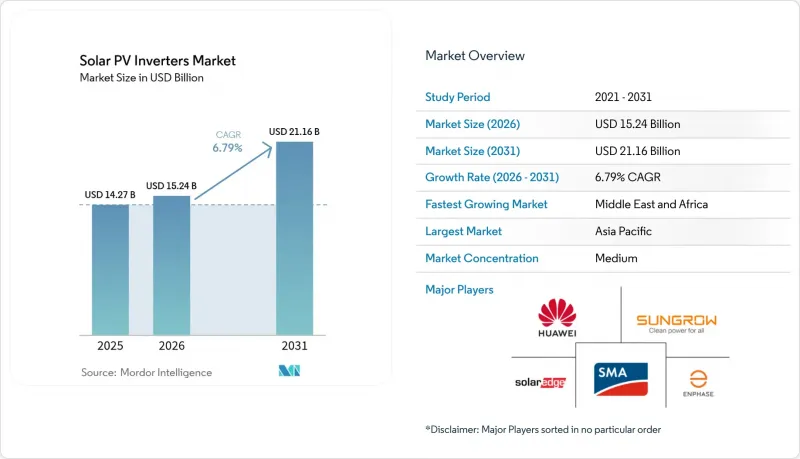
본 보고서는 인버터 유형(중앙 집중형 인버터, 스트링형 인버터, 마이크로 인버터, 하이브리드형/배터리 대응형 인버터), 상수(단상 및 3상), 연결 방식(계통 연계형 및 독립형), 용도(주거용, 상업 및 산업용, 유틸리티 규모), 지역(북미, 유럽, 아시아태평양, 남미, 중동 및 아프리카)별로 분류되어 있습니다.
전 세계 태양광 인버터 시장 동향 및 인사이트
유틸리티 규모 프로젝트(미국, 스페인)에서 1,500V 고전압 스트링 인버터의 급속한 보급
유틸리티 개발 사업자들은 시스템 전체의 비용을 절감하고 전력 밀도를 높이기 위해 1,500V, 나아가 시험적으로 2,000V DC 아키텍처를 사양으로 채택하는 경향이 강해지고 있습니다. GE Vernova사의 2,000V 플랫폼은 출력을 30% 향상시켜 균등화 발전 비용(LCOE)을 절감합니다. 이러한 전압 전환으로 인해 신규 건설 현장에서는 1,000V 어레이가 경제적으로 구식이 되었으며, 특히 토지 및 송전망 여유가 있어 대규모 블록 구성이 가능한 곳에서는 개조 프로젝트가 촉진되고 있습니다. 이에 따라 반도체 수요가 증가하고 SiC 소자공급이 부족해짐에 따라, 주요 브랜드 간 열 설계 전문 지식의 전략적 중요성이 더욱 커지고 있습니다.
인도 상업용 건물의 옥상 태양광 발전 의무화로 인해 100kW 이하 인버터 수요가 확대
인도의 정책에 따라 신축 및 기존 상업시설에는 옥상 태양광 패널 설치가 의무화되어 있으며, 이는 100 kW 이하 인버터에 대한 지속적인 수요를 견인하고 있습니다. 2024 회계연도에 기록된 4GW라는 사상 최대의 설치량은 이 시장 규모를 잘 보여줍니다. 국내 제조업체들은 2026년까지 110 GW 규모의 셀 및 모듈 생산을 목표로 하는 인도의 계획에 포함된 수입 대체 목표의 혜택을 받아 현지 밸류체인을 강화하고 있습니다. 일부 주에서는 시행상의 격차가 남아 있지만, 표준화된 설치 방식은 주거 부문에서의 더 광범위한 보급을 위한 모델이 되고 있습니다.
대전류 SiC/IGBT 전원 모듈의 만성적인 공급 부족과 가격 변동
SiC 웨이퍼 공급 부족은 여전히 고효율 인버터 공급을 제약하고 있으며, 부품 원가를 계속 상승시키고 있습니다. Wolfspeed사의 재정난은 위험 인식을 높이고 있지만, 한편 인피니언(Infineon)사가 비용 효율이 높은 200mm SiC 웨이퍼로의 전환을 추진하고 있는 것은 2026년 이후 공급 부족이 완화될 조짐을 보여주고 있습니다. 그리드 형성 기능에 첨단 반도체에 의존하고 있는 유럽 및 북미 제조업체들은 실리콘 대체품에 의존할 수 있는 수직 통합형 중국 기업들에 비해 더 심각한 이익률 압박에 직면해 있습니다.
부문 분석
2025년에도 중앙 집중형 유닛은 매출액에서 54.30%의 선두를 유지했으나, 모듈 수준의 전자 기기가 얼리 어답터 틈새 시장을 넘어서는 추세에 따라 마이크로 인버터는 연평균 성장률(CAGR) 7.96%를 나타낼 것으로 예측됩니다. Enphase는 2025년에 국내용 마이크로 인버터를 650만 대 이상 출하하여 미국의 현지 생산 기준을 충족하는 동시에 이 부문의 상업적 규모를 입증했습니다. 태양광 인버터 시장에서는 ASIC 설계, 무선 데이터 통신, 열 설계를 소형 케이스에 통합한 기업이 우위를 점하고 있습니다. 중앙 집중형 아키텍처는 중국에서 발전 제한으로 인해 수요가 정체 상태에 있지만, 특히 발전소 수준의 제어와 경쟁력 있는 설비 투자가 우선시되는 지역에서는 여전히 유틸리티 프로젝트의 기반이 되고 있습니다.
마이크로전자 분야에서는 경쟁이 격화되고 있으며, 진입 장벽은 하드웨어 원가보다는 펌웨어의 고도화 및 안전 인증에 기인하고 있습니다. 그 결과, 저가 전략을 내세우는 신규 진출기업들은 급속 차단이나 배터리 인터페이스 모드와 같은 기능의 급속한 전개에 발맞추는 데 어려움을 겪고 있습니다. 출하 대수는 견조하게 증가하고 있지만, 마이크로 인버터가 스트링형 플랫폼을 능가하는 것은 향후 10년 이후가 될 전망이며, 태양광 인버터 시장은 아키텍처의 다양성을 유지하게 될 것입니다.
2025년 출하 대수의 62.25%를 유틸리티 발전소가 차지하고 있으며, 이는 장기 전력 구매 계약(PPA)에 따라 확정된 대규모 프로젝트 파이프라인을 반영한 것입니다. 그럼에도 불구하고, 그리드 서비스 및 넷 빌링(net billing) 체계가 가정의 경제성을 높여감에 따라, 주거용 시스템은 연평균 7.45%의 성장률을 보일 것으로 전망됩니다. 인도의 ‘프라단 만트리 수리야 가르’ 프로그램은 2027년 3월까지 30GW 규모의 옥상 태양광 발전 시스템 도입을 목표로 하고 있는 반면, 호주에서는 배터리 추가 설치 추세에 힘입어 설치율이 상승하고 있습니다. 상업용 옥상 태양광 발전은 인도의 옥상 설치 의무화 흐름에 편승하고 있지만, 기타 지역에서는 신중한 대출 조건으로 인해 투자 회수 기간이 장기화되는 과제에 직면해 있습니다.
프로슈머는 양방향 통신 기능과 독립 운전 시의 내구성을 점점 더 중시하고 있으며, 이에 따라 인버터 OEM 각사는 배터리 제어 로직의 통합을 추진하고 있습니다. 그 결과, 평균 판매 가격(ASP)이 상승하여 태양광 발전 시스템 도입 대수 증가세 둔화를 상쇄함으로써, 태양광 인버터 시장 전체의 매출 성장을 뒷받침하고 있습니다. 한편, 유틸리티 개발 사업자들은 더욱 엄격해진 계통 연계 기준을 충족하기 위해 1,500V 및 2,000V 플랫폼에 주력하고 있으며, STATCOM과 같은 기능을 결합하고 있습니다.
지역별 분석
아시아태평양은 중국의 수직 통합형 공급망과 인도의 정책 주도형 지붕형 태양광 발전 추진에 힘입어 2025년 출하량의 54.40%를 차지했습니다. 중국의 새로운 시장 기반 요금 제도로 인해 신규 설치는 둔화될 가능성이 있지만, 에너지 저장 시스템 및 고전압 스트링을 통합한 기존 설비의 개조를 통해 출하 대수는 견조한 추세를 유지하고 있습니다. 인도의 생산 능력은 2026년까지 110GW에 달할 전망이며, 이로 인해 국내 조달 루프가 강화되어 현지 태양광 인버터 시장이 수입 가격 변동으로부터 보호받을 것입니다. 다만, 규제 시행에 있어 지역 간 격차가 당장의 이익을 억제하는 요인으로 작용하고 있습니다.
중동은 2031년까지 연평균 성장률(CAGR)이 9.31%로 가장 높으며, 기가와트 규모의 프로젝트를 경제 다각화 청사진과 연계하고 있습니다. 가혹한 사막 환경으로 인해 고온 환경에서도 성능 저하가 적은 설계에 대한 수요가 증가하고 있으며, 밀폐형 큐비클 솔루션을 전문으로 하는 유럽의 OEM 제조업체들에게 새로운 틈새 시장이 열리고 있습니다. 사우디아라비아와 아랍에미리트의 송전망 강화 노력에 따라 저전압 라이드스루 및 무효 전력 관리 사양이 상향 조정되고 있어, 각 벤더들은 더욱 엄격해진 전력 회사의 기준을 준수하는 제품 인증을 획득해야 하는 상황에 직면해 있습니다. 북미와 유럽에서는 설치 기반이 성숙되어 있어, 추가 수요의 대부분은 장비 교체 및 개보수 주기에 의해 차지되고 있습니다. 미국의 ‘인플레이션 억제법’에 따른 국내 조달 크레딧으로 인해 현지 생산이 가속화되고 있으며, 텍사스주, 사우스캐롤라이나주, 애리조나주의 각 시설에서는 2026년까지 연간 생산량을 30GW를 크게 상회하는 수준으로 끌어올리는 것을 목표로 하고 있습니다. 독일이나 스페인 등 시장에서 유럽의 재생에너지 보급률이 50%를 초과함에 따라 계통 연계 기능의 가치가 높아지고 있어, 신규 건설량이 정체된 상황에서도 공급업체는 더 높은 평균 판매 가격(ASP)을 반영할 수 있게 되었습니다.
기타 혜택:
- 엑셀 형식 시장 예측(ME) 시트
- 3개월간의 애널리스트 지원
자주 묻는 질문
목차
제1장 서론
제2장 조사 방법
제3장 주요 요약
제4장 시장 구도
제5장 시장 규모와 성장 예측
제6장 경쟁 구도
제7장 시장 기회와 향후 전망
JHS 26.09.11According to Mordor Intelligence, the solar PV inverters market size is expected to grow from USD 14.27 billion in 2025 to USD 15.24 billion in 2026 and is forecast to reach USD 21.16 billion by 2031 at 6.79% CAGR over 2026-2031.
This report is Segmented by Inverter Type (Central Inverters, String Inverters, Micro Inverters, and Hybrid/Battery-Ready Inverters), Phase (Single-Phase and Three-Phase), Connection Type (On-Grid and Off-Grid), Application (Residential, Commercial and Industrial, and Utility-Scale), and Geography (North America, Europe, Asia-Pacific, South America, and Middle East and Africa).
Global Solar PV Inverters Market Trends and Insights
Rapid adoption of high-voltage 1 500 V string inverters in utility-scale projects (US, Spain)
Utility developers increasingly specify 1,500 V-and pilot 2,000 V-DC architectures to lower balance-of-system costs and boost power density. GE Vernova's 2,000 V platform showcases a 30% output gain that decreases levelized energy costs. This voltage migration renders 1,000 V arrays economically obsolete on new-build sites and spurs retrofit projects, especially where land and grid headroom allow bigger block sizes. Heightened semiconductor demand follows, tightening the supply of SiC devices and elevating the strategic importance of thermal design expertise among leading brands.
Mandatory rooftop-solar mandates in India's commercial buildings boosting <=100 kW inverter demand
India's policy obliges new and existing commercial structures to install rooftop arrays, driving the sustained need for <=100 kW inverters. Record additions of 4 GW in fiscal 2024 signal the scale of the opportunity . Domestic manufacturers benefit from import-substitution targets embedded in the country's 110 GW cell-and-module build-out by 2026, reinforcing the local value chain. While implementation gaps remain across several states, standardized installation practices create a template for broader residential uptake.
Persistent shortages & price volatility of high-current SiC / IGBT power modules
SiC wafer supply tightness continues to constrain high-efficiency inverters and amplify bill-of-material costs. Wolfspeed's financial distress heightens risk perceptions, whereas Infineon's switch to cost-effective 200 mm SiC wafers signals relief from 2026 onward . European and North American producers, dependent on advanced semiconductors for grid-forming functionality, experience sharper margin compression than vertically integrated Chinese peers able to fall back on silicon alternatives.
Other drivers and restraints analyzed in the detailed report include:
- Aggressive replacement cycle of inverters installed during Japan's 2012-2016 FIT boom
- Integration of advanced grid-support functions lifting ASPs in Europe
- Rising curtailment in China's northwest dampening central-inverter orders
For complete list of drivers and restraints, kindly check the Table Of Contents.
Segment Analysis
Central units retained a 54.30% revenue lead in 2025, yet microinverters are forecast to grow at an 7.96% CAGR as module-level electronics move beyond the early-adopter niche. Enphase shipped more than 6.5 million domestic microinverters in 2025, satisfying US localization criteria and underlining the segment's commercial scale . The solar PV inverter market rewards firms that combine ASIC design, wireless data, and thermal engineering in a miniature footprint. Central architectures now confront flattish demand in China due to curtailment but remain anchored in utility projects elsewhere, especially where plant-level controls and competitive capex remain priorities.
Competitive intensity is pronounced in microelectronics; barriers arise from firmware sophistication and safety certifications rather than raw hardware cost. Consequently, low-price entrants struggle to keep pace with rapid feature rollouts such as rapid shutdown and battery interface modes. Despite robust volume growth, microinverters are not likely to eclipse string platforms before the next decade, keeping the solar PV inverter market diversified by architecture.
Utility plants captured 62.25% of 2025 shipments, reflecting large project pipelines locked under long-term PPAs. Even so, residential systems should expand by 7.45% annually as grid services and net-billing frameworks enhance household economics. India's Pradhan Mantri Surya Ghar program targets 30 GW of rooftop arrays by March 2027, while Australia's battery add-on trend lifts attachment rates. Commercial rooftops ride India's rooftop mandate wave but face cautious finance terms in other regions that stretch payback timelines.
Prosumers increasingly value bidirectional capability and island-mode resilience, prompting inverter OEMs to integrate battery control logic. The resulting ASP uplift compensates for slower macro installation growth, supporting aggregate revenue progression inside the solar PV inverter market. Utility developers, meanwhile, focus on 1,500 V and 2,000 V platforms, coupling them with STATCOM-like functionalities to meet stricter grid-code compliance.
Complete Report Scope:
- By Inverter Type
- Central Inverters
- String Inverters
- Microinverters
- Hybrid/Battery-Ready Inverters
- By Phase
- Single-Phase
- Three-Phase
- By Connection Type
- On-Grid
- Off-Grid
- By Application
- Residential
- Commercial and Industrial
- Utility-Scale
- By Geography
- North America
- United States
- Canada
- Mexico
- Europe
- United Kingdom
- Germany
- France
- Spain
- Nordic Countries
- Russia
- Rest of Europe
- Asia-Pacific
- China
- India
- Japan
- South Korea
- Malaysia
- Thailand
- Indonesia
- Vietnam
- Australia
- Rest of Asia-Pacific
- South America
- Brazil
- Argentina
- Colombia
- Rest of South America
- Middle East and Africa
- United Arab Emirates
- Saudi Arabia
- South Africa
- Egypt
- Rest of Middle East and Africa
- North America
Geography Analysis
Asia-Pacific generated 54.40% of 2025 shipments, underpinned by China's vertically integrated supply chain and India's policy-driven rooftop push. While China's new market-based tariff regime may slow greenfield installations, volume resilience stems from retrofits that embed storage and higher-voltage strings. India's manufacturing capacity, set to reach 110 GW by 2026, tightens domestic procurement loops and shields the local solar PV inverter market from import volatility, although regional disparities in regulatory execution temper immediate gains.
The Middle East, clocking the quickest 9.31% CAGR through 2031, aligns gigawatt-scale projects with economic diversification blueprints. Harsh desert conditions drive demand for high-derating-temperature designs, opening niches for European OEMs specializing in sealed cubicle solutions. Grid-reinforcement efforts in Saudi Arabia and the United Arab Emirates elevate low-voltage ride-through and reactive-power management specifications, pressing vendors to certify products against stricter utility benchmarks. North America and Europe operate in a mature install base where replacement and retrofit cycles dominate incremental demand. The US Inflation Reduction Act's domestic content credits accelerate localized production, with Texas, South Carolina, and Arizona facilities targeting annual output well above 30 GW by 2026. Europe's renewable penetration surpassing 50% in markets such as Germany and Spain raises the value of grid-forming features, allowing vendors to pass through higher ASPs even as new-build volumes plateau.
- Huawei Technologies Co., Ltd.
- Sungrow Power Supply Co., Ltd.
- SMA Solar Technology AG
- SolarEdge Technologies Inc.
- Enphase Energy Inc.
- FIMER SpA
- Delta Electronics, Inc.
- Growatt New Energy Technology Co., Ltd.
- Ginlong (Solis) Technologies
- TMEIC Corporation
- Mitsubishi Electric Corporation
- Schneider Electric SE
- Siemens AG
- Eaton Corporation plc
- Hitachi Energy Ltd.
- Omron Corporation
- Power Electronics Espana S.L.
- Chint Power Systems Co., Ltd.
- GoodWe Technologies Co., Ltd.
- GE Vernova
- Canadian Solar Inc. (CSI Solar)
- Toshiba Mitsubishi-Electric Industrial Systems Corp. (TMEIC)
- Kepco KPS (South Korea)
Additional Benefits:
- The market estimate (ME) sheet in Excel format
- 3 months of analyst support
TABLE OF CONTENTS
1 Introduction
- 1.1 Study Assumptions & Market Definition
- 1.2 Scope of the Study
2 Research Methodology
3 Executive Summary
4 Market Landscape
- 4.1 Market Overview
- 4.2 Market Drivers
- 4.2.1 Rapid adoption of high-voltage 1 500 V string inverters in utility-scale projects (US, Spain)
- 4.2.2 Mandatory rooftop-solar mandates in India's commercial buildings boosting ?100 kW inverter demand
- 4.2.3 Aggressive replacement cycle of inverters installed during Japan's 2012-2016 FIT boom
- 4.2.4 Integration of advanced grid-support functions lifting ASPs in Europe
- 4.2.5 Growth of hybrid PV-storage solutions driving bidirectional inverters in Australia
- 4.2.6 Localization incentives in Brazil encouraging domestic manufacture of central inverters
- 4.3 Market Restraints
- 4.3.1 Persistent shortages & price volatility of high-current SiC / IGBT power modules
- 4.3.2 Rising curtailment in China's northwest dampening central-inverter orders
- 4.3.3 Fragmented US interconnection codes inflating certification costs
- 4.3.4 Fire-safety concerns on rooftop DC circuits slowing microinverter uptake in Germany
- 4.4 Supply-Chain Analysis
- 4.5 Regulatory Outlook
- 4.6 Technological Outlook
- 4.7 Porter's Five Forces
- 4.7.1 Bargaining Power of Suppliers
- 4.7.2 Bargaining Power of Consumers
- 4.7.3 Threat of New Entrants
- 4.7.4 Threat of Substitutes
- 4.7.5 Intensity of Competitive Rivalry
5 Market Size & Growth Forecasts
- 5.1 By Inverter Type
- 5.1.1 Central Inverters
- 5.1.2 String Inverters
- 5.1.3 Microinverters
- 5.1.4 Hybrid/Battery-Ready Inverters
- 5.2 By Phase
- 5.2.1 Single-Phase
- 5.2.2 Three-Phase
- 5.3 By Connection Type
- 5.3.1 On-Grid
- 5.3.2 Off-Grid
- 5.4 By Application
- 5.4.1 Residential
- 5.4.2 Commercial and Industrial
- 5.4.3 Utility-Scale
- 5.5 By Geography
- 5.5.1 North America
- 5.5.1.1 United States
- 5.5.1.2 Canada
- 5.5.1.3 Mexico
- 5.5.2 Europe
- 5.5.2.1 United Kingdom
- 5.5.2.2 Germany
- 5.5.2.3 France
- 5.5.2.4 Spain
- 5.5.2.5 Nordic Countries
- 5.5.2.6 Russia
- 5.5.2.7 Rest of Europe
- 5.5.3 Asia-Pacific
- 5.5.3.1 China
- 5.5.3.2 India
- 5.5.3.3 Japan
- 5.5.3.4 South Korea
- 5.5.3.5 Malaysia
- 5.5.3.6 Thailand
- 5.5.3.7 Indonesia
- 5.5.3.8 Vietnam
- 5.5.3.9 Australia
- 5.5.3.10 Rest of Asia-Pacific
- 5.5.4 South America
- 5.5.4.1 Brazil
- 5.5.4.2 Argentina
- 5.5.4.3 Colombia
- 5.5.4.4 Rest of South America
- 5.5.5 Middle East and Africa
- 5.5.5.1 United Arab Emirates
- 5.5.5.2 Saudi Arabia
- 5.5.5.3 South Africa
- 5.5.5.4 Egypt
- 5.5.5.5 Rest of Middle East and Africa
- 5.5.1 North America
6 Competitive Landscape
- 6.1 Market Concentration
- 6.2 Strategic Moves (M&A, Partnerships, PPAs)
- 6.3 Market Share Analysis (Market Rank/Share for key companies)
- 6.4 Company Profiles (includes Global level Overview, Market level overview, Core Segments, Financials as available, Strategic Information, Products & Services, and Recent Developments)
- 6.4.1 Huawei Technologies Co., Ltd.
- 6.4.2 Sungrow Power Supply Co., Ltd.
- 6.4.3 SMA Solar Technology AG
- 6.4.4 SolarEdge Technologies Inc.
- 6.4.5 Enphase Energy Inc.
- 6.4.6 FIMER SpA
- 6.4.7 Delta Electronics, Inc.
- 6.4.8 Growatt New Energy Technology Co., Ltd.
- 6.4.9 Ginlong (Solis) Technologies
- 6.4.10 TMEIC Corporation
- 6.4.11 Mitsubishi Electric Corporation
- 6.4.12 Schneider Electric SE
- 6.4.13 Siemens AG
- 6.4.14 Eaton Corporation plc
- 6.4.15 Hitachi Energy Ltd.
- 6.4.16 Omron Corporation
- 6.4.17 Power Electronics Espana S.L.
- 6.4.18 Chint Power Systems Co., Ltd.
- 6.4.19 GoodWe Technologies Co., Ltd.
- 6.4.20 GE Vernova
- 6.4.21 Canadian Solar Inc. (CSI Solar)
- 6.4.22 Toshiba Mitsubishi-Electric Industrial Systems Corp. (TMEIC)
- 6.4.23 Kepco KPS (South Korea)
7 Market Opportunities & Future Outlook
- 7.1 White-Space & Unmet-Need Assessment