

|
시장보고서
상품코드
2121983
영국의 피임기구 : 시장 점유율 분석, 업계 동향과 통계, 성장 예측(2026-2031년)UK Contraceptive Devices - Market Share Analysis, Industry Trends & Statistics, Growth Forecasts (2026 - 2031) |
||||||
 Mordor Intelligence
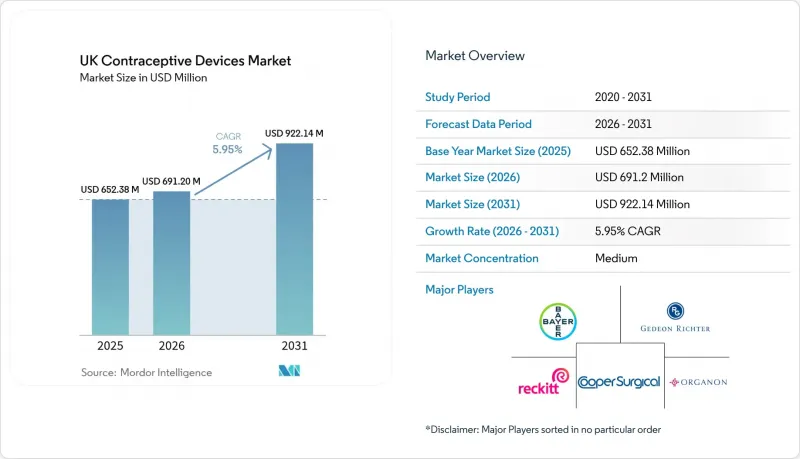
Mordor Intelligence에 따르면 2026년 영국의 피임기구 시장 규모는 6억 9,120만 달러로 추정되고 있으며, 2025년 6억 5,238만 달러에서 확대하며, 2031년에는 9억 2,214만 달러에 달할 것으로 예측됩니다.
2026-2031년까지 연평균 성장률(CAGR) 5.95%로 성장할 것으로 전망됩니다.
이 보고서는 유형별(콘돔, 다이어프램 및 자궁경부 캡, 질내 링, 자궁내 피임 장치, 임플란트 및 주사제, 살정제, 기타),성별(남성 및 여성), 판매 채널별(NHS 및 지역 성건강 클리닉, 소매 약국, 온라인 약국 및 E-Commerce 등)로 분류되어 있습니다. 시장 전망은 금액(달러) 기준으로 제시되어 있습니다.
영국 피임기구 시장의 동향 및 인사이트
성병(STI)의 높은 유병률과 인식 제고
2023년, 잉글랜드에서만 40만 1,800건의 성매개감염(STI) 사례가 보고되어 전년 대비 4.7% 증가했으며, 장벽 방식은 예방 정책의 중심적인 위치를 계속 차지하고 있습니다. 임질 사례 수는 1918년 이후 최고 수준에 달했으며, 2025년 중반까지 52종의 항생제 내성균이 확인되었습니다. 공중보건 메시지에서는 콘돔이 임신과 감염병을 모두 억제하는 ‘이중 기능’ 툴로 자리매김하게 되면서, 영국 피임 툴 시장의 판매량을 끌어올리고 있습니다. 또한 전국적인 감시 조사에 따르면 신규 성병 사례의 46%가 15-24세 연령대에서 발생하는 것으로 밝혀졌으며, 이에 따라 연령대별 인식 제고 캠페인이 전개되고 있습니다. 지방 자치 단체는 자원 부족을 이유로 자가 관리 및 콘돔 택배 프로그램을 더욱 적극적으로 추진하고 있으며, 예방 의식을 정착시키기 위해 노력하고 있습니다.
예기치 못한 임신 증가와 영국 전역의 공중보건 대책
영국의 생식 건강 관련 데이터에 따르면 25세 미만 여성의 장기 작용형 가역적 피임법(LARC) 이용률은 2019년 27.6%에서 2023년 36.2%로 상승했으나, 전반적인 이용률은 여전히 팬데믹 이전 수준보다 낮은 상태입니다. 스코틀랜드의 ‘브리징 콘돔(Bridging Condom)’ 구상에서는 약국을 통해 프로게스틴 단독 피임약 3개월분을 공급함으로써, 예약으로 인한 지연을 해소하고 접근성을 확대하고 있습니다. 이와 병행하여 진행되고 있는 교육 개혁을 통해 학교에서의 포괄적인 인간관계 및 성교육이 의무화되었으며, 이를 통해 성인이 되는 세대가 더 높은 기초 지식을 갖추고 영국의 피임 툴 시장에 진입할 수 있게 되었습니다(parliament.uk). 이러한 노력들이 결합되어 콘돔에 그치지 않고, LARC, 링, 다이어프램 등 다양한 제품군에 대한 잠재적 수요가 창출되고 있습니다.
피임기구와 관련된 이상반응 및 사용 중단
특정 주사용 프로게스틴의 장기 사용과 관련된 수막종 위험 등 안전성에 대한 우려가 언론을 통해 대대적으로 보도된 결과, 일부 피임법의 사용 중단률이 상승하고 있습니다. 현재 MHRA(의약품·의료제품규제청)는 제조업체에 엄격한 기한 내에 상세한 이상반응 보고서를 제출할 것을 의무화하고 있으며, 이로 인해 규정 준수 비용은 증가하고 있지만 시판 후 데이터의 투명성은 향상되고 있습니다. 영국 비뇨부인과학회(British Society of Urogynaecology) 등 전문 학회는 임상의들에게 피임기구로 인한 합병증 보고를 적극적으로 권장하고 있으며, 이에 따라 잠재적인 부작용에 대한 일반 대중의 인식이 더욱 높아지고 있습니다. 장시간 작용형 프로게스틴 요법은 재시술 횟수를 줄일 수 있지만, 위험과 이점에 대한 판단은 더욱 복잡해지고 있으며, 일부 여성들은 콘돔이나 비호르몬 요법으로 되돌아가고 있습니다.
부문 분석
이 부문은 2025년 영국 피임기구 시장 매출의 55.22%를 차지하며, 콘돔의 강력한 ‘이중 보호’라는 가치 제안과 소매점에서 폭넓게 구할 수 있다는 점을 부각시켰습니다. 2025년 영국의 콘돔 피임 툴 시장 규모는 3억 6,087만 달러에 달했으며, 성병(STI) 억제가 여전히 공중 보건상의 최우선 과제인 만큼 판매량은 견고한 추세를 보이고 있습니다. 자궁내장치(IUD)는 가장 빠르게 성장하는 제품군으로, 착용 기간 연장 및 뛰어난 비용 효율성에 힘입어 2031년까지 연평균 성장률(CAGR) 8.67%로 확대되고 있습니다. 바이엘의 ‘밀레나’ 및 ‘카일레나’ 시스템은 현재 8년간의 승인을 획득했으며, 이 획기적인 진전으로 인해 교체 빈도가 감소하고 평생 지속 사용률이 향상되고 있습니다. 2024년에는 호르몬형 자궁내 시스템(IUS)인 ‘레보사트’가 독자적으로 8년간의 승인 연장을 획득함으로써 규제 당국의 신뢰도 입증되었습니다. 이는 호르몬 기반 플랫폼에 대해 높은 안전성 및 유효성 기준이 인정되었음을 보여줍니다.
비호르몬 기술의 혁신 또한 이 분야의 폭을 넓히고 있습니다. 이미 40개국 가까이에서 등록된 입체 형태의 ‘카야(Caya)’ 다이어프램은 파일럿 연구에서 높은 수용성을 보였으며, 라텍스 과민증 사용자를 위해 실리콘이 포함되지 않은 대안을 제공하고 있습니다. 'Advanced Materials'지에 게재된 연구에서는 가역적인 난관 폐쇄를 유발하는 자극 반응성 하이드로겔의 유망성이 제시되었으며, 이는 향후 환자 스스로 조절할 수 있는 피임 기법의 가능성을 시사합니다. 질내 링은 단순한 호르몬 전달 시스템을 넘어 진화하고 있습니다. 바이엘은 호르몬 균형을 변화시키지 않으면서 정자의 운동성을 저해하는 글루콘산 제1철을 기반으로 한 링을 공동 개발하고 있습니다. 이러한 연구개발 파이프라인은 기술적 선택의 폭을 넓혀, 제조사들이 안전성 우려와 새로운 라이프스타일 선호도를 모두 충족시킬 수 있도록 하고 있습니다.
기타 혜택:
- 엑셀 형식의 시장 예측(ME) 시트
- 3개월간의 애널리스트 지원
자주 묻는 질문
목차
제1장 서론
제2장 조사 방법
제3장 개요
제4장 시장 구도
제5장 시장 규모와 성장 예측
제6장 경쟁 구도
제7장 시장 기회와 향후 전망
KSA 26.09.04According to Mordor Intelligence, UK contraceptive devices market size in 2026 is estimated at USD 691.2 million, growing from 2025 value of USD 652.38 million with 2031 projections showing USD 922.14 million, growing at 5.95% CAGR over 2026-2031.
This report is Segmented by Type (Condoms, Diaphragms & Cervical Caps, Vaginal Rings, Intra Uterine Devices, Implants & Injectables, Spermicidal Devices and Other Types), Gender (Male and Female) and Distribution Channel (NHS & Community Sexual-Health Clinics, Retail Pharmacies, Online Pharmacies & E-Commerce, and More). The Market Forecasts are Provided in Terms of Value (USD).
UK Contraceptive Devices Market Trends and Insights
High Prevalence of STIs & Rising Awareness
England alone logged 401,800 STI cases in 2023, a 4.7% year-on-year increase, keeping barrier methods at the centre of preventive policy. Gonorrhoea cases have reached their highest level since 1918, while 52 antibiotic-resistant strains had been identified by mid-2025. Public-health messaging now frames condoms as dual-function tools that curb both pregnancies and infections, boosting unit volumes in the UK contraceptive devices market. National surveillance also shows that 46% of new STI cases occur in the 15-24 age bracket, prompting age-specific outreach campaigns.Local authorities, citing resource strain, increasingly promote self-care and home-delivery condom programmes, reinforcing a preventive mindset.
Increasing Unintended Pregnancies & UK-Wide Public-Health Drives
UK reproductive-health profiles show long-acting reversible contraception (LARC) uptake among women under 25 rising from 27.6% in 2019 to 36.2% in 2023, yet overall utilisation remains below pre-pandemic levels. Scotland's bridging-contraception initiative delivers three-month supplies of progestogen-only pills through pharmacies, eliminating appointment delays and widening access. Parallel educational reforms mandate comprehensive relationships and sex education in schools, ensuring that the emerging adult cohort enters the UK contraceptive devices market with higher baseline awareness parliament.uk. Together, these programmes create latent demand for a diverse product mix that extends beyond condoms to LARCs, rings, and diaphragms.
Device-Related Adverse Effects & Discontinuation
Heightened media attention on safety concerns, such as the meningioma risk linked to prolonged use of certain injectable progestogens, has raised discontinuation rates for some methods. The MHRA now obliges manufacturers to submit granular adverse-event reports within strict timelines, elevating compliance costs but also improving post-market data transparency. Professional societies such as the British Society of Urogynaecology actively encourage clinicians to report device complications, further sensitising the public to possible side effects. While long-acting progestogen therapies can reduce repeat interventions, risk-benefit calculations have become more nuanced, leading some women to revert to condoms or non-hormonal methods.
Other drivers and restraints analyzed in the detailed report include:
- Government Support for Reproductive and Family-Planning Services
- Consumer Shift Toward OTC & E-Pharmacy Fulfilment
- NHS Funding Pressure Causing Supply Bottlenecks
For complete list of drivers and restraints, kindly check the Table Of Contents.
Segment Analysis
The segment generated 55.22% of UK contraceptive devices market revenue in 2025, underscoring condoms' strong dual-protection value proposition and extensive retail availability. The UK contraceptive devices market size for condoms amounted to USD 360.87 million in 2025, and volumes stay resilient as STI control remains a public-health priority. Intra-uterine devices (IUDs) are the fastest-growing line, advancing at a 8.67% CAGR to 2031, bolstered by extended wear times and favourable cost-utility ratios. Bayer's Mirena and Kyleena systems now carry eight-year licences, a milestone that reduces replacement frequency and elevates lifetime adherence. Regulatory confidence also surfaced in 2024 when the Levosert hormonal IUS secured its own eight-year extension, signalling a high safety-efficacy threshold for hormonal platforms.
Innovations in non-hormonal technology add breadth to the category. The contoured Caya diaphragm, already registered in nearly 40 countries, demonstrates high acceptability in pilot studies and offers a silicone-free alternative for latex-sensitive users. Research published in Advanced Materials shows promise for stimuli-responsive hydrogels that produce reversible fallopian-tube occlusion, hinting at future patient-controlled sterilisation modalities. Vaginal rings are evolving beyond hormone-delivery systems; Bayer is co-developing a ferrous-gluconate-based ring that impedes sperm motility without altering hormonal balance. These R&D pipelines widen the technology mix, enabling manufacturers to address both safety concerns and emerging lifestyle preferences.
Complete Report Scope:
- By Type
- Condoms
- Diaphragms & Cervical caps
- Vaginal Rings
- Intra-Uterine Devices
- Implants & Injectables
- Spermicidal Devices
- Other Types
- By Gender
- Male
- Female
- By Distribution Channel
- NHS & Community Sexual-Health Clinics
- Retail Pharmacies
- Online Pharmacies & e-commerce
- Supermarkets & Convenience Stores
- Others (Charities, Youth Centres)
List of Companies Covered in this Report:
- Bayer
- The Cooper Companies
- Pfizer
- Organon
- Gedeon Richter Plc.
- Reckitt Benckiser Group plc (Durex)
- Pregna International Ltd.
- Karex Berhad
- Okamoto Industries Inc.
- Femcap Inc
- Lifestyle Healthcare Pte Ltd
- Pasante Healthcare Ltd
- Relarc BV
- LTC Healthcare
- Skins Sexual Health
- KESSEL medintim GmbH
Additional Benefits:
- The market estimate (ME) sheet in Excel format
- 3 months of analyst support
TABLE OF CONTENTS
1 Introduction
- 1.1 Study Assumptions and Market Definition
- 1.2 Scope of the Study
2 Research Methodology
3 Executive Summary
4 Market Landscape
- 4.1 Market Overview
- 4.2 Market Drivers
- 4.2.1 High prevalence of STDs & rising awareness
- 4.2.2 Increasing unintended pregnancies & UK-wide public-health drives
- 4.2.3 Government support for Reproductive and Family Planning services
- 4.2.4 Consumer shift toward OTC & e-pharmacy fulfilment
- 4.2.5 Growth Demand for LARCs and Innovative Devices
- 4.2.6 Integration of Contraception with Digital Health Platforms
- 4.3 Market Restraints
- 4.3.1 Device-related adverse effects & discontinuation
- 4.3.2 Sociocultural resistance among specific faith & ethnic groups
- 4.3.3 NHS funding pressure causing supply bottlenecks
- 4.3.4 Regulatory and Privacy Challenges Amid Digital Contraceptive Solutions
- 4.4 Value / Supply-Chain Analysis
- 4.5 Regulatory Landscape
- 4.6 Technology Outlook
- 4.7 Porter's Five Forces Analysis
- 4.7.1 Bargaining Power of Suppliers
- 4.7.2 Bargaining Power of Buyers
- 4.7.3 Threat of New Entrants
- 4.7.4 Threat of Substitutes
- 4.7.5 Intensity of Competitive Rivalry
5 Market Size and Growth Forecasts (Value-USD)
- 5.1 By Type
- 5.1.1 Condoms
- 5.1.2 Diaphragms & Cervical caps
- 5.1.3 Vaginal Rings
- 5.1.4 Intra-Uterine Devices
- 5.1.5 Implants & Injectables
- 5.1.6 Spermicidal Devices
- 5.1.7 Other Types
- 5.2 By Gender
- 5.2.1 Male
- 5.2.2 Female
- 5.3 By Distribution Channel
- 5.3.1 NHS & Community Sexual-Health Clinics
- 5.3.2 Retail Pharmacies
- 5.3.3 Online Pharmacies & e-commerce
- 5.3.4 Supermarkets & Convenience Stores
- 5.3.5 Others (Charities, Youth Centres)
6 Competitive Landscape
- 6.1 Market Concentration
- 6.2 Market Share Analysis
- 6.3 Company profiles (includes Global level Overview, Market level overview, Core Segments, Financials as available, Strategic Information, Market Rank/Share for key companies, Products and Services, and Recent Developments)
- 6.3.1 Bayer AG
- 6.3.2 Cooper Surgical Inc.
- 6.3.3 Pfizer Inc.
- 6.3.4 Organon & Co.
- 6.3.5 Gedeon Richter Plc.
- 6.3.6 Reckitt Benckiser Group plc (Durex)
- 6.3.7 Pregna International Ltd.
- 6.3.8 Karex Berhad
- 6.3.9 Okamoto Industries Inc.
- 6.3.10 Femcap Inc
- 6.3.11 Lifestyle Healthcare Pte Ltd
- 6.3.12 Pasante Healthcare Ltd
- 6.3.13 Relarc BV
- 6.3.14 LTC Healthcare
- 6.3.15 Skins Sexual Health
- 6.3.16 KESSEL medintim GmbH
7 Market Opportunities and Future Outlook
- 7.1 White-Space and Unmet-Need Assessment


