|
시장보고서
상품코드
2122002
벤더 뉴트럴 아카이브(VNA) 및 PACS : 시장 점유율 분석, 업계 동향과 통계, 성장 예측(2026-2031년)Vendor-Neutral Archive And PACS - Market Share Analysis, Industry Trends & Statistics, Growth Forecasts (2026 - 2031) |
||||||
 Mordor Intelligence
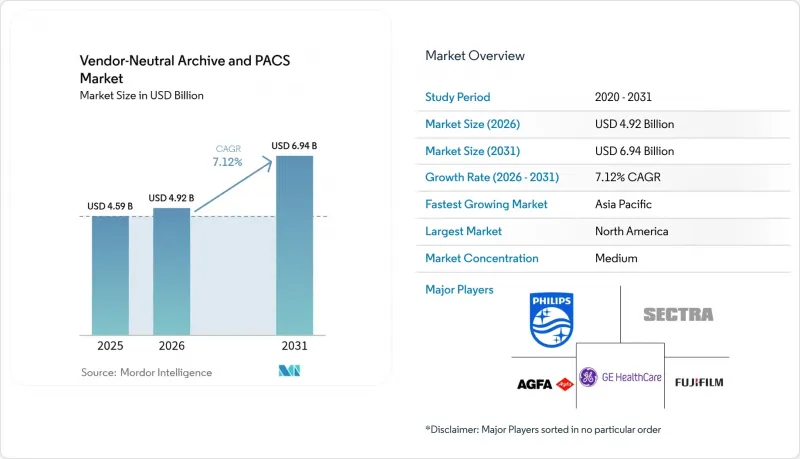
Mordor Intelligence에 따르면 벤더 뉴트럴 아카이브(VNA) 및 PACS(의료영상저장전송시스템) 시장 규모는 2025년에 45억 9,000만 달러로 평가되며, 2026년 49억 2,000만 달러에서 2031년까지 69억 4,000만 달러에 달할 것으로 예측되고 있으며, 예측 기간에 CAGR은 7.12%입니다.
(2026-2031년).
이 보고서는 영상 진단 모달리티(혈관조영술, 유방촬영술 등), 구성 요소(하드웨어, 소프트웨어 등), 유형(PACS 및 VNA 소프트웨어),제공 형태(온사이트, 하이브리드 등), 이용 모델(단일 부서, 다중 부서 등), 최종사용자(병원, 영상 진단센터 등) 및 지역별로 분류되어 있습니다. 시장 예측은 금액(달러) 기준으로 제시되어 있습니다.
전 세계 벤더 중립 아카이브(VNA) 및 PACS 시장의 동향과 인사이트
범용 의료 영상 아카이브에 대한 수요 증가
의료 기관에서는 각 진료과별로 분리된 시스템을 방사선과, 순환기내과, 병리과, 정형외과 이미지를 단일 백본 위에 통합하는 기업 아카이브로 대체하고 있습니다. 이러한 전환을 통해 임상의는 자신의 워크플로우 내에서 완전한 시간별 영상 이력을 확인할 수 있게 되어, 진단상의 사각지대를 제거하고 진료 연계성이 향상됩니다. Sectra나 Hyland와 같은 벤더들은 영상과 임상 데이터를 실시간으로 연동한다는 점을 내세워 자사의 VNA 제품군을 ‘픽셀 EMR’로 판매하고 있습니다. 가치 기반 보상 제도 역시 이러한 통합을 더욱 촉진하고 있으며, 벤더 중립 아카이브(VNA) 및 PACS 시장은 데이터베이스의 정밀 의료에서 핵심적인 역할을 하고 있습니다.
데이터 스토리지 비용 절감(클라우드 및 온프레미스)
클라우드의 경제성 덕분에 의료 기관은 영상 진단의 총 소유 비용(TCO)을 30% 절감하면서도, 점점 더 대규모화되는 검사에 대응할 수 있는 유연한 용량을 확보할 수 있습니다. 자동화된 수명주기 정책을 통해 검색 속도를 저하시키지 않고 오래된 검사 데이터를 더 저렴한 콜드 스토리지 계층으로 이전할 수 있으므로, 지역 병원이나 지방 진료소에서도 과거에는 학술기관으로만 제한되었던 기업급 기능을 도입할 수 있게 되었습니다. 신흥 시장에서는 기존 하드웨어를 완전히 건너뛰고 클라우드를 도입하고 있으며, 벤더 중립 아카이브(VNA) 및 PACS 시장에서 클라우드의 성장세가 더욱 가속화되고 있습니다.
초기 마이그레이션 및 통합 비용의 부담
기존 PACS에서 완전한 클라우드 네이티브 VNA로 전환하는 데는 수년이 소요될 수 있으며, 수백만 달러 규모의 프로그램이 필요할 수도 있습니다. 조직은 이중 시스템을 운영하고, 직원을 재교육하며, 워크플로우를 재설계해야 하므로 IT 예산에 부담이 됩니다. 그러나 입증된 사례에 따르면 대규모 소아 병원의 경우 도입 후 5년 동안 300만 달러의 비용 절감이, 성인 의료 네트워크의 경우 가동 시작 직후 70만 달러의 비용 절감이 실현되었습니다. 초기 비용은 도입의 걸림돌이 되지만, 장기적인 투자 회수가 예상되므로 벤더 중립 아카이브(VNA) 및 PACS 시장으로의 진출은 계속되고 있습니다.
부문 분석
CT는 뇌졸중 분류, 외상 평가 및 종양 병기 분류에서 다목적 역할을 수행함에 따라 2025년에는 벤더 중립 아카이브(VNA) 및 PACS 시장의 27.02%를 차지했습니다. 이 모달리티의 높은 처리 능력은 아카이브의 꾸준한 증가로 이어져, 벤더 중립 아카이브(VNA) 및 PACS 시장 전체의 확장을 지원하고 있습니다. 초음파 검사는 휴대용 기기 및 AI 지원 안내의 혜택을 받아 연평균 성장률(CAGR) 9.74%를 기록하고 있으며, 1차 진료 및 원격의료 분야에서 새로운 기회를 개발하고 있습니다.
다중 시퀀스 재구성을 통해 방대한 양의 데이터를 생성하는 MRI 및 PET에 대한 수요는 엄격한 저장 및 검색 요건을 수반하지만, 확장성이 뛰어난 VNA가 이에 가장 적합합니다. 또한 위험 예측 AI가 FDA 승인을 받음에 따라 유방촬영술의 워크로드도 증가하고 있으며, 더 많은 의료 기관이 유방 영상의 경과 추적 저장소를 도입하고 있습니다. 혈관조영술은 중재적 심장학의 성장에 연동되어 안정적인 수요를 가져오며, 모달리티의 다양성을 더욱 풍부하게 하고 있습니다.
2025년에는 푸시 업데이트를 통해 AI 및 사이버 보안 기능을 추가할 수 있는 민첩하고 클라우드 네이티브인 코드베이스 덕분에 소프트웨어가 VNA(Vendor Neutral Archive) 및 PACS 시장 규모의 39.08%를 차지했습니다. 규정 준수 및 가동 시간 확보를 위해 마이그레이션, 관리형 호스팅, 연중무휴 24시간 모니터링이 필수화됨에 따라 서비스 부문은 연평균 성장률(CAGR) 9.21%로 가장 빠르게 성장하고 있습니다. 지연 시간에 민감한 카테터실이나 수술실 환경에서 엣지 캐시에 대한 하드웨어 수요는 여전히 존재하지만, 그 점유율은 점차 줄어들고 있습니다.
도입 컨설팅 기업은 데이터 추출, 검증 및 다운타임 없는 전환을 총괄하기 위해 고액의 요금을 책정하고 있습니다. 매니지드 서비스는 자본 지출(CAPEX)보다 예측 가능한 운영 비용(OPEX)을 선호하는 자원이 제한적인 지역 병원에 매력적이며, 벤더 중립 아카이브(VNA) 및 PACS 시장에서 서비스의 입지를 강화하고 있습니다.
지역별 분석
2025년에 벤더 중립 아카이브(VNA) 및 PACS 시장의 43.21%를 차지하는 북미는 견고한 HIPAA(의료보험 이동성 및 책임에 관한 법률) 체계, 대규모 기업형 의료 시스템,및 여러 병원에 걸친 영상 진단 혁신을 지원하는 충분한 자본 예산의 혜택을 받고 있습니다. GE 헬스케어와 새터 헬스(Sutter Health) 간의 제휴는 300개 이상의 의료 기관을 아우르며, 이 지역의 규모와 첨단성을 상징합니다. 의료 서비스 제공자들은 영상 진단의 효율성과 관련된 품질 지표를 중시하는 진화하는 지불자 모델을 염두에 두고, 위조가 불가능한 아카이브와 AI 분석을 도입하고 있습니다.
아시아태평양은 중국, 인도, 아세안(ASEAN) 국가 정부들이 디지털 헬스 인프라에 부양책을 투입함에 따라 2031년까지 연평균 성장률(CAGR) 8.97%로 성장을 주도하고 있습니다. 국가 차원의 의료정보교환에는 표준을 준수하는 영상 데이터가 요구되고 있으며, 레거시 시스템에 대한 종속을 피하기 위한 클라우드 네이티브 VNA 도입이 촉진되고 있습니다. 민간 병원 체인과 원격 방사선 진단 기업은 고령화에 따른 영상 진단 수요의 급증과 암 검진의 확대에 대응하기 위해 도입을 더욱 가속화하고 있습니다.
유럽에서는 GDPR(일반 데이터 보호 규정)에 기반한 데이터 거버넌스 규제와 국경을 초월한 의료 구상에 힘입어 꾸준한 성장세가 이어지고 있습니다. 의료 제공자들은 데이터 주권을 우선시하며, 로컬 클라우드 리전이나 하이브리드 모델을 선호하고 있습니다. 중동 및 아프리카, 라틴아메리카에서는 신축 병원이 ‘디지털 퍼스트’ 영상 진단 스택을 구축하고, 초기 투자 비용을 절감하기 위해 구독형 VNA를 활용하고 있습니다. 이러한 지역들이 종합적으로 새로운 수요를 창출하며, 벤더 중립 아카이브(VNA) 및 PACS 시장의 세계적 확장에 기여하고 있습니다.
기타 혜택:
- 엑셀 형식의 시장 예측(ME) 시트
- 3개월간의 애널리스트 지원
목차
제1장 서론
제2장 조사 방법
제3장 개요
제4장 시장 구도
제5장 시장 규모와 성장 예측
제6장 경쟁 구도
제7장 시장 기회와 향후 전망
KSAAccording to Mordor Intelligence, the vendor-Neutral archive (VNA) & picture archiving and Communication System (PACS) market size was valued at USD 4.59 billion in 2025 and estimated to grow from USD 4.92 billion in 2026 to reach USD 6.94 billion by 2031, at a CAGR of 7.12% during the forecast period (2026-2031).
This report is Segmented by Imaging Modality (Angiography, Mammography, and More), Component (Hardware, Software and More), Type (PACS and VNA Software), Mode of Delivery (On-Site, Hybrid, and More), Usage Model (Single Department, Multiple Departments, and More), End User (Hospitals, Diagnostic Imaging Centers and More) and Geography. The Market Forecasts are Provided in Terms of Value (USD).
Global Vendor-Neutral Archive And PACS Market Trends and Insights
Increasing Demand For Universal Medical-Image Archiving
Health systems are replacing departmental silos with enterprise archives that house radiology, cardiology, pathology, and orthopedic images on a single backbone. The migration enables clinicians to review complete longitudinal imaging histories inside their workflow, eliminating diagnostic blind spots and improving care coordination. Vendors such as Sectra and Hyland market their VNA suites as "pixel EMRs" because they align images with clinical data in real time. Value-based reimbursement further rewards this consolidation, making the Vendor-Neutral Archive (VNA) & Picture Archiving and Communication System (PACS) market a linchpin for data-driven precision care.
Declining Data-Storage Cost (Cloud & On-Prem)
Cloud economics let providers lower imaging TCO by 30% while gaining elastic capacity for ever-larger studies. Automated lifecycle policies move older exams into cheaper cold tiers without harming retrieval speed, helping community hospitals and rural clinics adopt enterprise capabilities once limited to academic centers. Emerging markets leapfrog legacy hardware altogether, reinforcing cloud momentum within the Vendor-Neutral Archive (VNA) & Picture Archiving and Communication System (PACS) market.
High Upfront Migration & Integration Costs
Transitioning from legacy PACS to a fully cloud-native VNA can require multi-year, multi-million-dollar programs. Organizations must run dual systems, retrain staff, and redesign workflows, stretching IT budgets. Yet documented cases show five-year savings of USD 3 million for large children's hospitals and immediate reductions of USD 700,000 in adult networks after go-live. While initial expense slows orders, the long-term payback sustains participation in the Vendor-Neutral Archive (VNA) & Picture Archiving and Communication System (PACS) market.
Other drivers and restraints analyzed in the detailed report include:
- High-Level Integration With Electronic Health Records
- AI/ML Training Datasets Require Large Longitudinal Image Repositories
- Long Product Life Cycle Slows Replacement Sales
For complete list of drivers and restraints, kindly check the Table Of Contents.
Segment Analysis
CT captured 27.02% of the Vendor-Neutral Archive (VNA) & Picture Archiving and Communication System (PACS) market in 2025, driven by its versatile role in stroke triage, trauma evaluation, and oncology staging. The modality's high throughput translates into steady archive growth, reinforcing overall Vendor-Neutral Archive (VNA) & Picture Archiving and Communication System (PACS) market expansion. Ultrasound, benefiting from handheld devices and AI-assisted guidance, posts a 9.74% CAGR that opens new opportunities in primary care and remote settings.
Demand for MRI and PET data-rich in multi-sequence reconstructions-poses stringent storage and retrieval needs best met by scalable VNAs. Mammography workloads also intensify as risk prediction AI gains FDA clearance, pushing more facilities to adopt longitudinal breast-imaging repositories. Angiography contributes stable volumes linked to interventional cardiology growth, rounding out modality diversity.
Software owned 39.08% of the Vendor-Neutral Archive (VNA) & Picture Archiving and Communication System (PACS) market size in 2025 thanks to agile, cloud-native codebases that add AI and cybersecurity features via push updates. Services rise quickest at 9.21% CAGR as migrations, managed hosting, and 24/7 monitoring become mandatory for compliance and uptime. Hardware demand persists for edge caches in latency-sensitive cath-lab or OR settings, yet its share gradually tapers.
Implementation consultancies charge premium rates because they orchestrate data extraction, validation, and downtime-free cutovers. Managed services appeal to resource-strained community hospitals that prefer predictable OPEX rather than capital outlays, solidifying the service footprint within the Vendor-Neutral Archive (VNA) & Picture Archiving and Communication System (PACS) market.
Complete Report Scope:
- By Imaging Modality
- Angiography
- Mammography
- Computed Tomography (CT)
- Magnetic Resonance Imaging (MRI)
- Ultrasound
- Nuclear Medicine/PET
- Other Modalities
- By Component
- Hardware
- Software
- Services (Implementation, Migration, Managed)
- By Type
- PACS
- Vendor-Neutral Archive (VNA) Software
- By Mode of Delivery
- On-site (Premise)
- Hybrid
- Cloud-Hosted
- By Usage Model
- Single Department
- Multiple Departments (Enterprise Imaging)
- Multiple Sites / Health-system
- By End-User
- Hospitals (Large, Mid-size, Small)
- Diagnostic Imaging Centers
- Ambulatory Surgical Centers & Specialty Clinics
- By Geography
- North America
- United States
- Canada
- Mexico
- Europe
- Germany
- United Kingdom
- France
- Italy
- Spain
- Rest of Europe
- Asia-Pacific
- China
- Japan
- India
- Australia
- South Korea
- Rest of Asia-Pacific
- Middle East and Africa
- GCC
- South Africa
- Rest of Middle East and Africa
- South America
- Brazil
- Argentina
- Rest of South America
- North America
Geography Analysis
North America, holding 43.21% of the Vendor-Neutral Archive (VNA) & Picture Archiving and Communication System (PACS) market in 2025, benefits from robust HIPAA frameworks, large enterprise health systems, and sizeable capital budgets that support multi-hospital imaging transformations. GE HealthCare's partnership with Sutter Health covering 300+ facilities exemplifies regional scale and sophistication.Providers adopt immutable archives and AI analytics in anticipation of evolving payer models emphasizing quality metrics tied to imaging efficiency.
Asia-Pacific leads growth at 8.97% CAGR through 2031 as governments in China, India, and ASEAN channel stimulus into digital health infrastructure. National health-information exchanges require standards-based imaging, driving cloud-native VNA deployments that sidestep legacy lock-in. Private hospital chains and teleradiology firms further accelerate adoption to meet soaring imaging demand from aging populations and expanded cancer screening.
Europe records steady momentum supported by GDPR data-governance rules and cross-border care initiatives. Providers prioritize data sovereignty, favoring local cloud regions or hybrid models. In the Middle East, Africa, and Latin America, greenfield hospitals build digital-first imaging stacks, leveraging subscription VNAs to conserve upfront capital. Collectively these regions add incremental volume that broadens the global footprint of the Vendor-Neutral Archive (VNA) & Picture Archiving and Communication System (PACS) market.
- Agfa-Gevaert
- GE HealthCare Technologies Inc.
- FUJIFILM Holdings Corp.
- Koninklijke Philips
- Sectra
- Siemens Healthineers
- IBM Corp. (Merge PACS)
- Dell
- Hyland Software (OnBase / Acuo VNA)
- Mach7 Technologies
- Novarad Corp.
- Lexmark (Vidyo)
- Change Healthcare (Nucleus.io)
- Intelerad Medical Systems
- Carestream Health
- Ram Soft
- BridgeHead Software
- Canon Medical
- Visage Imaging
Additional Benefits:
- The market estimate (ME) sheet in Excel format
- 3 months of analyst support
TABLE OF CONTENTS
1 Introduction
- 1.1 Study Assumptions and Market Definition
- 1.2 Scope of the Study
2 Research Methodology
3 Executive Summary
4 Market Landscape
- 4.1 Market Overview
- 4.2 Market Drivers
- 4.2.1 Increasing Demand For Universal Medical-Image Archiving
- 4.2.2 Declining Data-Storage Cost (Cloud & On-Prem)
- 4.2.3 High-Level Integration With Electronic Health Records
- 4.2.4 Rising Imaging Volumes & Higher-Resolution Modalities
- 4.2.5 AI/ML Training Datasets Require Large Longitudinal Image Repositories
- 4.2.6 Cyber-Insurance Compliance Driving Immutable, Zero-Trust VNAs
- 4.3 Market Restraints
- 4.3.1 High Upfront Migration & Integration Costs
- 4.3.2 Long Product Life Cycle Slows Replacement Sales
- 4.3.3 Proprietary Metadata Mapping Raises Vendor-Lock-In Risk
- 4.3.4 Unpredictable Cloud-Egress Fees Inhibit Cloud VNA Adoption
- 4.4 Value / Supply-Chain Analysis
- 4.5 Regulatory Landscape
- 4.6 Technology Outlook
- 4.7 Porter's Five Forces Analysis
- 4.7.1 Bargaining Power of Suppliers
- 4.7.2 Bargaining Power of Buyers
- 4.7.3 Threat of New Entrants
- 4.7.4 Threat of Substitutes
- 4.7.5 Intensity of Competitive Rivalry
5 Market Size and Growth Forecasts (Value-USD)
- 5.1 By Imaging Modality
- 5.1.1 Angiography
- 5.1.2 Mammography
- 5.1.3 Computed Tomography (CT)
- 5.1.4 Magnetic Resonance Imaging (MRI)
- 5.1.5 Ultrasound
- 5.1.6 Nuclear Medicine/PET
- 5.1.7 Other Modalities
- 5.2 By Component
- 5.2.1 Hardware
- 5.2.2 Software
- 5.2.3 Services (Implementation, Migration, Managed)
- 5.3 By Type
- 5.3.1 PACS
- 5.3.2 Vendor-Neutral Archive (VNA) Software
- 5.4 By Mode of Delivery
- 5.4.1 On-site (Premise)
- 5.4.2 Hybrid
- 5.4.3 Cloud-Hosted
- 5.5 By Usage Model
- 5.5.1 Single Department
- 5.5.2 Multiple Departments (Enterprise Imaging)
- 5.5.3 Multiple Sites / Health-system
- 5.6 By End-User
- 5.6.1 Hospitals (Large, Mid-size, Small)
- 5.6.2 Diagnostic Imaging Centers
- 5.6.3 Ambulatory Surgical Centers & Specialty Clinics
- 5.7 By Geography
- 5.7.1 North America
- 5.7.1.1 United States
- 5.7.1.2 Canada
- 5.7.1.3 Mexico
- 5.7.2 Europe
- 5.7.2.1 Germany
- 5.7.2.2 United Kingdom
- 5.7.2.3 France
- 5.7.2.4 Italy
- 5.7.2.5 Spain
- 5.7.2.6 Rest of Europe
- 5.7.3 Asia-Pacific
- 5.7.3.1 China
- 5.7.3.2 Japan
- 5.7.3.3 India
- 5.7.3.4 Australia
- 5.7.3.5 South Korea
- 5.7.3.6 Rest of Asia-Pacific
- 5.7.4 Middle East and Africa
- 5.7.4.1 GCC
- 5.7.4.2 South Africa
- 5.7.4.3 Rest of Middle East and Africa
- 5.7.5 South America
- 5.7.5.1 Brazil
- 5.7.5.2 Argentina
- 5.7.5.3 Rest of South America
- 5.7.1 North America
6 Competitive Landscape
- 6.1 Market Concentration
- 6.2 Market Share Analysis
- 6.3 Company profiles (includes Global level Overview, Market level overview, Core Segments, Financials as available, Strategic Information, Market Rank/Share for key companies, Products and Services, and Recent Developments)
- 6.3.1 Agfa-Gevaert Group
- 6.3.2 GE HealthCare Technologies Inc.
- 6.3.3 FUJIFILM Holdings Corp.
- 6.3.4 Koninklijke Philips N.V.
- 6.3.5 Sectra AB
- 6.3.6 Siemens Healthineers AG
- 6.3.7 IBM Corp. (Merge PACS)
- 6.3.8 Dell Technologies Inc.
- 6.3.9 Hyland Software (OnBase / Acuo VNA)
- 6.3.10 Mach7 Technologies
- 6.3.11 Novarad Corp.
- 6.3.12 Lexmark (Vidyo)
- 6.3.13 Change Healthcare (Nucleus.io)
- 6.3.14 Intelerad Medical Systems
- 6.3.15 Carestream Health
- 6.3.16 RamSoft Inc.
- 6.3.17 BridgeHead Software
- 6.3.18 Canon Medical
- 6.3.19 Visage Imaging
7 Market Opportunities and Future Outlook
- 7.1 White-Space and Unmet-Need Assessment