
|
시장보고서
상품코드
2122027
중동 및 아프리카(MEA) 인력 관리 소프트웨어 : 시장 점유율 분석, 업계 동향과 통계, 성장 예측(2026-2031년)MEA Workforce Management Software - Market Share Analysis, Industry Trends & Statistics, Growth Forecasts (2026 - 2031) |
||||||
 Mordor Intelligence
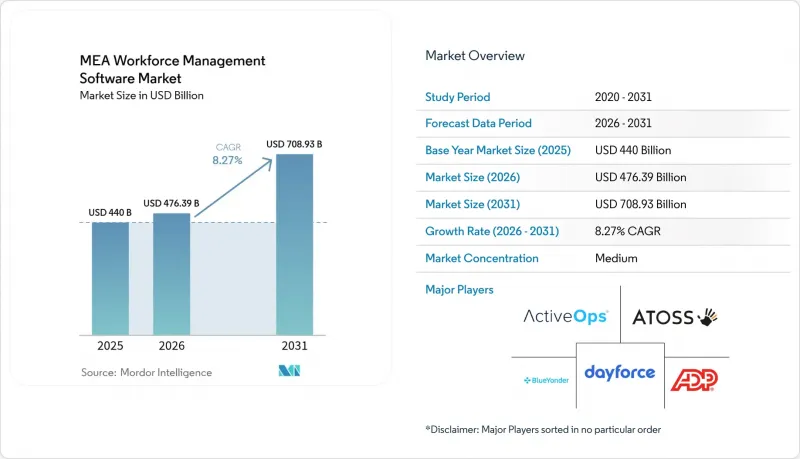
Mordor Intelligence에 따르면 중동 및 아프리카(MEA) 지역의 인력 관리 소프트웨어 시장 규모는 2025년 4억 4,000만 달러에서 2026년에는 4억 7,639만 달러로 확대하며, 2026-2031년에 CAGR 8.27%로 추이하며, 2031년에는 7억 893만 달러에 달할 것으로 예측됩니다.
이 보고서는 솔루션 유형(근무 일정 관리 및 분석, 근태 관리 등), 배포 방식(온프레미스, 클라우드), 최종사용자 산업(BFSI, 소매·소비재 등), 조직 규모(대기업, 중견기업, 중소기업) 및 지역별로 분류되어 있습니다. 시장 예측은 금액(달러) 기준으로 제시되어 있습니다.
중동 및 아프리카(MEA) 인력 관리 소프트웨어 시장의 동향 및 인사이트
클라우드 인프라 현대화가 WFM 도입을 가속화
클라우드 배포는 이미 신규 프로젝트의 대부분을 차지하고 있으며, 65.70%에 달하는 점유율은 신속한 확장성, 자동 업데이트 및 국경을 초월한 가용성을 추구하는 고용주들의 의향을 반영하고 있습니다. 사우디아라비아 국립 기술 플랫폼은 국가가 지원하는 기술 향상 프로그램에 클라우드 아키텍처를 통합함으로써 이러한 움직임에 더욱 탄력을 주고 있습니다. WorkForce Software사의 Azure에서 Oracle Cloud로의 전환을 통해 성능이 40% 향상된 것은 운영상 이점을 여실히 보여줍니다. 규정 준수 역시 촉진요인 중 하나입니다. UAE의 직원 모니터링 프레임워크에서는 기본적으로 감사 추적 및 동의 관리 기능을 갖춘 SaaS 제품군을 권장하고 있습니다. NEOM과 같은 메가 프로젝트에서는 몇 달 사이에 직원 수가 수만 명 단위로 변동할 가능성이 있으며, 유연한 용량이 필수적인 이유를 여실히 보여주고 있습니다.
규제 준수 요건이 근태 관리의 고도화를 촉진
MEA 지역의 관할 구역에 따라 초과근무 규정이 크게 다르기 때문에 근태 관리는 여전히 주요 분야로 남아 있습니다. 국제노동기구(ILO)의 지침에 따라 기업은 국가별 규정 세트에 대응할 수 있는 설정 가능한 시스템 도입이 요구되고 있습니다. SAP SuccessFactors의 2024년 릴리스에서는 이러한 복잡성을 해결하기 위해 Microsoft Teams를 통한 출퇴근 기록 기능과 급여 계산 주기와의 자동 연동 기능이 추가되었습니다. 잠비아에서 심의 중인 초과근무 관련 법안을 비롯해, 2025년에 예정된 아프리카 전역의 노동법 개정에 따라 규정을 준수하는 디지털 추적에 대한 수요가 높아지고 있습니다. 사우디아라비아의 Qiwa 플랫폼에서 처리된 거래량은 이미 진행 중인 규제 대응 자동화의 규모를 여실히 보여주고 있으며, 2023년에는 1억 2,600만 건의 거래가 처리되었습니다.
통합의 복잡성이 도입의 장벽이 되고 있다
중동 및 아프리카(MEA) 지역 중소기업의 3분의 2는 WFM 제품군을 기존 인사·급여 관리 시스템과 통합하는 데 어려움을 겪고 있으며, 이로 인해 프로젝트 기간이 길어지고 총 소유 비용(TCO)이 상승하고 있습니다. SAP SuccessFactors는 첫해 구독료와 동일한 금액의 도입 비용을 청구하는 경우가 있으며, 중견 기업 구매자들에게 예산상의 장벽을 더욱 높이고 있습니다. 그러나 도입에 성공하면 정량화 가능한 수익을 기대할 수 있습니다. Visa의 통합 HCM 환경은 급여 처리 비용을 대폭 절감하여 투자 회수 가능성을 보여주고 있습니다.
부문 분석
2025년, MEA 지역 전체에서 조직들이 각국의 서로 다른 초과근무 규정을 준수하는 것을 우선시한 결과, 근태 관리는 총 수익의 33.62%를 차지했습니다. 인력 분석 시장은 규모는 작지만, AI를 활용한 예측 및 처방적 인사이트를 통해 연평균 성장률(CAGR) 9.31%로 확대되고 있습니다. UKG Bryte에 통합된 ‘Promotion Agent’는 수동 인사 워크플로우를 줄여 AI의 실질적인 가치를 입증하고 있습니다. SAP SuccessFactors는 예측적 목표 제안 및 기술 검증 기능을 통합하여 성과 관리를 향상시키고 있습니다. 기업이 타임카드에서 분석 대시보드로 전환함에 따라 MEA의 인력 관리 소프트웨어 시장에서는 기본적인 일정 관리를 훨씬 뛰어넘는 애드온 모듈이 지속적으로 도입되고 있습니다.
안전이 극히 중요한 산업에서는 피로 관리 및 현장 서비스 최적화 툴에 대한 수요가 증가하고 있습니다. Pulsar Informatics의 ‘Fleet Insight’는 항공사를 대상으로 피로 위험 점수 산정 기능을 제공하여 규제상의 비행 근무 제한을 충족시킵니다. 따라서 MEA 지역의 인력 관리 소프트웨어 시장에서는 규정 준수, 웰빙, 데이터베이스 예측을 통합한 통합형 제품군으로의 명확한 전환이 나타나고 있습니다.
클라우드는 2025년에 65.25%의 점유율을 차지하며 연평균 성장률(CAGR) 10.02%의 궤도에 올라, 온프레미스 운영 방식에서 결정적인 전환을 반영하고 있습니다. Workforce Software의 Oracle Cloud로의 전환으로 시스템 성능이 40% 향상되어 ROI 논의의 벤치마크가 되고 있습니다. 엄격한 데이터 주권 요건이 부과된 기업은 데이터를 현지 관할 구역 내에 보관하면서도 SaaS의 민첩성을 유지할 수 있는 ‘Workday-on-AWS’ 도입에 주목하고 있습니다. 기업 그룹이 규제가 엄격한 산유국과 규제가 완화된 시장 모두에서 사업을 운영하고 있는 경우, 하이브리드 배포는 여전히 유효하며, 이는 중동 및 아프리카(MEA) 지역의 인력 관리 소프트웨어 시장에서 아키텍처의 유연성이 요구되고 있음을 여실히 보여줍니다.
Continuum Global Solutions가 NICE IEX 클라우드 스위트로 전환한 결과, 99.5%의 가동률을 달성하고 셀프 서비스 도입도 확대했습니다. 이는 많은 도입 기업에게 있으며, 전환에 따른 과제를 상회하는 운영상 이점을 얻고 있음을 보여줍니다. MENA 지역에서 하이퍼스케일 데이터센터 거점이 확대됨에 따라 인프라에 대한 우려는 줄어들고, 클라우드의 우위는 더욱 공고해지고 있습니다.
기타 혜택:
- 엑셀 형식의 시장 예측(ME) 시트
- 3개월간의 애널리스트 지원
자주 묻는 질문
목차
제1장 서론
제2장 조사 방법
제3장 개요
제4장 시장 구도
제5장 시장 규모와 성장 예측
제6장 경쟁 구도
제7장 시장 기회와 향후 전망
KSAAccording to Mordor Intelligence, the MEA workforce management software market size is expected to grow from USD 440 million in 2025 to USD 476.39 million in 2026 and is forecast to reach USD 708.93 million by 2031 at 8.27% CAGR over 2026-2031.
This report is Segmented by Solution Type (Workforce Scheduling and Analytics, Time and Attendance Management, and More), Deployment Mode (On-Premise, Cloud), End-User Industry (BFSI, Retail and Consumer Goods, and More), Organisation Size (Large Enterprises, Medium Enterprises, Small Enterprises), and Geography. The Market Forecasts are Provided in Terms of Value (USD).
MEA Workforce Management Software Market Trends and Insights
Cloud Infrastructure Modernization Accelerates WFM Adoption
Cloud deployment already underpins most new projects, and its 65.70% share reflects employers' preference for rapid scalability, automated updates, and cross-border availability. The Saudi National Skills Platform adds momentum by embedding cloud architecture in state-backed skilling programmes. WorkForce Software's migration from Azure to Oracle Cloud yielded a 40% performance gain, illustrating the operational upside. Compliance is another catalyst: the UAE's employee-monitoring framework favours SaaS suites that provide audit trails and consent management by default. Mega-projects such as NEOM, whose headcount can swing by tens of thousands within months, underline why elastic capacity is critical.
Regulatory Compliance Mandates Drive Time-Tracking Sophistication
Time and Attendance Management retains its lead because overtime rules differ markedly across MEA jurisdictions. The International Labour Office's guidelines push enterprises to deploy configurable systems capable of country-level rule sets. SAP SuccessFactors' 2024 release added Microsoft Teams punch-in and automated payroll-cycle alignment to address this complexity. Africa-wide labour-law changes slated for 2025, including Zambia's pending overtime legislation, heighten demand for compliant digital tracking. Transaction volumes on Saudi Arabia's Qiwa platform underscore the scale of regulatory automation already in play, with 126 million transactions processed in 2023.
Integration Complexity Creates Implementation Barriers
Two-thirds of MEA SMEs struggle to integrate WFM suites with legacy HR and payroll stacks, extending project timelines and elevating total cost of ownership. SAP SuccessFactors can charge implementation fees equal to the first year's subscription, amplifying budget hurdles for mid-market buyers. Yet successful roll-outs signal quantifiable returns: Visa's consolidated HCM environment cut payroll processing costs materially, illustrating payback potential.
Other drivers and restraints analyzed in the detailed report include:
- Mobile-First Solutions Capitalize on Smartphone Penetration
- AI-Powered Analytics Transform Workforce Optimisation
- Cultural Resistance to Real-Time Monitoring Persists
For complete list of drivers and restraints, kindly check the Table Of Contents.
Segment Analysis
Time and Attendance Management retained 33.62% of overall revenue in 2025 as organisations prioritised compliance under divergent overtime statutes across MEA. Workforce Analytics, while smaller, is expanding at 9.31% CAGR on the back of AI-driven forecasting and prescriptive insights. The Promotion Agent inside UKG Bryte trims manual HR workflows, illustrating practical AI value. SAP SuccessFactors embeds predictive goal suggestions and skills validation to elevate performance management. As enterprises graduate from punch clocks to analytics dashboards, the MEA Workforce Management Software market repeatedly absorbs add-on modules that stretch far beyond basic scheduling.
Increasing demand for fatigue and field-service optimisation tools is visible in safety-critical industries. Pulsar Informatics' Fleet Insight offers fatigue risk scoring for aviation operators, meeting regulatory flight-duty constraints. The MEA Workforce Management Software market therefore exhibits a clear shift toward unified suites that integrate compliance, wellbeing and data-driven forecasting.
Cloud captured 65.25% share in 2025 and is on a 10.02% CAGR trajectory, reflecting a decisive pivot away from on-premise upkeep. WorkForce Software's move to Oracle Cloud lifted system performance by 40%, providing a benchmark for ROI discussions. Enterprises with stringent sovereignty mandates turn to Workday-on-AWS deployments that house data within local jurisdictions yet retain SaaS agility. Hybrid roll-outs remain relevant where corporate groups operate both in regulated petro-states and lightly regulated markets, underscoring the MEA Workforce Management Software market's need for architectural flexibility.
Continuum Global Solutions' switch to NICE IEX cloud suite achieved 99.5% uptime and broader self-service adoption, underscoring operational benefits that now outweigh migration pain points for many adopters. As hyperscale data-centre footprints expand in MENA, infrastructural concerns recede, reinforcing cloud's leadership.
Complete Report Scope:
- By Solution Type
- Workforce Scheduling and Analytics
- Time and Attendance Management
- Performance and Goal Management
- Absence and Leave Management
- Fatigue, Task and Field Service WFM
- By Deployment Mode
- On-Premise
- Cloud
- By End-user Industry
- BFSI
- Retail and Consumer Goods
- Healthcare
- Manufacturing
- Energy and Utilities
- Transportation and Logistics
- Hospitality
- Other Industries
- By Organisation Size
- Large Enterprises (≥1 000 staff)
- Medium Enterprises (250-999)
- Small Enterprises (<250)
- By Country
- United Arab Emirates
- Saudi Arabia
- South Africa
- Nigeria
- Egypt
- Rest of Middle East and Africa
List of Companies Covered in this Report:
- Active Ops Management International LLP
- ADP LLC
- Atoss Software AG
- Blue Yonder Group Inc.
- Ceridian HCM Inc. (Dayforce)
- Deputy Group Pty Ltd
- IBM Corporation
- Infor Group
- Kirona Solutions Ltd
- NICE Ltd
- Oracle Corporation
- Reflexis Systems Inc.
- Sage Group plc
- SAP SE (SuccessFactors)
- ServiceMax Inc.
- SISQUAL
- Tamigo Solutions A/S
- UKG Inc. (Kronos + Ultimate)
- Workday Inc.
- WorkForce Software LLC
- Zoho Corporation Pvt Ltd (Zoho People)
Additional Benefits:
- The market estimate (ME) sheet in Excel format
- 3 months of analyst support
TABLE OF CONTENTS
1 INTRODUCTION
- 1.1 Study Assumptions and Market Definition
- 1.2 Scope of the Study
2 RESEARCH METHODOLOGY
3 EXECUTIVE SUMMARY
4 MARKET LANDSCAPE
- 4.1 Market Overview
- 4.2 Market Drivers
- 4.2.1 Cloud-based WFM adoption surge
- 4.2.2 Regulatory overtime-tracking mandates
- 4.2.3 Mobile-first WFM via smartphone ubiquity
- 4.2.4 Labor-cost optimisation amid diversification
- 4.2.5 Gig and quick-commerce workforce expansion
- 4.2.6 Mega-project workforce orchestration needs
- 4.3 Market Restraints
- 4.3.1 Integration cost and complexity
- 4.3.2 Shortage of WFM analytics talent
- 4.3.3 Data-residency barriers to cloud rollout
- 4.3.4 Cultural push-back on real-time tracking
- 4.4 Supply-Chain Analysis
- 4.5 Regulatory Landscape
- 4.6 Technological Outlook
- 4.7 Porter's Five Forces Analysis
- 4.7.1 Bargaining Power of Suppliers
- 4.7.2 Bargaining Power of Buyers
- 4.7.3 Threat of New Entrants
- 4.7.4 Threat of Substitutes
- 4.7.5 Competitive Rivalry
- 4.8 Assessment of Macroeconomic Factors on the Market
5 MARKET SIZE AND GROWTH FORECASTS (VALUE)
- 5.1 By Solution Type
- 5.1.1 Workforce Scheduling and Analytics
- 5.1.2 Time and Attendance Management
- 5.1.3 Performance and Goal Management
- 5.1.4 Absence and Leave Management
- 5.1.5 Fatigue, Task and Field Service WFM
- 5.2 By Deployment Mode
- 5.2.1 On-Premise
- 5.2.2 Cloud
- 5.3 By End-user Industry
- 5.3.1 BFSI
- 5.3.2 Retail and Consumer Goods
- 5.3.3 Healthcare
- 5.3.4 Manufacturing
- 5.3.5 Energy and Utilities
- 5.3.6 Transportation and Logistics
- 5.3.7 Hospitality
- 5.3.8 Other Industries
- 5.4 By Organisation Size
- 5.4.1 Large Enterprises (≥1 000 staff)
- 5.4.2 Medium Enterprises (250-999)
- 5.4.3 Small Enterprises (<250)
- 5.5 By Country
- 5.5.1 United Arab Emirates
- 5.5.2 Saudi Arabia
- 5.5.3 South Africa
- 5.5.4 Nigeria
- 5.5.5 Egypt
- 5.5.6 Rest of Middle East and Africa
6 COMPETITIVE LANDSCAPE
- 6.1 Strategic Moves
- 6.2 Market Share Analysis
- 6.3 Company Profiles (includes Global level Overview, Market level overview, Core Segments, Financials as available, Strategic Information, Market Rank/Share, Products and Services, Recent Developments)
- 6.3.1 Active Ops Management International LLP
- 6.3.2 ADP LLC
- 6.3.3 Atoss Software AG
- 6.3.4 Blue Yonder Group Inc.
- 6.3.5 Ceridian HCM Inc. (Dayforce)
- 6.3.6 Deputy Group Pty Ltd
- 6.3.7 IBM Corporation
- 6.3.8 Infor Group
- 6.3.9 Kirona Solutions Ltd
- 6.3.10 NICE Ltd
- 6.3.11 Oracle Corporation
- 6.3.12 Reflexis Systems Inc.
- 6.3.13 Sage Group plc
- 6.3.14 SAP SE (SuccessFactors)
- 6.3.15 ServiceMax Inc.
- 6.3.16 SISQUAL
- 6.3.17 Tamigo Solutions A/S
- 6.3.18 UKG Inc. (Kronos + Ultimate)
- 6.3.19 Workday Inc.
- 6.3.20 WorkForce Software LLC
- 6.3.21 Zoho Corporation Pvt Ltd (Zoho People)
7 MARKET OPPORTUNITIES AND FUTURE OUTLOOK
- 7.1 White-space and Unmet-Need Assessment