
|
시장보고서
상품코드
2118000
물류 인력 관리 소프트웨어 시장 : 시장 점유율 분석, 업계 동향 및 통계, 성장 예측(2026-2031년)Logistics Workforce Management Software - Market Share Analysis, Industry Trends & Statistics, Growth Forecasts (2026 - 2031) |
||||||
 Mordor Intelligence
Mordor Intelligence에 의하면, 물류 인력 관리 소프트웨어 시장 규모는 2025년 3억 4,989만 달러로 평가되었고, 2026년 4억 963만 달러에서 2031년까지 8억 3,044만 달러로 확대될 것으로 예측되며, 2026-2031년 연평균 복합 성장률(CAGR)은 15.18%를 나타낼 전망입니다.
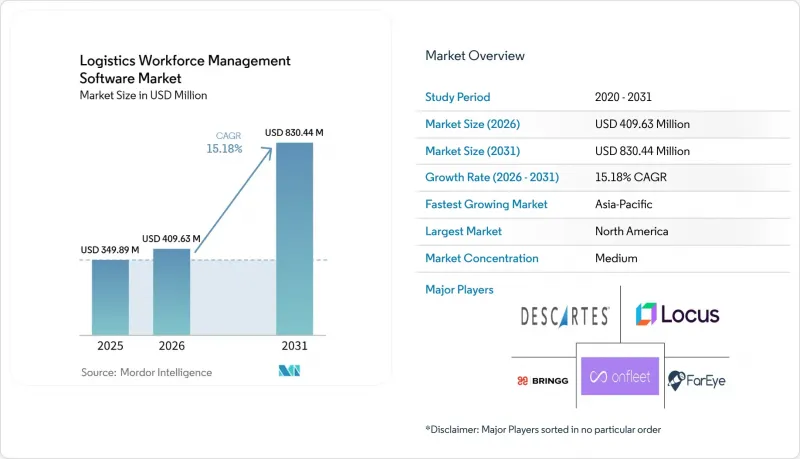
본 보고서는 제공 제품별(소프트웨어, 서비스), 배포 방식별(클라우드, 온프레미스), 최종 용도 및 기업 규모별(대기업, 중소기업), 최종 사용자별(물류 및 제3자 물류 제공업체, 전자상거래·소매, 식품·일용품 배송, 기타), 그리고 지역별로 분류되어 있습니다. 시장 전망은 금액(달러) 기준으로 제시되어 있습니다.
세계의 물류 인력 관리 소프트웨어 시장 동향 및 인사이트
전자상거래 및 당일 배송의 확대
소비자의 배송에 대한 기대가 높아짐에 따라, 경로 및 인력 계획에 할애되는 시간이 단축되고 있습니다. 아마존은 2026년 5월 하순, 당일 배송 네트워크를 다양한 시설로 확대하고 다른 대도시권으로도 서비스를 확장함에 따라, 물류 사업자들은 24시간 이내 배송 시간대에 맞추어 계획을 수립해야 하는 압박이 점점 더 커지고 있습니다. 따라서 물류 인력 관리 소프트웨어 시장에서는 영업일 중에 운전기사와 경로를 재할당할 수 있는 시스템이 요구되고 있습니다. Shipium의 보고서에 따르면, 4곳 이상의 풀필먼트 거점을 활용하는 판매업체를 배경으로 2025년 2분기부터 2026년 2분기에 걸쳐 24시간 이내에 배송되는 D2C(소비자 직배송) 주문 비율이 전년 대비 증가했습니다. 이러한 변화로 인해 D2C 브랜드에 서비스를 제공하는 제3자 물류 사업자에게 있어 고정된 근무 일정 계획의 유용성은 떨어지고 있습니다. 배차, 직원 근무 현황, 배송 예외 사항을 통합하는 소프트웨어를 활용하면 사업자는 수작업 조정을 늘리지 않고도 상황에 대응할 수 있게 됩니다.
인건비 최적화와 운전기사 유지
인건비와 운전기사 이직률 증가로 인해 운송 사업자에게 있어 보다 적절한 인력 계획의 중요성이 점점 더 커지고 있습니다. ATRI 보고서에 따르면, 2025년 트럭 1마일당 평균 운영 비용은 2.336달러이며, 그중에서도 운전기사의 임금과 복리후생이 가장 큰 비용 요인으로 나타났습니다. Platform Science는 2026년 2월, 조사 대상 운전기사의 52%가 고용주와 계속 근무할지 퇴사할지 결정하는 데 있어 기술의 영향을 받고 있다고 보고했습니다. 물류 인력 관리 소프트웨어 시장은 스케줄링, 근태 관리, 노선 연락, 급여 계산 연동, 규정 준수 대응 워크플로우를 통해 관리 부담을 늘리는 대신 경감함으로써 운전자의 이직 방지를 지원할 수 있습니다. 또한 이러한 도구는 차량 관리자가 교대 근무 계획을 개선하고, 운전 시간 규정을 모니터링하며, 막바지 일정 변경을 관리하고, 운전자에게 배차 정보 및 결제 상황에 대해 보다 명확한 가시성을 제공하는 데에도 도움이 됩니다. 연간 이직률을 90%에서 60%-70%로 낮출 수 있다면, 200명의 운전자를 보유한 차량 관리 부문에서 대체 비용을 절감할 수 있지만, 그 효과는 운전자가 일상 업무에서 사용하는 도구를 수용하느냐에 달려 있습니다.
레거시 시스템 통합 및 데이터 마이그레이션의 복잡성
레거시 시스템과의 통합은 대규모 물류 네트워크 전반에 걸친 도입에 있어 큰 제약 요인으로 작용하고 있습니다. 2025년 업무 조사에 따르면, 공급망 담당자의 42%가 기존 시스템과의 통합을 주요 도입 과제로 꼽은 반면, 37%는 데이터 가용성 및 품질 문제를 지적했습니다. 많은 사업자는 레거시 운송 관리 시스템, 이미 도입된 창고 관리 용도, 개별적인 노무 관리 도구를 동시에 운영하고 있습니다. 단 하나의 용도를 교체하는 것만으로도 이러한 시스템을 연결하고 있는 문서화되지 않은 워크플로우에 차질을 빚을 가능성이 있습니다. 물류 인력 관리 소프트웨어 시장에서는 시스템 전체를 교체하도록 요구하는 것보다, 애플리케이션 프로그래밍 인터페이스(API) 및 미들웨어와의 호환성을 제공하는 벤더가 선호되고 있습니다. EDI에서 API로의 전환 요건은 비용을 증가시키고, 평가 및 도입 과정을 장기화시킬 가능성이 있습니다.
부문 분석
2025년에는 소프트웨어가 매출의 69.32%를 차지했습니다. 이 결과는 개별 스케줄링 도구에서 배차, 추적, 분석, 규정 준수 기능을 단일 환경으로 통합한 플랫폼으로의 전환이 진행 중임을 반영합니다. 주요 물류 제공업체들은 유지 관리가 필요한 시스템 연결 수를 줄이고 운영 관리를 간소화하기 위해 1-2개의 플랫폼을 표준화하는 경우가 많습니다. 이러한 중앙 집중화를 통해 확고한 입지를 갖춘 소프트웨어 공급업체들은 지속적인 고객 관계를 구축하고, 플랫폼 도입을 강화하며, 지속적인 제품 개발을 뒷받침하고 있습니다.
서비스 부문은 2031년까지 연평균 성장률(CAGR) 17.12%를 나타낼 것으로 예측되며, 가장 빠르게 성장하는 분야가 될 전망입니다. 물류 인력 관리 소프트웨어 시장에서 이러한 성장은 플랫폼의 기능을 실용적인 일상 업무 프로세스로 전환하는 데 필요한 운영 작업을 반영하고 있습니다. 플랫폼에 AI 기반 배차 기능이나 여러 시스템 간의 연동 기능이 추가됨에 따라, 도입, 설정, 관리형 지원의 중요성이 높아지고 있습니다. 맨해튼 어소시에이츠는 2026년 5월, AI를 활용하여 자연어 입력을 통한 공급망 시스템 설정을 지원하는 ‘솔루션 디자인 스튜디오’를 도입했습니다. 이 도구는 고객이 직접 사용하기 전에 여전히 전문 서비스 팀에 의한 집중적인 도입 지원이 필요합니다. 소프트웨어 및 서비스를 결합한 제공 형태는 공급자가 제품과 운영 설계 모두를 지원하기 때문에 전환 비용을 높일 가능성이 있습니다.
2025년 매출에서 클라우드가 차지하는 비중은 64.81%이었으며, 2031년까지 연평균 성장률(CAGR) 18.79%를 나타낼 것으로 예측됩니다. 이 수치는 보다 유연하고 확장 가능한 기술 모델을 추구하는 고객들 사이에서 클라우드 기반 도입이 점점 더 선호되는 경향을 보여줍니다. 클라우드는 하드웨어 소유나 전담 유지보수 인력의 필요성을 줄여줌으로써, 물류 기술 환경을 관리하는 조직의 운영상 복잡성을 완화합니다. 또한 고객은 온프레미스 컴퓨팅 리소스를 교체하거나 대폭 업그레이드하지 않고도 최신 AI 기능을 활용할 수 있게 됩니다. 모듈형 SaaS(Software-as-a-Service) 제품은 기존의 온프레미스 방식 도입보다 신속하게 배포할 수 있으므로, 기업은 동일한 핵심 운영 목표를 유지하면서 새로운 기능을 보다 효율적으로 도입할 수 있게 됩니다.
SAP는 2026년 2월, 지역 거점 및 위성 거점을 위한 SaaS 제품으로 ‘SAP Logistics Management’의 일반 제공을 시작했습니다. SAP에 따르면, 이 제품은 며칠 만에 가동을 시작할 수 있으며, SAP Business Network를 통한 운송업체와의 연동을 지원합니다. 데이터 보관 의무가 부과되는 정부 기관, 국방 기관, 규제 대상 업무에서는 온프레미스형 시스템이 여전히 중요한 역할을 수행하고 있습니다. 중국, 독일, 걸프 국가 시장의 국내 규제로 인해 고객은 하이브리드형 아키텍처 도입을 불가피하게 선택해야 할 수도 있습니다. 이 아키텍처에서는 스케줄링 로직은 클라우드에서 실행되는 반면, 기밀성이 높은 운전자의 신원 정보는 로컬 서버에 보관됩니다.
지역별 분석
북미는 2025년에 매출의 38.19%를 차지한 것으로 평가되었으며, 이 지역의 성숙한 물류 기술 생태계와 디지털 인력 관리 도구의 조기 도입이 이를 뒷받침하고 있습니다. 이 지역에는 물류 기술 공급업체, 대형 제3자 물류 제공업체, 소포 배송 네트워크, 확립된 플랫폼 예산이 집중되어 있으며, 이러한 요소들이 스케줄링, 근태 관리, 배차, 규정 준수 솔루션에 대한 지속적인 투자를 뒷받침하고 있습니다. 미국 교통부의 ‘운전 시간 규정(Hours-of-Service)’에 따라 물류 사업자들이 근로 시간을 모니터링하고 규정 준수를 유지하기 위한 시스템을 필요로 함에 따라, 운전자의 근태 관리 도구에 대한 수요가 증가하고 있습니다. 미국은 대규모 물류 기반과 첨단 기술 도입에 힘입어 이 지역을 선도하는 국가가 되었습니다. 한편, 캐나다와 멕시코는 국경 간 무역 인프라 및 물류 회랑 확장을 통해 기술 도입을 추진하고 있습니다.
북미의 운송 사업자들은 근로 시간을 연장하지 않으면서도 촉진요인 1인당 주행 거리를 향상시키기 위해 AI를 활용한 배차 및 예측 스케줄링을 활용하고 있습니다. ATRI 보고서에 따르면, 2025년에는 1인당 1일 실제 운전 시간이 평균 7.41시간인 반면, 이용 가능한 시간은 11시간으로 나타나며, 이로 인해 스케줄링 플랫폼에는 명확한 운영 목표가 제시되고 있습니다. 유럽에서는 도입 기반이 널리 확산되어 있으며, EU 기업 지속가능성 보고 지침에 따른 운송 배출량 공개 및 ISO 14083:2023 등 규정 준수 요건이 변화하고 있습니다. 스웨덴에 본사를 둔 인력 관리 소프트웨어 제공업체인 Quinyx는 유럽, 중동,아프리카 전역에서 AI를 활용한 일정 관리, 인력 최적화, 규정 준수 솔루션의 사업 기반을 강화하고 있습니다. 해당 지역의 노동 규제, 근로 시간 요건, 데이터 보호 기준으로 인해 견고한 일정 관리, 규정 준수 추적, 직원 데이터 거버넌스 기능을 갖춘 인력 관리 플랫폼에 대한 수요가 지속적으로 증가하고 있습니다.
아시아태평양에서는 중국, 인도, 일본, 동남아시아 국가들이 대규모 긱 워커를 필요로 하는 전자상거래 및 퀵커머스 서비스를 확대함에 따라, 2031년까지 연평균 성장률(CAGR) 17.26%를 나타낼 것으로 예측됩니다. 이들 국가의 물류 인력 관리 소프트웨어 시장에서는 방대한 배송량과 현지 노동 관행을 처리할 수 있는 제품이 요구되고 있습니다. NITI Aayog에 따르면, 인도의 전자상거래 및 퀵커머스 분야의 긱 근로자는 2020-2021 회계연도에 770만 명이었으나, 2029-2030 회계연도까지 2,350만 명에 달할 것으로 예측됩니다. 또한, 중동 및 아프리카는 조기 도입 지역으로, 아랍에미리트와 사우디아라비아에서는 디지털 물류 인프라에 대한 투자가 진행되고 있습니다. 한편, 남미에서는 급여 계산의 정확도 향상과 노동 법규 준수를 목적으로 생체 인증을 활용한 근태 관리 도구가 도입되고 있습니다.
기타 혜택
- 엑셀 형식 시장 예측(ME) 시트
- 3개월간의 애널리스트 지원
자주 묻는 질문
목차
제1장 서론
제2장 조사 방법
제3장 주요 요약
제4장 시장 구도
제5장 시장 규모 및 성장 예측
제6장 경쟁 구도
제7장 시장 기회 및 향후 전망
AJY 26.09.03According to Mordor Intelligence, the logistics workforce management software market size is projected to expand from USD 349.89 million in 2025 and USD 409.63 million in 2026 to USD 830.44 million by 2031, registering a CAGR of 15.18% between 2026 and 2031.
This report is Segmented by Offering (Software, and Services), Deployment Mode (Cloud, and On-Premises), End Use Enterprise Size (Large Enterprises, and Small and Medium-Sized Enterprises), End User (Logistics and Third-Party Logistics Providers, E-Commerce and Retail, Food and Grocery Delivery, and More), and Geography. The Market Forecasts are Provided in Terms of Value (USD).
Global Logistics Workforce Management Software Market Trends and Insights
E-Commerce and Same-Day Delivery Expansion
Consumer delivery expectations are reducing the time available for route and workforce planning. Amazon expanded its same-day delivery network to various facilities in late May 2026 and extended the service to additional metropolitan areas, increasing the pressure on logistics providers to plan around sub-24-hour delivery windows. The logistics workforce management software market therefore needs systems that can reassign drivers and routes during the operating day. Shipium reported that the share of direct-to-consumer orders delivered within 24 hours increased year over year from Q2 2025 to Q2 2026, driven by merchants using 4 or more fulfillment locations. This shift makes static shift plans less useful for third-party logistics providers that serve direct-to-consumer brands. Software that joins dispatch, worker availability, and delivery exceptions can help operators respond without adding manual coordination.
Labor Cost Optimization and Driver Retention
Labor expense and driver turnover are making better workforce planning more important for carriers. ATRI reported an average truck operating cost of USD 2.336 per mile in 2025, with driver wages and benefits as the largest cost component. Platform Science reported in February 2026 that technology affected 52% of surveyed drivers' decisions to stay with or leave an employer. The logistics workforce management software market can support retention when scheduling, time tracking, route communication, payroll integration, and compliance workflows reduce administrative burden rather than add to it. These tools also help fleet managers improve shift planning, monitor hours-of-service requirements, manage last-minute schedule changes, and provide drivers with clearer visibility into assignments and payments. Reducing annual turnover from 90% toward 60%-70% can lower replacement costs for a 200-driver fleet, but the benefit depends on drivers accepting the tools used in daily work.
Legacy Integration and Data Migration Complexity
Legacy integration is a significant restraint on adoption across large logistics networks. A 2025 operations survey found that 42% of supply chain respondents identified integration with existing systems as a leading adoption challenge, while 37% cited data availability and quality issues. Many operators run a legacy transportation management system, acquired warehouse applications, and separate labor tools at the same time. Replacing 1 application can disrupt undocumented workflows that connect those systems. The logistics workforce management software market favors providers that offer application programming interfaces and middleware compatibility, rather than requiring a full system replacement. EDI-to-API transition requirements can add cost and extend the evaluation and deployment process.
Other drivers and restraints analyzed in the detailed report include:
- AI-Native Dynamic Dispatch and Predictive Rescheduling
- Real-Time Visibility and Customer Communication
- High Implementation Costs for Small and Medium-Sized Operators
For complete list of drivers and restraints, kindly check the Table Of Contents.
Segment Analysis
Software held 69.32% of revenue in 2025. This result reflects the ongoing move from separate scheduling tools to integrated platforms that combine dispatch, tracking, analytics, and compliance capabilities in a single environment. Large logistics providers often standardize on 1 or 2 platforms to reduce the number of system connections they must maintain and simplify operational oversight. This concentration gives established software vendors recurring customer relationships, strengthens platform adoption, and supports continued product development.
Services are projected to grow at a 17.12% CAGR through 2031, making them the fastest-growing offering. In the logistics workforce management software market, this growth reflects the operational work required to turn platform features into usable day-to-day processes. Implementation, configuration, and managed support are becoming more important as platforms add AI-based dispatch and multi-system coordination. Manhattan Associates introduced Solution Design Studio in May 2026, using AI to help configure supply chain systems through natural-language inputs. The tool still depends on expert service teams for focused customer deployments before direct customer use. Combined software and service offerings can increase switching costs because the provider supports both the product and the operating design.
Cloud accounted for 64.81% of revenue in 2025 and is expected to record an 18.79% CAGR through 2031. This share indicates an increasing preference for cloud-based deployment among customers seeking more flexible, scalable technology models. Cloud reduces the need for hardware ownership and dedicated maintenance staff, thereby lowering operational complexity for organizations managing logistics technology environments. It also gives customers access to updated AI capabilities without requiring them to replace or significantly upgrade on-premises computing resources. Modular software-as-a-service products can be deployed faster than traditional local installations, allowing companies to implement new capabilities more efficiently while maintaining the same core operational objectives.
SAP made SAP Logistics Management generally available in February 2026 as a software-as-a-service product designed for localized and satellite operations. The company stated that the product can go live in days and supports carrier collaboration through SAP Business Network. On-premises systems remain relevant for government, defense, and regulated operations with data-residency obligations. National requirements in China, Germany, and the Gulf markets can prompt customers to adopt hybrid designs. Under those designs, scheduling logic operates in the cloud while sensitive driver identity data remains on local servers.
Complete Report Scope:
- By Offering
- Software
- Services
- By Deployment Mode
- Cloud
- On-Premises
- By End Use Enterprise Size
- Large Enterprises
- Small and Medium-Sized Enterprises
- By End User
- Logistics and Third-Party Logistics Providers
- E-commerce and Retail
- Food and Grocery Delivery
- Parcel, Courier, and Express Delivery
- Manufacturing and Industrial Distribution
- Healthcare and Pharmaceutical Distribution
- By Geography
- North America
- United States
- Canada
- Mexico
- South America
- Brazil
- Argentina
- Rest of South America
- Europe
- Germany
- United Kingdom
- France
- Russia
- Rest of Europe
- Asia-Pacific
- China
- India
- Japan
- Australia
- Rest of Asia-Pacific
- Middle East
- United Arab Emirates
- Saudi Arabia
- Turkey
- Rest of Middle East
- Africa
- South Africa
- Egypt
- Nigeria
- Rest of Africa
- North America
Geography Analysis
North America held 38.19% of revenue in 2025, supported by the region's mature logistics technology ecosystem and early adoption of digital workforce management tools. The region has a high concentration of logistics technology vendors, major third-party logistics providers, parcel networks, and established platform budgets, which support continued investment in scheduling, time tracking, dispatch, and compliance solutions. US Department of Transportation Hours-of-Service rules have driven demand for driver time and attendance tools, as logistics operators seek systems to monitor working hours and maintain regulatory compliance. The United States is the leading country in the region, driven by its large logistics base and advanced technology adoption, while Canada and Mexico are advancing adoption through cross-border trade infrastructure and the expansion of logistics corridors.
North American carriers are using AI dispatch and predictive scheduling to improve miles per driver without extending work hours. ATRI reported that drivers averaged 7.41 hours of actual driving per day against 11 available hours in 2025, giving scheduling platforms a clear operational target. Europe has a large installed base and changing compliance requirements, including transport emissions disclosure under the EU Corporate Sustainability Reporting Directive and ISO 14083:2023. Quinyx, a Sweden-based provider of workforce management software, has strengthened its footprint in AI-enabled scheduling, workforce optimization, and compliance solutions across EMEA. Labor regulations, working-time requirements, and data protection standards in the region continue to drive demand for workforce management platforms with robust scheduling, compliance tracking, and employee data governance capabilities.
Asia-Pacific is projected to grow at a 17.26% CAGR through 2031 as China, India, Japan, and Southeast Asian countries expand e-commerce and quick-commerce services that require large gig workforces. The logistics workforce management software market in these countries needs products that can support high delivery volumes and localized work practices. According to NITI Aayog, India's e-commerce and quick-commerce gig workforce was 7.7 million workers in 2020-21 and is projected to reach 23.5 million by 2029-30. Moreover, the Middle East and Africa are early adopters, while the UAE and Saudi Arabia invest in digital logistics infrastructure, and South America adopts biometric time-and-attendance tools to improve payroll accuracy and labor compliance.
- Ehrhardt + Partner Group GmbH & Co. KG
- Manhattan Associates, Inc.
- Blue Yonder Group, Inc.
- ORTEC B.V.
- Infios, Inc.
- Infor Inc.
- SAP SE
- Oracle Corporation
- Softeon, Inc.
- Made4net LLC
- Lucas Systems, Inc.
- Easy Metrics, Inc.
- Quinyx AB
- UKG Inc.
- Tecsys Inc.
- Locus.sh Technologies Private Limited
- FarEye Technologies Private Limited
- Bringg Delivery Technologies Ltd.
- Shipsy Technologies Private Limited
- LogiNext Solutions Private Limited
Additional Benefits:
- The market estimate (ME) sheet in Excel format
- 3 months of analyst support
TABLE OF CONTENTS
1 INTRODUCTION
- 1.1 Study Assumptions and Market Definition
- 1.2 Scope of the Study
2 RESEARCH METHODOLOGY
3 EXECUTIVE SUMMARY
4 MARKET LANDSCAPE
- 4.1 Market Overview
- 4.2 Market Drivers
- 4.2.1 E-commerce and Same-Day Delivery Expansion
- 4.2.2 Labor Cost Optimization and Driver Retention
- 4.2.3 Real-Time Visibility and Customer Communication
- 4.2.4 AI-Native Dynamic Dispatch and Predictive Rescheduling
- 4.2.5 Sustainability Reporting and Low-Emission Fleet Compliance
- 4.2.6 Cross-Platform Worker Identity and Skills Portability
- 4.3 Market Restraints
- 4.3.1 Legacy Integration and Data Migration Complexity
- 4.3.2 High Implementation Costs for Small and Medium-Sized Operators
- 4.3.3 Driver Privacy, Surveillance, and Workforce Resistance
- 4.3.4 Fragmented Telematics, Carrier, and Payroll Data Standards
- 4.4 Impact of Macroeconomic Factors on the Market
- 4.5 Industry Value Chain Analysis
- 4.6 Regulatory Landscape
- 4.7 Technological Outlook
- 4.8 Porter's Five Forces Analysis
- 4.8.1 Bargaining Power of Suppliers
- 4.8.2 Bargaining Power of Buyers
- 4.8.3 Threat of New Entrants
- 4.8.4 Threat of Substitutes
- 4.8.5 Intensity of Competitive Rivalry
- 4.9 Functional Capability and Application Assessment
- 4.9.1 Workforce Scheduling and Dispatch
- 4.9.2 Route Optimization and Planning
- 4.9.3 Workforce Tracking and Field Visibility
- 4.9.4 Delivery Execution and Exception Handling
- 4.9.5 Driver Mobile Applications and Communications
- 4.9.6 Workforce Analytics, Productivity and Compliance
5 MARKET SIZE AND GROWTH FORECASTS (VALUE)
- 5.1 By Offering
- 5.1.1 Software
- 5.1.2 Services
- 5.2 By Deployment Mode
- 5.2.1 Cloud
- 5.2.2 On-Premises
- 5.3 By End Use Enterprise Size
- 5.3.1 Large Enterprises
- 5.3.2 Small and Medium-Sized Enterprises
- 5.4 By End User
- 5.4.1 Logistics and Third-Party Logistics Providers
- 5.4.2 E-commerce and Retail
- 5.4.3 Food and Grocery Delivery
- 5.4.4 Parcel, Courier, and Express Delivery
- 5.4.5 Manufacturing and Industrial Distribution
- 5.4.6 Healthcare and Pharmaceutical Distribution
- 5.5 By Geography
- 5.5.1 North America
- 5.5.1.1 United States
- 5.5.1.2 Canada
- 5.5.1.3 Mexico
- 5.5.2 South America
- 5.5.2.1 Brazil
- 5.5.2.2 Argentina
- 5.5.2.3 Rest of South America
- 5.5.3 Europe
- 5.5.3.1 Germany
- 5.5.3.2 United Kingdom
- 5.5.3.3 France
- 5.5.3.4 Russia
- 5.5.3.5 Rest of Europe
- 5.5.4 Asia-Pacific
- 5.5.4.1 China
- 5.5.4.2 India
- 5.5.4.3 Japan
- 5.5.4.4 Australia
- 5.5.4.5 Rest of Asia-Pacific
- 5.5.5 Middle East
- 5.5.5.1 United Arab Emirates
- 5.5.5.2 Saudi Arabia
- 5.5.5.3 Turkey
- 5.5.5.4 Rest of Middle East
- 5.5.6 Africa
- 5.5.6.1 South Africa
- 5.5.6.2 Egypt
- 5.5.6.3 Nigeria
- 5.5.6.4 Rest of Africa
- 5.5.1 North America
6 COMPETITIVE LANDSCAPE
- 6.1 Market Concentration
- 6.2 Strategic Moves
- 6.3 Market Share Analysis
- 6.4 Company Profiles (includes Global Level Overview, Market Level Overview, Core Segments, Financials as available, Strategic Information, Market Rank/Share, Products and Services, Recent Developments)
- 6.4.1 Ehrhardt + Partner Group GmbH & Co. KG
- 6.4.2 Manhattan Associates, Inc.
- 6.4.3 Blue Yonder Group, Inc.
- 6.4.4 ORTEC B.V.
- 6.4.5 Infios, Inc.
- 6.4.6 Infor Inc.
- 6.4.7 SAP SE
- 6.4.8 Oracle Corporation
- 6.4.9 Softeon, Inc.
- 6.4.10 Made4net LLC
- 6.4.11 Lucas Systems, Inc.
- 6.4.12 Easy Metrics, Inc.
- 6.4.13 Quinyx AB
- 6.4.14 UKG Inc.
- 6.4.15 Tecsys Inc.
- 6.4.16 Locus.sh Technologies Private Limited
- 6.4.17 FarEye Technologies Private Limited
- 6.4.18 Bringg Delivery Technologies Ltd.
- 6.4.19 Shipsy Technologies Private Limited
- 6.4.20 LogiNext Solutions Private Limited
7 MARKET OPPORTUNITIES AND FUTURE OUTLOOK
- 7.1 White-Space and Unmet-Need Assessment