|
시장보고서
상품코드
2122168
바이오포토닉스 : 시장 점유율 분석, 업계 동향과 통계, 성장 예측(2026-2031년)Global Biophotonics - Market Share Analysis, Industry Trends & Statistics, Growth Forecasts (2026 - 2031) |
||||||
 Mordor Intelligence
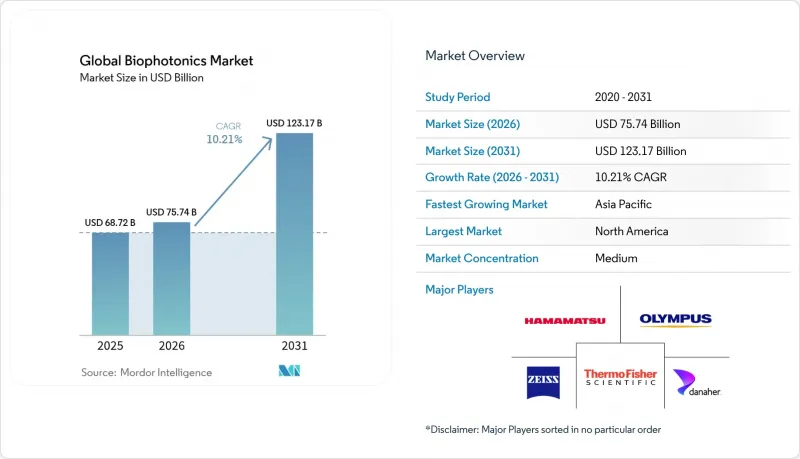
Mordor Intelligence에 따르면 2026년 바이오포토닉스 시장의 규모는 757억 4,000만 달러로 추정되고 있으며, 2025년 687억 2,000만 달러에서 확대하며, 2031년에는 1,231억 7,000만 달러에 달할 것으로 예측됩니다.
2026-2031년까지 연평균 성장률(CAGR) 10.21%로 성장할 것으로 전망됩니다.
이 보고서는 제품 유형(이미징 시스템 등), 기술(체외 및 생체 내), 용도(표면 이미징, 내부 이미징 등), 사용 방법(검사 및 부품, 의료 치료 등), 최종사용자(병원·클리닉 등), 지역(북미, 유럽, 아시아태평양 등)별로 분류되어 있습니다. 시장 전망은 금액(달러) 기준으로 제시되어 있습니다.
글로벌 바이오포토닉스 시장 동향 및 인사이트
진단 분야에서의 바이오포토닉스 활용 확대
기계학습을 통해 개선된 표면 증강 라만 분광법은 귀지 샘플을 이용한 두경부암 검출에서 87%의 균형 정확도를 달성했습니다. 광음향 단층촬영법은 뇌졸중 치료 중 혈관 모니터링을 실시간으로 실현합니다. 440-1,300 nm의 파장 범위에서 1 nm의 분해능을 실현하는 스마트폰용 분광계가 야외 진단을 가능하게 하고 있습니다. FDA는 근적외선 혈종 검출기에 대해 클래스 II 특별 관리 기준을 제정하여 광학 기법의 유효성을 입증했습니다. 6G 네트워크와의 통합을 통해 초저지연 전송이 가능해져, 즉각적인 임상 판단이 가능해집니다.
고령화 사회의 진전
65세 이상 고령자는 젊은 층에 비해 3-4배 더 많은 진단 처치가 필요하므로 장기적인 수요가 증가하고 있습니다. 근적외선 분광법은 5억 3,700만 명의 당뇨병 환자를 대상으로 한 연속 혈당 모니터링을 가능하게 합니다. 자가형광 이미징은 구강암 수술시 97%의 종양 없는 절제 경계를 확보합니다. 광생체 조절은 알츠하이머병 관리를 지원합니다. 고령화 추세는 정밀 의학과 맞물려 바이오포토닉 플랫폼의 보급을 지속시킬 것입니다.
인식도 부족과 숙련된 인력 부족
광학, 생물학, 데이터 과학 분야의 기술을 통합해야 하므로 학제 간 전문 지식의 부족이 도입을 저해하고 있습니다. 광학 진단에 익숙하지 않은 임상의들은 새로운 툴의 도입을 주저하는 경향이 있습니다. 대학들은 이 분야에 특화된 교육 과정 제공에 어려움을 겪고 있으며, 즉시 실무에 투입 가능한 인재 공급이 제한되고 있습니다. 규제 대응 문제도 상황을 더욱 복잡하게 만들고 있습니다. 센트럴 플로리다 대학의 전용 연구소는 기관 차원의 조기 대응 사례 중 하나입니다.
부문 분석
2025년, 레이저는 바이오포토닉스 시장 점유율의 35.88%를 차지하며, 이는 정밀한 광역학 치료 및 외과수술에서 레이저가 수행하는 역할을 반영합니다. 외과의사들이 수술 중 실시간 조직 특성 평가를 요구함에 따라 이미징 시스템은 제품군 중 가장 높은 연평균 성장률(CAGR)인 11.23%를 기록할 것으로 예측됩니다. 광섬유는 소형화 추세의 혜택을 받아 웨어러블 생체 센서를 주도하고 있습니다. 하이브리드 양자 센싱은 단일 분자 검출의 정확도를 향상시키고 있습니다. 칼 자이스는 포토닉스 사업부를 설립함으로써 기술력을 통합했습니다. 각 제조사는 비용 절감과 증가하는 생산량에 대응하기 위해 자동화 라인에 대한 투자를 추진하고 있습니다. 부품의 표준화가 진행됨에 따라 디바이스 인증 절차가 신속해지고 있습니다. 광학 기업과 AI 스타트업 간의 공동 연구개발을 통해 플랫폼 융합이 가속화되고 있습니다. 환경 모니터링 장비에서는 핵심이 되는 이미징 모듈이 재사용되고 있으며, 농업 및 수질 안전 분야에서 이에 대한 수요가 확대되고 있습니다.
시장에 진출한 기업은 새로운 광면역요법 프로토콜을 지원하기 위해 빔 품질과 펄스 안정성 향상에 주력하고 있습니다. 부품 공급업체들은 고출력 다이오드 레이저용 갈륨비소 웨이퍼의 생산 능력을 확대하고 있습니다. 이미징 시스템 공급업체들은 분석 시간을 단축하기 위해 클라우드 기반 분석 기능을 통합하고 있습니다. 이러한 시너지 효과로 인해 제품 분야의 리더십이 유지되는 동시에, 바이오포토닉스 시장 전체가 견고한 기반을 다지고 있습니다.
2025년, 확립된 실험실 워크플로우 덕분에 인비트로(체외) 플랫폼은 바이오포토닉스 시장 규모의 60.92%를 차지했습니다. 임상의들이 검체를 채취하지 않고도 실시간으로 조직 평가를 수행할 수 있는 저침습적 수술 유도 시스템을 선호함에 따라 인비보(생체 내) 시스템은 연평균 성장률(CAGR) 10.62%로 확대될 것으로 예측됩니다. 광음향 단층촬영법을 통해 현재는 두개골을 손상시키지 않고도 뇌혈관을 시각화할 수 있게 되었습니다. 광학 유도 기술을 통해 단 한 번의 천자로 뇌 생검을 수행할 때의 진단 성공률은 100%를 달성하고 있습니다. 규제 당국은 실시간 대응 기기를 위한 간소화된 승인 절차를 마련하고 있으며, 이는 상품화를 촉진하고 있습니다. 웨어러블 모니터는 IoT 네트워크로 연결되어 지속적인 데이터 전송을 실현하고 있습니다. 에너지 절약형 광원을 통해 기기의 작동 시간이 연장되고 있습니다. 병원에서는 생체 측정 데이터를 전자 차트에 통합함으로써 장기적인 치료의 질이 향상되고 있습니다. 스타트업 기업은 소형 콘솔을 활용하여 외래 수술 센터를 주요 타깃으로 삼고 있습니다. 새롭게 등장한 경피 프로브를 통해 대사 상태를 추적할 수 있게 됨에 따라 바이오포토닉스 시장의 성장 전망이 더욱 밝아지고 있습니다.
지역별 분석
북미는 2025년 바이오포토닉스 시장 점유율의 37.10%를 차지했습니다. 이는 성숙한 의료제도와, 방사선 최적화 시스템을 클래스 II로 분류하여 승인 절차를 신속하게 처리하는 FDA의 체계에 힘입은 결과입니다. 서모피셔(Thermo Fisher)는 국내 사업 확장을 위해 20억 달러를 투자하여 분석 장비 공급 체계를 강화했습니다. 메디케어(Medicare)의 보상 격차로 인해 일부 진단 기술의 도입이 제한되고 있습니다. 전문 센터에서는 광학 자궁경부암 검진의 보험 적용 범위가 확대되면서 수요가 유지되고 있습니다. 연구 지원금은 AI와 포토닉스의 융합을 지원하고 있는 반면, 해당 지역의 희토류 정책은 레이저 다이오드 원료 확보를 목적으로 하고 있습니다. 스타트업 기업이 휴대용 이미징 장치를 상용화함에 따라 경쟁이 심화되고 있으며, 이는 바이오포토닉스 시장의 추가적인 확장을 이끌고 있습니다.
유럽은 1,246억 유로 규모의 포토닉스 생태계에 힘입어 연평균 성장률(CAGR) 9.87%라는 견실한 성장세를 보이고 있습니다. 칼 자이스는 DORC 인수를 통해 매출의 15%를 연구개발에 재투자함으로써 안과용 제품 포트폴리오를 확충하고 있습니다. 의료기기 규정(MDR)은 기준의 조화를 초래하는 한편, 중소기업에게는 규정 준수 비용 증가 요인이 되고 있습니다. ‘호라이즌 유럽’의 자금 지원은 정밀농업을 우선시하며, 광학 센서 도입을 지원하고 있습니다. 국경을 초월한 학술 컨소시엄은 지역의 지속가능성 목표에 부합하도록 기술 검증을 강화하고 있습니다. 드레스덴의 반도체 연구소는 산업용 현미경 솔루션 개발을 가속화하여 시장의 깊이를 넓히고 있습니다.
아시아태평양은 연평균 성장률(CAGR) 10.96%를 기록하며 가장 빠르게 성장하는 지역입니다. 중국은 2024년에 41억 7,000만 달러를 바이오 제조 분야에 투자하며 주도적인 입지를 차지하고 있습니다. 상하이 교통대학교의 포토닉 칩 시범 생산 라인은 AI 및 양자 애플리케이션을 지원하고 있습니다. 일본의 3억 700만 달러 규모의 광학 칩 프로그램은 반도체 분야에서의 리더십을 목표로 하고 있습니다. 인도는 인프라 부족에도 불구하고 양자 포토닉스에 투자하고 있습니다. 현지 기업은 가격에 민감한 의료 서비스 제공자의 요구를 충족시키기 위해 저비용 레이저 광원에 중점을 두고 있습니다. 정부의 우대 조치로 진단용 광학 장비의 수입 관세가 인하되는 한편, 원격의료 구상을 통해 의료 서비스가 미치지 않는 지역에 모바일 분광기가 보급되고 있습니다. 동남아시아 전역에서 진료소가 급속히 건설되면서 수요가 가속화되고 있으며, 이는 바이오포토닉스 시장의 확장을 지원하고 있습니다.
기타 혜택:
- 엑셀 형식의 시장 예측(ME) 시트
- 3개월간의 애널리스트 지원
자주 묻는 질문
목차
제1장 서론
제2장 조사 방법
제3장 개요
제4장 시장 구도
제5장 시장 규모와 성장 예측
제6장 경쟁 구도
제7장 시장 기회와 향후 전망
KSA 26.09.04According to Mordor Intelligence, biophotonics market size in 2026 is estimated at USD 75.74 billion, growing from 2025 value of USD 68.72 billion with 2031 projections showing USD 123.17 billion, growing at 10.21% CAGR over 2026-2031.
This report is Segmented by Product Type (Imaging Systems and More), Technology (In-Vitro and In-Vivo), Application (Surface Imaging, Inside Imaging, and More), Usage (Tests and Components, Medical Therapeutics, and More), End-User (Hospitals & Clinics and More), and Geography (North America, Europe, Asia-Pacific, and More). The Market Forecasts are Provided in Terms of Value (USD).
Global Biophotonics Market Trends and Insights
Increasing Use of Biophotonics in Diagnostics
Surface-enhanced Raman spectroscopy improved with machine learning reaches 87% balanced accuracy for head and neck cancer detection using ear wax samples. Photoacoustic tomography supplies real-time vascular monitoring during stroke treatment. Smartphone spectrometers delivering 1 nm resolution across 440-1,300 nm open field diagnostics. The FDA created Class II special controls for near-infrared hematoma detectors, validating optical approaches. Integration with 6G networks offers ultra-low latency transmission for instant clinical decisions.
Growing Geriatric Population
Individuals aged 65 plus require three to four times more diagnostic procedures than younger cohorts, elevating long-term demand. Near-infrared spectroscopy enables continuous glucose monitoring, addressing 537 million diabetes cases. Autofluorescence imaging secures 97% tumor-free margins in oral cancer surgery. Photobiomodulation supports Alzheimer's management. Aging trends align with precision medicine to sustain biophotonic platform adoption.
Lack of Awareness & Skilled Personnel
Interdisciplinary expertise gaps slow adoption because staff must unite optics, biology, and data science skills. Clinicians unfamiliar with optical diagnostics hesitate to integrate new tools. Universities struggle to offer targeted curricula, limiting ready talent. Regulatory navigation adds complexity. Dedicated laboratories at the University of Central Florida reflect early institutional responses.
Other drivers and restraints analyzed in the detailed report include:
- Emergence of Nanotechnology in Biophotonics
- Advancements in Photo-acoustic Tomography (PAT)
- High Cost of Biophotonic Systems
For complete list of drivers and restraints, kindly check the Table Of Contents.
Segment Analysis
Lasers contributed 35.88% to the biophotonics market share in 2025, reflecting their role in precise photodynamic therapy and surgical work. Imaging systems are forecast to register an 11.23% CAGR, the highest among products, as surgeons seek real-time tissue characterization during operations. Fiber optics benefit from miniaturization trends, powering wearable biosensors. Hybrid quantum sensing improves single-molecule detection. Carl Zeiss consolidated capabilities by forming photonics business units. Manufacturers invest in automated lines to curb costs and meet growing volume. Greater component standardization speeds device certification. Collaborative R&D between optics firms and AI start-ups accelerates platform convergences. Environmental monitoring devices reuse core imaging modules, widening the addressable demand across agriculture and water safety.
Market participants refine beam quality and pulse stability to support emerging photoimmunotherapy protocols. Component vendors expand gallium arsenide wafer capacity for higher-power diode lasers. Imaging system suppliers integrate cloud-based analytics to cut interpretation time. The combined effect sustains product leadership while anchoring the broader biophotonics market.
In-vitro platforms maintained 60.92% of the biophotonics market size in 2025, thanks to established lab workflows. In-vivo systems are predicted to rise at a 10.62% CAGR as clinicians favor minimally invasive surgical guidance systems that provide real-time tissue assessment without specimen removal. Photoacoustic tomography now visualizes cerebral vessels through intact skulls. Optical guidance achieves 100% diagnostic success in single-insertion brain biopsies. Regulatory agencies outline streamlined pathways for real-time devices, aiding commercialization. Wearable monitors connect to IoT networks for continuous data feeds. Energy-efficient light sources extend device operating times. Hospitals integrate in vivo outputs into electronic health records, enhancing longitudinal care. Start-ups target ambulatory surgery centers with compact consoles. Emerging transdermal probes enable metabolic tracking, reinforcing expansion prospects for the biophotonics market.
Complete Report Scope:
- By Product Type
- Imaging Systems
- Lasers
- Fiber Optics
- Others
- By Technology
- In-Vitro
- In-Vivo
- By Application
- Surface Imaging
- Inside Imaging
- See-through Imaging
- Microscopy
- Biosensors
- Analytics Sensing
- Spectromolecular
- Light Therapy
- Optical Coherence Tomography
- By Usage
- Tests and Components
- Medical Therapeutics
- Medical Diagnostics
- Non-Medical Application
- By End-User
- Hospitals & Clinics
- Academic & Research Institutes
- Biotechnology & Pharma Companies
- Food-Quality Labs
- Other End-Users
- By Geography
- North America
- United States
- Canada
- Mexico
- Europe
- Germany
- United Kingdom
- France
- Italy
- Spain
- Rest of Europe
- Asia-Pacific
- China
- India
- Japan
- Australia
- South Korea
- Rest of Asia-Pacific
- Middle East and Africa
- GCC
- South Africa
- Rest of Middle East and Africa
- South America
- Brazil
- Argentina
- Rest of South America
- North America
Geography Analysis
North America commanded 37.10% of biophotonics market share in 2025, supported by a mature healthcare system and an FDA framework that now classifies radiological optimization systems under Class II for faster clearance. Thermo Fisher allocated USD 2 billion for domestic expansion, reinforcing analytical instrument supply. Medicare reimbursement gaps limit some diagnostic rollouts. Specialist centers gain coverage for optical cervical screening, sustaining demand. Research grants underpin AI-photonics convergence, while the region's rare-earth policies aim to secure laser diode inputs. Competition intensifies as start-ups commercialize handheld imaging, adding depth to the biophotonics market.
Europe posts a steady 9.87% CAGR, driven by a EUR 124.6 billion photonics ecosystem. Carl Zeiss advances ophthalmic portfolios by absorbing DORC and investing 15% of revenue back into R&D. The Medical Device Regulation harmonizes standards yet raises compliance costs for small firms. Horizon Europe funding prioritizes precision agriculture, lifting uptake of optical sensors. Cross-border academic consortia enhance technology validation, aligning with regional sustainability goals. Semiconductor laboratories in Dresden accelerate industrial microscopy solutions, extending market depth.
Asia-Pacific is the fastest-growing region at 10.96% CAGR. China leads with a USD 4.17 billion biomanufacturing infusion in 2024. Pilot photonic chip lines in Shanghai Jiao Tong University boost AI and quantum applications. Japan's USD 307 million optical chip program seeks semiconductor leadership. India invests in quantum photonics despite infrastructure gaps. Local firms emphasize low-cost laser sources to satisfy price-sensitive healthcare providers. Government incentives lower import taxes on diagnostic optics, while telehealth efforts spread mobile spectrometers to underserved zones. Rapid clinic construction across Southeast Asia accelerates demand, supporting expansion of the biophotonics market.
- Agilent Technologies
- Beckton Dickinson
- Bruker
- Canon
- Carl Zeiss
- Danaher
- FUJIFILM
- GE Healthcare
- Glenbrook Technologies, Inc.
- Hamamatsu Photonics
- IDEX
- IPG Photonics
- LUMICKS
- Olympus
- Oxford Instruments
- Revvity, Inc.
- Thermo Fisher Scientific
- Thorlabs
- Toshiba
- Zenalux Biomedical
Additional Benefits:
- The market estimate (ME) sheet in Excel format
- 3 months of analyst support
TABLE OF CONTENTS
1 Introduction
- 1.1 Study Assumptions & Market Definition
- 1.2 Scope of the Study
2 Research Methodology
3 Executive Summary
4 Market Landscape
- 4.1 Market Overview
- 4.2 Market Drivers
- 4.2.1 Increasing use of biophotonics in diagnostics
- 4.2.2 AI-enabled spectroscopy for rapid PoC testing
- 4.2.3 Growing geriatric population
- 4.2.4 Emergence of nanotechnology in biophotonics
- 4.2.5 Advancements in photo-acoustic tomography (PAT)
- 4.2.6 Precision-agriculture demand for biophotonic sensors
- 4.3 Market Restraints
- 4.3.1 Lack of awareness & skilled personnel
- 4.3.2 High cost of biophotonic systems
- 4.3.3 Stringent reimbursement frameworks
- 4.3.4 Rare-earth supply risk for laser diodes
- 4.4 Supply Chain Analysis
- 4.5 Regulatory Landscape
- 4.6 Technological Outlook
- 4.7 Porter's Five Forces Analysis
- 4.7.1 Threat of New Entrants
- 4.7.2 Bargaining Power of Buyers
- 4.7.3 Bargaining Power of Suppliers
- 4.7.4 Threat of Substitutes
- 4.7.5 Competitive Rivalry
5 Market Size & Growth Forecasts (Value)
- 5.1 By Product Type
- 5.1.1 Imaging Systems
- 5.1.2 Lasers
- 5.1.3 Fiber Optics
- 5.1.4 Others
- 5.2 By Technology
- 5.2.1 In-Vitro
- 5.2.2 In-Vivo
- 5.3 By Application
- 5.3.1 Surface Imaging
- 5.3.2 Inside Imaging
- 5.3.3 See-through Imaging
- 5.3.4 Microscopy
- 5.3.5 Biosensors
- 5.3.6 Analytics Sensing
- 5.3.7 Spectromolecular
- 5.3.8 Light Therapy
- 5.3.9 Optical Coherence Tomography
- 5.4 By Usage
- 5.4.1 Tests and Components
- 5.4.2 Medical Therapeutics
- 5.4.3 Medical Diagnostics
- 5.4.4 Non-Medical Application
- 5.5 By End-User
- 5.5.1 Hospitals & Clinics
- 5.5.2 Academic & Research Institutes
- 5.5.3 Biotechnology & Pharma Companies
- 5.5.4 Food-Quality Labs
- 5.5.5 Other End-Users
- 5.6 By Geography
- 5.6.1 North America
- 5.6.1.1 United States
- 5.6.1.2 Canada
- 5.6.1.3 Mexico
- 5.6.2 Europe
- 5.6.2.1 Germany
- 5.6.2.2 United Kingdom
- 5.6.2.3 France
- 5.6.2.4 Italy
- 5.6.2.5 Spain
- 5.6.2.6 Rest of Europe
- 5.6.3 Asia-Pacific
- 5.6.3.1 China
- 5.6.3.2 India
- 5.6.3.3 Japan
- 5.6.3.4 Australia
- 5.6.3.5 South Korea
- 5.6.3.6 Rest of Asia-Pacific
- 5.6.4 Middle East and Africa
- 5.6.4.1 GCC
- 5.6.4.2 South Africa
- 5.6.4.3 Rest of Middle East and Africa
- 5.6.5 South America
- 5.6.5.1 Brazil
- 5.6.5.2 Argentina
- 5.6.5.3 Rest of South America
- 5.6.1 North America
6 Competitive Landscape
- 6.1 Market Concentration
- 6.2 Competitive Benchmarking
- 6.3 Market Share Analysis
- 6.4 Company Profiles (includes Global level Overview, Market level overview, Core Segments, Financials as available, Strategic Information, Market Rank/Share for key companies, Products & Services, and Recent Developments)
- 6.4.1 Agilent Technologies, Inc.
- 6.4.2 Becton, Dickinson and Company
- 6.4.3 Bruker Corporation
- 6.4.4 Canon Medical Systems Corporation
- 6.4.5 Carl Zeiss AG
- 6.4.6 Danaher Corporation
- 6.4.7 FUJIFILM Corporation
- 6.4.8 GE Healthcare
- 6.4.9 Glenbrook Technologies, Inc.
- 6.4.10 Hamamatsu Photonics KK
- 6.4.11 IDEX Corporation
- 6.4.12 IPG Photonics Corporation
- 6.4.13 LUMICKS
- 6.4.14 Olympus Corporation
- 6.4.15 Oxford Instruments PLC
- 6.4.16 Revvity, Inc.
- 6.4.17 Thermo Fisher Scientific Inc.
- 6.4.18 Thorlabs, Inc.
- 6.4.19 Toshiba Corporation
- 6.4.20 Zenalux Biomedical Inc.
7 Market Opportunities & Future Outlook
- 7.1 White-space & Unmet-need Assessment