|
시장보고서
상품코드
2122293
주사기 시장 : 시장 점유율 분석, 업계 동향 및 통계, 성장 예측(2026-2031년)Syringes - Market Share Analysis, Industry Trends & Statistics, Growth Forecasts (2026 - 2031) |
||||||
 Mordor Intelligence
Mordor Intelligence에 의하면, 주사기 시장 규모는 2025년에 199억 6,000만 달러로 평가되었고, 2026년 215억 9,000만 달러에서 2031년까지 319억 4,000만 달러에 이를 것으로 예측되며, 예측 기간(2026-2031년) CAGR은 8.15%를 나타낼 전망입니다.

본 보고서는 용도별(재사용형 주사기 및 일회용 주사기), 제품 유형별(범용 및 특수), 소재별(유리, 플라스틱 등), 최종 사용자별(병원, 외래수술센터(ASC) 등), 용도별(당뇨병 등) 및 지역별(북미, 유럽, 아시아태평양 등)로 분류되어 있습니다. 시장 규모 및 전망은 금액(달러) 기준으로 제시되어 있습니다.
세계의 주사기 시장 동향 및 인사이트
만성 질환 및 감염병 부담 증가
세계 당뇨병 환자 수는 2045년까지 7억 8,300만 명에 달할 것으로 예측되며, 하루에 여러 번 주사를 투여할 수 있는 인슐린 투여 시스템에 대한 수요가 증가하고 있습니다. 점도가 높은 생물학적 제제의 경우, 잔류 폐기물을 최소화하는 데드 스페이스가 적은 주사기가 요구되므로, 수요량 증가에 더해 정밀도에 대한 요구도 수요를 더욱 끌어올리고 있습니다. 고령화에 따라 환자 1인당 주사 빈도가 증가하고 있어, 약제의 안정성을 유지하고 투여량의 정확성을 확보하는 첨단 주사기의 조달이 확대되고 있습니다. 특수한 형태의 주사기를 제조할 수 있는 제조업체는 바이오의약품 개발 기업과의 긴밀한 협력을 바탕으로 가격 프리미엄을 확보하고 있습니다. 제약 기업들도 병용 요법을 모색하고 있으며, 이로 인해 1회 치료당 단가가 상승하면서 만성 질환 치료에서 특수 주사기의 역할이 확고해지고 있습니다. 예측 기간 동안 만성 질환이라는 요인은 고소득 지역 전반에 걸쳐 꾸준하고 예측 가능한 판매량 증가를 뒷받침하는 동시에, 신흥 시장에서 프리미엄 디자인의 채택을 가속화할 것입니다.
대규모 백신 접종 프로그램의 확대
팬데믹 이후의 보건 정책에서는 대규모 예비 재고 확보가 제도화되어 있으며, 그 일례로 유니세프가 향후 캠페인을 대비해 10억 개의 주사기를 구매하여 현재도 재고로 보유하고 있다는 점을 들 수 있습니다. Gavi의 2026-2030년 로드맵에서는 긴급 예방접종 비축분에 5억 달러가 배정되어 있으며, 이는 WHO의 사전 승인 기준을 준수하는 자동 무효화 장치의 기준 수요를 확고히 하고 있습니다. 아프리카, 동남아시아, 라틴아메리카의 각국 정부는 수입 의존도를 줄이기 위해 현지 조립 라인에 투자하고 있으며, 이는 기존 공급업체에게 기술 이전의 기회가 되고 있습니다. 조달 모델에서는 장기적인 프레임워크 계약이 점점 더 중요해짐에 따라 생산 일정이 안정화되고, 공급업체는 대량 생산용 금형을 효과적으로 활용할 수 있게 됩니다. 표준화된 주사기 용량과 루어락 설계가 기본 사양으로 자리 잡으면서, 주요 일회용 제품 카테고리의 생산량이 더욱 집중되고 있습니다. 이러한 추세가 중기적으로 미치는 영향으로 인해 신뢰할 수 있는 재고 보충 주기가 확립되고, 안전성을 중시하여 설계된 제품군의 단가가 점진적으로 상승하게 될 것입니다.
안전 주사기의 높은 비용과 바늘 찔림 사고에 대한 우려
안전 설계가 적용된 모델의 소매 가격은 기존 제품의 2-3배에 달하기 때문에 예산에 제약이 있는 시설에서는 규제에 따라 더 안전한 기기의 사용이 권장되는 경우에도 전환에 소극적인 태도를 보이고 있습니다. 중저소득국의 중앙 의료 창고 입찰에서는 장기적인 상해 배상 책임을 상회하는 항목별 비용이 설정되어 있어 보급이 지연되고 있습니다. 제조 규모의 확대와 폴리머 가공의 자동화로 인해 단가 프리미엄은 서서히 축소되고 있지만, 대부분의 저소득국에서 가격 균등화가 실현되기까지는 아직 수년이 소요될 전망입니다. 의료기기의 비용을 잠재적인 소송 비용 절감분으로 상쇄하는 혁신적인 조달 메커니즘은 가치 제안을 재구성하는 데 도움이 됩니다. 임상 결과 데이터나 교육 패키지를 제공하는 공급업체는 총 소유 비용(TCO) 측면에서의 이점을 입증함으로써 가격 측면의 장벽을 완화하고 있습니다. 중기적으로는 규제 압력과 비용의 점진적인 수렴이 맞물려 이러한 제약의 영향은 제한적일 것으로 예측됩니다.
부문 분석
2025년에는 일회용 제품 시장 점유율이 주사기 시장의 88.74%를 차지했으며, 감염 관리의 중요성과 일회용 제품이 재고 주기에 주는 물류상의 이점이 부각되었습니다. 재사용 가능한 주사기 본체가 교차 오염 위험과 관련이 있다는 증거가 제시됨에 따라, 병원 프로토콜은 일회용 제품을 표준화했습니다. 또한, 기준을 충족하지 않는 수입품에 대한 FDA의 통지를 받아 이러한 전환은 가속화되었습니다. 단위 비용의 관점에서 보면, 대량 생산에 따른 금형 상각이 신속하게 이루어지기 때문에 일회용 제품이 유리하며, 반면 재사용 가능한 제품의 집중 멸균에는 여전히 막대한 노력이 필요합니다. BD사의 국내 사업 확대만으로도 연간 생산량은 6억 개 증가하여 일회용 제품공급 기반을 강화하게 될 것입니다.
현재 재사용 가능한 주사기는 수의학 수술이나 이미 오토클레이브를 통한 멸균이 이루어지고 있는 일부 자원이 제한된 환경 등 틈새 시장에서 역할을 담당하고 있습니다. 이러한 분야에서도 기부 기관들이 더욱 엄격한 안전 기준을 적용함에 따라, 보조금을 통한 일회용 제품으로의 전환이 진행되고 있습니다. 교육 자료, 규제 감사, 전자 재고 관리 플랫폼에서는 일회용 제품을 활용한 워크플로가 점점 더 기본 전제로 자리 잡고 있습니다. 그 결과, 공급업체가 일회용 제품의 혁신을 우선시하고 임상의가 일회용 프로토콜에 익숙해지는 선순환이 형성되어, 주사기 시장 전체에서 이 카테고리의 주도적 입지가 더욱 공고해지고 있습니다.
범용 기기는 일상적인 주사, 백신 접종 캠페인, 저점도 치료에 대한 공급을 통해 2025년에도 매출 점유율 64.62%를 유지했습니다. 특수 주사기(프리필형, 안전 설계형, 데드 스페이스가 적은 모델 등)는 연평균 성장률(CAGR) 9.05%를 나타낼 것으로 예측되며, 이는 모든 제품 카테고리 중 가장 높은 성장률입니다. 이 부문의 성장은 제약 업계의 바이오의약품에 대한 투자를 반영한 것으로, GLP-1 작용제, mRNA 치료제, CAR-T 주입액 등은 고정밀 용기가 필요합니다. 노스캐롤라이나주에 위치한 SCHOTT Pharma의 3억 7,100만 달러 규모의 시설은 이러한 첨단 제형에 대응하기 위해 생산 능력을 강화한 사례 중 하나입니다.
특수 유닛은 범용 배럴에 비해 20-150%의 가격 프리미엄이 붙어, 수지 비용 변동으로부터 공급업체를 보호하고 있습니다. 또한 내장형 바늘 안전 시스나 RFID 태그 등 기기의 복잡성도 지적 재산권에 의한 경쟁 우위(모트)를 창출하고 있습니다. 수탁 제조업체들은 각 분자에 맞추어 플런저 스토퍼나 실리콘 오일 코팅을 맞춤 제작하고 있으며, 이를 통해 공급업체들은 제약 산업의 밸류체인에 더욱 깊이 통합되고 있습니다. 그 결과, 특수 형식은 상대적으로 큰 가치를 확보하며 주사기 시장의 기술 로드맵을 형성하고 있습니다.
지역별 분석
2025년, 북미는 주사기 시장 매출의 39.12%를 차지했습니다. 이는 1인당 의료비 수준이 높고, 바이오의약품의 조기 도입, 그리고 대부분의 임상 워크플로우에서 안전 장치의 사용이 의무화된 데 힘입은 결과입니다. BD사가 미국 내 여러 공장을 업그레이드하여 리드타임을 40% 단축하는 동시에, FDA의 더욱 엄격해진 추적 및 추적 가능성 요건을 충족하는 생산 능력을 확충함에 따라, 국내로의 생산 복귀(리쇼어링)가 가속화되고 있습니다. 팬데믹 대책과 관련된 연방 정부의 자금 지원 조치는 충전 및 마무리(필-피니시) 인프라 확충을 더욱 촉진하여 특수 주사기에 대한 하류 수요를 확실히 뒷받침하고 있습니다.
아시아태평양은 급속히 확대되는 중산층 인구와 만성 질환 치료제 비용을 지원하는 정부의 의료 개혁에 힘입어 8.95%라는 지역별 최고 연평균 성장률(CAGR)을 기록하고 있습니다. 일본과 한국은 고부가가치 생물학적 제제의 충전 및 마무리 작업의 중심지인 반면, 인도와 베트남은 예방접종 프로그램을 위해 대량의 범용 일회용 제품을 흡수하고 있습니다. FDA의 품질 경고에 따른 중국 공장에 대한 규제 당국의 감시 강화로 인해, 다국적 제약 기업들은 규정 준수 실적이 우수한 아세안(ASEAN) 공급업체로 공급원을 다각화하고 있습니다. 이러한 다각화 전략으로 인해 수주가 재분배되고, 지역의 품질에 대한 기대치 기준이 높아지고 있습니다.
유럽은 안전성과 지속가능성을 평가하는 종합적인 환급 체계에 힘입어 특수 제형 및 친환경 설계 분야에서 선도적인 위치를 유지하고 있습니다. 게레스하이머(Geresheimer)사의 독일 생산 라인에서는 EU의 엄격한 재활용 소재 함유율 기준을 충족하는 사이클로올레핀 폴리머 재질의 주사기 배럴을 제공하고 있어, 유럽의 구매자들은 소재 등급을 변경하지 않고도 규정을 준수하는 대안을 선택할 수 있습니다. 중동 및 아프리카 및 남미는 백신 접종 확대와 병원 인프라 개선에 힘입어 주사기에 대한 수요가 꾸준히 증가하고 있는 신흥 성장 지역입니다. 그러나 환율 변동과 규제 조화가 미흡한 점이 이 지역들의 투자 속도를 둔화시키고 있습니다.
기타 혜택 :
- 엑셀 형식 시장 예측(ME) 시트
- 3개월간의 애널리스트 지원
자주 묻는 질문
목차
제1장 서론
제2장 조사 방법
제3장 주요 요약
제4장 시장 구도
제5장 시장 규모 및 성장 예측
제6장 경쟁 구도
제7장 시장 기회 및 향후 전망
AJY 26.09.07According to Mordor Intelligence, the syringes market size was valued at USD 19.96 billion in 2025 and estimated to grow from USD 21.59 billion in 2026 to reach USD 31.94 billion by 2031, at a CAGR of 8.15% during the forecast period (2026-2031).
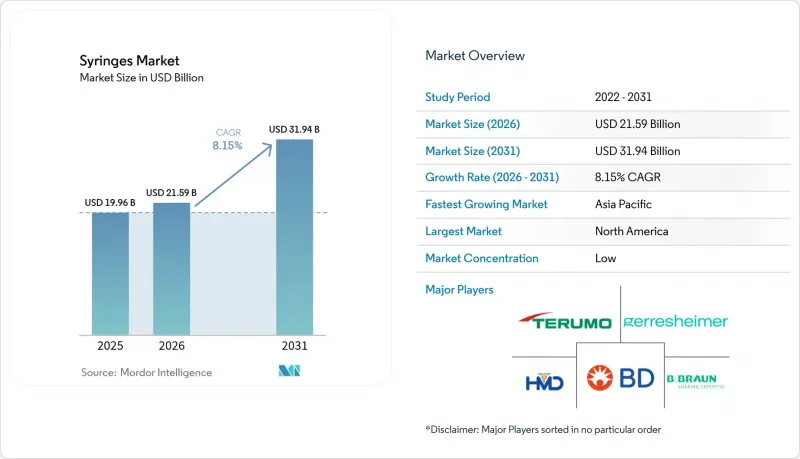
This report is Segmented by Usage (Reusable Syringes and Disposable Syringes), Product Type (General Purpose and Specialized ), Material (Glass, Plastic, and More), End User (Hospitals, Ambulatory Surgery Centers, and More), Application (Diabetes and More) and Geography (North America, Europe, Asia-Pacific, and More). The Market and Forecasts are Provided in Terms of Value (USD).
Global Syringes Market Trends and Insights
Rising Burden of Chronic & Infectious Diseases
Global diabetes cases are projected to reach 783 million by 2045, intensifying demand for insulin delivery systems that support multiple daily injections. The volume effect is amplified by precision needs because viscous biologics require low-dead-space barrels that limit residual waste . Aging demographics raise injection frequency per patient, driving procurement of advanced syringes that maintain drug stability and ensure dose accuracy. Manufacturers capable of producing specialized formats command price premiums, benefiting from tight alignment with biologics developers. Pharma companies also explore combination therapies, increasing unit value per treatment episode and cementing the role of specialty syringes in chronic-disease care. Over the forecast horizon, the chronic-disease driver will reinforce steady, predictable volume growth across high-income regions while accelerating adoption of premium designs in emerging markets.
Growth in Mass-Vaccination Programs
Post-pandemic health policy now institutionalizes large buffer inventories, evidenced by UNICEF's purchase of 1 billion syringes that remain in stock for future campaigns. Gavi's 2026-2030 roadmap earmarks USD 500 million for emergency immunization reserves, anchoring baseline demand for auto-disable devices that conform to WHO pre-qualification standards. Governments in Africa, Southeast Asia, and Latin America invest in local assembly lines to mitigate import dependence, presenting technology-transfer opportunities for established suppliers. Procurement models increasingly emphasize long-term framework agreements, stabilizing production schedules and enabling suppliers to leverage high-volume tooling. Standardized barrel volumes and luer-lock designs emerge as default specifications, further concentrating volume in dominant disposable categories. The driver's medium-term influence translates into reliable replenishment cycles and incremental unit-price uplift for safety-engineered variants.
High Cost of Safety Syringes & Needlestick-Injury Concerns
Safety-engineered models retail at 2-3 times the price of conventional variants, making budget-constrained facilities reluctant to switch even when regulations recommend safer devices. Central-medical-store tenders in lower-middle-income countries line-item cost above long-term injury liabilities, delaying widespread adoption. Manufacturing scale and polymer automation are gradually compressing unit premiums, but price parity remains several years away for most low-income settings. Innovative procurement mechanisms that amortize device cost against potential litigation savings help reframe the value proposition. Suppliers offering clinical-outcome data and training bundles demonstrate total cost-of-ownership benefits, easing affordability barriers. Over the medium term, combined regulatory pressure and gradual cost convergence are expected to limit the restraint's impact.
Other drivers and restraints analyzed in the detailed report include:
- Self-Administration Trend & Dose Precision Demand
- Regulatory Push for Safety & Smart Syringes
- Alternative Drug-Delivery Technologies
For complete list of drivers and restraints, kindly check the Table Of Contents.
Segment Analysis
Disposable formats held 88.74% of syringes market share in 2025, underscoring infection-control imperatives and the logistical advantage of single-use inventory cycles. Hospital protocols standardized on disposable devices after evidence linked reusable barrels to cross-contamination risks, and the shift accelerated following FDA notices on sub-standard imports . Unit-cost economics favor disposables because high-volume molding amortizes tooling quickly, while central sterilization of reusables remains labor-intensive. BD's domestic expansion alone will boost annual output by 600 million units, reinforcing the disposable supply backbone.
Reusable syringes now occupy niche roles such as veterinary surgeries and select low-resource settings where sterilization autoclaves are already in use. Even in those arenas, grant-funded upgrades to single-use devices are progressing as donors apply stricter safety metrics. Training materials, regulatory audits, and electronic inventory platforms increasingly presume disposable workflows. The result is a self-reinforcing cycle where suppliers prioritize disposable innovation and clinicians build familiarity with single-use protocols, further entrenching category leadership across the syringes market.
General-purpose devices retained 64.62% revenue share in 2025 by supplying routine injections, vaccine campaigns, and low-viscosity therapies. Specialized syringes-prefillable, safety-engineered, and low-dead-space models-are projected to post a 9.05% CAGR, the fastest among all product categories. The segment's expansion mirrors pharma's biologics investment, with GLP-1 agonists, mRNA therapeutics, and CAR-T infusions depending on high-precision containers. SCHOTT Pharma's USD 371 million facility in North Carolina exemplifies capacity added to satisfy these advanced formats.
Specialized units command price premiums of 20-150% over commoditized barrels, cushioning suppliers from resin cost volatility. Device complexity, including built-in needle-safety sheaths and RFID tags, also creates intellectual-property moats. Contract manufacturers tailor plunger stoppers and silicone-oil coatings to each molecule, embedding suppliers deeper into pharma value chains. Consequently, specialized formats capture disproportionate value and shape the technology roadmap for the syringes market.
Complete Report Scope:
- By Usage
- Reusable Syringes
- Disposable Syringes
- By Product Type
- General Purpose
- Specialized
- By Material
- Glass
- Plastic
- Others
- By End User
- Hospitals
- Ambulatory Surgery Centers
- Home-care
- Others
- By Application
- Diabetes
- Vaccination & Immunization
- Botox / Aesthetic
- Osteoarthritis
- Human Growth Hormone
- Others
- By Geography
- North America
- United States
- Canada
- Mexico
- Europe
- Germany
- United Kingdom
- France
- Italy
- Spain
- Rest of Europe
- Asia-Pacific
- China
- Japan
- India
- Australia
- South Korea
- Rest of Asia-Pacific
- Middle East and Africa
- GCC
- South Africa
- Rest of Middle East and Africa
- South America
- Brazil
- Argentina
- Rest of South America
- North America
Geography Analysis
North America controlled 39.12% of syringes market revenue in 2025, propelled by high per-capita healthcare spending, early biologic adoption, and mandatory safety-device use in most clinical workflows. Domestic reshoring accelerates as BD upgrades multiple U.S. plants, adding capacity that cuts lead times by 40% and meets stricter FDA track-and-trace mandates. Federal funding incentives, tied to pandemic preparedness, further underwrite expansion of fill-finish infrastructure, ensuring downstream demand for specialized syringes.
Asia-Pacific delivers the fastest regional CAGR at 8.95%, underpinned by rapidly expanding middle-class populations and government healthcare reforms that subsidize chronic-disease medications. Japan and South Korea anchor high-value biologic fill-finish activities, while India and Vietnam absorb large volumes of commodity disposables for immunization programs. Regulatory scrutiny of Chinese plants-sparked by FDA quality alerts-drives multinational pharma to diversify toward ASEAN suppliers with higher compliance credentials. This diversification strategy redistributes orders and sets a higher baseline for regional quality expectations.
Europe retains a stronghold in specialized formats and eco-design leadership, buoyed by comprehensive reimbursement frameworks that reward safety and sustainability. Gerresheimer's German production lines offer cyclo-olefin-polymer barrels that meet stringent EU recyclable-content thresholds, giving European buyers compliant options without switching material classes. Middle East and Africa, along with South America, represent emerging opportunity corridors where vaccination rollouts and improving hospital infrastructures drive steady syringe demand. Nevertheless, currency volatility and slower regulatory harmonization temper investment speed in those regions.
- Becton Dickinson & Co.
- Terumo Corp.
- B. Braun
- Nipro Corp.
- Gerresheimer
- Hindustan Syringes & Medical Devices
- Cardinal Health
- SCHOTT
- West Pharmaceutical Services
- Stevanato Group
- Retractable Technologies
- Smiths Group
- Sol-Millennium Medical
- Baxter
- Owen Mumford
- Catalent Pharma Solutions
- M.C. Johnson Co.
- Changzhou Mingle Medical
- Hi-Tech Syringes
- West (Daikyo)
Additional Benefits:
- The market estimate (ME) sheet in Excel format
- 3 months of analyst support
TABLE OF CONTENTS
1 Introduction
- 1.1 Study Assumptions & Market Definition
- 1.2 Scope of the Study
2 Research Methodology
3 Executive Summary
4 Market Landscape
- 4.1 Market Overview
- 4.2 Market Drivers
- 4.2.1 Rising burden of chronic & infectious diseases
- 4.2.2 Growth in mass-vaccination programs
- 4.2.3 Self-administration trend & dose-precision demand
- 4.2.4 Regulatory push for safety & smart syringes
- 4.2.5 Rapid uptake of low-dead-space syringes for cell & gene therapy
- 4.2.6 RFID-enabled waste-traceability boosting smart syringes adoption
- 4.3 Market Restraints
- 4.3.1 High cost of safety syringes & needlestick-injury concerns
- 4.3.2 Alternative drug-delivery (patches, pumps, inhalers)
- 4.3.3 Plastic-medical-waste compliance costs
- 4.3.4 Borosilicate glass-tubing shortages for prefillable formats
- 4.4 Regulatory Landscape
- 4.5 Technological Outlook
- 4.6 Porters Five Forces Analysis
- 4.6.1 Threat of New Entrants
- 4.6.2 Bargaining Power of Buyers
- 4.6.3 Bargaining Power of Suppliers
- 4.6.4 Threat of Substitutes
- 4.6.5 Competitive Rivalry
5 Market Size & Growth Forecasts (Value, USD)
- 5.1 By Usage
- 5.1.1 Reusable Syringes
- 5.1.2 Disposable Syringes
- 5.2 By Product Type
- 5.2.1 General Purpose
- 5.2.2 Specialized
- 5.3 By Material
- 5.3.1 Glass
- 5.3.2 Plastic
- 5.3.3 Others
- 5.4 By End User
- 5.4.1 Hospitals
- 5.4.2 Ambulatory Surgery Centers
- 5.4.3 Home-care
- 5.4.4 Others
- 5.5 By Application
- 5.5.1 Diabetes
- 5.5.2 Vaccination & Immunization
- 5.5.3 Botox / Aesthetic
- 5.5.4 Osteoarthritis
- 5.5.5 Human Growth Hormone
- 5.5.6 Others
- 5.6 By Geography
- 5.6.1 North America
- 5.6.1.1 United States
- 5.6.1.2 Canada
- 5.6.1.3 Mexico
- 5.6.2 Europe
- 5.6.2.1 Germany
- 5.6.2.2 United Kingdom
- 5.6.2.3 France
- 5.6.2.4 Italy
- 5.6.2.5 Spain
- 5.6.2.6 Rest of Europe
- 5.6.3 Asia-Pacific
- 5.6.3.1 China
- 5.6.3.2 Japan
- 5.6.3.3 India
- 5.6.3.4 Australia
- 5.6.3.5 South Korea
- 5.6.3.6 Rest of Asia-Pacific
- 5.6.4 Middle East and Africa
- 5.6.4.1 GCC
- 5.6.4.2 South Africa
- 5.6.4.3 Rest of Middle East and Africa
- 5.6.5 South America
- 5.6.5.1 Brazil
- 5.6.5.2 Argentina
- 5.6.5.3 Rest of South America
- 5.6.1 North America
6 Competitive Landscape
- 6.1 Market Concentration
- 6.2 Market Share Analysis
- 6.3 Company Profiles (includes Global level Overview, Market level overview, Core Segments, Financials as available, Strategic Information, Market Rank/Share for key companies, Products & Services, and Recent Developments)
- 6.3.1 Becton Dickinson & Co.
- 6.3.2 Terumo Corp.
- 6.3.3 B. Braun Melsungen AG
- 6.3.4 Nipro Corp.
- 6.3.5 Gerresheimer AG
- 6.3.6 Hindustan Syringes & Medical Devices
- 6.3.7 Cardinal Health Inc.
- 6.3.8 Schott AG
- 6.3.9 West Pharmaceutical Services
- 6.3.10 Stevanato Group
- 6.3.11 Retractable Technologies Inc.
- 6.3.12 Smiths Medical (ICU Medical)
- 6.3.13 Sol-Millennium Medical
- 6.3.14 Baxter International Inc.
- 6.3.15 Owen Mumford Ltd.
- 6.3.16 Catalent Pharma Solutions
- 6.3.17 M.C. Johnson Co.
- 6.3.18 Changzhou Mingle Medical
- 6.3.19 Hi-Tech Syringes
- 6.3.20 West (Daikyo)
7 Market Opportunities & Future Outlook
- 7.1 White-space & Unmet-Need Assessment