

|
시장보고서
상품코드
2122313
HVAC 서비스 시장 : 시장 점유율 분석, 업계 동향 및 통계, 성장 예측(2026-2031년)HVAC Services - Market Share Analysis, Industry Trends & Statistics, Growth Forecasts (2026 - 2031) |
||||||
 Mordor Intelligence
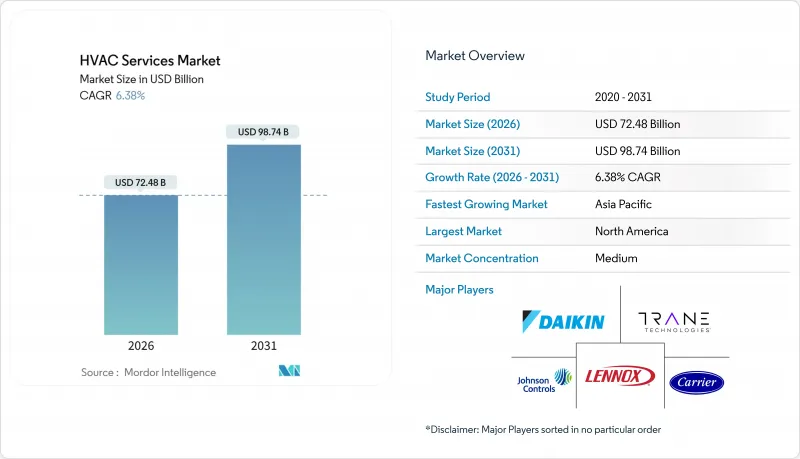
Mordor Intelligence에 의하면, HVAC 서비스 시장 규모는 2026년에 724억 8,000만 달러로 추정되고, 2031년까지 987억 4,000만 달러에 이를 것으로 예측됩니다.
이는 연평균 성장률(CAGR) 6.38%에 해당합니다.
본 보고서는 도입 형태별(신축 및 리모델링 건물), 서비스 유형별(설치·교체 등), 시스템 유형별(난방, 냉방 등), 최종 사용자별(주거, 상업, 산업), 용도 분야별(데이터센터 등) 및 지역별로 분류되어 있습니다. 시장 전망은 금액(달러) 기준으로 제시되어 있습니다.
세계의 HVAC 서비스 시장 동향 및 인사이트
신흥 경제국에서의 건설 활동 확대
인도 및 걸프협력회의(GCC) 지역의 견조한 유틸리티 파이프라인이 신규 설치 수요를 뒷받침하고 있습니다. 인도의 건설 부문은 정부의 도시 주택 계획에 힘입어 2026 회계연도에 8-10%의 성장이 예상됩니다. GCC에는 3조 달러 규모의 미집행 프로젝트가 있으며, NEOM과 같은 메가 프로젝트에서는 지역 냉방 플랜트가 필요로 되어, 이것이 장기적인 서비스 기회를 창출하고 있습니다. 개발업자들은 그린 빌딩 인증을 획득하기 위해 가변 냉매 유량(VRF) 시스템을 사전 사양에 포함시키고 있으며, 현지 조달 규정에 따라 다국적 공급업체들은 국내에 지원 거점을 설립해야 하는 압박을 받고 있습니다. 이러한 요인으로 인해 기존 공급망은 세분화되었으며, 현지 조달 기준과 언어에 정통한 지역 계약업체들이 유리한 입지를 점하고 있습니다.
하이퍼스케일 데이터센터 건설 확대
GPU가 밀집된 클러스터는 랙당 100kW를 초과하는 열 부하를 발생시키기 때문에 운영자는 액체 냉각 도입을 추진하고 있습니다. 마이크로소프트는 2025년에 ‘직접 투 칩(Direct-to-Chip)’ 냉각을 도입하고, 한편 구글은 리어 도어식 열교환기를 도입했으나, 두 경우 모두 전용 칠러의 개조가 필요합니다. 벤더들은 전력 사용 효율(PUE) 지표와 연계된 가동 시간 기반 계약을 협상하고 있으며, 지속적인 모니터링에 대한 투자를 피할 수 없게 된 제공업체로 위험이 전가되고 있습니다. 국제에너지기구(IEA)는 2030년까지 데이터센터의 전력 수요가 2배로 증가할 것으로 예측하고 있으며, 이는 전력망의 부하를 평준화하는 열 저장 프로젝트의 병행 성장을 의미합니다.
숙련된 인력 부족과 인건비 급등
미국에서는 2025년에 HVAC 기술자 미충원 자리가 11만 건을 기록했는데, 이는 중앙값 임금이 12% 상승하여 5만 7,300달러에 도달했음에도 불구하고 발생한 현상입니다. 은퇴로 인한 인력 감소와 제한된 이민 유입이 이러한 제약을 더욱 심화시키고 있으며, 독일에서는 메카트로닉스 관련 직종의 공석률이 15%에 달하는 것으로 보고되고 있습니다. 수습 제도만으로는 적어도 3년 동안은 충분히 훈련된 인재를 배출할 수 없을 전망이며, 서비스 수익의 절반 이상을 인건비가 차지하고 있어 도급업체의 이익률이 압박을 받게 될 것입니다.
지역별 분석
북미는 2조 1,000억 달러에 달하는 미뤄진 건물 유지보수 미처리 건에 힘입어 2025년 매출의 38.17%를 차지했습니다. 수명 15년을 초과한 노후화된 시스템이 교체 수요를 견인하고 있지만, 기술자 부족과 인허가 절차 지연으로 인해 프로젝트 주기가 장기화되고 있습니다. AIM법에 따라 냉매의 단계적 폐지가 가속화되고 있으며, 캘리포니아주의 타이틀 24 규제는 향후 히트펌프로의 개조를 촉진하고 있습니다. 2025년 캐나다의 탄소 가격(1톤당 80캐나다 달러 = 59달러)은 천연가스 보일러에서 열펌프로의 전환을 촉진하고 있지만, 앨버타주의 송전망 제약으로 인해 열펌프 도입은 억제되고 있습니다. 멕시코의 니어쇼어링 열풍으로 인해 2025년 산업용 HVAC 수요는 18% 증가했습니다.
아시아태평양은 인도의 두 자릿수 건설 성장과 중국의 4억 m²에 달하는 지역 냉방 네트워크에 힘입어 2031년까지 연평균 성장률(CAGR) 7.90%를 나타낼 것으로 예측됩니다. 일본에서는 고령화가 진행됨에 따라 원격 모니터링 기능을 갖춘 주거용 히트 펌프의 도입이 진행되고 있는 반면, 동남아시아에서는 높은 전기 요금으로 인해 소유주들이 축열 전략을 채택하도록 유도하고 있습니다. 호주의 2025년 건축 기준법에서는 주택 전체의 에너지 예산이 도입되었으며, 서비스 제공업체는 통합적인 에너지 효율 감사를 실시해야 할 의무가 있습니다.
유럽의 개정 건축 성능 지침에서는 2050년까지 기존 건축물의 탄소 중립 달성이 요구되고 있어, 개보수 공사의 가속화가 시급합니다. 독일에서는 1980년 이전에 건설된 2,100만 호의 주택이 2,000억 유로(2,200억 달러) 규모의 히트펌프 도입 기회를 내포하고 있지만, 설치 업체의 미처리 수주 물량으로 인해 진행 속도가 둔화되고 있습니다. 영국의 7,500파운드(9,450달러) 히트펌프 보조금 제도는 에너지 가격 격차가 여전히 존재하기 때문에 도입 목표를 아직 달성하지 못하고 있습니다. 중동의 GCC 국가들에서는 메가 프로젝트를 위한 지역 냉방 시스템 도입이 진행되고 있는 반면, 라틴아메리카에서는 통화 약세로 인해 수입이 저해되고 있어 브라질의 인버터식 에어컨과 아르헨티나의 현지 조립 제품이 성장을 주도하고 있습니다.
기타 혜택 :
- 엑셀 형식 시장 예측(ME) 시트
- 3개월간의 애널리스트 지원
자주 묻는 질문
목차
제1장 서론
제2장 조사 방법
제3장 주요 요약
제4장 시장 구도
제5장 시장 규모 및 성장 예측
제6장 경쟁 구도
제7장 시장 기회 및 향후 전망
AJY 26.09.07According to Mordor Intelligence, the HVAC services market size is valued at USD 72.48 billion in 2026 and is projected to reach USD 98.74 billion by 2031, reflecting a 6.38% CAGR.
This report is Segmented by Implementation Type (New Construction and Retrofit Buildings), Service Type (Installation and Replacement, and More), System Type (Heating, Cooling, and More), End User (Residential, Commercial, and Industrial), Application Vertical (Data Centers, and More), and Geography. The Market Forecasts are Provided in Terms of Value (USD).
Global HVAC Services Market Trends and Insights
Growing Construction Activity in Emerging Economies
Robust public-works pipelines in India and the Gulf Cooperation Council (GCC) are sustaining new installation demand. India's construction sector is expanding by 8-10% in fiscal 2026, supported by government urban housing schemes. The GCC maintains a USD 3 trillion project backlog, and megaprojects such as NEOM require district-cooling plants that open long-term service opportunities. Developers are pre-specifying variable-refrigerant-flow systems to secure green-building certifications, and local-content rules are pushing multinational vendors to establish in-country support hubs. These factors are fragmenting traditional supply chains and favoring regional contractors fluent in local procurement norms and languages.
Expansion of Hyperscale Data-Center Build-Outs
GPU-dense clusters generate thermal loads exceeding 100 kW per rack, prompting operators to adopt liquid cooling. Microsoft introduced direct-to-chip cooling in 2025, while Google deployed rear-door heat exchangers, each requiring specialized chiller retrofits. Service vendors are negotiating uptime-based contracts tied to power-usage-effectiveness metrics, shifting risk to providers that must invest in continuous monitoring. The International Energy Agency projects data-center electricity demand to double by 2030, implying parallel growth in thermal-storage projects that flatten grid loads.
Skilled-Labor Shortages and Escalating Wage Bills
The United States recorded 110,000 unfilled HVAC technician posts in 2025 despite a 12% median-wage rise to USD 57,300. Retirement-driven attrition and limited immigration inflows intensify constraints, and Germany reports a 15% vacancy rate for mechatronics roles. Apprenticeship programs will not yield fully trained personnel for at least 3 years, squeezing contractor margins, as labor costs account for more than half of service revenue.
Other drivers and restraints analyzed in the detailed report include:
- Mandatory Refrigerant Phase-Downs Driving Retrofit Demand
- Remote Diagnostics and Robotics Lowering Service Costs
- Volatile HVAC Component Supply and Material Inflation
For complete list of drivers and restraints, kindly check the Table Of Contents.
Geography Analysis
North America delivered 38.17% of 2025 revenue, supported by a USD 2.1 trillion backlog of deferred building maintenance. Aging systems exceeding 15 years of service life are driving replacement demand, yet technician shortages and permitting delays lengthen project cycles. The AIM Act accelerates refrigerant phase-outs, and California's Title 24 rules seed future heat-pump retrofits. Canada's carbon price of CAD 80 (USD 59) per ton in 2025 encourages natural-gas boiler conversions, though grid constraints in Alberta temper heat-pump deployment. Mexico's nearshoring wave lifted industrial HVAC demand by 18% in 2025.
Asia-Pacific is forecast to post a 7.90% CAGR to 2031, led by India's double-digit construction growth and China's 400 million m2 of district-cooling networks. Japan's aging demographics spur the adoption of residential heat pumps with remote monitoring, while Southeast Asia's high electricity tariffs push owners toward thermal-storage strategies. Australia's 2025 building code adopts whole-of-home energy budgets, forcing service providers to deliver integrated efficiency audits.
Europe's revised building-performance directive requires zero-emission stock by 2050, compelling accelerated retrofits. Germany's 21 million pre-1980 homes face a EUR 200 billion (USD 220 billion) heat-pump opportunity, although installer backlogs slow progress. The United Kingdom's GBP 7,500 (USD 9,450) heat-pump grants have yet to meet adoption targets due to persistent energy-price differentials. Middle Eastern GCC nations continue to roll out district-cooling for megaprojects, whereas Latin American growth is led by Brazilian inverter air conditioners and Argentine local assembly as currency depreciation hampers imports.
- Johnson Controls International PLC
- Carrier Global Corporation
- Daikin Industries Ltd.
- Trane Technologies PLC
- Lennox International Inc.
- Honeywell International Inc.
- Siemens AG
- LG Electronics Inc.
- Electrolux AB
- Robert Bosch GmbH
- Fujitsu General Ltd.
- Nortek Global HVAC
- Mitsubishi Electric Corporation
- Rheem Manufacturing Company
- Danfoss A/S
- GREE Electric Appliances Inc.
- Midea Group Co. Ltd.
- Johnson Service Group PLC
- Comfort Systems USA Inc.
- EMCOR Group Inc.
Additional Benefits:
- The market estimate (ME) sheet in Excel format
- 3 months of analyst support
TABLE OF CONTENTS
1 INTRODUCTION
- 1.1 Study Assumptions and Market Definition
- 1.2 Scope of the Study
2 RESEARCH METHODOLOGY
3 EXECUTIVE SUMMARY
4 MARKET LANDSCAPE
- 4.1 Market Overview
- 4.2 Market Drivers
- 4.2.1 Growing Construction Activity in Emerging Economies
- 4.2.2 Expansion of Hyperscale Data-Center Build-Outs
- 4.2.3 Mandatory Refrigerant Phase-Downs Driving Retrofit Demand
- 4.2.4 Aging Building Stock in OECD Markets Requiring Upgrades
- 4.2.5 Remote Diagnostics and Robotics Lowering Service Costs
- 4.2.6 HVAC-as-a-Service Contracts Unlocking Annuity Revenues
- 4.3 Market Restraints
- 4.3.1 Skilled-Labor Shortages and Escalating Wage Bills
- 4.3.2 Volatile HVAC Component Supply and Material Inflation
- 4.3.3 Cyber-Security Risks in Connected Building Systems
- 4.3.4 Subscription-Based Disruptors Compressing Margins
- 4.4 Industry Value-Chain Analysis
- 4.5 Regulatory Landscape
- 4.6 Technological Outlook
- 4.7 Impact of Macroeconomic Factors on the Market
- 4.8 Porter's Five Forces Analysis
- 4.8.1 Bargaining Power of Suppliers
- 4.8.2 Bargaining Power of Buyers
- 4.8.3 Threat of New Entrants
- 4.8.4 Threat of Substitutes
- 4.8.5 Intensity of Competitive Rivalry
- 4.9 Investment and M&A Landscape
5 MARKET SIZE AND GROWTH FORECASTS (VALUE)
- 5.1 By Implementation Type
- 5.1.1 New Construction
- 5.1.2 Retrofit Buildings
- 5.2 By Service Type
- 5.2.1 Installation and Replacement Services
- 5.2.2 Maintenance and Repair Services
- 5.2.3 Energy-Efficiency and Retrofit Services
- 5.2.4 HVAC Controls Upgrade and Integration
- 5.2.5 Consulting and Other Services
- 5.3 By System Type
- 5.3.1 Heating Services
- 5.3.2 Cooling Services
- 5.3.3 Ventilation and IAQ Services
- 5.3.4 Integrated Building-Management Services
- 5.4 By End User
- 5.4.1 Residential
- 5.4.2 Commercial
- 5.4.3 Industrial
- 5.5 By Application Vertical
- 5.5.1 Data Centers
- 5.5.2 Healthcare Facilities
- 5.5.3 Educational Institutions
- 5.5.4 Hospitality and Leisure
- 5.5.5 Retail Spaces
- 5.5.6 Government and Public Buildings
- 5.5.7 Others
- 5.6 By Geography
- 5.6.1 North America
- 5.6.1.1 United States
- 5.6.1.2 Canada
- 5.6.1.3 Mexico
- 5.6.2 South America
- 5.6.2.1 Brazil
- 5.6.2.2 Argentina
- 5.6.2.3 Mexico
- 5.6.2.4 Rest of South America
- 5.6.3 Europe
- 5.6.3.1 United Kingdom
- 5.6.3.2 Germany
- 5.6.3.3 France
- 5.6.3.4 Benelux
- 5.6.3.5 Rest of Europe
- 5.6.4 Asia-Pacific
- 5.6.4.1 China
- 5.6.4.2 India
- 5.6.4.3 Japan
- 5.6.4.4 Rest of Asia-Pacific
- 5.6.5 Middle East and Africa
- 5.6.5.1 United Arab Emirates
- 5.6.5.2 Saudi Arabia
- 5.6.5.3 South Africa
- 5.6.5.4 Rest of Middle East and Africa
- 5.6.1 North America
6 COMPETITIVE LANDSCAPE
- 6.1 Market Concentration
- 6.2 Strategic Moves
- 6.3 Market Share Analysis
- 6.4 Company Profiles (includes Global Level Overview, Market Level Overview, Core Segments, Financials as Available, Strategic Information, Market Rank/Share for Key Companies, Products and Services, and Recent Developments)
- 6.4.1 Johnson Controls International PLC
- 6.4.2 Carrier Global Corporation
- 6.4.3 Daikin Industries Ltd.
- 6.4.4 Trane Technologies PLC
- 6.4.5 Lennox International Inc.
- 6.4.6 Honeywell International Inc.
- 6.4.7 Siemens AG
- 6.4.8 LG Electronics Inc.
- 6.4.9 Electrolux AB
- 6.4.10 Robert Bosch GmbH
- 6.4.11 Fujitsu General Ltd.
- 6.4.12 Nortek Global HVAC
- 6.4.13 Mitsubishi Electric Corporation
- 6.4.14 Rheem Manufacturing Company
- 6.4.15 Danfoss A/S
- 6.4.16 GREE Electric Appliances Inc.
- 6.4.17 Midea Group Co. Ltd.
- 6.4.18 Johnson Service Group PLC
- 6.4.19 Comfort Systems USA Inc.
- 6.4.20 EMCOR Group Inc.
7 MARKET OPPORTUNITIES AND FUTURE OUTLOOK
- 7.1 White-Space and Unmet-Need Assessment


