
|
시장보고서
상품코드
2125508
유럽의 HVAC 서비스 시장 : 점유율 분석, 업계 동향과 통계, 성장 예측(2026-2031년)Europe HVAC Services - Market Share Analysis, Industry Trends & Statistics, Growth Forecasts (2026 - 2031) |
||||||
 Mordor Intelligence
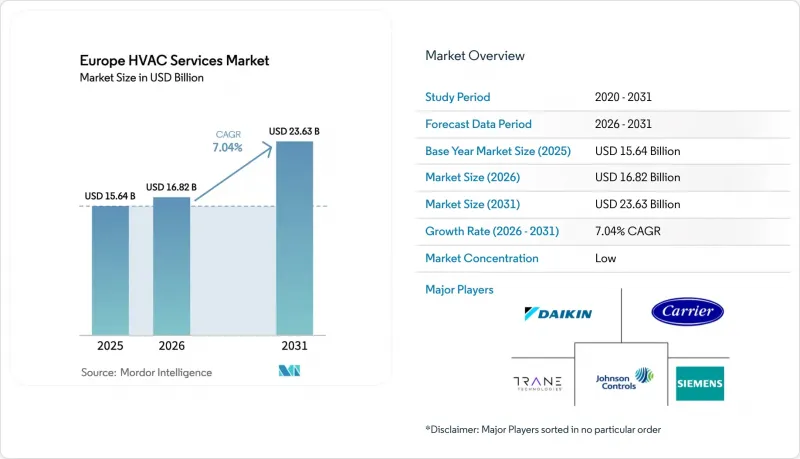
Mordor Intelligence에 의하면, 유럽 HVAC 서비스 시장 규모는 2025년에 156억 4,000만 달러, 2026년에 168억 2,000만 달러가 되어, 2031년까지 236억 3,000만 달러에 이를 것으로 예측됩니다.
2026년부터 2031년까지 연평균 성장률(CAGR) 7.04%로 성장할 것으로 전망됩니다.
본 보고서는 서비스 유형(유지보수·수리, 설치 등), 실행 형태(신축, 기존 건물 개보수), 최종 사용자 산업(주택 등), 서비스 제공 모델(기존의 시간·자재 계약, 성과 연계형 에너지 계약 등), 지역별로 분류되어 있습니다. 시장 예측은 금액(달러) 기준으로 제시되어 있습니다.
유럽 HVAC 서비스 시장 동향 및 인사이트
EU의 ‘리노베이션 웨이브’ 의무화
유럽연합 집행위원회는 2030년까지 3,500만 채의 건물을 개보수할 방침이며, 일반적으로 외피 단열, 히트 펌프, 스마트 제어 시스템을 결합한 개보수를 의무화하고 있습니다. 독일은 2024년에 144억 5,000만 달러를 편성하여 대상 리모델링 비용의 최대 70%를 보조하고 있으며, 프랑스와 네덜란드도 마찬가지로 5년간의 서비스 계약과 인센티브 지급을 연계하는 지원 제도를 시행하고 있습니다. 유럽 건축 물량의 약 4분의 3은 1990년 이전의 에너지 절약 기준에 따라 건설되었기 때문에 규제 준수에 따라 유럽의 난방·환기·공조(HVAC) 서비스 시장에는 향후 10년까지 안정적인 수요가 예상됩니다. 적격성 기준은 인증 시공업체를 우대하고 있어 지속적인 유지보수 수익이 보장됩니다. 보조금 예산이 지속적으로 투입되는 가운데, 턴키 방식으로 개보수를 제공할 수 있는 서비스 제공업체는 높은 이익률을 확보할 수 있는 입장에 있습니다.
열펌프 교체 붐
2024년에는 독일에서 35만 6,000대 이상이 설치될 예정이며, EU 전역에서 수백만 대에 달하는 노후된 보일러가 수명 주기의 끝을 맞이하고 있습니다. 서비스 수요는 가스 보일러 교체에 비해 40%-60% 더 높아, 유럽의 난방·환기·공조(HVAC) 서비스 시장의 평균 거래액을 끌어올리고 있습니다. 폴란드의 ‘My Heat’ 제도만 해도 2026년까지 주거용 히트펌프 도입을 위해 32억 1,000만 달러가 투입될 예정입니다. 전력과 가스의 가격 비율이 4 대 1 미만으로 유지되는 한, 총 소유 비용(TCO)의 관점에서 볼 때 전기식 시스템이 지속적으로 유리합니다. 그러나 기술자 부족으로 인해 독일에서는 대기 시간이 16주까지 늘어났으며, 각 공급업체들은 교육 투자 및 소규모 설치 업체 인수를 단행하고 있습니다.
F가스 인증 기술자 부족
현재 유럽에는 약 36만 7,000명의 인증 기술자가 있지만, 정책 목표를 달성하기 위해서는 2030년까지 추가로 7만-50만 명의 기술자가 필요한 것으로 추정됩니다. 인증 과정은 최대 80시간이 소요되며, 수강생 1인당 1,605-3,210달러의 비용이 듭니다. 그 결과 발생하는 인력 부족으로 인해 독일에서는 서비스 출장비가 192.60달러까지 치솟아, 가격에 민감한 주택 프로젝트의 이익률을 압박하고 있습니다. 이러한 병목 현상은 복잡한 통합 작업에 능숙한 시공업체가 필요한 리모델링 공사의 일정을 특히 지연시키고 있습니다.
부문별 분석
2025년에는 대륙 전체에 1억 8,000만 대가 넘는 HVAC 기기가 설치된 것을 바탕으로, 유지보수 및 수리가 매출의 46.74%를 차지했습니다. 그러나 머신러닝 플랫폼이 며칠 전에 고장을 예측하여 가동 중단 시간을 최대 35%까지 줄일 수 있기 때문에 스마트 연결형 운영 및 유지보수는 2031년까지 연평균 7.39%의 성장률을 보일 것으로 예측됩니다. 이 부문에서 예측 분석으로의 전환에 따라 계약 금액은 1대당 연간 85.60달러에서 428달러 이상으로 상승했습니다. 설치 서비스는 여전히 필수적이며, 히트 펌프 교체 및 액체 냉각 시스템의 대대적인 점검을 통해 7.2%의 성장률을 유지하고 있습니다. 독일에서는 1회 출장 수리당 평균 비용이 128.40달러에 달하기 때문에 원격 진단이 촉진되고 있으며, 이로 인해 이익률이 향상되고 있습니다. 온라인 마켓플레이스의 부상으로 인해 주거용 채널에서는 설치 업체의 가격이 최대 15%까지 압박받고 있으며, 공급업체들은 수익원을 지키기 위해 10년 보증을 패키지로 제공할 수밖에 없는 상황입니다. 그 결과, 유럽의 HVAC 서비스 시장은 인력 수에 의존하지 않고 데이터를 수익화하는 디지털 대응형 서비스 모델로 전환되고 있습니다.
스마트 플랫폼은 여러 EU 지침에서 의무화하고 있는 상세한 에너지 보고도 가능하게 합니다. 캐리어(Carrier)사의 ‘Abound’ 제품군은 200만 대의 연결 기기를 모니터링하고, 비성수 시간대에 유지보수를 예약함으로써 노동 시간을 18% 절감하고 있습니다. 매출의 4%-6%를 디지털 트윈에 투자하고 있는 서비스 제공업체들은 서비스 이익률이 200-300 베이시스 포인트 향상되었다고 보고하고 있습니다. 반면, 기존 유지보수 사업은 IoT 기능을 통합하지 않으면 수익이 잠식될 위험에 직면해 있습니다. 구독형 원격 모니터링이 임계점에 도달함에 따라, 유럽의 HVAC 서비스 시장에서 스마트 연결형 계약 시장 규모는 2020년대 후반까지 기존 유지보수를 넘어설 전망입니다.
2025년에는 개보수 프로젝트가 도입 수익의 58.59%를 차지하며, 2031년까지의 연평균 성장률(CAGR)은 7.84%로 신축 프로젝트를 110 베이시스 포인트 상회할 것입니다. 에너지 절약 효과와 탄소세 회피를 고려할 때, 딥 에너지 패키지는 최대 9%의 내부 수익률을 가져다줍니다. 조사, 석면 대책 및 레거시 시스템 통합으로 인해, 리모델링 공사 1제곱미터당 서비스 수익은 신축 공사에 비해 40%-60% 더 높아집니다. 6.74%의 성장률을 보이는 신축 시장은 북유럽 시장 전체에서 히트 펌프가 표준 열원으로 자리 잡아가고 있는 혜택을 누리고 있지만, 개발업자와의 치열한 협상으로 인해 이익률은 압박을 받고 있습니다. 금리 상승으로 인해 2024년 독일의 주택 착공 건수는 18% 감소한 반면, 리모델링 공사 허가 건수는 27% 증가했습니다. 그 결과, 유럽 HVAC 서비스 시장에서 리모델링 공사의 점유율은 예측 기간 동안 계속해서 확대될 전망입니다.
정책의 불균형이 이러한 추세를 뒷받침하고 있습니다. 개정된 ‘건축물의 에너지 성능에 관한 지침’은 기존 건축물 중 에너지 성능이 하위 15%에 해당하는 건물을 대상으로 하며, 건물주는 대책을 마련하지 않을 경우 자산 가치 하락을 초래하게 됩니다. 보조금 제도는 개보수의 철저한 이행을 더욱 강조하고 있으며, 독일에서는 대상 비용의 최대 70%가 보조금 지원 대상이 됩니다. 인력 부족은 여전히 불확실한 요소이지만, 한편으로는 현장 작업 시간을 단축하는 디지털 모니터링 도구의 도입을 촉진하고 있습니다. 궁극적으로, 특히 탄소 가격이 상승함에 따라, 개보수 활동과 연계된 유럽의 HVAC 서비스 시장 규모가 장기적으로 시장을 견인할 전망입니다.
기타 혜택:
- 엑셀 형식 시장 예측(ME) 시트
- 3개월간의 애널리스트 지원
자주 묻는 질문
목차
제1장 서론
제2장 조사 방법
제3장 주요 요약
제4장 시장 구도
제5장 시장 규모와 성장 예측
제6장 경쟁 구도
제7장 시장 기회와 향후 전망
JHS 26.09.11According to Mordor Intelligence, the Europe HVAC services market size is projected to be USD 15.64 billion in 2025, USD 16.82 billion in 2026, and reach USD 23.63 billion by 2031, growing at a CAGR of 7.04% from 2026 to 2031.
This report is Segmented by Type of Service (Maintenance and Repair, Installation, and More), Implementation Type (New Construction, and Retrofit Buildings), End-User Industry (Residential, and More), Service Delivery Model (Conventional Time-And-Material Contracts, Performance-Based Energy Contracts, and More), and Geography. The Market Forecasts are Provided in Terms of Value (USD).
Europe HVAC Services Market Trends and Insights
EU Renovation Wave Mandates
The European Commission intends to renovate 35 million buildings by 2030, forcing upgrades that normally bundle envelope insulation, heat pumps, and smart controls. Germany allocated USD 14.45 billion in 2024 to subsidize up to 70% of qualifying retrofit costs, and both France and the Netherlands run parallel grant schemes that link incentive payouts to five-year service contracts. Because roughly three-quarters of Europe's stock predates 1990 efficiency codes, compliance guarantees a decade-long pipeline for the Europe heating, ventilation, and air conditioning services market. Eligibility rules favour certified installers, locking in recurring maintenance revenue. As subsidy budgets roll forward, service providers capable of delivering turnkey retrofits are positioned to capture premium margins.
Heat-Pump Replacement Boom
More than 356,000 units were installed in Germany during 2024, and millions of aging boilers across the bloc are entering end-of-life cycles. Service intensity runs 40%-60% higher than gas-boiler swaps, lifting average ticket sizes for the Europe heating, ventilation, and air conditioning services market. Poland's "My Heat" scheme alone directs USD 3.21 billion toward residential heat-pump adoption by 2026. Total cost-of-ownership models consistently favour electric systems whenever electricity-to-gas price ratios hold below four-to-one. Yet technician scarcity has pushed wait times to 16 weeks in Germany, nudging providers to invest in training and acquisition of smaller installers.
Shortage of F-Gas-Certified Technicians
Europe maintains roughly 367,000 certified technicians, yet needs an additional 70,000-500,000 by 2030 to meet policy targets. Certification courses require up to 80 hours and cost USD 1,605-3,210 per trainee. Resulting labour scarcity inflates service-call fees to USD 192.60 in Germany, eroding margins for price-sensitive residential projects. The bottleneck particularly hampers retrofit timelines where complex integrations demand seasoned installers.
Other drivers and restraints analyzed in the detailed report include:
- Growing Demand for Energy-Efficient Retrofits
- Data-Center Cooling Demand Surge
- High IoT Retrofit Costs for Legacy Systems
For complete list of drivers and restraints, kindly check the Table Of Contents.
Segment Analysis
Maintenance and repair represented 46.74% of revenue in 2025, anchored by an installed base exceeding 180 million HVAC units across the continent. Smart-connected operations and maintenance, however, is expanding at 7.39% to 2031 as machine-learning platforms forecast faults days in advance, cutting downtime by up to 35%. The segment's shift toward predictive analytics elevates contract values from USD 85.60 to beyond USD 428 per unit annually. Installation services are still vital, growing at 7.2% thanks to heat-pump swaps and liquid-cooling overhauls. In Germany, the average truck-roll cost of USD 128.40 incentivizes remote diagnostics, bolstering margins. Online marketplaces are compressing installer prices by as much as 15% in residential channels, compelling providers to bundle ten-year warranties to protect revenue streams. Consequently, the Europe HVAC services market is tilting toward digitally enabled service models that monetize data rather than headcount.
Smart platforms also enable granular energy reporting, a requirement under multiple EU directives. Carrier's Abound suite monitors 2 million connected units, scheduling maintenance during off-peak hours and reducing labour hours by 18%. Providers investing 4%-6% of revenue in digital twin's report service-margin lifts of 200-300 basis points. Meanwhile, traditional maintenance businesses risk erosion unless they integrate IoT competencies. As subscription remote monitoring reaches critical mass, the Europe HVAC services market size for smart-connected contracts is poised to surpass conventional maintenance by the late 2020s.
Retrofit projects accounted for 58.59% of implementation revenue in 2025, and their 7.84% CAGR through 2031 outpaces new construction by 110 basis points. Deep-energy packages yield internal rates of return up to 9% when energy savings and avoided carbon taxes are considered. Each retrofit square meter generates 40%-60% more service revenue than new builds owing to surveys, asbestos mitigation, and legacy system integration. New construction, growing at 6.74%, benefits from heat pumps becoming the default heat source across Nordic markets, yet aggressive developer negotiations compress margins. Rising interest rates trimmed German housing starts by 18% in 2024, whereas retrofit permits climbed 27%. As a result, the retrofit share within the Europe HVAC services market will continue expanding throughout the forecast horizon.
Policy asymmetry reinforces this trend. The revised Energy Performance of Buildings Directive targets the worst 15% of stock, compelling landlords to act or risk asset devaluation. Subsidies tilt further toward retrofit depth, with German grants covering up to 70% of qualifying costs. Labor scarcity remains a wild card but also encourages digital oversight tools that reduce onsite time. Ultimately, the Europe HVAC services market size tied to retrofit activity is likely to dominate long term, particularly as carbon prices tighten.
Complete Report Scope:
- By Type of Service
- Maintenance and Repair
- Installation
- Smart-Connected O&M
- By Implementation Type
- New Construction
- Retrofit Buildings
- By End-User Industry
- Residential
- Non-Residential
- Commercial
- Industrial
- Public and Institutional
- By Service Delivery Model
- Conventional Time-and-Material Contracts
- Performance-Based Energy Contracts
- Heat-as-a-Service Contracting
- Subscription Remote Monitoring
- By Country
- Germany
- United Kingdom
- France
- Italy
- Spain
- Rest of Europe
List of Companies Covered in this Report:
- Johnson Controls International PLC
- Carrier Corporation
- Daikin Industries Ltd
- Vaillant Group
- Aggreko PLC
- Aermec SpA
- Trane Technologies PLC
- Bosch Thermotechnology GmbH
- Siemens Building Technologies
- Honeywell International Inc.
- BDR Thermea Group
- Ingersoll Rand PLC
- Crystal Air Holdings Limited
- Klima Venta
- IAC Vestcold AS
- Airedale International Air Conditioning Ltd
- Envirotec Limited
- Kospel SA
- Spectrum Engineering Limited
- Pentair Inc.
Additional Benefits:
- The market estimate (ME) sheet in Excel format
- 3 months of analyst support
TABLE OF CONTENTS
1 INTRODUCTION
- 1.1 Study Assumptions and Market Definition
- 1.2 Scope of the Study
2 RESEARCH METHODOLOGY
3 EXECUTIVE SUMMARY
4 MARKET LANDSCAPE
- 4.1 Market Overview
- 4.2 Market Drivers
- 4.2.1 EU Renovation Wave Mandates
- 4.2.2 Heat-Pump Replacement Boom
- 4.2.3 Growing Demand for Energy-Efficient Retrofits
- 4.2.4 Data-Center Cooling Demand Surge
- 4.2.5 Expansion of Heat-as-a-Service Contracting
- 4.2.6 Seasonal Thermal-Storage-Enabled O&M Revenue Streams
- 4.3 Market Restraints
- 4.3.1 Shortage of F-Gas-Certified Technicians
- 4.3.2 High IoT Retrofit Costs for Legacy Systems
- 4.3.3 Compressor Supply-Chain Vulnerability Amid Heat-Pump Spike
- 4.3.4 Data-Privacy Compliance Burdens on Remote Maintenance
- 4.4 Impact of Macroeconomic Factors on the Market
- 4.5 Industry Value-Chain Analysis
- 4.6 Regulatory Landscape
- 4.7 Technological Outlook
- 4.8 Porter's Five Forces Analysis
- 4.8.1 Bargaining Power of Suppliers
- 4.8.2 Bargaining Power of Buyers
- 4.8.3 Threat of New Entrants
- 4.8.4 Threat of Substitute Products
- 4.8.5 Intensity of Competitive Rivalry
- 4.9 Investment Analysis
5 MARKET SIZE AND GROWTH FORECASTS (VALUE)
- 5.1 By Type of Service
- 5.1.1 Maintenance and Repair
- 5.1.2 Installation
- 5.1.3 Smart-Connected O&M
- 5.2 By Implementation Type
- 5.2.1 New Construction
- 5.2.2 Retrofit Buildings
- 5.3 By End-User Industry
- 5.3.1 Residential
- 5.3.2 Non-Residential
- 5.3.2.1 Commercial
- 5.3.2.2 Industrial
- 5.3.2.3 Public and Institutional
- 5.4 By Service Delivery Model
- 5.4.1 Conventional Time-and-Material Contracts
- 5.4.2 Performance-Based Energy Contracts
- 5.4.3 Heat-as-a-Service Contracting
- 5.4.4 Subscription Remote Monitoring
- 5.5 By Country
- 5.5.1 Germany
- 5.5.2 United Kingdom
- 5.5.3 France
- 5.5.4 Italy
- 5.5.5 Spain
- 5.5.6 Rest of Europe
6 COMPETITIVE LANDSCAPE
- 6.1 Market Concentration
- 6.2 Strategic Moves
- 6.3 Market Share Analysis
- 6.4 Company Profiles (includes Global Level Overview, Market Level Overview, Core Segments, Financials as available, Strategic Information, Market Rank/Share, Products and Services, Recent Developments)
- 6.4.1 Johnson Controls International PLC
- 6.4.2 Carrier Corporation
- 6.4.3 Daikin Industries Ltd
- 6.4.4 Vaillant Group
- 6.4.5 Aggreko PLC
- 6.4.6 Aermec SpA
- 6.4.7 Trane Technologies PLC
- 6.4.8 Bosch Thermotechnology GmbH
- 6.4.9 Siemens Building Technologies
- 6.4.10 Honeywell International Inc.
- 6.4.11 BDR Thermea Group
- 6.4.12 Ingersoll Rand PLC
- 6.4.13 Crystal Air Holdings Limited
- 6.4.14 Klima Venta
- 6.4.15 IAC Vestcold AS
- 6.4.16 Airedale International Air Conditioning Ltd
- 6.4.17 Envirotec Limited
- 6.4.18 Kospel SA
- 6.4.19 Spectrum Engineering Limited
- 6.4.20 Pentair Inc.
7 MARKET OPPORTUNITIES AND FUTURE OUTLOOK
- 7.1 White-Space and Unmet-Need Assessment