
|
시장보고서
상품코드
2124933
미국의 HVAC 기기 및 서비스 : 시장 점유율 분석, 업계 동향 및 통계, 성장 예측(2026-2031년)United States HVAC Equipment And Services - Market Share Analysis, Industry Trends & Statistics, Growth Forecasts (2026 - 2031) |
||||||
 Mordor Intelligence
Mordor Intelligence에 의하면, 미국의 HVAC 기기 및 서비스 시장 규모는 2025년에 764억 8,000만 달러로 평가되었습니다. 2026년에 799억 6,000만 달러에 달하고, 2031년까지 1,005억 5,000만 달러에 이를 것으로 예측되며, 2026-2031년에 걸쳐 CAGR 4.69%로 성장할 전망입니다.
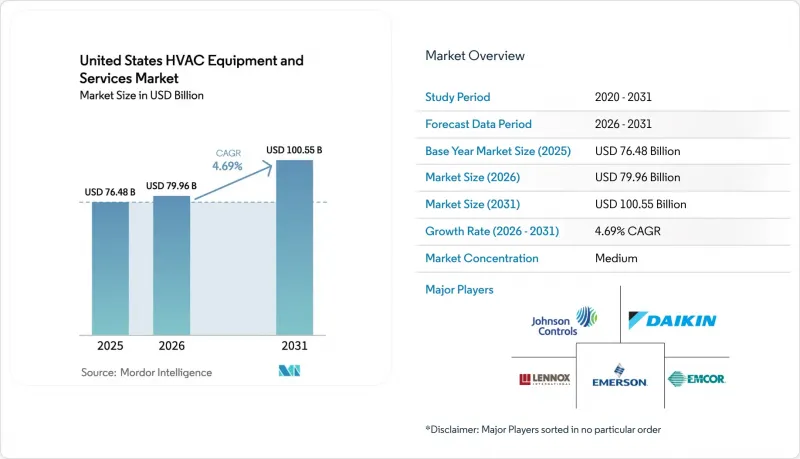
본 보고서는 장비(스플릿 시스템, 패키지 유닛, 칠러, 기타), 서비스 유형(신규 도입, 개보수, 유지보수), 유통 채널(직접 판매, 도매업체, 소매, 온라인), 최종 사용자(주거, 상업, 산업, 기관), 기술(덕트식, 덕트리스,스마트 HVAC)별로 분류되어 있습니다. 시장 전망은 금액(달러) 기준으로 제시되어 있습니다.
미국의 HVAC 기기 및 서비스 시장 동향 및 인사이트
고효율 HVAC로의 교체에 대한 연방 정부의 인센티브
‘인플레이션 억제법’에 따라 2032년까지 연장된, 적격 히트펌프 시스템에 대해 최대 2,000달러의 세액 공제가 적용되는 연방 정부의 제도는 주택 소유자 및 중소기업의 총 소유 비용(TCO) 계산 방식에 변화를 가져오고 있습니다. 45억 달러 규모의 ‘고효율 전기 주택 리베이트 프로그램’은 저소득 및 중산층 가구를 대상으로 하며, 최대 8,000달러의 리베이트를 제공할 뿐만 아니라 주 정부 프로그램과 병행하여 설치 비용의 최대 70%를 상쇄할 수 있습니다. 9개 주가 2030년까지 히트펌프 보급률을 65%로 끌어올리겠다고 공약하고 있어, 의사결정 주기를 단축하는 협력적인 정책 추진이 나타나고 있습니다. 캘리포니아주의 ‘TECH Clean California’ 프로그램은 연방 정부의 인센티브에 더해 시공업체를 위한 교육 및 기술 지원을 제공함으로써, 프로젝트 중단을 초래하기 쉬운 소프트 비용을 절감하고 있습니다. 이러한 조치들이 결합되어 평균 가구의 투자 회수 기간이 5년 미만으로 단축되었으며, 이는 미국의 HVAC 기기 및 서비스 시장에서 히트펌프 도입을 촉진하고 있습니다.
냉매 단계적 감축 의무화로 장비 교체 가속화
‘미국 혁신 및 제조법’에 따라 2025년 1월 이후 신규 HVAC 시스템에는 GWP 값 700 미만의 냉매 사용이 의무화되어, R-410A에서 급격한 전환이 촉진되고 있습니다. 각 제조업체는 R-454B 및 R-32와 같은 A2L 냉매에 대응할 수 있도록 조립 라인을 전환하는 한편, 낮은 수준의 가연성 특성에 대처하기 위한 기술자용 안전 프로그램을 도입하고 있습니다. 이러한 급속한 전환으로 인해 설비 교체 수요가 현저히 증가하고 있으며, 자재 비용 상승에도 불구하고 규제를 준수하는 솔루션에 대한 투자가 촉진되고 있습니다. 조기에 도입한 기업은 수명 주기 배출량 감축이라는 이점을 누릴 수 있으며, 법인 구매자의 경우 ESG 규정 준수를 달성하는 데에도 기여하고 있습니다. A2L 시스템이 이미 신규 주택용 출하량의 60% 이상을 차지하는 가운데, 미국의 HVAC 기기 및 서비스 시장은 법정 기한을 대폭 앞당겨 저GWP 제품으로 제품 구성을 재편하고 있습니다.
HFC 대체 냉매 가격의 급등
R-454B의 가격은 1파운드당 17달러에서 60달러로 상승하여, 대형 상업용 시스템의 비용에 3,000-5,000달러의 추가 부담을 초래하고 있습니다. 또한 2024년 이후, 최종 사용자에게는 약 250억 달러의 추가 비용이 전가되고 있습니다. 공급은 여전히 중국산 수입에 크게 의존하고 있어, 시장은 지정학적 리스크와 운임 변동에 노출되어 있습니다. 국내 생산 능력이 제한적이어서 규제 전환 기간 중 공급이 제약받고 있으며, 시공업체는 재고를 미리 구매할 수밖에 없어 운영 자금에 부담이 가중되고 있습니다. 칠러 및 VRF 시스템의 냉매 충전량 증가는 상업용 구매자에게 미치는 영향을 더욱 가중시키고 있으며, 효율이 대폭 향상될 것으로 기대됨에도 불구하고 일부 프로젝트가 지연되고 있습니다.
부문별 분석
히트 펌프는 인센티브 및 탈탄소화 정책으로 인해 예산이 전기 난방 솔루션으로 재할당됨에 따라, 2031년 연평균 성장률(CAGR)이 5.89%로 가장 빠르게 성장하고 있는 기기 카테고리입니다. 스플릿 시스템은 판매점의 확고한 전문 지식과 폭넓은 SKU 라인업 덕분에 2025년에도 매출 점유율 36.92%를 유지하며 우위를 지켰습니다. 그러나 일반 가정과 소규모 상업시설이 듀얼 기능 히트펌프로 전환함에 따라 그 성장세는 둔화되고 있습니다. 패키지형·옥상 설치형 유닛은 특히 플러그 앤 플레이 방식의 교체를 중시하는 소매 스트립 몰이나 저층 사무실에서 신속한 상업시설 개보수의 표준으로 자리 잡았습니다. 칠러는 엄격한 온도 제어가 요구되는 병원, 대학, 제조 시설의 대규모 중앙 공조 플랜트에서 계속해서 주력으로 자리 잡고 있습니다. VRF 솔루션은 구역 단위의 조절을 통해 부분 부하 시 에너지 소비를 대폭 절감할 수 있기 때문에 중규모 사무실이나 호텔·리조트 산업에서 보급이 확대되고 있습니다. 에어 핸들링 유닛, 팬 코일, 코일은 이러한 핵심 시스템을 뒷받침하고 있으며, 그 수요는 덕트식 및 덕트리스식 건축 구조의 동향과 밀접하게 관련되어 있습니다.
덕트식 스플릿에서 덕트리스 미니 스플릿, 하이브리드, 지열 이용과 같은 히트 펌프 기술의 다양화로 인해 대응 가능한 기후대가 확대되고 있습니다. 가변속 인버터 기술의 발전으로 한랭지용 모델에서도 5°F에서 100%의 난방 능력을 발휘할 수 있게 되어, 북부 지역 전체에서 적용 범위가 확대되고 있습니다. 가장 추운 지방 시장에서는 여전히 난방용 보일러가 주류를 이루고 있지만, 듀얼 연료 및 전전기식 패키지 시스템의 도입이 경제적으로 유리해짐에 따라 그 점유율은 서서히 감소하고 있습니다. 창문형 및 벽 관통형 유닛은 기존 공동 주택이나 가설 건축물에서 이용되고 있지만, 컴팩트한 미니 스플릿이 뛰어난 계절 효율을 발휘함에 따라 그 점유율은 축소되는 추세에 있습니다. 보일러는 복사식 배관 시스템이 갖춰진 공공시설이나 오래된 고층 빌딩에서 온수 난방의 기반으로서 계속해서 중요한 역할을 하고 있습니다. 가습기나 제습기 등 부수적인 공기질 개선 기기는 팬데믹 기간 동안의 인식 제고에 힘입어 착실히 성장했으나, 여전히 판매 수량을 견인하는 요소는 아니며 보완적인 수익원에 그치고 있습니다. 이러한 포트폴리오 구성은 미국의 HVAC 기기 및 서비스 시장에서 전기식·가변속 히트 펌프 플랫폼으로의 완만하지만 분명한 전환이 진행되고 있음을 보여줍니다.
신규 도입은 지속적인 상업시설의 인테리어 공사 및 주택 신축 수요에 힘입어 2025년 매출의 43.62%를 차지했습니다. 그러나 규제 및 효율화 요건으로 인해 시스템 교체 시기가 앞당겨짐에 따라, 개보수 및 교체 공사 부문은 더욱 빠르게 성장하여 연평균 성장률(CAGR) 5.74%로 성장할 전망입니다. 노후화된 HVAC 설비의 평균 가동 연수는 15-20년에 달하며, 새로운 냉매 규제로 인해 대규모 수리가 필요해지는 시점에 많은 R-410A 유닛은 기술적으로 구식이 될 것입니다. 최종 사용자들은 장비 교체 외에도, 유틸리티자의 리베이트, 융자, 예측 유지보수 구독을 결합한 턴키 방식의 업그레이드 패키지에 점점 더 많은 관심을 보이고 있습니다.
유지보수 계약은 여전히 안정적인 핵심 수익원이지만, 디지털 도구가 업무 관행을 재구성하고 있습니다. 클라우드 기반 진단 기능을 통해 이상을 조기에 감지할 수 있게 됨에 따라, 서비스 제공업체는 사후 대응형 파견에서 가동 중단 시간을 최소화하는 정기적인 개입으로 전환할 수 있게 되었습니다. 계약업체가 입증된 에너지 절감 효과를 공유하는 ‘성과 기반 서비스 계약’은 지자체나 학군에서 보급이 확대되고 있습니다. 전력 회사 수요 반응 프로그램은 수요 억제 조치를 통해 수익을 창출함으로써 수익성을 높이고 있습니다. 이러한 비즈니스 모델을 통해 미국의 HVAC 기기 및 서비스 시장에서 서비스 기업들은 일회성 설치 업체가 아닌, 장기적인 에너지 파트너로서의 입지를 확립해 가고 있습니다.
기타 혜택
- 엑셀 형식 시장 예측(ME) 시트
- 3개월간의 애널리스트 지원
자주 묻는 질문
목차
제1장 서론
제2장 조사 방법
제3장 주요 요약
제4장 시장 구도
제5장 시장 규모 및 성장 예측
제6장 경쟁 구도
제7장 시장 기회 및 향후 전망
KTH 26.09.14According to Mordor Intelligence, the United States HVAC equipment and Services Market size is projected to be USD 76.48 billion in 2025, USD 79.96 billion in 2026, and reach USD 100.55 billion by 2031, growing at a CAGR of 4.69% from 2026 to 2031.
This report is Segmented by Equipment (Split Systems, Packaged Units, Chillers, and More), Service Type (New Installations, Retrofits, Maintenance), Distribution Channel (Direct Sales, Distributors, Retail, Online), End User (Residential, Commercial, Industrial, Institutional), Technology (Ducted, Ductless, Smart HVAC). Market Forecasts are Provided in Terms of Value (USD).
United States HVAC Equipment And Services Market Trends and Insights
Federal Incentives for High-Efficiency HVAC Upgrades
Federal tax credits covering up to USD 2,000 for qualified heat pump systems, extended through 2032 under the Inflation Reduction Act, are changing total-cost-of-ownership calculations for homeowners and small businesses. The USD 4.5 billion High-Efficiency Electric Home Rebate Program targets low- and moderate-income households, offering rebates up to USD 8,000 and stacking with state programs to offset as much as 70% of installed cost. Nine states have pledged to secure 65% heat-pump penetration by 2030, signaling a coordinated policy push that compresses decision cycles. California's TECH Clean California program augments the federal incentives with contractor training and technical assistance, reducing soft costs that often derail projects. Collectively, these measures shorten payback periods to fewer than five years for average households, propelling heat pump adoption in the United States HVAC Equipment and Services market.
Mandatory Refrigerant Phase-Downs Accelerating Equipment Replacement
The American Innovation and Manufacturing Act restricts new HVAC systems to refrigerants under 700 GWP starting January 2025, prompting an abrupt shift away from R-410A. Manufacturers have converted assembly lines to A2L refrigerants such as R-454B and R-32 while deploying technician safety programs to address mild flammability characteristics. Rapid switchover drives a pronounced replacement spike and channels capital toward compliant solutions despite material cost inflation. Early adopters benefit from reduced lifecycle emissions, aiding ESG compliance for corporate buyers. With A2L systems already representing more than 60% of new residential shipments, the United States HVAC Equipment and Services market is realigning its product mix toward low-GWP offerings well ahead of the statutory deadline.
Surging HFC-Alternative Refrigerant Prices
Prices for R-454B have climbed from USD 17 to USD 60 per pound, adding USD 3,000-5,000 to the cost of large commercial systems and transferring roughly USD 25 billion of incremental expense to end users since 2024. Supply remains heavily dependent on imports from China, exposing the market to geopolitical risks and freight volatility. Limited domestic production capacity constrains availability during the regulatory transition, forcing contractors to pre-purchase inventory and strain working capital. Larger refrigerant charges in chillers and VRF systems intensify the effect on commercial buyers, delaying some projects despite compelling efficiency gains.
Other drivers and restraints analyzed in the detailed report include:
- Southern Heat-Wave Frequency Boosting Cooling Demand
- Building-Electrification Mandates in Key States
- Skilled-Labor Shortages Inflating Install Costs
For complete list of drivers and restraints, kindly check the Table Of Contents.
Segment Analysis
Heat pumps represent the fastest-expanding equipment class at a 5.89% CAGR through 2031 as incentives and decarbonization policies redirect budgets toward electric heating solutions. Split systems retain dominance with 36.92% revenue share in 2025 due to entrenched dealer familiarity and broad SKU variety. However, their growth moderates as households and light commercial sites migrate to dual-function heat pumps. Packaged and rooftop units remain staples for quick-turn commercial retrofits, particularly in retail strip centers and low-rise offices that value plug-and-play replacement. Chillers continue to anchor large central plants in hospitals, universities, and manufacturing sites that demand tight temperature controls. VRF solutions gain traction in medium-size offices and hospitality because zone-level modulation slashes part-load energy use. Air-handling units, fan coils, and coils support these core systems, with demand linked to the trajectory of ducted versus ductless architectures.
Heat-pump technological diversity from ducted split to ductless mini-split, hybrid, and geothermal configurations broadens addressable climates. Advancements in variable-speed inverters allow cold-climate models to deliver 100% heating capacity at 5 °F, expanding relevance across the northern tier. Furnaces still dominate in the coldest rural markets but face a measured share decline as homeowner economics improve for dual-fuel or all-electric packages. Window and through-the-wall units serve legacy multifamily buildings and temporary structures, yet their share erodes as compact mini-splits provide superior seasonal efficiency. Boilers continue to underpin hydronic heating in institutions and older high-rise assets where radiant distribution exists. Ancillary air-quality equipment such as humidifiers and dehumidifiers grew steadily after pandemic-era awareness, though they remain supplementary revenue streams rather than volume drivers. The resulting portfolio mix underscores a gradual but clear pivot toward electric, variable-speed heat-pump platforms within the United States HVAC Equipment and Services market.
New installations commanded 43.62% of 2025 revenue, fueled by ongoing commercial fit-outs and residential new-builds. Yet retrofit and replacement workstreams are set to grow more quickly, expanding at a 5.74% CAGR as regulatory and efficiency triggers pull forward system changeouts. Ageing HVAC fleets average 15-20 years in service, and new refrigerant rules now make many R-410A units technically obsolete once major repairs arise. End users are increasingly attracted to turnkey upgrade packages that combine equipment changeouts with utility rebates, financing, and predictive-maintenance subscriptions.
Maintenance contracts remain stable anchor revenue, but digital tools are reshaping execution practices. Cloud-based diagnostics detect anomalies early, allowing service providers to shift from reactive dispatches to scheduled interventions that minimize downtime. Performance-based service agreements, in which contractors share verified energy savings, are gaining traction in municipalities and school districts. Utility demand-response programs augment profitability by creating revenue for capacity curtailment events. These models position service firms as long-term energy partners rather than one-off installers inside the United States HVAC Equipment and Services market.
Complete Report Scope:
- By Equipment
- Split Systems (Ducted and Ductless)
- Packaged and Rooftop Units
- Chillers
- Air-Handling Units
- Furnaces
- Fan Coils
- Window / Through-the-Wall / PTAC
- Boilers
- Heat Pumps
- Humidifiers and Dehumidifiers
- Variable Refrigerant Flow (VRF) Systems
- Other Equipment Types
- By Service Type
- New Installations
- Retrofits / Replacements
- Maintenance and Repair
- Demand-Response and Performance Contracting
- By Distribution Channel
- Direct Sales (OEM to End-User)
- HVAC Distributors / Wholesalers
- Retail / DIY Stores
- Online E-commerce Platforms
- By End User
- Residential
- Commercial
- Industrial
- Institutional (Healthcare, Education)
- Other End-users
- By Technology
- Ducted Systems
- Ductless Mini-Splits
- Hybrid / Geothermal Heat-Pump Systems
- Smart and Connected HVAC
List of Companies Covered in this Report:
- Carrier Global Corporation
- Johnson Controls International plc
- Daikin Industries Ltd.
- Trane Technologies plc
- Lennox International Inc.
- Goodman Manufacturing Company LP (Daikin)
- Rheem Manufacturing Company
- Emerson Electric Co.
- Bosch Thermotechnology Corp.
- Mitsubishi Electric US, Inc.
- Uponor Corporation
- Fujitsu General America
- EMCOR Group
- Samsung HVAC America
- Honeywell International Inc.
- Danfoss A/S
- York International Corp. (JCI)
- LG Electronics USA Air Conditioning
- Bosch Thermotechnology
- AAON Inc.
Additional Benefits:
- The market estimate (ME) sheet in Excel format
- 3 months of analyst support
TABLE OF CONTENTS
1 INTRODUCTION
- 1.1 Study Assumptions and Market Definition
- 1.2 Scope of the Study
2 RESEARCH METHODOLOGY
3 EXECUTIVE SUMMARY
4 MARKET LANDSCAPE
- 4.1 Market Overview
- 4.2 Market Drivers
- 4.2.1 Federal incentives for high-efficiency HVAC upgrades
- 4.2.2 Mandatory refrigerant phase-downs accelerating equipment replacement
- 4.2.3 Southern heat-wave frequency boosting cooling demand
- 4.2.4 Building-electrification mandates in key states
- 4.2.5 IoT-enabled predictive-maintenance cost savings
- 4.2.6 Growth of data-center cooling load
- 4.3 Market Restraints
- 4.3.1 Surging HFC-alternative refrigerant prices
- 4.3.2 Skilled-labor shortages inflating install costs
- 4.3.3 Rising electricity tariffs dampening HVAC run-time
- 4.3.4 Volatility of steel and copper input costs
- 4.4 Value Chain Analysis
- 4.5 Regulatory Landscape
- 4.6 Technological Outlook
- 4.7 Porter's Five Forces Analysis
- 4.7.1 Threat of New Entrants
- 4.7.2 Bargaining Power of Buyers
- 4.7.3 Bargaining Power of Suppliers
- 4.7.4 Threat of Substitutes
- 4.7.5 Intensity of Competitive Rivalry
- 4.8 Assessment of Macro Economic Trends on the Market
5 MARKET SIZE AND GROWTH FORECASTS (VALUES)
- 5.1 By Equipment
- 5.1.1 Split Systems (Ducted and Ductless)
- 5.1.2 Packaged and Rooftop Units
- 5.1.3 Chillers
- 5.1.4 Air-Handling Units
- 5.1.5 Furnaces
- 5.1.6 Fan Coils
- 5.1.7 Window / Through-the-Wall / PTAC
- 5.1.8 Boilers
- 5.1.9 Heat Pumps
- 5.1.10 Humidifiers and Dehumidifiers
- 5.1.11 Variable Refrigerant Flow (VRF) Systems
- 5.1.12 Other Equipment Types
- 5.2 By Service Type
- 5.2.1 New Installations
- 5.2.2 Retrofits / Replacements
- 5.2.3 Maintenance and Repair
- 5.2.4 Demand-Response and Performance Contracting
- 5.3 By Distribution Channel
- 5.3.1 Direct Sales (OEM to End-User)
- 5.3.2 HVAC Distributors / Wholesalers
- 5.3.3 Retail / DIY Stores
- 5.3.4 Online E-commerce Platforms
- 5.4 By End User
- 5.4.1 Residential
- 5.4.2 Commercial
- 5.4.3 Industrial
- 5.4.4 Institutional (Healthcare, Education)
- 5.4.5 Other End-users
- 5.5 By Technology
- 5.5.1 Ducted Systems
- 5.5.2 Ductless Mini-Splits
- 5.5.3 Hybrid / Geothermal Heat-Pump Systems
- 5.5.4 Smart and Connected HVAC
6 COMPETITIVE LANDSCAPE
- 6.1 Market Concentration
- 6.2 Strategic Moves
- 6.3 Market Share Analysis
- 6.4 Company Profiles (includes Global-level Overview, Market-level Overview, Core Segments, Financials as available, Strategic Information, Market Rank/Share, Products and Services, Recent Developments)
- 6.4.1 Carrier Global Corporation
- 6.4.2 Johnson Controls International plc
- 6.4.3 Daikin Industries Ltd.
- 6.4.4 Trane Technologies plc
- 6.4.5 Lennox International Inc.
- 6.4.6 Goodman Manufacturing Company LP (Daikin)
- 6.4.7 Rheem Manufacturing Company
- 6.4.8 Emerson Electric Co.
- 6.4.9 Bosch Thermotechnology Corp.
- 6.4.10 Mitsubishi Electric US, Inc.
- 6.4.11 Uponor Corporation
- 6.4.12 Fujitsu General America
- 6.4.13 EMCOR Group
- 6.4.14 Samsung HVAC America
- 6.4.15 Honeywell International Inc.
- 6.4.16 Danfoss A/S
- 6.4.17 York International Corp. (JCI)
- 6.4.18 LG Electronics USA Air Conditioning
- 6.4.19 Bosch Thermotechnology
- 6.4.20 AAON Inc.
7 MARKET OPPORTUNITIES AND FUTURE OUTLOOK
- 7.1 White-Space and Unmet-Need Assessment