
|
시장보고서
상품코드
2122348
통증 관리 : 시장 점유율 분석, 업계 동향과 통계, 성장 예측(2026-2031년)Pain Management - Market Share Analysis, Industry Trends & Statistics, Growth Forecasts (2026 - 2031) |
||||||
 Mordor Intelligence
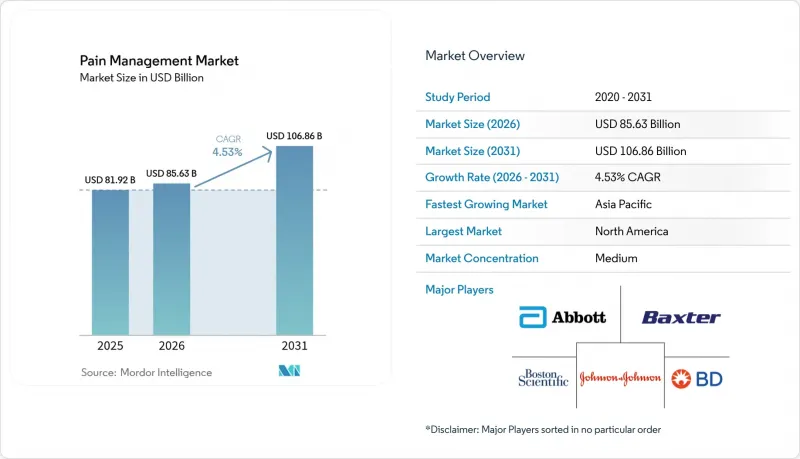
Mordor Intelligence에 의하면, 2026년 통증 관리 시장 규모는 856억 3,000만 달러로 추정되며, 2025년 819억 2,000만 달러에서 성장하여 2031년에는 1,068억 6,000만 달러에 달할 것으로 예측됩니다.
또한, 2026-2031년 연평균 성장률(CAGR) 4.53%를 기록할 전망입니다.
본 보고서는 통증 관리 방법별(의약품(오피오이드, 비마약성 진통제), 의료기기(신경 조절 기기 등)), 용도별(신경성 통증, 암성 통증, 안면통·편두통, 기타), 치료 제공 장소별(병원, 외래수술센터(ASC), 기타),지역별(북미, 유럽, 아시아태평양, 기타)에 따라 분류되어 있습니다. 시장 예측은 금액(달러)으로 제시되어 있습니다.
전 세계 통증 관리 시장 동향 및 인사이트
고령화에 따른 만성 통증 유병률 상승
45세 이상 인구층 증가에 따라 만성 근골격계 및 신경성 통증의 유병률이 현재 가장 높은 수준입니다. 2024년에는 미국 성인의 24.3%가 만성 통증을 호소했으며, 그 유병률은 65세 이상에서 정점을 기록했습니다. 유럽의 메타분석에 따르면, 당뇨병, 관절염, 수술 후 증후군을 요인으로 하여 성인의 유병률은 21.45%에 달할 전망입니다. 지속적인 통증으로 고통받는 환자는 같은 연령대의 다른 사람들에 비해 2배의 의료비가 소요되며, 고소득 국가에서는 연간 1만 2,167달러의 생산성 손실을 초래하고 있습니다. 이에 따라 보험사들은 의약품, 의료기기, 행동 치료 요소를 결합한 장기적인 프로그램에 자금을 투입하고 있습니다. 만성 통증이 독립적인 질환으로 인식되면서 전 세계적으로 전용 보험 청구 코드가 도입되었고, 전문 클리닉의 수용 능력도 더욱 확대되고 있습니다.
신경 조절 요법의 유효성에 대한 임상적 검증
획기적인 비용 대비 효과 연구에 따르면, 척수 자극 요법을 최적의 약물 요법과 병용할 경우 10년 동안 비용 대비 효과가 높게 유지되며, 일반적인 지불 의향 금액 기준에서 약물 요법을 능가하는 성과가 나타났습니다. 후근 신경절 기술은 초기 비용이 높음에도 불구하고, 국소성 신경병증 증후군에서 더 높은 질 조정 생존년(QALY)을 제공합니다. 폐쇄 루프형 플랫폼은 유발 복합 활동 전위를 기반으로 진폭을 자동으로 조정하여, 생리적 상태가 변화하더라도 진통 효과를 유지합니다. 규제 당국은 ‘획기적인 의료기기(Breakthrough Device)’ 지정을 통해 시장 진입을 가속화하고, 심사 기간을 단축하는 동시에 벤처 투자를 촉진하고 있습니다. 일부 EU 회원국에서의 보험 적용 범위 확대는 신경 조절 요법의 지속적인 가치가 인정받고 있음을 뒷받침하며, 병원의 구매 의욕과 의사의 도입률을 높이고 있습니다.
이식형 의료기기의 높은 CAPEX/OPEX
환자 1인당 2만-5만 달러 가격대의 이식형 펄스 발생 장치는 신흥 경제국 많은 공공 부문의 예산을 초과합니다. 4-7년마다 이루어지는 교체 수술에는 마취비와 입원비가 추가되어 지불 주체의 부담 수용 한계를 압박하고 있습니다. 의료기술평가기관은 현재 고가의 신경 조절 요법에 대한 보험 급여를 승인하기 전에 10년에 걸친 실제 임상 데이터(REW) 제출을 요구하고 있습니다. 이에 대해 제조업체들은 충전식 배터리로의 전환, 임상의의 조작 횟수를 줄여주는 자동 프로그래밍 기능 도입 등으로 대응하고 있습니다. 리스 모델이나 성과 연동형 계약도 등장하기 시작했으나, 저·중소득 국가에서는 여전히 자본 집약성이 장벽으로 작용하고 있습니다.
부문 분석
2025년, 통증 관리 시장에서 의약품의 점유율은 68.92%를 유지했습니다. 이는 신경병성 통증 적응증에 사용되는 NSAIDs, 항경련제, 선택적 항우울제가 뒷받침하고 있습니다. 가이드라인 작성자들이 오피오이드 사용을 자제하는 치료법을 권장하는 가운데, 나트륨 채널 차단제를 포함한 비오피오이드계 신약의 성장세는 계속되고 있습니다. 금액 기준으로는 아시아태평양 및 라틴아메리카의 제네릭 의약품 보급이 견인 역할을 하여, 의약품 부문은 전년 대비 32억 달러 증가했습니다. 의료기기 부문은 연평균 성장률(CAGR) 9.99%로 의약품 부문을 능가하는 성장이 예상되며, 2031년까지 통증 관리 시장 규모를 약 110억 달러까지 끌어올릴 것으로 전망됩니다.
이러한 급속한 성장을 주도하고 있는 것은 폐쇄 루프형 척수 자극 장치와 후근 신경절 시스템으로, 이들은 실시간 생리학적 피드백을 활용하여 진폭과 펄스 폭을 미세 조정합니다. 진통제 주입 펌프는 소형화가 진행되는 한편, 블루투스 지원 투여 기록 기능을 갖추고 있어 해당 데이터가 임상의의 대시보드에 반영되도록 되어 있습니다. 2024년과 2025년에 FDA로부터 부여받은 ‘획기적 의료기기(Breakthrough Device)’ 지정에 따라 심사 주기가 6-9개월 단축되어 시장 출시가 가속화되고 있습니다. 금액 기준 조달이 확대되고 있는 가운데, 병원의 조달 담당자들은 총 소유 비용(TCO)을 점점 더 중요하게 여기고 있으며, 이 지표에 비추어 볼 때 배터리 수명이 긴 충전식 자극 장치가 유리합니다.
지역별 분석
북미는 2025년, 성숙한 보험 환급 제도, 광범위한 ASC(외래수술센터(ASC)) 네트워크, 신속한 FDA 승인 절차에 힘입어 매출의 38.10%를 계속 차지했습니다. 오피오이드 마케팅을 둘러싼 소송이 계속되는 가운데, 비의존성 치료법으로의 다각화가 진행되면서 신경 조절 요법 및 비오피오이드계 진통제에 대한 수요가 증가하고 있습니다. 2025년에 미국의 더 많은 주에서 메디케이드가 확대됨에 따라, 종합적인 통증 관리 프로그램의 대상 환자층이 더욱 넓어졌습니다.
유럽에서는 균형 잡힌 성숙세가 나타나고 있습니다. 서유럽 국가에서는 점진적인 성장이 지속되는 한편, 동유럽 시장에서는 EU의 지역 통합 기금에 힘입어 의료기기 도입이 가속화되고 있습니다. 유럽의약품청(EMA)의 롤링 리뷰 절차에 따라 2025년에는 바이오시밀러와 신규 진통제의 평균 승인 기간이 15% 단축되었습니다. 각국의 의료기술평가기관은 삶의 질(QOL)과 관련된 결과를 점점 더 중시하게 되어, 유효성이 입증된 신경 조절 요법의 적응증에 대한 보험 적용 범위가 확대되고 있습니다.
아시아태평양은 2031년까지 연평균 성장률(CAGR) 10.55%를 기록하며, 지역별 가장 높은 성장률을 보이고 있습니다. 중국의 ‘건강 중국 2030’ 계획에서는 만성 통증이 우선 과제로 지정되어, 이에 따라 2급 병원에서도 전문 통증 클리닉을 개설할 수 있게 되었습니다. 2025년에 통과된 인도의 원격의료 지침에 따라 비지정 의약품에 대한 전자처방이 합법화되어 디지털 진료 플랫폼이 활성화되고 있습니다. 그러나 보험 가입률의 불균형과 의료 제공업체 시장의 세분화로 인해 고가의 이식형 의료기기의 보급은 여전히 제한되고 있으며, 인구통계학적 잠재력에 비해 절대적인 시장 규모가 억제되고 있습니다.
기타 혜택
- 엑셀 형식 시장 예측(ME) 시트
- 3개월간의 애널리스트 지원
자주 묻는 질문
목차
제1장 서론
제2장 조사 방법
제3장 주요 요약
제4장 시장 구도
제5장 시장 규모와 성장 예측
제6장 경쟁 구도
제7장 시장 기회와 향후 전망
LSH 26.09.04According to Mordor Intelligence, pain management market size in 2026 is estimated at USD 85.63 billion, growing from 2025 value of USD 81.92 billion with 2031 projections showing USD 106.86 billion, growing at 4.53% CAGR over 2026-2031.
This report is Segmented by Mode of Pain Management (Drugs [Opioids and Non-Narcotic Analgesics] and Devices [Neuro-Modulation Devices and More]), Application (Neuropathic Pain, Cancer Pain, Facial Pain & Migraine and More), Setting of Care (Hospitals, Ambulatory Surgical Centers and More), and Geography (North America, Europe, Asia-Pacific, and More). The Market Forecasts are Provided in Terms of Value (USD).
Global Pain Management Market Trends and Insights
Ageing-Related Rise in Chronic Pain Prevalence
Growing cohorts aged >= 45 now represent the highest incidence of chronic musculoskeletal and neuropathic complaints. In 2024, 24.3% of U.S. adults reported chronic pain, with prevalence peaking in the 65+ group. European meta-analysis places adult prevalence at 21.45%, propelled by diabetes, arthritis, and postsurgical syndromes. Patients living with persistent pain incur double the healthcare expenditure of age-matched peers and lose USD 12,167 annually in productivity within high-income countries. Payers, therefore, channel funds toward longitudinal programs combining pharmaceutical, device, and behavioral elements. Recognition of chronic pain as a standalone disease entity further unlocks dedicated reimbursement codes and specialty clinic capacity worldwide.
Clinical Validation of Neuromodulation Efficacy
Landmark cost-utility studies show spinal cord stimulation paired with best medical therapy remains cost-effective over 10 years, outperforming pharmacologic management at typical willingness-to-pay thresholds. Dorsal root ganglion technology delivers even higher quality-adjusted life years for focal neuropathic syndromes, despite steeper upfront costs. Closed-loop platforms now auto-adjust amplitude based on evoked compound action potentials, sustaining analgesia as physiologic states shift. Regulatory bodies accelerate market entry through Breakthrough Device designations, trimming review times and incentivizing venture investment. Expanded reimbursement in select EU member states confirms recognition of durable neuromodulation value, increasing hospital purchasing confidence and physician adoption rates.
High CAPEX/OPEX for Implantable Devices
Implantable pulse generators priced between USD 20,000 - 50,000 per patient exceed many public-sector budgets in emerging economies. Replacement surgeries every 4-7 years add anesthesia and hospitalization charges, straining payer tolerance. Health technology assessment agencies now demand ten-year real-world evidence before approving high-cost neuromodulation reimbursement lines. Manufacturers react by migrating to rechargeable batteries and automated programming that lower clinician touchpoints. Leasing models and outcome-based contracts have begun surfacing, yet capital intensity remains a gating factor across low- and middle-income settings.
Other drivers and restraints analyzed in the detailed report include:
- Shift Toward Opioid-Sparing Multimodal Protocols
- Rapid ASC Adoption for Pain Procedures
- Limited Reimbursement in Emerging Markets
For complete list of drivers and restraints, kindly check the Table Of Contents.
Segment Analysis
Drugs retained 68.92% of pain management market share in 2025, anchored by NSAIDs, anticonvulsants and selective antidepressants used for neuropathic indications. Non-opioid innovations, including sodium-channel blockers, sustain momentum as guideline authors promote opioid-sparing regimens. In value terms, the drugs segment added USD 3.2 billion year-over-year, supported by strong generic uptake in Asia-Pacific and Latin America. Devices are set to outpace pharmaceuticals at a 9.99% CAGR, adding roughly USD 11 billion to the pain management market size by 2031.
Closed-loop spinal cord stimulators and dorsal root ganglion systems headline this surge, leveraging real-time physiologic feedback to fine-tune amplitude and pulse width. Analgesic infusion pumps shrink in form factor while gaining Bluetooth-enabled dosage logs that feed clinician dashboards. FDA Breakthrough Device designations granted in 2024 and 2025 shave six to nine months from review cycles, accelerating commercial rollout. As value-based procurement spreads, hospital buyers increasingly weigh total cost of ownership, a metric favoring rechargeable stimulators with extended battery life.
Complete Report Scope:
- By Mode of Pain Management
- Drugs
- Opioids
- Non-narcotic Analgesics
- NSAIDs
- Anesthetics
- Anticonvulsants
- Antidepressants
- Devices
- Neuro-modulation Devices
- TENS
- Spinal Cord Stimulation (SCS)
- Dorsal Root Ganglion (DRG)
- Vagus & Peripheral Nerve Stimulators
- Analgesic Infusion Pumps
- Intrathecal Pumps
- External PCA Pumps
- Radio-frequency Ablation Systems
- Neuro-modulation Devices
- Drugs
- By Application
- Neuropathic Pain
- Cancer Pain
- Musculoskeletal Pain
- Facial Pain & Migraine
- Post-operative & Acute Pain
- By Setting of Care
- Hospitals
- Ambulatory Surgical Centers
- Home-care & Remote Monitoring
- Geography
- North America
- United States
- Canada
- Mexico
- Europe
- Germany
- United Kingdom
- France
- Italy
- Spain
- Rest of Europe
- Asia-Pacific
- China
- Japan
- India
- Australia
- South Korea
- Rest of Asia-Pacific
- Middle East and Africa
- GCC
- South Africa
- Rest of Middle East and Africa
- South America
- Brazil
- Argentina
- Rest of South America
- North America
Geography Analysis
North America retained 38.10% revenue in 2025, supported by mature reimbursement, extensive ASC networks and swift FDA clearance pathways. Continued litigation over opioid marketing drives diversification toward non-addictive modalities, inflating demand for neuromodulation and non-opioid analgesics. Medicaid expansion in additional U.S. states during 2025 further widens patient pools for comprehensive pain management programs.
Europe displays balanced maturation; Western states sustain incremental gains while Eastern markets accelerate device adoption under EU cohesion funding. The European Medicines Agency's rolling review procedures shortened average approval times for biosimilars and novel analgesics by 15% in 2025. National health technology assessment bodies increasingly recognize quality-of-life outcomes, prompting broader reimbursement for validated neuromodulation indications.
Asia-Pacific delivers the fastest regional CAGR at 10.55% through 2031. China's Healthy 2030 blueprint earmarks chronic pain as a priority, enabling tier-two hospitals to establish specialty pain clinics. India's telemedicine guidelines passed in 2025 legitimize e-prescriptions of non-schedule drugs, spurring digital consultation platforms. However, uneven insurance penetration and fragmented provider markets still limit uptake of high-cost implantables, constraining absolute market size relative to demographic potential.
- Abbott Laboratories
- Baxter
- Beckton Dickinson
- Boston Scientific
- Endo International
- Fresenius
- Grunenthal GmbH
- Hikma Pharmaceuticals
- Hisamitsu Pharmaceutical
- Insulet
- Johnson & Johnson (DePuy Synthes, Ethicon)
- Medtronic
- Nevro
- Novartis
- OMRON
- Pfizer
- Smiths Group
- Stryker
- Terumo
- Teva Pharmaceutical Industries
Additional Benefits:
- The market estimate (ME) sheet in Excel format
- 3 months of analyst support
TABLE OF CONTENTS
1 Introduction
- 1.1 Study Assumptions & Market Definition
- 1.2 Scope of the Study
2 Research Methodology
3 Executive Summary
4 Market Landscape
- 4.1 Market Overview
- 4.2 Market Drivers
- 4.2.1 Ageing-Related Rise in Chronic Pain Prevalence
- 4.2.2 Clinical Validation of Neuro-Modulation Efficacy
- 4.2.3 Shift Toward Opioid-Sparing Multimodal Protocols
- 4.2.4 Rapid ASC Adoption for Pain Procedures
- 4.2.5 Venture Funding for Closed-Loop Stimulation Platforms
- 4.2.6 AI-Driven, Patient-Specific Dosing Algorithms
- 4.3 Market Restraints
- 4.3.1 High CAPEX/OPEX for Implantable Devices
- 4.3.2 Limited Reimbursement in Emerging Markets
- 4.3.3 Cyber-Security Risks in Connected Pumps
- 4.3.4 ESG Scrutiny on Opioid Manufacturers
- 4.4 Supply-Chain Analysis
- 4.5 Regulatory Landscape
- 4.6 Technological Outlook
- 4.7 Porter's Five Forces
- 4.7.1 Threat of New Entrants
- 4.7.2 Bargaining Power of Buyers/Consumers
- 4.7.3 Bargaining Power of Suppliers
- 4.7.4 Threat of Substitute Products
- 4.7.5 Intensity of Competitive Rivalry
5 Market Size & Growth Forecasts (Value, USD)
- 5.1 By Mode of Pain Management
- 5.1.1 Drugs
- 5.1.1.1 Opioids
- 5.1.1.2 Non-narcotic Analgesics
- 5.1.1.2.1 NSAIDs
- 5.1.1.2.2 Anesthetics
- 5.1.1.2.3 Anticonvulsants
- 5.1.1.2.4 Antidepressants
- 5.1.2 Devices
- 5.1.2.1 Neuro-modulation Devices
- 5.1.2.1.1 TENS
- 5.1.2.1.2 Spinal Cord Stimulation (SCS)
- 5.1.2.1.3 Dorsal Root Ganglion (DRG)
- 5.1.2.1.4 Vagus & Peripheral Nerve Stimulators
- 5.1.2.2 Analgesic Infusion Pumps
- 5.1.2.2.1 Intrathecal Pumps
- 5.1.2.2.2 External PCA Pumps
- 5.1.2.3 Radio-frequency Ablation Systems
- 5.1.2.1 Neuro-modulation Devices
- 5.1.1 Drugs
- 5.2 By Application
- 5.2.1 Neuropathic Pain
- 5.2.2 Cancer Pain
- 5.2.3 Musculoskeletal Pain
- 5.2.4 Facial Pain & Migraine
- 5.2.5 Post-operative & Acute Pain
- 5.3 By Setting of Care
- 5.3.1 Hospitals
- 5.3.2 Ambulatory Surgical Centers
- 5.3.3 Home-care & Remote Monitoring
- 5.4 Geography
- 5.4.1 North America
- 5.4.1.1 United States
- 5.4.1.2 Canada
- 5.4.1.3 Mexico
- 5.4.2 Europe
- 5.4.2.1 Germany
- 5.4.2.2 United Kingdom
- 5.4.2.3 France
- 5.4.2.4 Italy
- 5.4.2.5 Spain
- 5.4.2.6 Rest of Europe
- 5.4.3 Asia-Pacific
- 5.4.3.1 China
- 5.4.3.2 Japan
- 5.4.3.3 India
- 5.4.3.4 Australia
- 5.4.3.5 South Korea
- 5.4.3.6 Rest of Asia-Pacific
- 5.4.4 Middle East and Africa
- 5.4.4.1 GCC
- 5.4.4.2 South Africa
- 5.4.4.3 Rest of Middle East and Africa
- 5.4.5 South America
- 5.4.5.1 Brazil
- 5.4.5.2 Argentina
- 5.4.5.3 Rest of South America
- 5.4.1 North America
6 Competitive Landscape
- 6.1 Market Concentration
- 6.2 Market Share Analysis
- 6.3 Company Profiles (includes Global level Overview, Market level overview, Core Business Segments, Financials, Headcount, Key Information, Market Rank, Market Share, Products and Services, and analysis of Recent Developments)
- 6.3.1 Abbott Laboratories
- 6.3.2 Baxter International Inc.
- 6.3.3 Becton, Dickinson and Company
- 6.3.4 Boston Scientific Corporation
- 6.3.5 Endo International plc
- 6.3.6 Fresenius SE & Co. KGaA
- 6.3.7 Grunenthal GmbH
- 6.3.8 Hikma Pharmaceuticals
- 6.3.9 Hisamitsu Pharmaceutical
- 6.3.10 Insulet Corporation
- 6.3.11 Johnson & Johnson (DePuy Synthes, Ethicon)
- 6.3.12 Medtronic plc
- 6.3.13 Nevro Corp.
- 6.3.14 Novartis AG
- 6.3.15 Omron Healthcare
- 6.3.16 Pfizer Inc.
- 6.3.17 Smiths Medical (ICU Medical)
- 6.3.18 Stryker Corporation
- 6.3.19 Terumo Corporation
- 6.3.20 Teva Pharmaceutical Industries
7 Market Opportunities & Future Outlook
- 7.1 White-space & Unmet-need Assessment