

|
시장보고서
상품코드
2122431
레이저 : 시장 점유율 분석, 업계 동향 및 통계, 성장 예측(2026-2031년)Lasers - Market Share Analysis, Industry Trends & Statistics, Growth Forecasts (2026 - 2031) |
||||||
 Mordor Intelligence
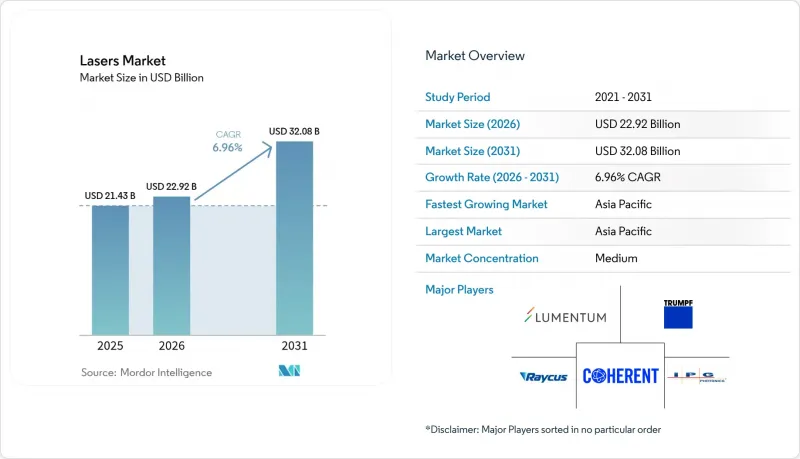
Mordor Intelligence에 의하면, 레이저 시장 규모는 2025년 214억 3,000만 달러로 평가되었습니다. 2026년에는 229억 2,000만 달러로 확대되어 2026-2031년에 걸쳐 CAGR 6.96%로 성장을 지속하여, 2031년에는 320억 8,000만 달러에 이를 것으로 예측됩니다.

본 보고서는 레이저 유형별(파이버 레이저, 다이오드 레이저, 기타), 용도별(재료 가공, 기타), 정격 출력별(저출력, 중출력, 고출력), 동작 모드별(연속파, 펄스), 최종 사용자 산업별(일렉트로믹스 및 반도체, 기타),지역별(북미, 남미, 유럽, 아시아태평양, 기타)로 분류되어 있습니다. 시장 전망은 금액(달러) 기준으로 제시되어 있습니다.
세계의 레이저 시장 동향 및 인사이트
반도체 백엔드 패키징 분야의 고정밀 마이크로 머시닝 수요 급증
팬아웃 웨이퍼 레벨 패키징 및 스루 글라스 비아(TGV) 공정에서는 10마이크로미터 이하의 미세 구조를 펄스 간 에너지 편차 1% 이하로 구현하는 펨토초 레이저와 엑시머 레이저 광원이 지정되어 있으며, 300mm 웨이퍼 전체에 걸쳐 균일한 비아 형성이 보장됩니다. 와이어 본딩을 레이저 성형된 마이크로 범프로 대체함으로써 상호 연결 저항을 40% 저감하고, 3차원 칩 스태킹의 길을 열게 됩니다. 현장 모니터링과 동기화된 빔 성형 모듈을 통해 대량 생산을 수행하는 팹의 수율이 향상되고, 불량률이 감소합니다. 아시아태평양의 파운드리 기업들은 계속해서 턴키 방식의 레이저 스테이션을 도입하고 있으며, 이는 초고속 광원 공급업체에 대한 큰 수요를 창출하고 있습니다. 포장 라인의 택트 타임이 단축됨에 따라, 더욱 높은 반복 주파수에 대한 수요가 증가하여 프리미엄 초고속 광원 부문의 평균 판매 가격이 상승할 것으로 예측됩니다.
항공우주용 초합금 부품에서 적층 가공용 레이저의 채택 확대
항공우주 산업의 주요 제조업체들은 현재 티타늄 알루미늄 화합물 및 니켈 초합금을 재료 이용률 95% 이상으로 가공하는 분말 베드 용융 방식의 파이버 레이저를 인증하고 있으며, 이는 절삭 가공을 크게 능가하는 성능을 보여주고 있습니다. 다이나믹 빔 셰이핑을 통해 성형 주기를 40% 단축하고 에너지 소비를 60% 절감하면서도, 비행용 하드웨어에 필수적인 미세 조직의 무결성을 유지하고 있습니다. AS9100 개정판에서는 레이저 성형 부품이 명시적으로 언급되어 있으며, 인증 워크플로가 간소화되었습니다. 미국과 유럽의 엔진 프로그램에서는 경제적으로 기계 가공이 불가능한 형태에 대해 ‘프린트 퍼스트(Print First)’ 설계가 점점 더 많이 채택되고 있습니다. 이러한 변화로 인해 레이저 수요는 와이드바디 항공기의 기체 교체 및 2020년대 후반 취항이 예정된 초초음속 추진 프로젝트와 밀접하게 연결되어 있습니다.
고순도 갈륨비소·인화인듐 에피택셜 웨이퍼의 만성적인 공급 부족
갈륨과 게르마늄에 대한 수출 규제로 인해, 고출력 레이저 다이오드에 필수적인 화합물 반도체 기판공급 부족이 심화되고 있습니다. 로트 간 열전도율의 편차로 인해 레이저 제조업체들은 장기간에 걸친 재인증 주기를 감수해야 하며, 이는 출하 지연과 재고 버퍼 증가로 이어지고 있습니다. 북미와 유럽의 신생 기업들은 새로운 결정 성장 팹을 계획하고 있지만, 장비 리드타임과 공정 노하우 확보 문제로 인해 실질적인 양산 개시는 2027년 이후가 될 전망입니다. 고품질 기판의 가격 급등으로 인해, 특히 높은 접합 온도에서 작동하는 LiDAR 및 통신용 레이저의 경우 부품 원가가 두 자릿수 비율로 상승하고 있습니다. 각 제조업체들은 기존 에피택셜 웨이퍼공급을 조율하기 위해 실리콘 기반 인터포저 도입을 시도하고 있으나, 성능 저하는 여전히 무시할 수 없는 수준입니다.
부문별 분석
파이버 레이저는 뛰어난 빔 품질, 전체 파이버 구조, 유지보수 필요성이 최소화되어 2025년 세계 레이저 시장에서 41.40%의 점유율을 차지했습니다. 한편, 고체 레이저 플랫폼은 지향성 에너지 무기나 핵융합 실험에서 수 메가와트급 광학 시스템이 요구되기 때문에 2031년까지 연평균 성장률(CAGR) 9.18%라는 가장 빠른 성장세를 기록할 것으로 전망됩니다. 고체 장치의 세계 레이저 시장 규모는 국방 예산 동향을 반영하여 2031년까지 56억 2,000만 달러를 넘어설 것으로 예측됩니다. 슬래브형 이득 매체를 장갑 광섬유 전송 라인에 접합하는 하이브리드 구성은 밝기를 유지하면서 단일 광섬유의 출력 상한을 돌파하는 데 도움이 됩니다. CO₂ 레이저는 두꺼운 재료 절단 부문에서 계속 사용되고 있지만, 다이오드 레이저는 펌프 어레이 및 직접 라이트 응용 분야에서 확대되고 있습니다. 엑시머 레이저와 UV 레이저는 100nm 이하의 반도체 리소그래피에 필수적이며, 주조 설비 투자가 주기적인 변동을 보이는 가운데서도 안정적인 수요를 뒷받침하고 있습니다.
분산 이득 아키텍처에 대한 지속적인 연구를 통해 열로 인한 모드 불안정성을 유발하지 않으면서 출력을 확장할 수 있을 것으로 기대됩니다. 자유 전자 및 양자 캐스케이드 기술은 여전히 분광법의 틈새 시장에 머물러 있지만, 소형 가속기 구조에서의 기술적 돌파구로 인해 향후 중적외선 영역에 대한 접근이 널리 보급될 가능성이 있습니다. IEC 60825-1에 따른 안전 기준 준수가 인클로저 설계를 좌우하며, 고도로 자동화된 공장의 총 도입 비용에 영향을 미치고 있습니다. 파이버의 신뢰성과 솔리드 스테이트의 강점을 융합한 공급업체들은 용도의 경계가 모호해지는 가운데 압도적인 시장 점유율을 확보할 준비를 갖추고 있습니다.
2025년, 재료 가공은 세계 레이저 시장에서 30.10%의 점유율을 유지하며, 자동차, 항공우주, 일반 산업에 걸친 절단, 용접, 드릴링, 적층 가공 공정에 이르렀습니다. 그러나 센서 도입, 특히 LiDAR 및 분광 모듈은 연평균 성장률(CAGR) 8.58%를 기록하며, 10년 말까지 그 격차를 좁힐 태세를 갖추고 있습니다. 중공업 부문의 수주는 여전히 경기 순환의 영향을 받지만, 기존 공장(브라운필드)의 개보수 프로그램이 기초 수요를 뒷받침하고 있습니다. 이와 병행하여, 의료·미용용 레이저는 저침습성과 신속한 회복이 중시되는 외래 진료 분야에서 점진적인 성장을 이루고 있습니다.
리소그래피에 대한 지출은 대형 파운드리 업체들의 첨단 노드 양산 확대에 좌우되고 있으며, 각 EUV 스캐너에는 여러 개의 고반복률 엑시머 광원이 탑재되어 있습니다. 차세대 디스플레이는 수율을 유지하기 위해 초고속 복구에 의존하고 있으며, 이를 통해 패널의 이익률 향상이 가능해집니다. UAS(무인 항공기 시스템) 임무용 고에너지 시스템의 군사 조달로 인해 수요 변동성이 높아지는 한편, 기초 광학 연구에 대한 공공 부문의 자금 지원도 증가하고 있습니다. 엣지 및 클라우드 데이터센터가 급증함에 따라, 광 인터커넥트에 대한 수요가 통신용 레이저 출하량을 끌어올리고 있으며, 이는 전 세계 레이저 시장의 응용 분야 구성을 더욱 다각화하고 있습니다.
지역별 분석
아시아태평양은 2025년에 전 세계 레이저 시장의 46.40%를 차지했으며, 반도체 제조 공장의 밀집, 디스플레이 생산 라인의 급증, 정부 지원에 의한 포토닉스 파크의 발전에 힘입어 2031년까지 연평균 성장률(CAGR) 8.17%로 확대될 것으로 전망됩니다. 중국은 최첨단 리소그래피 노드용 엑시머 레이저와 초고속 레이저 조달을 주도하고 있는 반면, 일본은 우수한 빔 품질이 요구되는 정밀 가공 용도의 기술 향상에 주력하고 있습니다. 한국의 OLED 및 마이크로 LED 생산 라인은 높은 가동률을 유지하고 있어 레이저 서비스 계약의 지속적인 확대로 이어지고 있습니다. 인도의 ‘생산 연계형 인센티브(PLI)’ 제도는 공작기계 제조업체에 대해 레이저 절단·용접 능력의 현지화를 촉진하고 있어, 이에 따른 수요를 확대시키고 있습니다. 대만과 싱가포르는 각각 화합물 반도체 및 정밀 공학 클러스터를 통해 틈새 시장을 주도하고 있습니다.
북미는 항공우주 산업의 생산 속도와 메가와트급 지향성 에너지 시스템 관련 방위 계약에 힘입어 2위를 차지했습니다. 'Manufacturing USA' 산하의 미국 포토닉스 허브는 집적 포토닉스 및 양자 캐스케이드 설계 부문에서 스타트업 설립을 촉진하고 있습니다. 캐나다의 재료과학 연구소는 현지 기계 가공 공장과 제휴하여 레이저 클래딩 및 레이저 경화 검사를 수행하고 있는 반면, 멕시코의 전기차 산업 회랑에서는 배터리 트레이용 파이버 레이저 용접이 확대되고 있습니다. 국경을 넘는 공급망은 USMCA(미국·멕시코·캐나다 협정)에 따른 규제 조화의 혜택을 받고 있지만, 수출 규제로 인해 특정 수출처로의 고출력 장비 수출은 제한되고 있습니다. 또한, 환경 모니터링 의무화도 중적외선 가스 감지 모듈의 국내 수요를 뒷받침하고 있습니다.
유럽은 고에너지 연구용 레이저를 추진하는 독일의 대형 기계 제조업체와 프랑스의 방위 시스템 통합사업자를 통해 상당한 시장 점유율을 차지하고 있습니다. 영국에서는 층간 박리 결함을 최소화하기 위해 레이저 어블레이션을 이용한 항공우주용 복합재료 가공이 진행되고 있으며, 이탈리아의 슈퍼카 제조업체는 알루미늄 섀시를 효율적으로 용접하기 위해 수 kW급 디스크 레이저를 채택하고 있습니다. ‘기계 지침’ 및 IEC 60825-1 준수를 포함한 EU 전역의 규제에 따라, 수출용 시스템에 탑재될 안전 기능이 규정되어 있습니다. DioHELIOS와 같은 공동 프로그램은 유럽이 핵융합 에너지 실현 기술에 주력하고 있음을 보여주며, 컨소시엄이 다이오드 레이저에 대한 전문 지식을 결집하여 비용 대비 효과가 높은 규모 확대를 추진하고 있습니다. 그린 수소 관련 노력의 확대에 따라, 유럽 전역에서 레이저를 이용한 판재 절단 및 파이프 용접에 대한 관심이 더욱 높아지고 있습니다.
기타 혜택
- 엑셀 형식 시장 예측(ME) 시트
- 3개월간의 애널리스트 지원
자주 묻는 질문
목차
제1장 서론
제2장 조사 방법
제3장 주요 요약
제4장 시장 구도
제5장 시장 규모 및 성장 예측
제6장 경쟁 구도
제7장 시장 기회 및 향후 전망
KTH 26.09.08According to Mordor Intelligence, the lasers market size is expected to grow from USD 21.43 billion in 2025 to USD 22.92 billion in 2026 and is forecast to reach USD 32.08 billion by 2031 at 6.96% CAGR over 2026-2031.
This report is Segmented by Laser Type (Fiber Lasers, Diode Lasers, and More), Application (Materials Processing, and More), Power Output (Low-Power, Medium-Power, High-Power), Mode of Operation (Continuous-Wave, Pulsed), End-User Industry (Electronics and Semiconductor, and More), and Geography (North America, South America, Europe, Asia-Pacific, and More). The Market Forecasts are Provided in Terms of Value (USD).
Global Lasers Market Trends and Insights
Surging Demand for High-Precision Micromachining in Semiconductor Back-End Packaging
Fan-Out Wafer Level Packaging and Through-Glass Via processes specify femtosecond and excimer sources that deliver sub-10 µm features with under-1% pulse-to-pulse energy deviation, ensuring uniform via formation across full 300 mm wafers. Replacing wire bonding with laser-formed micro-bumps reduces interconnect resistance by 40% and opens the path to three-dimensional chip stacks. Beam-shaping modules synchronized with in-situ monitoring raise yield and lower scrap rates in high-volume fabs. Asia-Pacific foundries continue to procure turnkey laser stations, creating a substantial pull on ultrafast source suppliers. As packaging line takt times tighten, demand for even higher repetition rates is expected to lift average selling prices in the premium ultrafast tier.
Growing Adoption of Additive Manufacturing Lasers for Aerospace Super-Alloy Parts
Aerospace primes now qualify powder-bed-fusion fiber lasers that process titanium aluminide and nickel super-alloys at material utilization rates above 95%, sharply outperforming subtractive machining. Dynamic beam shaping shortens build cycles by 40% and lowers energy consumption by 60%, while maintaining microstructure integrity critical for flight hardware. AS9100 revisions explicitly reference laser-printed parts, simplifying certification workflows. U.S. and European engine programs increasingly design for "print-first" geometries that cannot be machined economically. The shift ties laser demand to wide-body fleet renewal and hypersonic propulsion projects scheduled for late-decade entry into service.
Persistent Shortages of High-Grade Gallium Arsenide/Indium Phosphide Epi-Wafers
Export curbs on gallium and germanium intensify the scarcity of compound semiconductor substrates vital for high-power laser diodes. Variability in thermal conductivity across lots forces laser makers into lengthy re-qualification cycles, delaying shipments and elevating inventory buffers. Start-ups in North America and Europe plan new crystal-growth fabs, but tooling lead times and process know-how push meaningful volumes past 2027. Premium substrate pricing inflates the bill of materials by double digits, particularly for LiDAR and telecom lasers operating at elevated junction temperatures. Manufacturers are experimenting with silicon-based interposers to stretch the existing epi-wafer supply, yet performance penalties remain non-trivial.
Other drivers and restraints analyzed in the detailed report include:
- Rising Installation of LiDAR Lasers in Autonomous Mobility Stacks
- Expanding Use of Ultrafast Lasers for Next-Gen OLED and Micro-LED Display Repair
- Export-Control Regimes Limiting High-Power Laser Shipments to Certain Countries
For complete list of drivers and restraints, kindly check the Table Of Contents.
Segment Analysis
Fiber lasers held 41.40% of the global lasers market in 2025 thanks to robust beam quality, all-fiber architectures, and minimal service needs. Solid-state platforms, however, register the swiftest 9.18% CAGR to 2031 as directed-energy weapons and fusion experiments demand multi-megawatt optical chains. The global lasers market size for solid-state devices is projected to cross USD 5.62 billion by 2031, reflecting defense funding pipelines. Hybrid configurations that splice slab gain media into armored fiber delivery lines help transcend single-fiber power ceilings while preserving brightness. CO2 sources persist in thick-section cutting, whereas diode lasers expand in pump arrays and direct-write applications. Excimer and UV variants remain indispensable in sub-100 nm semiconductor lithography, anchoring steady demand despite cyclical foundry capex.
Ongoing research into distributed-gain architectures promises power scaling without thermally induced mode instabilities. Free-electron and quantum cascade technologies still occupy niche spectroscopy realms, but breakthroughs in compact accelerator structures could eventually democratize mid-infrared access. Safety compliance under IEC 60825-1 shapes enclosure designs, influencing total landed cost in high-automation factories. Vendors that fuse fiber reliability with solid-state punch position themselves to capture outsized share as application boundaries blur.
Materials processing retained a 30.10% share of the global lasers market in 2025, spanning cutting, welding, drilling, and additive build processes across automotive, aerospace, and general industry. Yet sensor deployments, notably LiDAR and spectroscopy modules, post an 8.58% CAGR, poised to narrow the gap by decade-end. Heavy-industry orders remain cyclical, but retrofit programs in brownfield plants sustain baseline volume. In parallel, medical and aesthetic lasers harvest incremental growth from outpatient procedures that favor low invasiveness and quick recovery.
Lithography expenditures hinge on advanced-node ramps at the top foundries, with each EUV scanner embedding multiple high-repetition excimer sources. Next-generation displays rely on ultrafast repair to maintain yield, unlocking higher panel profit margins. Military procurement of high-energy systems for counter-UAS duties injects lumpiness but also elevates public-sector funding for fundamental optics research. As edge and cloud data centers mushroom, optical interconnect demand boosts telecom laser volumes, reinforcing the application mix diversity within the global lasers market.
Complete Report Scope:
- By Laser Type
- Fiber Lasers
- Diode Lasers
- CO2 Lasers
- Solid-State Lasers
- Excimer and Ultraviolet Lasers
- Other Types (Quantum Cascade, Free-Electron)
- By Application
- Materials Processing (Cutting, Welding, Drilling)
- Communications and Optical Interconnects
- Medical and Aesthetic
- Lithography and Semiconductor Metrology
- Military and Defense
- Displays (OLED, Micro-LED, Projection)
- Sensors (LiDAR, Spectroscopy)
- Printing and Marking
- By Power Output
- Low-Power (Less than 1 kW)
- Medium-Power (1-3 kW)
- High-Power (More than 3 kW)
- By Mode of Operation
- Continuous-Wave (CW)
- Pulsed (ns, ps, fs)
- By End-User Industry
- Electronics and Semiconductor
- Automotive
- Industrial Machinery
- Healthcare
- Aerospace and Defense
- Research and Academia
- By Geography
- North America
- United States
- Canada
- Mexico
- South America
- Brazil
- Argentina
- Rest of South America
- Europe
- Germany
- United Kingdom
- France
- Italy
- Rest of Europe
- Asia-Pacific
- China
- Japan
- South Korea
- India
- Rest of Asia-Pacific
- Middle East
- Saudi Arabia
- United Arab Emirates
- Rest of Middle East
- Africa
- South Africa
- Rest of Africa
- North America
Geography Analysis
Asia-Pacific controlled 46.40% of the global lasers market in 2025 and is projected to compound at 8.17% CAGR to 2031, propelled by dense semiconductor fabs, burgeoning display lines, and state-backed photonics parks. China leads excimer and ultrafast procurement for advanced lithography nodes, while Japan refines precision machining applications that demand superior beam quality. South Korea's OLED and micro-LED lines maintain high utilization, feeding sustained laser service contracts. India's Production-Linked Incentive schemes entice machine-tool makers to localize laser cutting and welding capacities, widening addressable demand. Taiwan and Singapore contribute niche volumes from compound semiconductor and precision engineering clusters, respectively.
North America ranks second, buoyed by aerospace build rates and defense contracts for megawatt-class directed-energy systems. U.S. photonics hubs under the Manufacturing USA umbrella foster start-up formation in integrated photonics and quantum cascade designs. Canada's materials-science institutes partner with local machine shops to trial laser cladding and hardening, while Mexico's electric-vehicle corridor scales fiber-laser welding for battery trays. Cross-border supply chains benefit from USMCA harmonization, though export controls constrain outbound shipments of high-power units to certain destinations. Environmental-monitoring mandates also spur domestic demand for mid-infrared gas-sensing modules.
Europe holds notable share through Germany's machinery giants and France's defense integrators that champion high-energy research lasers. The United Kingdom pursues aerospace composites processing with laser ablation to minimize delamination defects, and Italy's super-car makers adopt multi-kW disk lasers to weld aluminum chassis efficiently. EU-wide regulations, including the Machinery Directive and IEC 60825-1 alignment, shape safety features embedded in export-grade systems. Collaborative programs like DioHELIOS illustrate Europe's focus on fusion-energy enablers, with consortiums pooling diode-laser expertise to drive cost-effective scaling. Growing green-hydrogen initiatives further elevate interest in laser-based plate cutting and pipe welding across the region.
- Coherent Corp.
- IPG Photonics Corporation
- TRUMPF SE + Co. KG
- nLIGHT, Inc.
- Lumentum Holdings Inc.
- Jenoptik AG
- Novanta, Inc.
- Lumibird SA
- Wuhan Raycus Fiber Laser Technologies Co. Ltd
- Hans Laser Technology Industry Group Co., Ltd.
- Maxphotonics Co., Ltd.
- Keyence Corporation
- EKSPLA UAB
- MKS Instruments, Inc. (Spectra-Physics)
- Panasonic Corporation
- EdgeWave GmbH
- Civan Lasers Ltd.
- Synrad Laser Division
- Amonics Ltd.
- TOPTICA Photonics AG
Additional Benefits:
- The market estimate (ME) sheet in Excel format
- 3 months of analyst support
TABLE OF CONTENTS
1 INTRODUCTION
- 1.1 Study Assumptions and Market Definition
- 1.2 Scope of the Study
2 RESEARCH METHODOLOGY
3 EXECUTIVE SUMMARY
4 MARKET LANDSCAPE
- 4.1 Market Overview
- 4.2 Market Drivers
- 4.2.1 Surging demand for high-precision micromachining in semiconductor back-end packaging
- 4.2.2 Growing adoption of additive manufacturing lasers for aerospace super-alloy parts
- 4.2.3 Rising installation of LiDAR lasers in autonomous mobility stacks
- 4.2.4 Expanding use of ultrafast lasers for next-gen OLED and micro-LED display repair
- 4.2.5 Government-funded photonics clusters driving regional manufacturing ecosystems
- 4.2.6 Rapid price/performance improvements in kW-class fiber lasers for sheet-metal cutting
- 4.3 Market Restraints
- 4.3.1 Persistent shortages of high-grade gallium arsenide/indium phosphide epi-wafers
- 4.3.2 Export-control regimes limiting high-power laser shipments to certain countries
- 4.3.3 Thermal-management challenges above 30 kW limiting cutting-thickness roadmap
- 4.3.4 Fragmented safety standards increasing certification costs for OEMs
- 4.4 Value Chain Analysis
- 4.5 Technological Outlook
- 4.6 Regulatory Landscape
- 4.7 Porter's Five Forces Analysis
- 4.7.1 Bargaining Power of Suppliers
- 4.7.2 Bargaining Power of Buyers
- 4.7.3 Threat of New Entrants
- 4.7.4 Threat of Substitutes
- 4.7.5 Degree of Competition
5 MARKET SIZE AND GROWTH FORECASTS (VALUE)
- 5.1 By Laser Type
- 5.1.1 Fiber Lasers
- 5.1.2 Diode Lasers
- 5.1.3 CO2 Lasers
- 5.1.4 Solid-State Lasers
- 5.1.5 Excimer and Ultraviolet Lasers
- 5.1.6 Other Types (Quantum Cascade, Free-Electron)
- 5.2 By Application
- 5.2.1 Materials Processing (Cutting, Welding, Drilling)
- 5.2.2 Communications and Optical Interconnects
- 5.2.3 Medical and Aesthetic
- 5.2.4 Lithography and Semiconductor Metrology
- 5.2.5 Military and Defense
- 5.2.6 Displays (OLED, Micro-LED, Projection)
- 5.2.7 Sensors (LiDAR, Spectroscopy)
- 5.2.8 Printing and Marking
- 5.3 By Power Output
- 5.3.1 Low-Power (Less than 1 kW)
- 5.3.2 Medium-Power (1-3 kW)
- 5.3.3 High-Power (More than 3 kW)
- 5.4 By Mode of Operation
- 5.4.1 Continuous-Wave (CW)
- 5.4.2 Pulsed (ns, ps, fs)
- 5.5 By End-User Industry
- 5.5.1 Electronics and Semiconductor
- 5.5.2 Automotive
- 5.5.3 Industrial Machinery
- 5.5.4 Healthcare
- 5.5.5 Aerospace and Defense
- 5.5.6 Research and Academia
- 5.6 By Geography
- 5.6.1 North America
- 5.6.1.1 United States
- 5.6.1.2 Canada
- 5.6.1.3 Mexico
- 5.6.2 South America
- 5.6.2.1 Brazil
- 5.6.2.2 Argentina
- 5.6.2.3 Rest of South America
- 5.6.3 Europe
- 5.6.3.1 Germany
- 5.6.3.2 United Kingdom
- 5.6.3.3 France
- 5.6.3.4 Italy
- 5.6.3.5 Rest of Europe
- 5.6.4 Asia-Pacific
- 5.6.4.1 China
- 5.6.4.2 Japan
- 5.6.4.3 South Korea
- 5.6.4.4 India
- 5.6.4.5 Rest of Asia-Pacific
- 5.6.5 Middle East
- 5.6.5.1 Saudi Arabia
- 5.6.5.2 United Arab Emirates
- 5.6.5.3 Rest of Middle East
- 5.6.6 Africa
- 5.6.6.1 South Africa
- 5.6.6.2 Rest of Africa
- 5.6.1 North America
6 COMPETITIVE LANDSCAPE
- 6.1 Market Concentration
- 6.2 Strategic Moves
- 6.3 Market Share Analysis
- 6.4 Company Profiles (includes Global-level Overview, Market-level Overview, Core Segments, Financials as available, Strategic Information, Market Rank/Share, Products and Services, Recent Developments)
- 6.4.1 Coherent Corp.
- 6.4.2 IPG Photonics Corporation
- 6.4.3 TRUMPF SE + Co. KG
- 6.4.4 nLIGHT, Inc.
- 6.4.5 Lumentum Holdings Inc.
- 6.4.6 Jenoptik AG
- 6.4.7 Novanta, Inc.
- 6.4.8 Lumibird SA
- 6.4.9 Wuhan Raycus Fiber Laser Technologies Co. Ltd
- 6.4.10 Hans Laser Technology Industry Group Co., Ltd.
- 6.4.11 Maxphotonics Co., Ltd.
- 6.4.12 Keyence Corporation
- 6.4.13 EKSPLA UAB
- 6.4.14 MKS Instruments, Inc. (Spectra-Physics)
- 6.4.15 Panasonic Corporation
- 6.4.16 EdgeWave GmbH
- 6.4.17 Civan Lasers Ltd.
- 6.4.18 Synrad Laser Division
- 6.4.19 Amonics Ltd.
- 6.4.20 TOPTICA Photonics AG
7 MARKET OPPORTUNITIES AND FUTURE OUTLOOK
- 7.1 White-space and Unmet-need Assessment


