

|
시장보고서
상품코드
2122439
ASEAN의 상용차 : 시장 점유율 분석, 업계 동향 및 통계, 성장 예측(2026-2031년)ASEAN Commercial Vehicles - Market Share Analysis, Industry Trends & Statistics, Growth Forecasts (2026 - 2031) |
||||||
 Mordor Intelligence
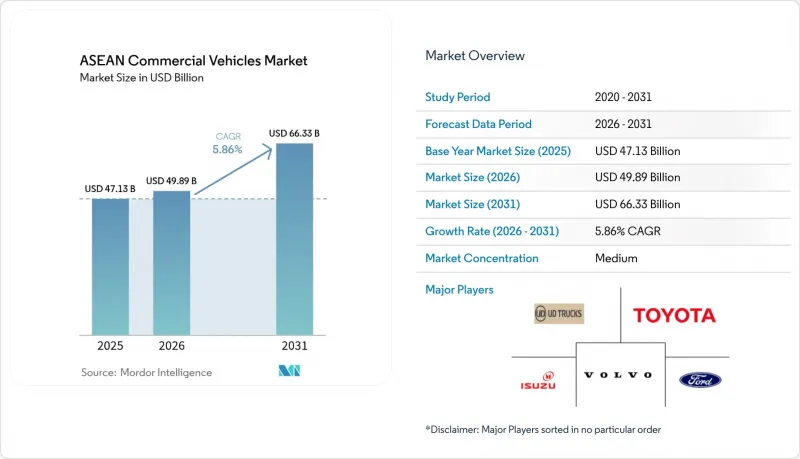
Mordor Intelligence에 의하면, ASEAN의 상용차 시장 규모는 2025년에 471억 3,000만 달러로 평가되었습니다. 2026년 498억 9,000만 달러에서 2031년까지 663억 3,000만 달러에 이를 것으로 예상되며, 예측 기간(2026-2031년) CAGR은 5.86%를 나타낼 전망입니다.

본 보고서는 차종별(소형 상용차, 중형 상용차, 기타), 추진 방식별(내연기관, 배터리 전기차, 기타), 용도별(물류·전자상거래 배송, 기타), 차체 구성별(리지드 트럭·밴, 기타), 국가별로 분류되어 있습니다. 시장 예측은 금액(달러)과 수량(대)으로 제시되어 있습니다.
ASEAN의 상용차 시장 동향 및 인사이트
전자상거래의 급속한 성장과 라스트 마일 물류
온라인 소매의 폭발적인 성장으로 인해 배송 형태가 완전히 바뀌었고, 차량 운영 사업자들은 혼잡한 도심 지역을 원활하게 주행할 수 있는 소형 밴, 픽업 트럭, 이륜 화물 운송 차량을 선호하게 되었습니다. 2024년, 태국 전역의 택배 네트워크는 서비스 거점을 2배로 확대하여, 사업자들이 배송 시간대를 단축해야 할 시급성을 부각시켰습니다. 모듈식 적재함을 갖춘 전용 설계의 소형 전기 트럭이, 특히 접근 제한으로 인해 디젤 차량이 불리한 지역에서 기세를 얻고 있습니다. 라이드셰어 플랫폼과 현지 조립 제조업체간의 제휴를 통해 1,000달러 미만의 배터리 교체형 이륜차가 등장하여 대기 시간을 단축하고 자산 수명을 연장하고 있습니다. 또한, 소셜 커머스 플랫폼을 통한 신선식품 취급량이 증가함에 따라, 온도 관리 기능을 갖춘 소형 배송 차량에 대한 수요도 높아지고 있습니다. 이러한 변화들이 맞물리면서 소형 상용차 조달이 증가하는 동시에, 다중 배송 경로를 최적화할 수 있는 텔레매틱스 공급업체에게 새로운 비즈니스 기회가 창출되고 있습니다.
대규모 인프라 프로젝트 계획 안건
태국, 인도네시아, 말레이시아, 베트남에서는 2035년까지 43조 달러 이상의 도로 및 교량 건설비가 책정되어 있으며, 이는 아시아태평양 교통 인프라 예산의 63%에 해당합니다. 고속도로 개보수 및 채석장 확장으로 인해 덤프트럭, 콘크리트 믹서, 대형 광산용 운반차의 수주가 즉시 증가하고 있습니다. 렘차반 및 클랑 주변에 형성되고 있는 항만 중심의 물류 회랑 또한 컨테이너용 트랙터 수요를 끌어올리고 있습니다. 프로젝트 승인은 안정적인 수요 기반을 창출하지만, 부지 확보 및 재정적 제약에 따른 지연으로 분기별 수요 변동이 발생하여 OEM 업체들은 모듈식 차체 프로그램 및 유연한 교대 근무 체제를 도입할 수밖에 없는 상황입니다. 차량 소유주들이 초기 구매 비용보다 가동 시간을 우선시하는 경향이 있기 때문에 구동계 내구성 솔루션이나 현장 정비 서비스를 제공하는 공급업체들은 혜택을 보고 있습니다.
유로 VI에 상응하는 더 엄격한 기준
태국은 2024년 1월에 유로 5 디젤 규정을 시행하고, 늦어도 2030년까지 유로 VI 준수를 목표로 하는 방침을 밝혔으며, 캄보디아와 필리핀도 유사한 움직임을 보였습니다. 환경적 이점은 분명하지만, 이러한 기준 강화로 인해 엔진과 배기 후처리 시스템의 비용이 15-20% 상승하여 소규모 조립 제조업체의 이익률이 압박받고 있습니다. 회원국 간 디젤 연료의 황 함량에 차이가 있어 보정 작업이 복잡해지고, 형식 인증 주기가 장기화되고 있습니다. 선택적 촉매 환원(SCR) 기술을 보유한 OEM은 판매 대수 증가가 예상되지만, 소규모 제조업체는 설비 투자 수요가 재무 능력을 초과함에 따라 시장에서 철수할 위험에 직면해 있습니다.
부문별 분석
2025년, 소형 상용차는 소포 배송의 호조와 대형 디젤 차량에 대한 지자체 규제의 영향으로 ASEAN의 상용차 시장 점유율의 55.70%를 차지했습니다. 이 부문의 매출은 2031년까지 연평균 6.65% 성장하여 ASEAN의 상용차 시장 전체를 상회하는 속도로 확대될 것으로 예측됩니다. 중국의 신규 진출기업들은 기존 모델보다 20% 저렴한 가격의 배터리식 전기 픽업 트럭을 출시하고 있는 반면, 일본의 기존 제조업체들은 마일드 하이브리드로의 업그레이드로 대응하고 있습니다. 방콕과 호치민시 주변에서는 도시 지역의 집적 거점이 급증하고 있으며, 이는 출고 시 선반과 텔레매틱스 장비가 장착된 패널 밴 수요를 뒷받침하고 있습니다.
중형차 부문은 건설 물류 및 폐기물 관리와 같은 틈새 시장을 대상으로 하며, 교통 체증을 극복하기 위해 개선된 토크 특성과 자동 변속기에 의존하고 있습니다. 대형 트랙터는 아세안(ASEAN) 지역 내 화물 운송 노선에서 여전히 필수적이지만, 본토 노선에서 철도 운송이 힘을 얻으면서 그 성장세는 둔화되고 있습니다. 그 결과, 경량 복합 소재 및 공기역학적 성능 향상에 주력하는 섀시 제조업체들은 연비 효율을 중시하고 신속한 투자 회수를 추구하는 차량 플리트 시장에서 경쟁 우위를 확보하고 있습니다.
2025년 ASEAN의 상용차 시장 규모에서 내연기관 차량은 93.85%를 차지했지만, 정책적 인센티브가 차량 함대의 경제성을 좌우함에 따라 그 점유율은 축소되었습니다. 배터리 전기자동차(BEV) 모델은 낮은 수준에서 출발하지만, 2031년까지 연평균 성장률(CAGR) 10.12%를 기록하며 ASEAN의 상용차 시장 내 점유율을 2배로 확대할 것으로 예측됩니다. 태국의 ‘EV3.5’ 제도에서는 소비세 면제를 통해 OEM의 입고 비용이 절감되어 모델 라인업 확충이 가속화되고 있습니다. 인도네시아가 내세운 2030년까지 전기차 60만 대라는 야심찬 목표는 니켈이 풍부한 국내 배터리 공급과 연계된 벤더 파이낸싱 패키지를 뒷받침하고 있습니다.
플러그인 하이브리드 전기차는 관세 우대 조치 덕분에 저탄소이면서도 주행 거리를 연장하는 솔루션으로서 가교 역할을 수행하고 있습니다. 연료전지차 시제차는 주로 말레이시아와 싱가포르 간 국경을 넘는 장거리 운송 시범 사업에서 등장하고 있으며, 항만 당국과 공동 개발된 단거리 수소 운송 회랑을 활용하고 있습니다. 내연기관(ICE) 차량을 계속 사용하는 사용자에게는 유로 VI 규격의 하드웨어 및 합성 디젤 연료 지원이 주요 판매 포인트가 되고 있으며, 고객은 미래의 재판매 가치와 단기적인 초기 투자 비용을 저울질하며 검토하고 있습니다.
기타 혜택
- 엑셀 형식 시장 예측(ME) 시트
- 3개월간의 애널리스트 지원
자주 묻는 질문
목차
제1장 서론
제2장 조사 방법
제3장 주요 요약
제4장 시장 구도
제5장 시장 규모 및 성장 예측
제6장 경쟁 구도
제7장 시장 기회 및 향후 전망
KTH 26.09.08According to Mordor Intelligence, the ASEAN commercial vehicles market size was valued at USD 47.13 billion in 2025 and estimated to grow from USD 49.89 billion in 2026 to reach USD 66.33 billion by 2031, at a CAGR of 5.86% during the forecast period (2026-2031).
This report is Segmented by Vehicle Type (Light Commercial Vehicles, Medium-Duty Commercial Vehicles, and More), Propulsion (Internal Combustion Engine, Battery Electric Vehicle, and More), Application (Logistics and E-Commerce Delivery, and More), Body Configuration (Rigid Truck and Van, and More) and by Country. The Market Forecasts are Provided in Terms of Value (USD) and Volume (Units).
ASEAN Commercial Vehicles Market Trends and Insights
E-commerce Boom and Last-Mile Logistics
Explosive online retail growth has redrawn shipment profiles, pushing fleet operators to favour compact vans, pickups, and two-wheeler cargo carriers that can slip through congested urban cores. Courier networks doubled service points across Thailand during 2024, underscoring operators' urgency to narrow fulfilment windows. Purpose-built electric light trucks featuring modular cargo bays are gaining traction, especially where access restrictions penalise diesel vehicles. Partnerships between ride-hailing platforms and local assemblers have yielded sub-USD 1,000 battery-swappable motorbikes that cut idle time and extend asset life. Demand also tilts toward temperature-controlled micro-delivery units as social-commerce platforms heighten fresh-food throughput. Collectively, these shifts amplify procurement of light commercial platforms and open opportunities for telematics suppliers that can optimise multi-drop routing.
Infrastructure Mega-Projects Pipeline
Across Thailand, Indonesia, Malaysia, and Vietnam, more than USD 43 trillion in road and bridge spending is earmarked through 2035, equal to 63% of Asia-Pacific transport allocations. Highway upgrades and quarry expansions lift immediate orders for tipper trucks, concrete mixers, and heavy-duty mining haulers. Port-centric logistics corridors spawning around Laem Chabang and Klang also boost container tractors. While project approvals create a steady baseline, delays tied to land acquisition or fiscal constraints introduce quarterly demand swings that compel OEMs to pursue modular body programmes and flexible shift patterns. Suppliers of drivetrain durability solutions and on-site maintenance services benefit as fleet owners prioritise uptime over outright acquisition cost.
Stricter Euro VI-Equivalent Standards
Thailand enforced Euro 5 diesel specifications in January 2024 and signalled Euro VI compliance no later than 2030, moves mirrored by Cambodia and the Philippines. While environmental gains are clear, the upgrades inflate engine and exhaust-after-treatment costs by 15-20%, squeezing margins for low-volume assemblers. Disparities in diesel sulphur content across member states complicate calibration work, lengthening homologation cycles. OEMs with selective catalytic reduction portfolios stand to gain volume, but smaller players risk exit as capital-expenditure demands outstrip balance-sheet capacity.
Other drivers and restraints analyzed in the detailed report include:
- Intra-ASEAN Trade Growth
- Localization by Chinese EV-CV OEMs
- Cold-Chain Demand Surge
- EV-CV Charging & TCO Barrier
For complete list of drivers and restraints, kindly check the Table Of Contents.
Segment Analysis
Light commercial vehicles held 55.70% of ASEAN commercial vehicles market share in 2025, buoyed by parcel-delivery momentum and municipal restrictions on heavy diesels. Segment revenue is projected to compound at 6.65% annually through 2031, outpacing the broader ASEAN commercial vehicles market. Chinese challengers introduce battery-electric pickups that undercut traditional offerings by 20%, while Japanese incumbents counter with mild-hybrid upgrades. Urban consolidation centres proliferate around Bangkok and Ho Chi Minh City, catalysing demand for panel vans equipped with factory-fitted shelving and telematics bundles.
The medium-duty cohort serves construction logistics and waste-management niches, relying on improved torque curves and automated transmissions to navigate congestion. Heavy-duty tractors remain vital for intra-ASEAN freight corridors, yet their growth moderates as rail pipelines gain traction on mainland routes. Consequently, chassis makers exploring lightweight composites and aerodynamics enhancements secure competitive advantage in fuel-efficiency-obsessed fleets seeking quick returns on capital.
Internal-combustion engines represent 93.85% of the ASEAN commercial vehicles market size in 2025, but their share erodes as policy incentives tilt fleet economics. Battery-electric models, starting from a low base, are expected to post a 10.12% CAGR to 2031, doubling their contribution within the ASEAN commercial vehicles market. Thailand's EV3.5 scheme grants excise waivers that reduce OEM landed costs, accelerating model-line additions. Indonesia's aspirational target of 600,000 electric vehicles by 2030 stimulates vendor finance packages tied to nickel-rich domestic battery supply.
Plug-in hybrids occupy a bridging role where duty concessions favour low-carbon yet range-extending solutions. Fuel-cell prototypes surface mainly in cross-border haulage pilots between Malaysia and Singapore, leveraging short hydrogen corridors co-developed with port authorities. For ICE holdouts, Euro VI hardware and synthetic-diesel compatibility become selling points as customers weigh future resale value against near-term capital outlay.
Complete Report Scope:
- By Vehicle Type
- Light Commercial Vehicles
- Medium-Duty Commercial Vehicles
- Heavy-Duty Commercial Vehicles
- By Propulsion
- Internal Combustion Engine
- Battery Electric Vehicle
- Plug-in Hybrid Electric Vehicle
- Fuel Cell Electric Vehicle
- By Application / End-Use
- Logistics and E-commerce Delivery
- Construction and Mining
- Agriculture and Forestry
- Public Transportation (Bus & Coach)
- Utilities and Municipal Services
- By Body Configuration (NEW)
- Rigid Truck and Van
- Tractor-Trailer
- Bus and Coach
- Tipper and Dump
- Refrigerated
- By Country
- Indonesia
- Thailand
- Vietnam
- Malaysia
- Philippines
- Singapore
- Rest of the ASEAN Countries
List of Companies Covered in this Report:
- Isuzu Motors
- AB Volvo
- Toyota Motor Corporation
- Ford Motor Company
- UD Trucks
- Iveco Group
- Tata Motors
- BYD Auto
- Chery Commercial Vehicles
- Foton Motor
- Dongfeng Trucks
- MAN Truck & Bus
- Daimler Truck (Mitsubishi Fuso & Mercedes-Benz Trucks)
- Hyundai Motor Company
- Ashok Leyland
- Suzuki Motor
Additional Benefits:
- The market estimate (ME) sheet in Excel format
- 3 months of analyst support
TABLE OF CONTENTS
1 Introduction
- 1.1 Study Assumptions & Market Definition
- 1.2 Scope of the Study
2 Research Methodology
3 Executive Summary
4 Market Landscape
- 4.1 Market Overview
- 4.2 Market Drivers
- 4.2.1 E-Commerce Boom and Last-Mile Logistics
- 4.2.2 Infrastructure Mega-Projects Pipeline
- 4.2.3 Intra-ASEAN Trade Growth
- 4.2.4 Localization by Chinese EV-CV OEMs
- 4.2.5 Cold-Chain Demand Surge
- 4.2.6 Carbon-Credit and Green-Fleet Mandates
- 4.3 Market Restraints
- 4.3.1 Stricter Euro VI-Equivalent Standards
- 4.3.2 EV-CV Charging and TCO Barrier
- 4.3.3 Fragmented Advanced-Powertrain After-Sales
- 4.3.4 SME Credit Tightening for Fleet Renewal
- 4.4 Value / Supply-Chain Analysis
- 4.5 Regulatory Landscape
- 4.6 Technological Outlook
- 4.7 Porter's Five Forces
- 4.7.1 Bargaining Power of Suppliers
- 4.7.2 Bargaining Power of Buyers
- 4.7.3 Threat of New Entrants
- 4.7.4 Threat of Substitute Products
- 4.7.5 Intensity of Competitive Rivalry
5 Market Size & Growth Forecasts (Value (USD), Volume (Units))
- 5.1 By Vehicle Type
- 5.1.1 Light Commercial Vehicles
- 5.1.2 Medium-Duty Commercial Vehicles
- 5.1.3 Heavy-Duty Commercial Vehicles
- 5.2 By Propulsion
- 5.2.1 Internal Combustion Engine
- 5.2.2 Battery Electric Vehicle
- 5.2.3 Plug-in Hybrid Electric Vehicle
- 5.2.4 Fuel Cell Electric Vehicle
- 5.3 By Application / End-Use
- 5.3.1 Logistics and E-commerce Delivery
- 5.3.2 Construction and Mining
- 5.3.3 Agriculture and Forestry
- 5.3.4 Public Transportation (Bus & Coach)
- 5.3.5 Utilities and Municipal Services
- 5.4 By Body Configuration (NEW)
- 5.4.1 Rigid Truck and Van
- 5.4.2 Tractor-Trailer
- 5.4.3 Bus and Coach
- 5.4.4 Tipper and Dump
- 5.4.5 Refrigerated
- 5.5 By Country
- 5.5.1 Indonesia
- 5.5.2 Thailand
- 5.5.3 Vietnam
- 5.5.4 Malaysia
- 5.5.5 Philippines
- 5.5.6 Singapore
- 5.5.7 Rest of the ASEAN Countries
6 Competitive Landscape
- 6.1 Market Concentration
- 6.2 Strategic Moves
- 6.3 Market Share Analysis
- 6.4 Company Profiles (includes Global Level Overview, Market Level Overview, Core Segments, Financials as Available, Strategic Information, Market Rank/Share for Key Companies, Products and Services, SWOT Analysis, and Recent Developments)
- 6.4.1 Isuzu Motors
- 6.4.2 AB Volvo
- 6.4.3 Toyota Motor Corporation
- 6.4.4 Ford Motor Company
- 6.4.5 UD Trucks
- 6.4.6 Iveco Group
- 6.4.7 Tata Motors
- 6.4.8 BYD Auto
- 6.4.9 Chery Commercial Vehicles
- 6.4.10 Foton Motor
- 6.4.11 Dongfeng Trucks
- 6.4.12 MAN Truck & Bus
- 6.4.13 Daimler Truck (Mitsubishi Fuso & Mercedes-Benz Trucks)
- 6.4.14 Hyundai Motor Company
- 6.4.15 Ashok Leyland
- 6.4.16 Suzuki Motor


