

|
시장보고서
상품코드
2117369
미국의 지게차 렌탈 시장 : 시장 점유율 분석, 산업 동향 및 통계 데이터, 성장 예측(2026-2031년)United States Forklift Rental - Market Share Analysis, Industry Trends & Statistics, Growth Forecasts (2026 - 2031) |
||||||
 Mordor Intelligence
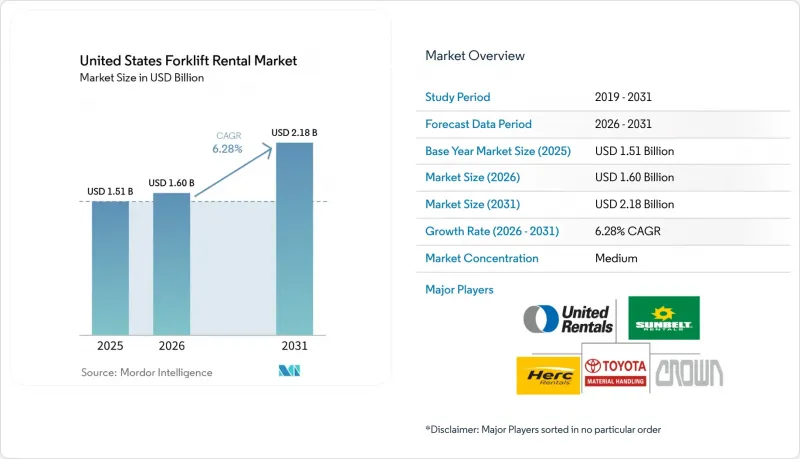
Mordor Intelligence에 의하면, 미국의 지게차 렌탈 시장 규모는 2025년에 15억 1,000만 달러로 평가되었고, 2026년 16억 달러에서 2031년까지 21억 8,000만 달러에 이를 것으로 예측되며, 예측 기간(2026-2031년) CAGR은 6.28%를 나타낼 전망입니다.
본 보고서는 적재 용량별(3.5톤 미만, 3.6톤-10톤, 10톤 이상), 임대 기간별(단기/일회성,중기, 장기 리스), 동력원별(전기, 내연기관, 하이브리드), 트럭 등급별(클래스 I, 클래스 II 등), 최종 이용 산업별(창고 및 물류, 건설 등), 지역별로 분류되어 있습니다. 시장 예측은 금액(달러) 기준으로 제시되어 있습니다.
미국의 지게차 렌탈 시장 동향 및 인사이트
폭발적으로 증가하는 전자상거래 창고 수요
아마존은 최근 미국 전역에 여러 개의 새로운 풀필먼트 센터를 개설했는데, 각 센터에서는 설치 및 가동 시작의 피크기에 수십 대의 렌탈 지게차가 필요했습니다. 월마트는 첨단 기술을 적용한 고객 대상 풀필먼트 센터의 자동화 업그레이드에 막대한 투자를 단행하여, 장기적인 확장 기간 동안 단기적인 지게차 수요를 견인했습니다. 퀵 커머스 업계의 선두주자인 Gopuff와 DoorDash는 단기 임대되는 소형 클래스 III 팔레트 잭을 활용하여 마이크로 창고를 설립했습니다. 이러한 수요 패턴은 지게차를 소유할 때의 경제성과는 맞지 않습니다. 텍사스주 물류 회랑에 새로운 창고 공간이 대폭 증설되고 조지아주도 크게 기여함에 따라, 미국 지게차 임대 시장에서 남부 지역의 주도적 입지가 더욱 공고해졌습니다. 전미 각지에서 진행 중인 풀필먼트 센터 건설은 임대 차량의 가동률에 안정적인 기반을 제공합니다.
금리 상승 국면에서의 CAPEX 억제 경향
연방준비제도이사회(FRB)가 2026년 초까지 정책 금리를 3.5%-3.75% 범위로 동결함에 따라 설비 자금 조달 비용이 상승했습니다. 썬벨트 렌탈스는 중기 계약을 통한 수익 증가를 보고하고 있으며, 고객이 직접 구매에서 렌탈로 전환하는 뚜렷한 변화가 부각되었습니다. 한편, 알타 이큅먼트사는 신형 지게차 판매의 이익률 축소를 지적하며, 렌탈에 대한 매력이 높아지고 있음을 뒷받침하고 있습니다. 전동 지게차를 장기 할부로 구매할 경우의 월 납입액은 렌탈 요금에 비해 낮습니다. 이는 렌탈 요금에 유지보수 비용과 예정에 없던 교체 비용이 포함되어 있기 때문입니다. 이에 따라 가동 중단 위험을 고려하면 경제적 차이는 줄어듭니다. CFO들이 대차대조표의 유연성을 우선시하는 가운데, 이러한 상황은 미국 지게차 렌탈 시장에 유리하게 작용하고 있습니다.
예상되는 유지보수 비용과 손해배상금
공급업체가 기본 요금에 면책 조항을 포함하고 있음에도 불구하고, 많은 중소규모의 하청업체들은 불확실성을 렌탈을 주저하게 만드는 요인으로 꼽으며, 그 결과 손해배상 비용을 과대평가했습니다. 보험을 추가하면 일일 요금이 대폭 상승하여, 중고 장비를 구매하는 경우와 비교했을 때의 비용 절감 효과가 희석되어 버립니다. 지역별 차량군이 충분히 활용되지 않는 경우가 많기 때문에 이러한 마찰 비용이 미국 지게차 렌탈 시장의 잠재력을 제한하고 있음은 분명합니다. 기업들은 렌탈 전 사진 점검, 운전자의 오용을 감시하기 위한 텔레매틱스를 도입하고 있지만, 렌탈을 처음 이용하는 사용자에게는 여전히 지식의 격차가 존재합니다.
부문 분석
2025년, 3.5톤 미만의 지게차는 미국 지게차 렌탈 시장 점유율의 45.87%를 차지한 것으로 평가되었으며, 2031년까지 연평균 성장률(CAGR) 8.52%로 성장할 것으로 전망됩니다. 밀집된 도시 지역의 물류 센터에서는 처리 능력을 저해하지 않으면서 30피트 폭의 통로를 이동하기 위해 이러한 소형 전동 팔레트 잭과 스태커가 활용되고 있습니다. 성수기인 연말연시에는 아마존과 월마트가 이러한 장비를 빈번하게 이용하며, 대부분의 경우 단기 계약을 선택합니다. 기존에는 중량물 제조업체들이 중형 장비에 의존해 왔으나, 자동화가 추진되면서 반복적인 하역 작업의 필요성이 줄어들면서 이 부문의 성장은 둔화될 것으로 예측됩니다.
임대 기간의 추세는 장비의 용량에 따라 다릅니다. 소형 모델은 단기 임대가 주류를 이루는 반면, 대형 기종은 특히 건설업이나 철강 취급 분야에서 장기 임대로 이용되는 사례가 증가하고 있습니다. 도요타의 ‘T-Matics’나 크라운의 ‘InfoLink’와 같은 시스템을 통해 임대 사업자는 장비의 이용 상황을 모니터링할 수 있게 되어, 예상치 못한 가동 중단 시간을 줄이고 자산의 수명을 연장할 수 있게 되었습니다. 중장비 부문에서도 전동화로의 뚜렷한 전환이 나타나고 있습니다. 최근 뉴어크 항구는 지역 대기질 규제를 준수하기 위해 대형 배터리 구동 장비를 발주했습니다.
2025년, 미국 지게차 렌탈 시장에서 단기 렌탈이 51.87%를 차지했습니다. 이는 소매업, 농업, 이벤트 물류 분야의 계절적 수요에 힘입은 결과입니다. 그러나 마이크로 풀필먼트의 확충, 데이터센터 건설, 그리고 90일에서 180일에 걸친 시운전 활동이 확대됨에 따라, 1개월에서 12개월에 걸친 중기 계약은 연평균 성장률(CAGR) 9.04%로 성장할 전망입니다. 로봇이 업무를 인수함에 따라, 크로거(Kroger)의 오카도(Ocado)가 운영하는 고객 주문 처리 센터에서는 지게차가 더 이상 필요하지 않게 되었으며, 이러한 변화는 자동화 그리드 도입 시에 두드러지게 나타났습니다.
유나이티드 렌탈스는 고객이 단기 렌탈을 장기 계약으로 전환할 수 있는 ‘플렉스 리스’를 도입했습니다. 여기에는 소급 적용되는 요금 조정이 수반되어 예측 불확실성에 대한 헤지 역할을 하며, 유나이티드 렌탈스에 안정적인 수익원을 확보해 주고 있습니다. 알타 이퀄리먼트(Alta Equipment)는 보유 장비 수를 줄이는 전략적 조치를 취했습니다. 이는 취급량 확대가 반드시 유기적 성장에 기인하는 것은 아니라는 점을 시사하며, 경우에 따라서는 규율 있는 자본 회전을 통해 공급량 감축으로 이어질 수도 있음을 보여줍니다. 성수기에는 단기 이용자의 상당수가 손해 보상 옵션을 선택하는 반면, 중기 계약 고객은 보험료를 월별 청구액에 포함시킨 패키지 서비스를 선호하는 경향이 있습니다.
기타 혜택 :
- Excel 형식 시장 예측(ME) 시트
- 3개월간의 애널리스트 지원
자주 묻는 질문
목차
제1장 서론
제2장 분석 방법
제3장 개요
제4장 시장 구도
제5장 시장 규모 및 성장률 예측
제6장 경쟁 구도
제7장 시장 기회 및 향후 전망
AJY 26.09.01According to Mordor Intelligence, the United States forklift rental market size was valued at USD 1.51 billion in 2025 and estimated to grow from USD 1.60 billion in 2026 to reach USD 2.18 billion by 2031, at a CAGR of 6.28% during the forecast period (2026-2031).
This report is Segmented by Load Capacity (Less Than 3. 5 T, 3. 6 To 10 T, More Than 10 T), Rental Duration (Short-term/Spot, Mid-Term, Long-Term Lease), Power Source (Electric, Internal Combustion, Hybrid), Truck Class (Class I, Class II, and More), End-Use Industry (Warehousing and Logistics, Construction, and More), and Geography. The Market Forecasts are Provided in Terms of Value (USD).
United States Forklift Rental Market Trends and Insights
Explosive E-commerce Warehousing Demand
Amazon recently opened several new fulfillment centers across the U.S., with each center requiring dozens of rental forklifts during peak installation and ramp-up phases. Walmart invested significantly in automation upgrades for its high-tech customer fulfillment centers, driving short-term forklift demand during extended buildout periods. Quick-commerce giants Gopuff and DoorDash established micro-warehouses, relying on compact Class III pallet jacks rented for short-term periods. This demand pattern does not align with ownership economics. Texas logistics corridors added substantial new warehouse space, while Georgia also contributed significantly, reinforcing the South's leadership in the U.S. forklift rental market. Ongoing construction of fulfillment centers across the country provides a stable foundation for rental fleet utilization.
CAPEX-lite Preference Amid Higher Interest Rates
The Federal Reserve kept its policy rate in the 3.5%-3.75% band through early 2026, inflating equipment-financing costs . Sunbelt Rentals reported an increase in mid-term contract revenue, highlighting a notable shift among customers moving away from direct purchases. Meanwhile, Alta Equipment observed tighter margins on new forklift sales, underscoring the growing allure of rentals. Financing an electric forklift over a long-term period results in a monthly payment that is lower compared to rental rates, which are higher but include maintenance and unscheduled swap-outs. This narrows the economic gap when downtime risk is considered. These conditions favor the United States forklift rental market as CFOs prioritize balance-sheet flexibility.
Perceived Maintenance Liability and Damage Charges
Despite providers embedding waivers in base rates, many small contractors cite uncertainty as a rental deterrent, leading them to overestimate damage fees. Adding insurance can significantly increase daily rates, diminishing the savings compared to purchasing a used unit. With regional fleets often underutilized, it's evident that friction costs are capping the potential of the U.S. forklift rental market. While firms are introducing pre-rental photo audits and telematics to monitor operator misuse, first-time renters still face educational gaps.
Other drivers and restraints analyzed in the detailed report include:
- Stricter U.S. EPA/CARB Emission Rules Accelerating Electric Rentals
- OEM Fleet-as-a-Service Programs Boosting Rental Penetration
- Cyclical Construction Project Delays
For complete list of drivers and restraints, kindly check the Table Of Contents.
Segment Analysis
Less-than-3.5-ton forklifts captured 45.87% of the United States forklift rental market share in 2025 and are forecast to grow at an 8.52% CAGR through 2031. Dense urban fulfillment nodes rely on these compact electric pallet jacks and stackers to navigate 30-foot aisles without compromising throughput. During holiday peaks, Amazon and Walmart frequently utilize such units, often opting for short-term contracts. While manufacturers of heavier goods traditionally relied on mid-range equipment, this segment is projected to grow more slowly as the push for automation reduces the need for repetitive lifting.
Rental duration patterns shift with equipment capacity: smaller models dominate short-term rentals, whereas larger units are increasingly leased for longer periods, especially in construction and steel handling. Systems like Toyota's T-Matics and Crown's InfoLink empower lessors to monitor equipment utilization, reducing unplanned downtime and extending asset life. Even in the heavy equipment segment, there's a noticeable shift towards electric. Recently, Port Newark ordered large battery units to align with regional air-quality regulations.
Short-term rentals accounted for 51.87% of the United States forklift rental market in 2025, driven by seasonal retail, agricultural, and event logistics needs. Yet mid-term contracts spanning 1 to 12 months will advance at a 9.04% CAGR as micro-fulfillment buildouts, data center construction, and 90- to 180-day commissioning activities proliferate. Once the bots took over, Kroger's Ocado-powered customer fulfillment centers no longer needed forklifts, a shift evident during the automated grid's installation.
United Rentals has introduced a "flex lease" that allows customers to convert short-term rentals into extended agreements. This comes with retroactive rate adjustments, providing a hedge against forecast uncertainties and ensuring United Rentals a steady stream of revenue. Alta Equipment made a strategic move by reducing its fleet, underscoring that volume growth isn't always organic; sometimes, a disciplined capital rotation can lead to a reduced supply. During peak seasons, short-term users opt for damage waivers at a high rate, while mid-term clients prefer a bundled service that integrates insurance into their monthly billing.
Complete Report Scope:
- By Load Capacity
- Less than 3.5 T
- 3.6 to 10 T
- More than 10 T
- By Rental Duration
- Short-term/Spot (Less than 1 month)
- Mid-term (1 to 12 months)
- Long-term Lease (3 to 5 years)
- By Power Source
- Electric
- Internal Combustion (Diesel/LPG)
- Hybrid
- By Truck Class
- Class I
- Class II
- Class III
- Class IV
- Class V
- By End-use Industry
- Warehousing and Logistics
- Construction
- Automotive
- Food and Beverage
- Aerospace and Defense
- Others (Retail, Pharma, etc.)
- By Region (U.S.)
- Northeast
- Midwest
- South
- West
List of Companies Covered in this Report:
- United Rentals
- Sunbelt Rentals (Ashtead Group)
- Herc Rentals
- Toyota Material Handling USA
- Crown Equipment Corp.
- Raymond Corporation
- Hyster-Yale Group
- Komatsu Forklift USA
- Mitsubishi Logisnext Americas
- CLARK Material Handling
- Doosan Industrial Vehicle America
- Jungheinrich PROFISHARE (rental)
- Alta Equipment Company
- Briggs Equipment
- EquipmentShare
- BigRentz
- Home Depot Rental
- BlueLine Rentals
- Thompson Lift Truck
Additional Benefits:
- The market estimate (ME) sheet in Excel format
- 3 months of analyst support
TABLE OF CONTENTS
1 Introduction
- 1.1 Study Assumptions and Market Definition
- 1.2 Scope of the Study
2 Research Methodology
3 Executive Summary
4 Market Landscape
- 4.1 Market Overview
- 4.2 Market Drivers
- 4.2.1 Explosive E-Commerce Warehousing Demand
- 4.2.2 CAPEX-Lite Preference Amid Higher Interest Rates
- 4.2.3 Stricter U.S. EPA/CARB Emission Rules Accelerating Electric Rentals
- 4.2.4 OEM Fleet-as-a-Service Programs Boosting Rental Penetration
- 4.2.5 Telematics-Enabled Pay-Per-Use Contracts
- 4.2.6 Pop-Up Micro-Fulfillment Centers Needing Flexible Fleets
- 4.3 Market Restraints
- 4.3.1 Perceived Maintenance Liability and Damage Charges
- 4.3.2 Cyclical Construction Project Delays
- 4.3.3 Lithium-Ion Battery Supply Tightness for Rental Fleets
- 4.3.4 AMR/AGV Adoption Cannibalizing Light-Duty Forklifts
- 4.4 Value/Supply-Chain Analysis
- 4.5 Regulatory Landscape
- 4.6 Technological Outlook
- 4.7 Porter's Five Forces
- 4.7.1 Threat of New Entrants
- 4.7.2 Bargaining Power of Suppliers
- 4.7.3 Bargaining Power of Customers
- 4.7.4 Threat of Substitutes
- 4.7.5 Competitive Rivalry
5 Market Size and Growth Forecasts (Value (USD))
- 5.1 By Load Capacity
- 5.1.1 Less than 3.5 T
- 5.1.2 3.6 to 10 T
- 5.1.3 More than 10 T
- 5.2 By Rental Duration
- 5.2.1 Short-term/Spot (Less than 1 month)
- 5.2.2 Mid-term (1 to 12 months)
- 5.2.3 Long-term Lease (3 to 5 years)
- 5.3 By Power Source
- 5.3.1 Electric
- 5.3.2 Internal Combustion (Diesel/LPG)
- 5.3.3 Hybrid
- 5.4 By Truck Class
- 5.4.1 Class I
- 5.4.2 Class II
- 5.4.3 Class III
- 5.4.4 Class IV
- 5.4.5 Class V
- 5.5 By End-use Industry
- 5.5.1 Warehousing and Logistics
- 5.5.2 Construction
- 5.5.3 Automotive
- 5.5.4 Food and Beverage
- 5.5.5 Aerospace and Defense
- 5.5.6 Others (Retail, Pharma, etc.)
- 5.6 By Region (U.S.)
- 5.6.1 Northeast
- 5.6.2 Midwest
- 5.6.3 South
- 5.6.4 West
6 Competitive Landscape
- 6.1 Market Concentration
- 6.2 Strategic Moves
- 6.3 Market Share Analysis
- 6.4 Company Profiles (Includes Global level Overview, Market level overview, Core Segments, Financials as available, Strategic Information, Market Rank/Share for key companies, Products and Services, and Recent Developments)
- 6.4.1 United Rentals
- 6.4.2 Sunbelt Rentals (Ashtead Group)
- 6.4.3 Herc Rentals
- 6.4.4 Toyota Material Handling USA
- 6.4.5 Crown Equipment Corp.
- 6.4.6 Raymond Corporation
- 6.4.7 Hyster-Yale Group
- 6.4.8 Komatsu Forklift USA
- 6.4.9 Mitsubishi Logisnext Americas
- 6.4.10 CLARK Material Handling
- 6.4.11 Doosan Industrial Vehicle America
- 6.4.12 Jungheinrich PROFISHARE (rental)
- 6.4.13 Alta Equipment Company
- 6.4.14 Briggs Equipment
- 6.4.15 EquipmentShare
- 6.4.16 BigRentz
- 6.4.17 Home Depot Rental
- 6.4.18 BlueLine Rentals
- 6.4.19 Thompson Lift Truck
7 Market Opportunities and Future Outlook
- 7.1 White-space and Unmet-Need Assessment


