|
시장보고서
상품코드
2122477
군용 바이오메트릭스 : 시장 점유율 분석, 업계 동향 및 통계, 성장 예측(2026-2031년)Military Biometrics - Market Share Analysis, Industry Trends & Statistics, Growth Forecasts (2026 - 2031) |
||||||
 Mordor Intelligence
Mordor Intelligence에 의하면, 군용 바이오메트릭스 시장 규모는 2026년에 106억 8,000만 달러에 달하고 2031년까지 148억 3,000만 달러까지 성장하며 예측 기간 CAGR 6.80%를 나타낼 것으로 전망됩니다.

본 보고서는 인식 방식별(지문, 얼굴, 홍채, 기타), 솔루션별(하드웨어, 소프트웨어), 플랫폼별(지상 시스템, 해군 시스템, 항공기 탑재 시스템), 도입 환경별(고정 설치형, 이동형·전술형),지역별(북미, 남미, 유럽, 기타)로 분류되어 있습니다. 시장 예측은 금액(달러) 기준으로 제시되어 있습니다.
세계의 군용 바이오메트릭스 시장 동향 및 인사이트
비대칭 전쟁 증가와 국경 경비 수요의 고조
비국가 주체에 의한 적대 세력이나 이민자 흐름은 현재 고정 검문소를 우회하고 있어, 지휘관은 순찰 중이나 전선 초소, 외딴 사막 지대 등에서 신원 확인을 할 수밖에 없는 실정입니다. 미 육군은 ‘바이오메트릭스 지원 능력(Biometrics Enabling Capability)’의 일환으로 이라크, 아프가니스탄, 시리아 전역에서 730만 명을 등록하여 현장용 키트의 운영적 가치를 입증했습니다. 인도 국경 경비대는 2025년, 방글라데시 및 미얀마와의 국경 지역에 1,200대의 이동식 바이오메트릭스 장비를 설치하여 6개월 이내에 불법 국경 횡단을 34% 감소시켰습니다. 사우디아라비아는 89곳의 육로 국경 검문소에서 홍채 스캐너를 인터폴의 모니터링 목록과 연동하여 첫해에 2,400건의 불법 입국을 저지했습니다. 이러한 선례들이 2025년 매출의 3분의 2 가까이 모바일 및 전술 시스템이 차지한 이유를 설명해 줍니다. 분산형 분쟁이 지속되는 가운데, 군용 바이오메트릭스 시장에서는 주둔지 인프라 이외의 환경에서도 작동하는 견고한 휴대용 단말기가 계속해서 중요시될 것으로 보입니다.
정부의 디지털 ID 및 국방 현대화 프로그램
각국의 국방부는 군인과 계약업체의 인증 정보를 전국 규모의 전자 신분증(e-ID) 프레임워크와 동기화하고 있습니다. 미국 국방부(DoD)는 2025년, 약 210만 명의 인원을 대상으로 공통 접근 카드(CAC)에 생체 인증 기능을 통합하기 위해 9,200만 달러 규모의 계약을 체결했습니다. 일본은 2025 회계연도에 1억 2,000만 달러를 편성하여 340곳의 시설에 멀티모달 게이트를 도입했습니다. 그 결과, 검문소에서의 무단 접근 사건이 67% 감소했습니다. EU의 PESCO 이니셔티브에서는 2027년까지 ISO/IEC 19794 준수가 의무화되어 있으며, 각국의 네트워크를 연결하는 미들웨어 조달이 가속화되고 있습니다. 이러한 프로그램을 통해 인증 대상이 기지 출입에서 공급망 검문소 및 해군 부두까지 확대됨에 따라, 자산 등급이나 임무 범위에 관계없이 대상 군용 생체 인증 시장이 확대되고 있습니다.
바이오메트릭스 데이터베이스와 관련된 개인정보 보호 및 시민의 자유에 대한 우려
민주주의 국가의 규제 당국은 중앙 집중식 데이터 저장소를 제한하고 있습니다. 유럽 데이터 보호 위원회는 회원국 군이 사용하는 얼굴 인식 시스템에 대해 단말기에서 대조를 완료하도록 의무화하고 있으며, 이 규정으로 인해 단가가 40% 증가하고 클라우드 도입이 제한되고 있습니다. GAO(미국 정부감사원)의 2025년 감사에서는 DHS(미국 국토안보부)의 HART 프로젝트에서 17건의 개인정보 보호상 결함이 확인되었으며, 그 결과 2억 1,400만 달러의 지출이 지연되었습니다. 캐나다에서는 현재 기소되지 않는 경우 90일 이내에 바이오메트릭스 데이터를 삭제해야 할 의무가 있어, 현장 등록을 통한 수사상의 유용성이 떨어지고 있습니다. 이러한 결정으로 인해 대규모 중앙 데이터베이스를 추구하는 관할 구역과 엄격한 현지 보관을 의무화하는 관할 구역 간에 군용 바이오메트릭스 시장이 분열되어, 공급업체의 제품 로드맵이 복잡해지고 있습니다.
부문별 분석
지문 인식 시스템은 미국 각 여단에 배치된 1만 4,000대의 SEEK II 핸드헬드 단말기와 형사 사법 부문의 풍부한 판례에 힘입어 2025년 매출의 44.67%를 차지했습니다. 그 뒤를 이어 얼굴 인식이 뒤를 이었으며, 미국 세관·국경 보호국(CBP)이 2025 회계연도에 9,700만 건의 대조 처리를 수행한 검문소에서 수동적 데이터 수집의 혜택을 받고 있습니다. 홍채 인식은 피검사자의 협력이 필요하기 때문에 여전히 틈새 기술에 머물러 있지만, 2024년에는 미국 해병대가 수륙양용함에 800대의 홍채 인식 지원 태블릿을 설치하여 함내 출입 통제에 활용했습니다. 그 밖의 범주인 음성, 손바닥 정맥, 보행, 행동 인증은 특수 부대가 화학적·생물학적 위협이 있는 지역에서 비접촉식 대안을 선호함에 따라 연평균 성장률(CAGR) 8.89%로 성장하고 있습니다. DARPA는 2024년 현장 검사에서 150미터 떨어진 거리에서 보행 인증 정확도가 87%임을 입증했습니다. 손바닥 정맥 인증은 현재 일본의 120개 병기창에 도입되어 있으며, 지문 인증을 곤란하게 하는 표면 마모로 인한 제한에 대해 높은 내성을 보이고 있습니다. 음성 생체 인증은 탈레스(Thales) 사의 AN/PRC-163 무전기에서 암호화된 무선 채널을 보호하고 화자를 실시간으로 인증했습니다. 다중 모드 융합이 장기적인 최종 목표입니다. 미국 국방부(DoD)가 조만간 발표할 3모드 지원 휴대용 단말기 공모는 2031년까지 하이브리드 단말기용 군사 생체 인증 시장 규모가 확대될 것으로 예상되는 부문을 부각시키고 있습니다.
2025년 매출액 중 하드웨어가 61.13%를 차지했으며, 이는 스캐너 및 내구성이 뛰어난 태블릿의 자본 집약성을 반영합니다. 그러나 소프트웨어 라이선스는 연평균 성장률(CAGR) 9.91%로 가장 급격한 성장세를 보이고 있는데, 이는 신경망 매칭 업그레이드를 통해 센서를 교체하지 않고도 정확도를 98%라는 지침상 기준치까지 끌어올릴 수 있기 때문입니다. Aware는 기존 리더기에 머신러닝(ML) 엔진을 추가함으로써 2025년에 소프트웨어 라이선스 매출을 34% 늘리고, 오거부율을 40% 감소시켰습니다. NeoFace의 1,000만 건 템플릿에 대한 1초 미만의 검색 기능은 독일,스페인, 폴란드에서 국경 관리의 실시간 판단을 가능하게 하고 있습니다. 암호화 및 감사 모듈이 부가가치를 높이고 있습니다. DERMALOG는 연방 법 집행 기관용 증거 체인을 유지하기 위해 블록체인 감사 추적을 통합함으로써 4,900만 달러 규모의 계약을 수주했습니다. 하드웨어 공급업체들은 현재 구독 서비스를 번들로 제공하고 있으며, IDEMIA의 ‘MorphoWave Compact’에는 3년간의 클라우드 대조 옵션이 포함되어 있어 이러한 융합 추세를 반영하고 있습니다. 소프트웨어 업그레이드 주기가 핵심 요소가 됨에 따라, 군용 바이오메트릭스 시장에서는 예산의 더 큰 비중을 미들웨어, 알고리즘, 연합 데이터베이스 관리에 할당하게 될 것으로 보입니다.
지역별 분석
북미는 3억 8,600만 달러 규모의 CBP OBIM 계약과 대규모 국방 현대화 예산에 힘입어 2025년 매출의 36.75%를 차지하며 1위를 차지했습니다. 캐나다는 2029년까지 인사 관리 시스템에 생체 인증을 통합하기 위해 1억 8,000만 달러를 투자했습니다. 멕시코는 2024년, 남부 국경 경비를 위해 800세트의 키트를 도입했습니다.
아시아태평양은 연평균 성장률(CAGR) 8.32%로 성장하고 있습니다. 인도는 2025년, 4억 2,000만 달러 규모의 프로그램 자금을 통해 실효 지배선(LAC)을 따라 위치한 198곳의 전방 기지에 바이오메트릭스 게이트를 설치했습니다. 중국 공안부는 국경 기록을 12억 건으로 늘리고, 312곳의 국경 검문소에 얼굴 인식을 통한 출입국 관리 시스템을 도입했습니다.
일본은 NEC사의 멀티모달 게이트를 도입하고, 340곳의 기지를 개보수하기 위해 1억 9,000만 달러를 투입했습니다. 한국은 280곳의 시설에 홍채 스캐너를 도입하기 위해 HID Global을 9,500만 달러에 선정했습니다. 유럽에서는 GDPR(EU 개인정보보호규정)의 개인정보 보호 제한과 NATO 기준 간의 균형을 맞추면서, 독일의 데이터베이스를 규정 준수 기반 시스템으로 전환하기 위해 1억 3,000만 달러를 투자했습니다. 중동 및 아프리카의 성장은 국경 경비 울타리와 병역 등록에 중점을 두고 있습니다. 사우디아라비아에서는 현재 89곳의 국경 검문소에서 바이오메트릭스 검문소를 운영하고 있으며, 그 결과 부정 행위가 67% 감소했습니다.
기타 혜택
- 엑셀 형식 시장 예측(ME) 시트
- 3개월간 애널리스트 지원
자주 묻는 질문
목차
제1장 서론
제2장 조사 방법
제3장 주요 요약
제4장 시장 구도
제5장 시장 규모 및 성장 예측
제6장 경쟁 구도
제7장 시장 기회 및 향후 전망
KTH 26.09.08According to Mordor Intelligence, the military biometrics market size is expected to reach USD 10.68 billion in 2026 and is projected to grow to USD 14.83 billion by 2031, registering a 6.80% CAGR over the forecast period.
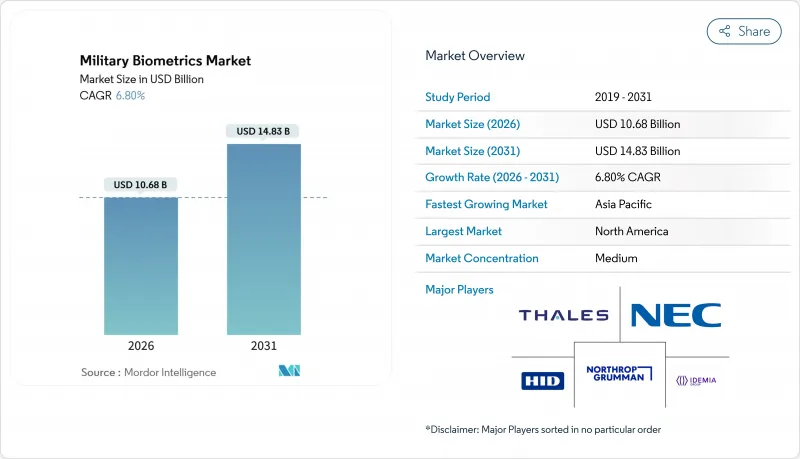
This report is Segmented by Recognition Type (Fingerprint, Facial, Iris, and Others), Solution (Hardware and Software), Platform (Land-Based, Naval, and Airborne Systems), Deployment Environment (Fixed Installations and Mobile and Tactical), and Geography (North America, South America, Europe, and More). The Market Forecasts are Provided in Terms of Value (USD).
Global Military Biometrics Market Trends and Insights
Rising Asymmetric Warfare And Border Security Needs
Non-state adversaries and migration flows now bypass fixed checkpoints, forcing commanders to verify identities during patrols, at forward posts, and along remote deserts. The US Army enrolled 7.3 million individuals across Iraq, Afghanistan, and Syria under its Biometrics Enabling Capability, demonstrating the operational value of field kits. India's Border Security Force installed 1,200 mobile biometric devices along the Bangladesh and Myanmar frontiers in 2025 and cut illegal crossings by 34% within six months. Saudi Arabia integrated iris scanners with Interpol watchlists at 89 land crossings, intercepting 2,400 fraudulent entries in the first year. These precedents explain why mobile and tactical systems captured nearly two-thirds of 2025 revenue. As distributed conflict persists, the military biometrics market will continue to privilege rugged handheld devices that work beyond garrison infrastructure.
Government Digital Identity And Defense Modernization Programs
Defense ministries are synchronizing soldier and contractor credentials with nationwide electronic identification (e-ID) frameworks. The DoD awarded a USD 92 million contract in 2025 to integrate biometric verification into the Common Access Card, covering approximately 2.1 million personnel. Japan earmarked USD 120 million in fiscal 2025 to retrofit 340 facilities with multimodal gates, resulting in a 67% reduction in unauthorized-access incidents at test sites. The EU's PESCO initiative mandates ISO/IEC 19794 compliance by 2027, accelerating middleware procurements that bridge national networks. Such programs extend verification from base entry to supply-chain checkpoints and naval docks, thereby broadening the addressable military biometrics market across asset classes and mission sets.
Privacy and Civil-Liberty Concerns Over Biometric Databases
Regulators in democratic jurisdictions are curtailing centralized repositories. The European Data Protection Board requires that facial recognition systems used by member militaries complete matching on-device, a rule that increases per-unit costs by 40% and limits cloud deployments. GAO's 2025 audit identified 17 privacy gaps in DHS's HART project, resulting in a delay of USD 214 million in spending. Canada now requires the deletion of biometric data within 90 days if no charges are filed, reducing the investigatory utility of field enrollments. Such rulings fragment the military biometrics market between jurisdictions that pursue expansive central databases and those that enforce strict local retention, complicating vendor product roadmaps.
Other drivers and restraints analyzed in the detailed report include:
- Cost Decline of Fingerprint and Facial Sensors
- Integration of AI/ML Boosting Accuracy and Speed
- High Integration Cost With Legacy Defense IT
For complete list of drivers and restraints, kindly check the Table Of Contents.
Segment Analysis
Fingerprint systems accounted for 44.67% of 2025 revenue, underpinned by 14,000 SEEK II handhelds deployed across US brigades and extensive criminal-justice precedent. Facial recognition follows, benefiting from passive capture at checkpoints where the US CBP processed 97 million comparisons in fiscal 2025. Iris recognition remains a niche technology because it requires cooperative subjects; yet, the US Marine Corps installed 800 iris-enabled tablets on amphibious ships for shipboard access in 2024. The other categories, voice, palm vein, gait, and behavioral, grow at an 8.89% CAGR, as special forces favor contactless options in chemical or biological threat zones. DARPA proved gait identification accuracy of 87% at 150 meters in 2024 field trials. Palm-vein access is now tested at 120 Japanese armories, showing resilience against surface abrasion limits that plague fingerprints. Voice biometrics defended encrypted radio channels on Thales AN/PRC-163 sets, authenticating speakers in real time. Multimodal fusion is the long-term end-state. The DoD's forthcoming tri-modal handheld solicitation highlights a channel where the military biometrics market size for hybrid devices is expected to expand through 2031.
Hardware contributed 61.13% of 2025 sales, reflecting the capital intensity of scanners and ruggedized tablets. Yet software licenses post the steepest slope at 9.91% CAGR because neural matching upgrades can raise accuracy to the 98% directive threshold without sensor swaps. Aware recorded 34% software license growth in 2025 by retrofitting legacy readers with ML engines, which reduced false rejects by 40%. NeoFace's sub-second searches across 10 million templates facilitate real-time border decisions in Germany, Spain, and Poland. Encryption and audit modules enhance value; DERMALOG won a USD 49 million contract by embedding blockchain audit trails to preserve evidentiary chains for federal law enforcement agencies. Hardware vendors now offer bundled subscriptions; IDEMIA's MorphoWave Compact includes a three-year cloud matching option, reflecting the convergence. As software upgrade cycles are key, the military biometrics market will allocate a larger portion of its budget toward middleware, algorithms, and federated database management.
Complete Report Scope:
- By Recognition Type
- Fingerprint Recognition
- Facial Recognition
- Iris Recognition
- Others
- By Solution
- Hardware (Scanners, Sensors, Portable Kits)
- Software (Matching Engines, Database, Middleware, Encryption)
- By Platform
- Land-Based Systems
- Naval Systems
- Airborne Systems
- By Deployment Environment
- Fixed Installations
- Mobile and Tactical
- By Geography
- North America
- United States
- Canada
- Mexico
- South America
- Brazil
- Rest of South America
- Europe
- United Kingdom
- Germany
- France
- Russia
- Rest of Europe
- Asia-Pacific
- China
- India
- Japan
- South Korea
- Rest of Asia-Pacific
- Middle East and Africa
- Middle East
- United Arab Emirates
- Saudi Arabia
- Rest of Middle East
- Africa
- Egypt
- Rest of Africa
- Middle East
- North America
Geography Analysis
North America led with 36.75% of 2025 revenue, driven by the USD 386 million CBP OBIM contract and large defense modernization budgets. Canada committed USD 180 million to integrate biometrics into its personnel management system through 2029. Mexico deployed 800 kits in 2024 for southern border patrols.
The Asia-Pacific region is growing at an 8.32% CAGR. India installed biometric gates at 198 forward posts along the Line of Actual Control in 2025, financed within a USD 420 million program. China's Ministry of Public Security grew its border records to 1.2 billion and rolled out facial exit-entry systems at 312 crossings.
Japan funded USD 190 million for 340 base retrofits with NEC multimodal gates. South Korea selected HID Global for USD 95 million of iris scanners across 280 facilities. Europe balances GDPR privacy limits with NATO standards, investing USD 130 million to migrate Germany's database onto a compliant backbone. The Middle East and Africa growth centers on border security fences and national service enrollment. Saudi Arabia now operates biometric checkpoints at 89 crossings, resulting in a 67% reduction in fraud.
- IDEMIA
- Thales Group
- HID Global (ASSA ABLOY group)
- NEC Corporation
- Aware, Inc.
- M2SYS
- Fulcrum Biometrics, Inc.
- Northrop Grumman Corporation
- Leidos, Inc.
- DERMALOG Identification Systems GmbH
- Parsons Corporation
- S.I.C. Biometrics Inc.
Additional Benefits:
- The market estimate (ME) sheet in Excel format
- 3 months of analyst support
TABLE OF CONTENTS
1 INTRODUCTION
- 1.1 Study Assumptions and Market Definition
- 1.2 Scope of the Study
2 RESEARCH METHODOLOGY
3 EXECUTIVE SUMMARY
4 MARKET LANDSCAPE
- 4.1 Market Overview
- 4.2 Market Drivers
- 4.2.1 Rising asymmetric warfare and border security needs
- 4.2.2 Government digital identity and defense modernization programs
- 4.2.3 Cost decline of fingerprint and facial sensors
- 4.2.4 Integration of AI/ML boosting accuracy and speed
- 4.2.5 Deployment of biometric-enabled wearables for soldier authentication
- 4.2.6 NATO push for interoperable multimodal biometric repositories
- 4.3 Market Restraints
- 4.3.1 Privacy and civil-liberty concerns over biometric databases
- 4.3.2 High integration cost with legacy defense IT
- 4.3.3 Spoof-resistant tech lag in austere battlefield environments
- 4.3.4 Cyber-physical attacks targeting tactical biometric sensors
- 4.4 Value Chain Analysis
- 4.5 Regulatory Outlook
- 4.6 Technological Outlook
- 4.7 Porter's Five Forces Analysis
- 4.7.1 Bargaining Power of Suppliers
- 4.7.2 Bargaining Power of Buyers/Consumers
- 4.7.3 Threat of New Entrants
- 4.7.4 Threat of Substitute Products
- 4.7.5 Intensity of Competitive Rivalry
5 MARKET SIZE AND GROWTH FORECASTS (VALUE)
- 5.1 By Recognition Type
- 5.1.1 Fingerprint Recognition
- 5.1.2 Facial Recognition
- 5.1.3 Iris Recognition
- 5.1.4 Others
- 5.2 By Solution
- 5.2.1 Hardware (Scanners, Sensors, Portable Kits)
- 5.2.2 Software (Matching Engines, Database, Middleware, Encryption)
- 5.3 By Platform
- 5.3.1 Land-Based Systems
- 5.3.2 Naval Systems
- 5.3.3 Airborne Systems
- 5.4 By Deployment Environment
- 5.4.1 Fixed Installations
- 5.4.2 Mobile and Tactical
- 5.5 By Geography
- 5.5.1 North America
- 5.5.1.1 United States
- 5.5.1.2 Canada
- 5.5.1.3 Mexico
- 5.5.2 South America
- 5.5.2.1 Brazil
- 5.5.2.2 Rest of South America
- 5.5.3 Europe
- 5.5.3.1 United Kingdom
- 5.5.3.2 Germany
- 5.5.3.3 France
- 5.5.3.4 Russia
- 5.5.3.5 Rest of Europe
- 5.5.4 Asia-Pacific
- 5.5.4.1 China
- 5.5.4.2 India
- 5.5.4.3 Japan
- 5.5.4.4 South Korea
- 5.5.4.5 Rest of Asia-Pacific
- 5.5.5 Middle East and Africa
- 5.5.5.1 Middle East
- 5.5.5.1.1 United Arab Emirates
- 5.5.5.1.2 Saudi Arabia
- 5.5.5.1.3 Rest of Middle East
- 5.5.5.2 Africa
- 5.5.5.2.1 Egypt
- 5.5.5.2.2 Rest of Africa
- 5.5.5.1 Middle East
- 5.5.1 North America
6 COMPETITIVE LANDSCAPE
- 6.1 Market Concentration
- 6.2 Strategic Moves
- 6.3 Market Share Analysis
- 6.4 Company Profiles {(includes Global level Overview, Market level overview, Core Segments, Financials as available, Strategic Information, Market Rank/Share for key companies, Products and Services, and Recent Developments)}
- 6.4.1 IDEMIA
- 6.4.2 Thales Group
- 6.4.3 HID Global (ASSA ABLOY group)
- 6.4.4 NEC Corporation
- 6.4.5 Aware, Inc.
- 6.4.6 M2SYS
- 6.4.7 Fulcrum Biometrics, Inc.
- 6.4.8 Northrop Grumman Corporation
- 6.4.9 Leidos, Inc.
- 6.4.10 DERMALOG Identification Systems GmbH
- 6.4.11 Parsons Corporation
- 6.4.12 S.I.C. Biometrics Inc.
7 MARKET OPPORTUNITIES AND FUTURE OUTLOOK
- 7.1 White-space and Unmet-need Assessment