

|
시장보고서
상품코드
2122512
자연어처리(NLP) : 시장 점유율 분석, 업계 동향과 통계, 성장 예측(2026-2031년)Natural Language Processing - Market Share Analysis, Industry Trends & Statistics, Growth Forecasts (2026 - 2031) |
||||||
 Mordor Intelligence
Mordor Intelligence에 의하면, 자연어처리(NLP) 시장 규모는 2025년 393억 7,000만 달러, 2026년 473억 7,000만 달러에서 2031년까지 1,175억 7,000만 달러로 성장할 것으로 예측되며, 2026-2031년 연평균 복합 성장률(CAGR)은 19.94%를 기록할 전망입니다.
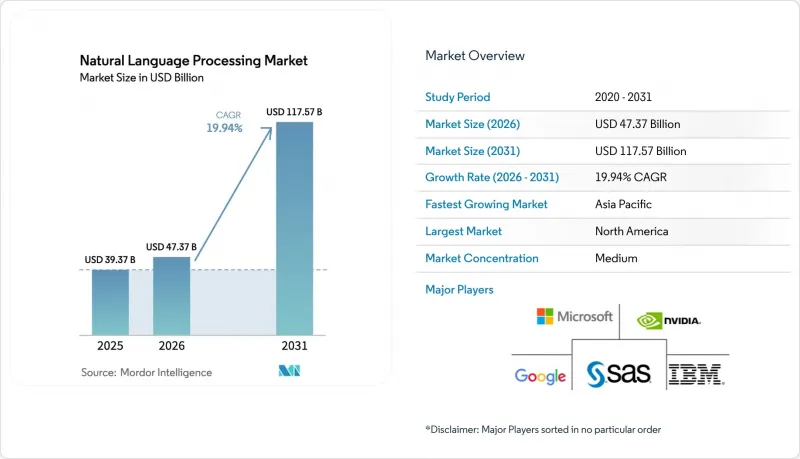
본 보고서는 도입 형태(On-Premise 및 클라우드), 조직 규모(대기업 및 중소기업), 구성 요소(하드웨어, 소프트웨어, 서비스), 처리 유형(텍스트, 음성, 이미지 또는 비전), 최종 사용자 산업(은행, 금융서비스 및 보험(BFSI), 헬스케어 및 생명과학, IT 및 통신, 기타) 및 지역별로 분류되어 있습니다. 시장 전망은 금액(달러) 기준으로 제시되어 있습니다.
전 세계 자연어처리(NLP) 시장 동향 및 인사이트
생성형 AI를 활용한 모델 정확도 향상
2025년에 출시된 파운데이션 모델은 1만 건 미만의 레이블로 미세 조정될 경우,전문 벤치마크에서 18-23퍼센트 포인트의 정확도 향상을 기록했으며, 어노테이션 비용을 대폭 절감하는 동시에 법적 조항 추출이나 ICD-10 코딩과 같은 책임이 중대한 워크플로우에 활용할 수 있게 했습니다. 구글의 Gemini 2.0 Flash는 추론 지연 시간을 40% 단축하여, 과거에는 배치 처리가 필요했던 대화 및 요약 작업을 가능하게 했습니다. ‘Mixture-of-experts’ 라우팅을 통해 쿼리당 1조 개의 매개변수 중 단 10-15%만 활성 상태로 유지함으로써, 정확도를 저하시키지 않고 전력 소비를 줄이고 있습니다. OpenAI의 o3 모델은 ARC-AGI에서 87.5%를 기록하며, 다단계 추론이 자동화 영역에 진입하고 있음을 시사합니다. 이러한 발전들이 결합되어, 자연어처리(NLP) 시장이 미션 크리티컬한 업무를 지원할 수 있다는 경영진 수준의 확신을 뒷받침했습니다.
고객 지원 분야에서 대화형 AI 도입 급증
Tier 1 상담원의 임금 상승률이 12-18%에 달함에 따라, 컨택 센터는 자동화 방향으로 전환되었습니다. 또한, 검색 강화 생성(RAG) 기술 덕분에 2025년 중반까지 첫 상담 해결률은 75-85%까지 향상되었습니다. Salesforce의 ‘Agentforce 2.0’은 CRM, 청구, 재고 흐름을 수동 인계 없이 통합하여 평균 처리 시간을 최대 40% 단축합니다. 클라우드 플랫폼은 기존 엔터프라이즈 계약에 채팅 API를 번들로 제공함에 따라, 시범 도입 주기가 분기 단위에서 몇 주 단위로 단축되었습니다. EU의 AI법에 따라 대부분의 고객 서비스 봇이 ‘위험 제한’으로 분류되어 적합성 심사가 면제됨에 따라, EU 내 도입이 가속화되었습니다.
고품질의 편향 없는 훈련 데이터 부족
감사 결과, 코퍼스의 70-80%가 여전히 영어로 구성되어 있는 것으로 밝혀졌으며, 그 결과 다른 언어에서의 정확도가 15-25포인트 하락하여 다국어 지역에서 기업의 규정 준수 위험이 높아지고 있습니다. 합성 데이터 생성 도구가 부족한 부분을 보완하고 있지만, 반복적으로 미세 조정을 수행하면 모드 붕괴의 위험이 있습니다. 의료 기록은 HIPAA에 의해 격리되어 있고, PCI-DSS에 의해 트랜잭션 로그가 엄격하게 관리되고 있어 훈련 데이터 풀이 파편화되어 있습니다. 표준화된 편향 테스트가 없어 기업들은 독자적인 감사 기법을 고안하고 있지만, 이로 인해 조달이 지연되고 있습니다. 이러한 제약은 AI 분야에서 주권적 자율성을 추구하는 각국 시장에 큰 부담이 되고 있습니다.
부문 분석
2025년, 기업들이 유연한 확장성과 AI 서비스 번들링을 선호함에 따라 클라우드는 자연어처리(NLP) 시장에서 64.31%의 점유율을 유지했습니다. 2031년까지 하이퍼스케일러가 독자적인 모델을 종합적인 계약에 포함시켜 워크로드를 고정화함에 따라, 이 부문은 20.01%의 성장률을 유지할 것입니다. 은행과 병원에서는 비용이 최대 50% 증가하더라도 모든 데이터 흐름을 감사해야 하기 때문에 On-Premise 클러스터가 여전히 사용되고 있습니다. 현재 AWS Bedrock 및 Azure의 기밀 엔클레이브로 인해 그 경계가 모호해졌으며, 고객은 기밀성이 높은 페이로드를 가상 사설 클라우드 내에 보관하면서 관리형 오케스트레이션을 계속 이용할 수 있게 되었습니다.
아시아태평양의 스마트폰 보급률이 70%를 넘고, 자동차 제조업체들이 결정론적인 음성 제어를 요구하는 가운데, 엣지 기술의 채택이 급증하고 있습니다. Google의 AI Edge SDK는 Gemini Nano를 2GB 미만으로 압축하여, 중급형 스마트폰에서도 높은 수준의 자연어 처리(NLP)가 가능함을 입증했습니다. 메르세데스-벤츠와 BMW는 추론을 현지화한 결과, 음성 의도 인식 정확도가 20포인트 향상되었음을 보여주었습니다. 기기 내 데이터 처리는 아키텍처 변경 없이 중국의 ‘개인정보 보호법’을 준수하며, 인도의 ‘디지털 개인 데이터 보호법’ 하에서도 유사한 추세가 나타나고 있습니다. 이러한 두 가지 진화에 힘입어, 자연어처리(NLP) 시장에서는 단일 플랫폼에 의한 우위성보다 클라우드와 엣지의 대등성이 더욱 중요시되고 있습니다.
2025년에는 대기업이 페타바이트 규모의 데이터와 전담 MLOps 팀을 활용하여 자연어처리(NLP) 시장의 73.13% 점유율을 차지했습니다. 그러나 노코드 에이전트와 토큰 단위 과금 모델을 통해 자본적 장벽이 제거됨에 따라, 중소기업의 성장률은 연평균 성장률(CAGR) 19.98%로 대기업을 상회할 것으로 예측됩니다. Hugging Face 허브와 종량제 클라우드 가격 정책 덕분에 실험 비용은 2만 달러 미만으로 억제되어, 시드 단계의 스타트업도 부담 없이 이용할 수 있습니다. 의사결정 주기가 빠르기 때문에 중소기업은 몇 주 만에 음성 커머스 봇이나 계약 분석 도구의 시범 운영을 시작할 수 있으며, 움직임이 더딘 기존 기업보다 앞서 틈새 비즈니스 기회를 잡는 경우가 많습니다.
대기업은 ERP, CRM, 공급망 피드를 동시에 활용하는 다중 시스템 통합 분야에서 우위를 유지하고 있습니다. 또한 EU AI법에 따른 감사 부담도 커서 이로 인해 도입이 최대 1년 지연될 가능성이 있지만, 위험이 제한적인 범주에 해당하는 이용 사례를 가진 소규모 기업은 이러한 추가 비용을 피할 수 있습니다. 예측 기간 동안에는 격차가 점차 좁혀질 가능성이 높으며, 성숙한 도구를 통해 기술적 격차가 해소됨에 따라 양측 모두 단순한 연산 규모가 아닌 워크플로우와의 밀착도를 통해 차별화를 꾀할 수밖에 없을 것입니다.
지역별 분석
북미는 2025년 시점에서 37.92%의 점유율을 유지하고 있으며, 하이퍼스케일러의 인프라와 위험 허용도가 높은 조기 도입 기업이 그 기반을 이루고 있습니다. 기업들은 풍부한 벤처 자금을 활용하고 있으며, 규제 샌드박스를 통해 은행들은 감독 당국의 지도 하에 생성형 모델을 시험적으로 도입할 수 있습니다. 그러나 시장 포화와 규정 준수 관련 부담 증가로 인해 성장률은 10%대 후반에 머물고 있습니다.
아시아태평양은 중국의 500억 달러 규모 국가 주도 AI 추진 정책, 인도의 공공 디지털 스택, 그리고 일본의 고령화로 인한 압박 등의 요인이 맞물려 연평균 성장률(CAGR) 22.13%라는 가장 빠른 성장세를 기록하고 있습니다. 중국의 국영 기업들은 국산 모델 도입을 의무화하고 있으며, 이로 인해 바이두(Baidu)와 알리바바에서의 도입이 촉진되고 있습니다. 인도의 통합 결제 인터페이스(UPI)는 수십억 건에 달하는 다국어 기록을 부정 감지 및 신용 평가 모델에 제공합니다. 일본의 병원에서는 앰비언트 다큐멘테이션을 도입하면 세제 혜택이 주어지기 때문에 임상 분야에서의 NLP 도입이 촉진되고 있습니다.
유럽에서는 EU AI법의 명확성이 장점으로 작용하고 있지만, 적합성 심사로 인해 위험도가 높은 서비스 출시에는 6-12개월의 추가 기간이 필요합니다. 독일의 자동차 제조업체들은 GDPR(EU 개인정보보호규정) 준수를 충족하기 위해 현지 음성 어시스턴트를 탑재하고 있습니다. 영국에서는 규정 준수 비용을 절감하기 위해 KYC(고객 신원 확인) 자동화가 추진되고 있습니다. 남미에서는 지역 방언에 맞춘 고객 서비스용 봇이 도입되고 있는 반면, 중동에서는 경제 다각화의 핵심 축으로서 국가 주도의 AI 개발에 자금을 투입하고 있습니다. 아프리카에서의 도입은 나이지리아와 케냐에 집중되어 있으며, 모바일 우선 NLP가 핀테크 및 농업 보급을 위한 메시징을 뒷받침하고 있습니다. 출발점은 각기 다르지만, 모든 지역에서 금세기 말까지 자연어처리(NLP) 시장을 핵심 디지털 인프라로 자리매김하게 될 것입니다.
기타 혜택:
- 엑셀 형식 시장 예측(ME) 시트
- 3개월간의 애널리스트 지원
자주 묻는 질문
목차
제1장 서론
제2장 조사 방법
제3장 주요 요약
제4장 시장 구도
제5장 시장 규모와 성장 예측
제6장 경쟁 구도
제7장 시장 기회와 향후 전망
LSH 26.09.03According to Mordor Intelligence, the natural language processing market size is projected to expand from USD 39.37 billion in 2025 and USD 47.37 billion in 2026 to USD 117.57 billion by 2031, registering a CAGR of 19.94% between 2026 to 2031.
This report is Segmented by Deployment (On-Premise, and Cloud), Organization Size (Large Enterprises, and Small and Medium Enterprises), Component (Hardware, Software, and Services), Processing Type (Text, Speech or Voice, and Image or Vision), End-User Industry (BFSI, Healthcare and Life Sciences, IT and Telecom, and More), and Geography. The Market Forecasts are Provided in Terms of Value (USD).
Global Natural Language Processing Market Trends and Insights
Generative-AI-Powered Model Accuracy Gains
Foundation releases in 2025 posted 18-23 percentage-point jumps on specialist benchmarks when fine-tuned on fewer than 10,000 labels, slashing annotation budgets and opening high-liability workflows such as legal clause extraction and ICD-10 coding. Google's Gemini 2.0 Flash trimmed inference latency by 40%, enabling conversational and summarization tasks that once demanded batch processing. Mixture-of-experts routing keeps only 10-15% of a trillion parameters active per query, lowering energy draw without hurting precision. OpenAI's o3 model logged 87.5% on ARC-AGI, signaling that multi-step reasoning is entering automated scope. Together these advances fueled board-level confidence that the natural language processing market can underpin mission-critical operations.
Surge in Conversational AI Adoption in Customer Support
Twelve-to-eighteen-percent wage inflation for tier-1 agents pushed contact centers toward automation, and retrieval-augmented generation raised first-contact resolution to 75-85% by mid-2025.Salesforce's Agentforce 2.0 orchestrates CRM, billing, and inventory flows without hand-offs, cutting average handle time by up to 40%. Cloud platforms bundled chat APIs into existing enterprise agreements, shrinking pilot cycles from quarters to weeks. The EU AI Act tagged most customer-service bots as limited-risk, sparing them conformity reviews and accelerating adoption across the trading bloc.
Shortage of High-Quality, Bias-Free Training Data
Audits showed 70-80% of corpora remain English, leading to 15-25-point drops in other languages and exposing enterprises to compliance risk in multilingual regions. Synthetic generators fill gaps yet risk mode collapse after repeated fine-tunes. Health records are siloed behind HIPAA, while PCI-DSS locks down transaction logs, fragmenting training pools. Without standardized bias tests, firms invent bespoke audits that slow procurement. The restraint weighs heavily on national markets seeking sovereign AI autonomy.
Other drivers and restraints analyzed in the detailed report include:
- Integration of NLP in Embedded or Edge Devices
- Proliferation of Domain-Specific LLMs for Regulated Industries
- Escalating Inference Costs for Large Models
For complete list of drivers and restraints, kindly check the Table Of Contents.
Segment Analysis
Cloud retained 64.31% share of the natural language processing market in 2025 as enterprises favored elastic scaling and bundled AI services. Through 2031 the segment grows at 20.01% as hyperscalers lock in workloads by embedding proprietary models into broader contracts. On-premise clusters persist inside banks and hospitals that must audit every data flow, even when this choice raises cost by up to 50%. AWS Bedrock and Azure confidential enclaves now blur the line, letting clients keep sensitive payloads inside virtual private clouds while still relying on managed orchestration.
Edge adoption surges as smartphone penetration tops 70% in Asia-Pacific and automakers demand deterministic voice control. Google's AI Edge SDK compresses Gemini Nano to under 2 GB, proving high-grade NLP can live on mid-tier handsets. Mercedes-Benz and BMW show 20-point gains in voice intent accuracy after localizing inference. Processing data in the device satisfies China's Personal Information Protection Law with no architecture changes, and similar dynamics play out under India's Digital Personal Data Protection Act. The dual-track evolution means the natural language processing market now values cloud and edge parity rather than single-venue supremacy.
Large enterprises held 73.13% of the natural language processing market share in 2025, leveraging petabytes of data and dedicated MLOps teams. Yet SMEs are projected to outpace at a 19.98% CAGR because no-code agents and pay-per-token models eliminate capital barriers. Hugging Face hubs and consumption-based cloud pricing push experimentation costs below USD 20,000, affordable even to seed-stage startups. Fast decision cycles let SMEs pilot voice commerce bots or contract analyzers in weeks, often beating slow-moving incumbents to niche opportunities.
Corporate titans keep an edge in multi-system integrations that tap ERP, CRM and supply chain feeds concurrently. They also shoulder heavier EU AI Act audits that can extend deployment by up to a year, an overhead the smallest firms avoid when their use cases fall under limited-risk classifications. Over the forecast horizon convergence is likely, with mature tooling erasing technical gaps and forcing both cohorts to differentiate on workflow intimacy rather than raw compute scale.
Complete Report Scope:
- By Deployment
- On-Premise
- Cloud
- By Organization Size
- Large Enterprises
- Small and Medium Enterprises (SMEs)
- By Component
- Hardware
- Software
- Services
- By Processing Type
- Text
- Speech or Voice
- Image or Vision
- By End-User Industry
- BFSI
- Healthcare and Life Sciences
- IT and Telecom
- Retail and E-Commerce
- Manufacturing
- Media and Entertainment
- Education
- Others End-User Industry
- By Geography
- North America
- United States
- Canada
- Mexico
- South America
- Brazil
- Argentina
- Rest of South America
- Europe
- Germany
- United Kingdom
- France
- Italy
- Spain
- Rest of Europe
- Asia Pacific
- China
- Japan
- South Korea
- India
- Australia
- New Zealand
- Rest of Asia-Pacific
- Middle East and Africa
- Middle East
- United Arab Emirates
- Saudi Arabia
- Turkey
- Rest of Middle East
- Africa
- South Africa
- Nigeria
- Kenya
- Rest of Africa
- Middle East
- North America
Geography Analysis
North America kept 37.92% share in 2025, anchored by hyperscaler infrastructure and risk-tolerant early adopters. Enterprises tap generous venture funding, and regulatory sandboxes let banks trial generative models under supervisory guidance. Yet saturation and rising compliance overhead temper growth to high teens.
Asia-Pacific records the fastest climb at 22.13% CAGR as China's USD 50 billion sovereign-AI push, India's public digital stack, and Japan's aging-population pressures converge. Chinese state-owned firms mandate domestic model deployment, boosting Baidu and Alibaba adoption. India's Unified Payments Interface feeds billions of multilingual records into fraud and credit models. Japanese hospitals enjoy tax breaks when installing ambient documentation, spurring clinical NLP rollouts.
Europe benefits from the EU AI Act's clarity, though conformity reviews add 6-12 months to high-risk launches. Germany's automakers embed local voice assistants to satisfy GDPR. The United Kingdom encourages KYC automation to trim compliance costs. South America adopts customer-service bots tuned to regional dialects, while the Middle East funds sovereign AI as economic-diversification pillars. Africa's uptake clusters in Nigeria and Kenya where mobile-first NLP supports fintech and ag-extension messaging. Despite disparate starting points, every region positions the natural language processing market as core digital infrastructure by decade's end.
- Microsoft Corp.
- Google LLC
- SAS Institute Inc.
- IBM Corp.
- NVIDIA Corp.
- OpenAI LP
- Meta Platforms Inc.
- SAP SE
- Oracle Corp.
- Baidu Inc.
- Intel Corp.
- Qualcomm Inc.
- Amazon Web Services
- Adobe Inc.
- Salesforce Inc.
- Apple Inc.
- Verint Systems Inc.
- Nuance Communications
- Cohere Inc.
- Hugging Face
- Grammarly Inc.
Additional Benefits:
- The market estimate (ME) sheet in Excel format
- 3 months of analyst support
TABLE OF CONTENTS
1 INTRODUCTION
- 1.1 Study Assumptions and Market Definition
- 1.2 Scope of the Study
2 RESEARCH METHODOLOGY
3 EXECUTIVE SUMMARY
4 MARKET LANDSCAPE
- 4.1 Market Overview
- 4.2 Market Drivers
- 4.2.1 Generative-AI-Powered Model Accuracy Gains
- 4.2.2 Surge in Conversational AI Adoption in Customer Support
- 4.2.3 Integration of NLP in Embedded or Edge Devices
- 4.2.4 Proliferation of Domain-Specific LLMs for Regulated Industries
- 4.2.5 Rising Demand for Real-Time Speech Recognition in Automotive and Smart Devices
- 4.2.6 Multimodal Foundation Models Unlocking New Verticals
- 4.3 Market Restraints
- 4.3.1 Shortage of High-Quality, Bias-Free Training Data
- 4.3.2 Escalating Inference Costs for Large Models
- 4.3.3 Cross-Border Data Residency Compliance Barriers
- 4.3.4 Environmental Footprint of Large-Scale Training Compute
- 4.4 Industry Value-Chain Analysis
- 4.5 Regulatory Landscape
- 4.6 Technological Outlook
- 4.7 Porter's Five Forces Analysis
- 4.7.1 Bargaining Power of Buyers
- 4.7.2 Bargaining Power of Suppliers
- 4.7.3 Threat of New Entrants
- 4.7.4 Threat of Substitutes
- 4.7.5 Competitive Rivalry
5 MARKET SIZE AND GROWTH FORECASTS (VALUE)
- 5.1 By Deployment
- 5.1.1 On-Premise
- 5.1.2 Cloud
- 5.2 By Organization Size
- 5.2.1 Large Enterprises
- 5.2.2 Small and Medium Enterprises (SMEs)
- 5.3 By Component
- 5.3.1 Hardware
- 5.3.2 Software
- 5.3.3 Services
- 5.4 By Processing Type
- 5.4.1 Text
- 5.4.2 Speech or Voice
- 5.4.3 Image or Vision
- 5.5 By End-User Industry
- 5.5.1 BFSI
- 5.5.2 Healthcare and Life Sciences
- 5.5.3 IT and Telecom
- 5.5.4 Retail and E-Commerce
- 5.5.5 Manufacturing
- 5.5.6 Media and Entertainment
- 5.5.7 Education
- 5.5.8 Others End-User Industry
- 5.6 By Geography
- 5.6.1 North America
- 5.6.1.1 United States
- 5.6.1.2 Canada
- 5.6.1.3 Mexico
- 5.6.2 South America
- 5.6.2.1 Brazil
- 5.6.2.2 Argentina
- 5.6.2.3 Rest of South America
- 5.6.3 Europe
- 5.6.3.1 Germany
- 5.6.3.2 United Kingdom
- 5.6.3.3 France
- 5.6.3.4 Italy
- 5.6.3.5 Spain
- 5.6.3.6 Rest of Europe
- 5.6.4 Asia Pacific
- 5.6.4.1 China
- 5.6.4.2 Japan
- 5.6.4.3 South Korea
- 5.6.4.4 India
- 5.6.4.5 Australia
- 5.6.4.6 New Zealand
- 5.6.4.7 Rest of Asia-Pacific
- 5.6.5 Middle East and Africa
- 5.6.5.1 Middle East
- 5.6.5.1.1 United Arab Emirates
- 5.6.5.1.2 Saudi Arabia
- 5.6.5.1.3 Turkey
- 5.6.5.1.4 Rest of Middle East
- 5.6.5.2 Africa
- 5.6.5.2.1 South Africa
- 5.6.5.2.2 Nigeria
- 5.6.5.2.3 Kenya
- 5.6.5.2.4 Rest of Africa
- 5.6.5.1 Middle East
- 5.6.1 North America
6 COMPETITIVE LANDSCAPE
- 6.1 Market Concentration
- 6.2 Strategic Moves
- 6.3 Market Share Analysis
- 6.4 Company Profiles (includes Global Level Overview, Market Level Overview, Core Segments, Financials as available, Strategic Information, Market Rank/Share, Products and Services, Recent Developments)
- 6.4.1 Microsoft Corp.
- 6.4.2 Google LLC
- 6.4.3 SAS Institute Inc.
- 6.4.4 IBM Corp.
- 6.4.5 NVIDIA Corp.
- 6.4.6 OpenAI LP
- 6.4.7 Meta Platforms Inc.
- 6.4.8 SAP SE
- 6.4.9 Oracle Corp.
- 6.4.10 Baidu Inc.
- 6.4.11 Intel Corp.
- 6.4.12 Qualcomm Inc.
- 6.4.13 Amazon Web Services
- 6.4.14 Adobe Inc.
- 6.4.15 Salesforce Inc.
- 6.4.16 Apple Inc.
- 6.4.17 Verint Systems Inc.
- 6.4.18 Nuance Communications
- 6.4.19 Cohere Inc.
- 6.4.20 Hugging Face
- 6.4.21 Grammarly Inc.
7 MARKET OPPORTUNITIES AND FUTURE OUTLOOK
- 7.1 White-Space and Unmet-Need Assessment


