

|
시장보고서
상품코드
2122525
SSD : 시장 점유율 분석, 업계 동향과 통계, 성장 예측(2026-2031년)Solid State Drive (SSD) - Market Share Analysis, Industry Trends & Statistics, Growth Forecasts (2026 - 2031) |
||||||
 Mordor Intelligence
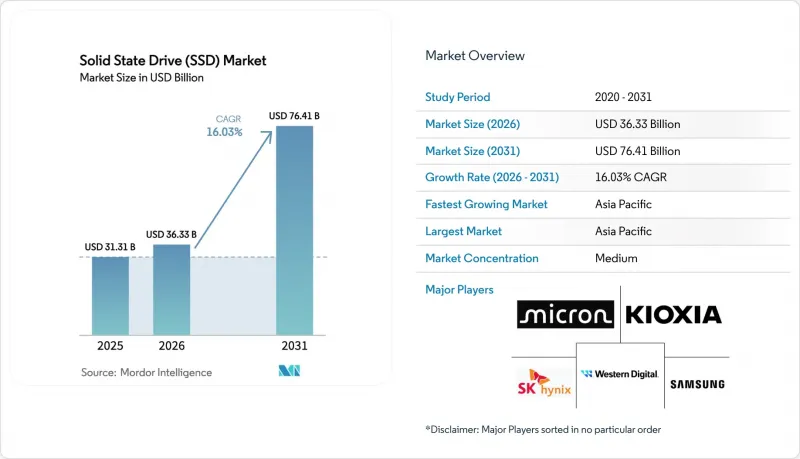
Mordor Intelligence에 의하면, SSD 시장 규모는 2025년 313억 1,000만 달러에서 2026년에는 363억 3,000만 달러로 성장하고, 2026-2031년 CAGR 16.03%로 성장을 지속하여 2031년에는 764억 1,000만 달러에 달할 것으로 예측됩니다.
본 보고서는 폼 팩터(2.5인치, M.2, U.2 등), 인터페이스(SATA, PCIe/NVMe, SAS), 기술/NAND 유형(SLC, MLC 등), 용량(500GB 이하, 500GB-1TB, 기타),최종 사용자/용도(소비자용 전자기기, 엔터프라이즈/데이터센터용 서버 등), 판매 채널(직접 판매/OEM, 온라인 소매 등), 지역별로 분류되어 있습니다. 시장 예측은 금액(달러) 기준으로 제시되어 있습니다.
전 세계 SSD 시장 동향 및 인사이트
AI 및 ML 워크로드가 데이터센터 스토리지를 재구성하고 있습니다.
생성형 AI 클러스터는 현재 네트워크 공유가 아닌 로컬 NVMe 계층에서 테라바이트 규모의 파라미터 파일을 스트리밍하고 있으며, Meta의 2025년 보고서에 따르면 Llama 3 훈련에는 2.4 엑사바이트의 플래시 스토리지가 사용되고 있으며, 이는 2024년 대비 60% 증가한 수치입니다. 그 결과, 10GB/s를 초과하는 순차 쓰기 속도를 제공하는 PCIe Gen5 드라이브가 SATA 및 초기 세대 PCIe 장치를 대체하고 있습니다. 엣지 AI 수요 증가에 따라 자율주행차에는 차량 내 추론용으로 4TB에서 8TB 용량의 SSD가 탑재되고 있으며, 1밀리초의 지연 시간 단축은 더 안전한 제어 루프로 이어집니다. 엔비디아는 GTC 2025에서 많은 AI 파이프라인의 병목 현상을 일으키는 요인은 GPU 사이클이 아니라 스토리지 I/O라고 강조했습니다. 각 하이퍼스케일러 기업들은 데이터 경로에서 지연 시간이 제거되면 랙당 VM 밀도를 높이고 전력 소비를 줄일 수 있다는 점에서 플래시 스토리지를 운영 비용 절감 수단으로 간주하며, 이에 따라 예산 배분을 전환하고 있습니다.
엔터프라이즈용 NVMe의 보급이 레거시 시스템 교체를 가속화
2025년, 엔터프라이즈용 어레이에서 NVMe 출하 대수는 60%라는 대망을 돌파했습니다. 또한, NVMe-over-Fabrics(NVMe-oF)는 동등한 신뢰성을 유지하면서 처리량을 10배로 높이기 때문에 SAS 및 파이버 채널을 대체하고 있습니다. Dell의 PowerStore는 NVMe-oF의 존(zone) 기능을 활용하여 700만 IOPS를 달성하고 있으며, 이를 통해 어레이 통합이 경제적으로 가능해졌습니다. NVMe 2.0 사양에서는 존화된 네임스페이스와 키-값 명령이 추가되어 CPU 사이클이 감소함에 따라, 구매자들은 감가상각 기간보다 몇 년이나 앞서 SATA 셸프를 폐기하고 있습니다. PCIe Gen4는 현재 혼합 워크로드를 지원하지만, 얼리 어답터들은 이미 분석 클러스터용으로 Gen5를 지정하고 있으며, 프로토콜 전환이 SSD 시장의 성장을 이끄는 가장 큰 요인이 되고 있습니다.
가격 변동이 조달을 어둡게 만들다.
2024년부터 2025년에 걸쳐 분기별 NAND 가격은 35%나 변동하여 OEM의 이익률을 압박하는 한편, 구매자들은 예산 부족을 피하기 위해 24개월 계약을 체결할 수밖에 없게 되었습니다. 2023년 웨이퍼 생산량 과잉과 QLC로의 급속한 전환이 맞물리면서 SSD 시장은 공급 과잉에 빠졌고, 소비자용 SSD의 평균 판매 가격(ASP)은 전년 대비 28% 하락했습니다. 다이 및 컨트롤러 제조 거점을 보유하지 않은 중소 브랜드들은 가장 큰 타격을 입었습니다. 이는 수직 통합이 가격 변동에 대한 보험 역할을 한다는 점을 여실히 보여줍니다.
부문 분석
노트북, SFF 데스크톱, 게임기에서 ‘검스틱’ 레이아웃이 표준화됨에 따라 M.2 드라이브는 2025년 매출의 47.11%를 차지했습니다. 그러나 데이터센터 내 SSD 시장은 전환기를 맞이하고 있습니다. EDSFF E1.S, E1.L 및 E3.S 모듈은 2031년까지 연평균 성장률(CAGR) 18.12%를 나타낼 것으로 예측되며, 이는 폼 팩터 중 가장 높은 수치입니다. Meta의 Open Rack V3는 1U 서버당 32개의 E3.S 드라이브를 탑재할 수 있어 U.2 베이보다 33% 더 많은 수량을 수용할 수 있으므로, 페타바이트당 설치 면적과 냉각 비용을 절감하고 있습니다.
삼성이 곧 출시할 64TB E1.L은 하이퍼스케일러 기업들이 PCB 전체에 걸쳐 길쭉한 쉘형 열 확산판을 선호하는 이유를 여실히 보여주고 있으며, 이를 통해 18W의 쓰기 부하에서도 스로틀링을 방지할 수 있습니다. 하이퍼스케일 환경 이외의 경우, 기존 IT 부서에는 공구가 필요 없는 트레이가 없고 새로운 섀시를 도입할 예산도 부족하기 때문에 EDSFF의 보급은 더딘 임베디드니다. 그러나 알리바바 조달 구성의 80%를 EDSFF가 차지하고 있다는 사실은 규모 확대가 비용 균형을 뒤집을 것임을 시사하며, 2029년까지 신규 도입에서 EDSFF가 U.2를 능가할 전망입니다. 한편, 애드인 카드의 점유율은 5% 미만에 그쳐 여전히 틈새 시장으로 남아 있습니다. 주요 용도는 직접 x16 대역폭이 필요한 워크스테이션이나 과학 계산 클러스터입니다.
NVMe over PCIe는 2025년에 매출의 62.34%를 차지하며, 연평균 성장률(CAGR) 17.03%로 보급이 확대되고 있습니다. NVMe의 간결한 명령어 세트 덕분에 AHCI에 비해 CPU 오버헤드가 절반으로 줄어들었으며, 그 멀티 큐 깊이는 현대의 코어 수와 완벽하게 일치합니다. 대조적으로, 마더보드의 포트 축소와 USB 4로의 레인 전환이 진행됨에 따라 SATA의 점유율은 25% 미만으로 떨어졌습니다. SAS는 듀얼 포트 엔터프라이즈용 어레이에서 여전히 사용되고 있지만, NVMe-oF가 5배의 처리량으로 동등한 중복성 목표를 달성할 수 있기 때문에 그 점유율은 8% 미만에 그치고 있습니다.
PCIe Gen5의 채택으로 NVMe SSD 시장 규모는 더욱 빠르게 확대되고 있습니다. Dell의 PowerEdge Gen5 서버는 NVMe를 기본 탑재하고 있으며, SATA는 특별 주문 생산(BTO) SKU에서만 제공됩니다. 앞으로 PCIe Gen6의 PAM-4 신호 방식은 더 낮은 전력 소비로 동등한 대역폭을 실현할 것으로 예상되며, NVMe는 제품 로드맵의 중심에서 확고한 위치를 계속 유지하는 한편, 레거시 프로토콜은 기존 시스템의 업데이트 주기에만 남아 있게 될 것입니다.
지역별 분석
아시아태평양은 2025년에 매출의 46.73%를 차지할 것으로 보이며, 웨이퍼 생산량 증가와 지역 내 소비의 혜택을 모두 받아 연평균 성장률(CAGR) 18.67%로 확대될 것으로 예측됩니다. 삼성, SK하이닉스, 키오크시아는 한국, 대만, 일본에서 200층 팹을 운영하고 있으며, 이는 전 세계 비용 곡선에 큰 영향을 미치고 있습니다. 대조적으로, 알리바바 클라우드는 국내 AI 훈련을 위해 1.2 엑사바이트의 플래시 메모리를 도입했습니다. 인도에서는 ‘디지털 인디아’ 구상이 새로운 은행 업무 및 전자정부 워크로드를 견인한 결과, 기업용 SSD 구매량이 32% 증가했습니다. 이 지역의 성장에는 지정학적 리스크와 지진 리스크가 수반되지만, 현재로서는 그 비용 구조에 필적할 만한 대체 허브는 존재하지 않습니다.
2025년에는 북미와 유럽이 매출의 약 38%를 차지했습니다. Azure와 AWS는 생성형 AI 트래픽에 대한 수요 증가에 대응하기 위해 분기마다 각각 50만 대의 SSD를 도입했습니다. 미국 CHIPS법에 따른 자금 지원을 받아 마이크론은 2028년 가동을 목표로 150억 달러 규모의 뉴욕 공장을 건설 중이며, 초기 생산은 NAND 증설에 앞서 DRAM에 중점을 둘 전망입니다. 유럽의 GDPR(EU 개인정보보호규정) 및 제정 예정인 데이터 법에 따라 코로케이션 센터는 현지 플래시 메모리를 비축하도록 권장받고 있습니다. 한편, EU 칩 법에서는 역내 팹을 위해 430억 유로(503억 달러)가 배정되었으나, 현재로서는 아직 시범 운영 단계에 이른 사례는 없습니다.
중동 및 아프리카 및 남미의 합산 매출액은 전체의 약 15%를 차지했습니다. 사우디아라비아의 NEOM은 스마트 시티 그리드를 위해 NVMe 엣지 스토리지를 지정했으며, 남아프리카공화국의 한 은행은 즉시 결제 요건을 충족하기 위해 플래시 메모리를 채택했습니다. 브라질의 소매업체에서는 2025년에 판매 대수가 24% 증가했으나, 수입 관세로 인해 대용량 제품의 도입이 억제되고 있습니다. 전력망의 불안정성과 광섬유 회선 부족이 여전히 기업 도입을 저해하고 있지만, 디지털 전환이 레거시 IT를 비약적으로 추월함에 따라 전년 대비 성장률은 세계 평균을 상회하고 있습니다.
기타 혜택:
- 엑셀 형식 시장 예측(ME) 시트
- 3개월간의 애널리스트 지원
자주 묻는 질문
목차
제1장 서론
제2장 조사 방법
제3장 주요 요약
제4장 시장 구도
제5장 시장 규모와 성장 예측
제6장 경쟁 구도
제7장 시장 기회와 향후 전망
LSH 26.09.03According to Mordor Intelligence, the solid state drive market size is expected to grow from USD 31.31 billion in 2025 to USD 36.33 billion in 2026 and is forecast to reach USD 76.41 billion by 2031 at 16.03% CAGR over 2026-2031.
This report is Segmented by Form Factor (2. 5-Inch, M. 2, U. 2, and More), Interface (SATA, PCIe/NVMe, and SAS), Technology/NAND Type (SLC, MLC, and More), Capacity (Up To 500 GB, 500 GB-1 TB, and More), End-user/Application (Client Electronics, Enterprise/Data-Center Servers, and More), Sales Channel (Direct/OEM, Online Retail, and More), and Geography. The Market Forecasts are Provided in Terms of Value (USD).
Global Solid State Drive (SSD) Market Trends and Insights
AI and ML Workloads Reshape Data-Center Storage
Generative AI clusters now stream terabyte-scale parameter files from local NVMe tiers rather than network shares, and Meta's 2025 report showed Llama 3 training pulling 2.4 exabytes of flash, up 60% from 2024. PCIe Gen5 drives offering more than 10 GB/s sequential writes are therefore replacing SATA and early-generation PCIe devices. Edge AI compounds demand autonomous vehicles ship with 4 TB to 8 TB SSDs for onboard inference, and every millisecond saved translates into safer control loops. Nvidia highlighted at GTC 2025 that storage I/O, not GPU cycles, cap many AI pipelines. Hyperscalers have shifted budgets accordingly, viewing flash as an operating-expense reducer because they can increase VM density per rack and lower power draw once latency is removed from the data path.
Enterprise NVMe Uptake Accelerates Legacy Replacement
NVMe crossed a 60% shipment threshold for enterprise arrays in 2025, and NVMe-over-Fabrics is displacing SAS and Fibre Channel because it brings tenfold throughput at similar reliability. Dell's PowerStore uses NVMe-oF zoning to hit 7 million IOPS, making array consolidation economical. The NVMe 2.0 spec added zoned namespaces and key-value commands that cut CPU cycles, so buyers are scrapping SATA shelves years ahead of depreciation. PCIe Gen4 satisfies mixed workloads today, yet early adopters already specify Gen5 for analytics clusters, turning protocol migration into the fastest lever for solid state drive market growth.
Pricing Volatility Clouds Procurement
Quarterly NAND prices swung 35% during 2024-2025, compressing OEM margins and forcing buyers to lock in 24-month contracts to avoid budget shortfalls. Excess wafer starts in 2023 combined with rapid QLC conversions pushed the solid state drive market into oversupply, dropping consumer SSD ASPs 28% year-on-year. Smaller brands lacking die or controller plants felt the squeeze most, underscoring that vertical integration is an insurance policy against price cycles.
Other drivers and restraints analyzed in the detailed report include:
- Edge-Computing Nodes Boost Demand Beyond the Core
- PCIe 5.0 Bandwidth and EDSFF Density Reach the Mainstream
- Concentration Exposes the Supply Chain to Shock
For complete list of drivers and restraints, kindly check the Table Of Contents.
Segment Analysis
M.2 drives generated 47.11% of 2025 revenue as laptops, SFF desktops, and consoles standardized on the gum-stick layout. However, the solid state drive market is pivoting in the data center; EDSFF E1.S, E1.L, and E3.S modules are forecast to post an 18.12% CAGR through 2031, the highest among form factors. Meta's Open Rack V3 now accommodates 32 E3.S drives per 1U server, 33% more than U.2 bays, reducing floor space and cooling costs per petabyte.
Samsung's upcoming 64 TB E1.L showcases why hyperscalers prefer the elongated shell thermal spreader across the PCB, which avoids throttling even under 18 W write loads. Outside hyperscale halls, EDSFF uptake lags because traditional IT shops lack tool-free trays and budget for new chassis. Yet Alibaba's 80% EDSFF procurement mix signals that scale tips the cost balance, so EDSFF should eclipse U.2 for fresh deployments before 2029. Meanwhile, add-in cards stay niche at <5% share, mostly in workstations and scientific clusters craving direct x16 bandwidth.
NVMe over PCIe claimed 62.34% of revenue in 2025 and is marching toward ubiquity at a 17.03% CAGR. NVMe's lean command set halves CPU overhead compared to AHCI, and its multi-queue depth aligns perfectly with modern core counts. Conversely, SATA slid below 25% as motherboards drop ports or repurpose lanes for USB 4. SAS clings to dual-port enterprise arrays, yet its share is under 8% because NVMe-oF meets the same redundancy target with five times the throughput.
The adoption of PCIe Gen5 raises the solid-state drive market size for NVMe even faster. Dell's PowerEdge Gen5 servers ship NVMe as the default, offering SATA only on special, build-to-order SKUs. Looking ahead, PCIe Gen6's PAM-4 signaling promises equal bandwidth at lower watts, keeping NVMe firmly at the center of product roadmaps while legacy protocols linger only in brownfield refresh cycles.
Complete Report Scope:
- By Form Factor
- 2.5-inch
- M.2
- U.2
- PCIe Add-in Card
- EDSFF
- Other Form Factors
- By Interface
- SATA
- PCIe/NVMe
- SAS
- By Technology (NAND Type)
- SLC
- MLC
- TLC
- QLC
- Other NAND Types
- By Capacity
- Up to 500 GB
- 500 GB - 1 TB
- 1 TB - 2 TB
- Above 2 TB
- By End-user/Application
- Client Electronics (Laptops, Desktops)
- Enterprise/Data-Center Servers
- Industrial and Embedded Systems
- Automotive
- Other End-user/Application
- By Sales Channel
- Direct/OEM
- Distribution and Resellers
- Online Retail
- By Geography
- North America
- United States
- Canada
- Mexico
- South America
- Brazil
- Argentina
- Rest of South America
- Europe
- Germany
- United Kingdom
- France
- Italy
- Spain
- Russia
- Rest of Europe
- Asia Pacific
- China
- Japan
- South Korea
- India
- Australia
- New Zealand
- Rest of Asia Pacific
- Middle East
- United Arab Emirates
- Saudi Arabia
- Turkey
- Rest of Middle East
- Africa
- South Africa
- Nigeria
- Kenya
- Rest of Africa
- North America
Geography Analysis
The Asia Pacific region controlled 46.73% of the revenue in 2025 and is expected to advance at an 18.67% CAGR, benefiting from both increased wafer output and local consumption. Samsung, SK hynix, and Kioxia operate 200-layer fabs in South Korea, Taiwan, and Japan, which significantly influence global cost curves. In contrast, Alibaba Cloud has deployed 1.2 exabytes of flash for domestic AI training. India posted a 32% increase in enterprise SSD purchases as the Digital India agenda drove new banking and e-gov workloads. The region's growth faces geopolitical and earthquake risks, yet no alternative hub can yet match its cost structure.
North America and Europe generated approximately 38% of the revenue in 2025. Azure and AWS each inserted half a million SSDs per quarter to support the growing demand for generative AI traffic. U.S. CHIPS funding supports Micron's USD 15 billion New York fab, slated for a 2028 start-up, with early output focusing on DRAM before adding NAND. Europe's GDPR and pending Data Act are prompting colocation centers to stock local flash, while the EU Chips Act earmarks EUR 43 billion (USD 50.30 billion) for onshore fabs; yet, none have yet reached pilot runs.
Middle East and Africa and South America together yielded about 15% revenue. Saudi Arabia's NEOM specified NVMe edge storage for its smart-city grid, while South African banks adopted flash to meet instant-payment mandates. Brazilian retailers saw a 24% unit rise in 2025, though import tariffs temper high-capacity adoption. Power grid instability and limited fiber still curb enterprise rollouts, yet year-on-year growth rates eclipse global averages as digital transformation leapfrogs legacy IT.
- Samsung Electronics Co., Ltd.
- Western Digital Corporation
- Kioxia Holdings Corporation
- SK hynix Inc. (incl. Solidigm)
- Micron Technology, Inc.
- Seagate Technology Holdings plc
- Kingston Technology Corporation
- ADATA Technology Co., Ltd.
- Transcend Information, Inc.
- Corsair Memory, Inc.
- Sabrent
- Silicon Motion Technology Corp.
- Phison Electronics Corporation
- Intel Corporation (Optane)
- Marvell Technology, Inc.
- Patriot Memory
- Team Group Inc.
- Mushkin Enhanced MFG
- Microsemi (Microchip Technology)
- Violin Systems LLC
Additional Benefits:
- The market estimate (ME) sheet in Excel format
- 3 months of analyst support
TABLE OF CONTENTS
1 INTRODUCTION
- 1.1 Study Assumptions and Market Definition
- 1.2 Scope of the Study
2 RESEARCH METHODOLOGY
3 EXECUTIVE SUMMARY
4 MARKET LANDSCAPE
- 4.1 Market Overview
- 4.2 Market Drivers
- 4.2.1 Rising Demand From AI/ML Data-Center Workloads
- 4.2.2 Accelerating NVMe Adoption Across Enterprise Storage Arrays
- 4.2.3 Rapid Growth of Edge Computing Nodes in 5G and IoT
- 4.2.4 Mainstreaming of PCIe 5.0 and EDSFF Form-Factors
- 4.2.5 Government Green-Data Policies Favor Flash Over HDDs
- 4.2.6 OEM Firmware-Defined Flash Creating New Upgrade Cycles
- 4.3 Market Restraints
- 4.3.1 High ASP Volatility Due to NAND Bit Oversupply
- 4.3.2 Supply-Chain Concentration Risk in NAND Wafer Manufacturing
- 4.3.3 Thermal Management Challenges in Ultrathin Client Devices
- 4.3.4 Growing Security-Certification Costs for Enterprise Drives
- 4.4 Industry Value Chain Analysis
- 4.5 Technological Outlook
- 4.6 Regulatory Landscape
- 4.7 Porter's Five Forces Analysis
- 4.7.1 Bargaining Power of Suppliers
- 4.7.2 Bargaining Power of Buyers
- 4.7.3 Threat of New Entrants
- 4.7.4 Threat of Substitute Products
- 4.7.5 Intensity of Competitive Rivalry
- 4.8 Impact of Macroeconomic Factors on the Market
5 MARKET SIZE AND GROWTH FORECASTS (VALUE)
- 5.1 By Form Factor
- 5.1.1 2.5-inch
- 5.1.2 M.2
- 5.1.3 U.2
- 5.1.4 PCIe Add-in Card
- 5.1.5 EDSFF
- 5.1.6 Other Form Factors
- 5.2 By Interface
- 5.2.1 SATA
- 5.2.2 PCIe/NVMe
- 5.2.3 SAS
- 5.3 By Technology (NAND Type)
- 5.3.1 SLC
- 5.3.2 MLC
- 5.3.3 TLC
- 5.3.4 QLC
- 5.3.5 Other NAND Types
- 5.4 By Capacity
- 5.4.1 Up to 500 GB
- 5.4.2 500 GB - 1 TB
- 5.4.3 1 TB - 2 TB
- 5.4.4 Above 2 TB
- 5.5 By End-user/Application
- 5.5.1 Client Electronics (Laptops, Desktops)
- 5.5.2 Enterprise/Data-Center Servers
- 5.5.3 Industrial and Embedded Systems
- 5.5.4 Automotive
- 5.5.5 Other End-user/Application
- 5.6 By Sales Channel
- 5.6.1 Direct/OEM
- 5.6.2 Distribution and Resellers
- 5.6.3 Online Retail
- 5.7 By Geography
- 5.7.1 North America
- 5.7.1.1 United States
- 5.7.1.2 Canada
- 5.7.1.3 Mexico
- 5.7.2 South America
- 5.7.2.1 Brazil
- 5.7.2.2 Argentina
- 5.7.2.3 Rest of South America
- 5.7.3 Europe
- 5.7.3.1 Germany
- 5.7.3.2 United Kingdom
- 5.7.3.3 France
- 5.7.3.4 Italy
- 5.7.3.5 Spain
- 5.7.3.6 Russia
- 5.7.3.7 Rest of Europe
- 5.7.4 Asia Pacific
- 5.7.4.1 China
- 5.7.4.2 Japan
- 5.7.4.3 South Korea
- 5.7.4.4 India
- 5.7.4.5 Australia
- 5.7.4.6 New Zealand
- 5.7.4.7 Rest of Asia Pacific
- 5.7.5 Middle East
- 5.7.5.1 United Arab Emirates
- 5.7.5.2 Saudi Arabia
- 5.7.5.3 Turkey
- 5.7.5.4 Rest of Middle East
- 5.7.6 Africa
- 5.7.6.1 South Africa
- 5.7.6.2 Nigeria
- 5.7.6.3 Kenya
- 5.7.6.4 Rest of Africa
- 5.7.1 North America
6 COMPETITIVE LANDSCAPE
- 6.1 Market Concentration
- 6.2 Strategic Moves
- 6.3 Market Share Analysis
- 6.4 Company Profiles
- 6.4.1 Samsung Electronics Co., Ltd.
- 6.4.2 Western Digital Corporation
- 6.4.3 Kioxia Holdings Corporation
- 6.4.4 SK hynix Inc. (incl. Solidigm)
- 6.4.5 Micron Technology, Inc.
- 6.4.6 Seagate Technology Holdings plc
- 6.4.7 Kingston Technology Corporation
- 6.4.8 ADATA Technology Co., Ltd.
- 6.4.9 Transcend Information, Inc.
- 6.4.10 Corsair Memory, Inc.
- 6.4.11 Sabrent
- 6.4.12 Silicon Motion Technology Corp.
- 6.4.13 Phison Electronics Corporation
- 6.4.14 Intel Corporation (Optane)
- 6.4.15 Marvell Technology, Inc.
- 6.4.16 Patriot Memory
- 6.4.17 Team Group Inc.
- 6.4.18 Mushkin Enhanced MFG
- 6.4.19 Microsemi (Microchip Technology)
- 6.4.20 Violin Systems LLC
7 MARKET OPPORTUNITIES AND FUTURE OUTLOOK
- 7.1 White-space and Unmet-need Assessment


