|
시장보고서
상품코드
2122603
연부 조직 수복 : 시장 점유율 분석, 업계 동향 및 통계, 성장 예측(2026-2031년)Soft Tissue Repair - Market Share Analysis, Industry Trends & Statistics, Growth Forecasts (2026 - 2031) |
||||||
 Mordor Intelligence
Mordor Intelligence에 의하면, 세계의 연부 조직 수복 시장 규모는 2025년에 155억 1,000만 달러로 평가되었습니다. 2026년 162억 3,000만 달러에서 2031년까지 203억 3,000만 달러에 이를 것으로 예상되며, 예측 기간(2026-2031년) CAGR은 4.62%를 나타낼 전망입니다.

본 보고서는 제품별(조직 고정 장치, 조직 매트릭스, 기타 제품), 용도별(정형외과·스포츠 의학 등), 최종 사용자별(병원, 외래수술센터(ASC), 기타), 지역별(북미, 유럽, 아시아태평양, 중동 및 아프리카, 남미)로 분류되어 있습니다. 시장 예측은 금액(달러)으로 표시되어 있습니다.
세계의 연부 조직 수복 시장 동향 및 인사이트
스포츠 관련 부상 증가
모든 연령대의 스포츠 참여자가 꾸준히 증가함에 따라 연부 조직 수복 시장은 성장 궤도를 유지하고 있습니다. 스웨덴에서는 2001년부터 2023년에 걸쳐 수술을 요하는 햄스트링 손상 발생률이 3배 이상 증가했습니다. 상지 외상에서도 유사한 추세가 관찰되었으며, 2007년부터 2022년에 걸쳐 손 손상 사례는 연평균 2% 증가했습니다. 고령의 레크리에이션 운동선수들은 조직의 질이 저하된 경우가 많아, 재활 기간을 단축시켜 주는 첨단 생체 이식편 및 하중 분산형 고정 시스템에 대한 수요를 촉진하고 있습니다. 이 계층에서 보다 신속한 기능 회복을 입증할 수 있는 의료기기 제조업체는 뚜렷한 경쟁 우위를 확보하게 됩니다.
외상 및 교통사고 사례 수 증가
도로 교통사고는 특히 신흥 경제국에서 여전히 전 세계 건강에 큰 부담으로 남아 있습니다. 복잡한 사지 손상은 많은 경우 여러 연조직 층에 걸쳐 발생하기 때문에 외과의사들은 고정, 지지대 형성, 지혈 기능을 결합한 통합형 복구 플랫폼을 선호하고 있습니다. 외상 유형에는 지역별 차이가 있으므로, 제조업체는 현지 수요에 맞추어 교육 및 재고 관리 모델을 조정해야 합니다. 아시아와 라틴아메리카 각국 정부가 외상 의료 시스템 강화를 추진하고 있는 만큼, 수술 건수 증가로 인해 연부 조직 수복 시장은 더욱 확대될 것으로 예측됩니다.
높은 수술 비용과 의료기기 비용
고급 생체 유래 매트릭스는 표준 폴리프로필렌 메쉬보다 몇 배나 더 비쌀 수 있습니다. 미국의 보험 지급 기관은 현재 특정 피부 대체재의 사용 횟수에 상한선을 설정하고, 그 우월성을 입증할 비교 증거를 요구하고 있습니다. 민간 보험사의 유사한 심사로 인해 많은 신규 이식편이 ‘임상시험 중’으로 분류되고 있습니다. 지속적인 치료 성과 데이터가 부족하여 비용에 민감한 환경에서의 도입이 정체되고 있으며, 연부 조직 수복 시장이 새로운 소재로 전환되는 속도가 둔화되고 있습니다.
부문별 분석
2025년, 연부 조직 수복 시장에서 고정용 기기는 38.02%의 점유율을 차지했습니다. 이는 봉합 앵커, 간섭 나사, 의료용 접착제에 대한 외과의사의 익숙함이 배경에 있습니다. 2025년 CONMED사의 ‘BioBrace’ 적응증 확대가 FDA에 의해 승인됨에 따라, 해당 적응증에 50건 이상의 정형외과 수술이 추가되었습니다. 2024년에 출시된 TELA Bio사의 액체 접착제는 탈장 폐쇄를 위한 봉합이 필요 없는 대안을 제공합니다. 지속적인 혁신이 이 부문의 수익원을 확보하고 있습니다.
조직 매트릭스는 연평균 성장률(CAGR) 5.15%로, 다른 모든 카테고리를 능가하는 성장이 예상됩니다. 콜라겐·엘라스틴 하이브리드 및 ECM 코팅 폴리프로필렌 메쉬는 전임상 모델에서 재발률 감소와 염증 반응 완화를 보여주고 있습니다. 재수술 감소에 따른 장기적인 비용 절감에 대한 보험사 측의 관심이 높아짐에 따라, 이 급성장 중인 부문은 연부 조직 수복 시장에서 점유율을 확대될 전망입니다.
지역별 분석
북미는 2025년에 연부 조직 수복 시장의 42.55%를 차지했으며, 2031년까지 그 주도적 지위를 유지할 것으로 보입니다. 성숙한 ASC(외래수술센터(ASC)) 네트워크가 현재 미국 내 수술의 72%를 담당하고 있으며, 비용을 절감하면서도 수술 건수를 늘리고 있습니다. FDA는 외상 복구를 위한 Humacyte사의 무세포 혈관 등 획기적인 의료기기의 승인을 계속하고 있어, 이 지역의 혁신 생태계를 강화하고 있습니다.
유럽은 국민건강보험 제도와 CE 마크의 조화를 통해 견고한 입지를 유지하고 있습니다. 그러나 재정적 압박으로 인해 의료 기술 평가가 엄격해지고 있으며, 이로 인해 고품질 생체 매트릭스에 대한 보험 급여가 지연되고 있습니다. 로봇 공학 및 적층 가공에 대한 지속적인 투자로 현지 공급업체들은 경쟁력을 유지하고 있으며, 연부 조직 수복 시장에서 차세대 솔루션의 형성에 있어 이 지역의 역할은 지속되고 있습니다.
아시아태평양은 가장 두드러진 성장을 보이고 있는 지역으로, 연평균 성장률(CAGR)은 5.90%로 예측됩니다. 중국과 인도의 규제 현대화로 승인 절차가 명확해진 한편, 고령화가 진행됨에 따라 탈장 및 회전근개 수술 대상 환자층이 확대되고 있습니다. 일본에서 생체유도성 임플란트의 채택은 선진적이면서도 임상적으로 입증된 기술에 대한 해당 지역의 높은 수요를 보여줍니다.
기타 혜택 :
- 엑셀 형식 시장 예측(ME) 시트
- 3개월간의 애널리스트 지원
자주 묻는 질문
목차
제1장 서론
제2장 조사 방법
제3장 주요 요약
제4장 시장 구도
제5장 시장 규모 및 성장 예측
제6장 경쟁 구도
제7장 시장 기회 및 향후 전망
KTH 26.09.08According to Mordor Intelligence, the global soft tissue repair market size was valued at USD 15.51 billion in 2025 and estimated to grow from USD 16.23 billion in 2026 to reach USD 20.33 billion by 2031, at a CAGR of 4.62% during the forecast period (2026-2031).
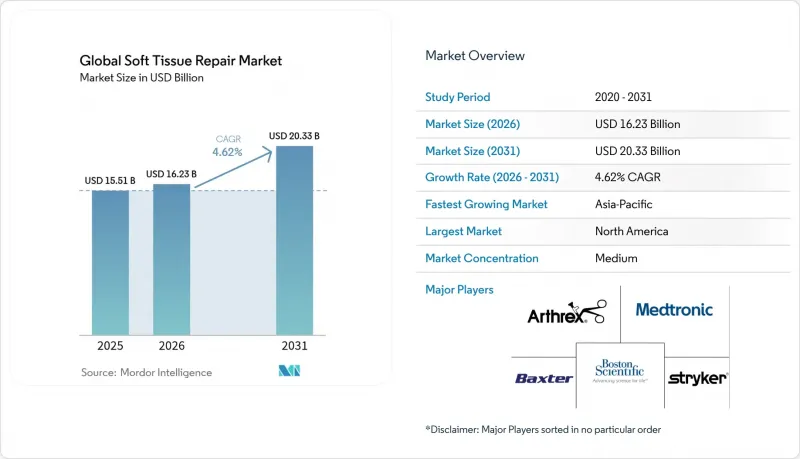
This report is Segmented by Product (Tissue Fixation Devices, Tissue Matrix, Other Products), Application (Orthopedics & Sports Medicine, and More), End User (Hospitals, Ambulatory Surgical Centers, Others), and Geography (North America, Europe, Asia-Pacific, Middle East & Africa, South America). The Market Forecasts are Provided in Terms of Value (USD).
Global Soft Tissue Repair Market Trends and Insights
Rising Sports-Related Injuries
A steady uptick in athletic participation across age groups keeps the soft tissue repair market on a growth trajectory. Incidence of surgically treated hamstring injuries climbed more than threefold in Sweden between 2001 and 2023. Similar trends appear in upper-extremity trauma, where hand injury cases rose 2% annually from 2007 to 2022. Older recreational athletes often present diminished tissue quality, fueling demand for advanced biologic grafts and load-sharing fixation systems that shorten rehabilitation timelines. Device makers able to document quicker functional recovery in this cohort gain a clear competitive edge.
Increasing Trauma & Road-Accident Cases
Road traffic accidents remain a major global health burden, markedly in emerging economies. Complex extremity injuries often involve multiple soft tissue layers, prompting surgeons to favor integrated repair platforms combining fixation, scaffold, and hemostatic functions. Regional disparities in trauma patterns compel manufacturers to tailor training and inventory models to local needs. As governments in Asia and Latin America roll out trauma system upgrades, procedure volumes are expected to lift the soft tissue repair market further.
High Procedure & Device Costs
Premium biologic matrices can cost multiples of standard polypropylene mesh. U.S. payers now cap the number of applications for certain skin substitutes and demand comparative evidence of superiority . Similar scrutiny by private insurers has tagged many novel grafts as investigational. Without sustained outcome data, adoption in cost-sensitive settings stalls, slowing the pace at which the soft tissue repair market converts to newer materials.
Other drivers and restraints analyzed in the detailed report include:
- Growing Geriatric Population
- Technological Advances in Bio-Engineered Meshes & Fixation Devices
- Outpatient ASC Expansion Driving Procedure Volumes
- 3D-Printed Patient-Specific Scaffolds
- Infection Litigation & Stringent Mesh Regulations
- Reimbursement Pushback on Novel Biologic Meshes
- Limited Surgeon Training in Emerging Markets
For complete list of drivers and restraints, kindly check the Table Of Contents.
Segment Analysis
Fixation devices held a 38.02% share of the soft tissue repair market in 2025, underpinned by surgeon familiarity with suture anchors, interference screws, and medical adhesives. FDA clearance for CONMED's expanded BioBrace indications in 2025 adds over 50 orthopedic procedures to its label . TELA Bio's liquid adhesive, launched in 2024, offers a suture-less option for hernia closure. Continuous innovation secures this segment's revenue stream.
Tissue matrices are forecast to outpace all other categories at a 5.15% CAGR. Collagen-elastin hybrids and ECM-coated polypropylene meshes are demonstrating reduced recurrence and lower inflammatory profiles in pre-clinical models. As payers warm to the long-term cost savings of fewer re-operations, this fast-growing segment is poised to enlarge its slice of the soft tissue repair market size.
Complete Report Scope:
- By Product
- Tissue Fixation Devices
- Suture Anchors
- Sutures & Staples
- Interference Screws
- Cyanoacrylate & Fibrin Glues
- Tissue Matrix
- Synthetic Mesh
- Biologic / Hybrid Mesh
- Other Products
- Tissue Fixation Devices
- By Application
- Orthopedics & Sports Medicine
- Dental Repair
- Hernia Repair
- Breast Reconstruction
- Skin & Burn Repair
- Other Applications
- By End User
- Hospitals
- Ambulatory Surgical Centers (ASCs)
- Others
- By Geography
- North America
- United States
- Canada
- Mexico
- Europe
- Germany
- United Kingdom
- France
- Italy
- Spain
- Rest of Europe
- Asia-Pacific
- China
- Japan
- India
- Australia
- South Korea
- Rest of Asia-Pacific
- Middle East & Africa
- GCC
- South Africa
- Rest of Middle East & Africa
- South America
- Brazil
- Argentina
- Rest of South America
- North America
Geography Analysis
North America commanded 42.55% of the soft tissue repair market in 2025 and is expected to maintain leadership through 2031. A mature ASC network now delivers 72% of U.S. surgeries, enhancing throughput while containing costs. The FDA continues to clear breakthrough devices such as Humacyte's acellular vessel for trauma repair, reinforcing the region's innovation ecosystem.
Europe retains solid positioning thanks to universal health systems and CE-mark harmonization. Nevertheless, fiscal pressures are prompting stricter health-technology assessments, which slow reimbursement for premium biologic matrices. Ongoing investments in robotics and additive manufacturing keep local suppliers competitive, sustaining the region's role in shaping next-generation solutions for the soft tissue repair market.
Asia-Pacific is the fastest-growing region, forecast at 5.90% CAGR. Regulatory modernization in China and India is clarifying approval pathways, while an aging population widens the candidate pool for hernia and rotator cuff procedures. Japan's adoption of bio-inductive implants underscores the region's appetite for advanced yet clinically validated technologies.
- Arthrex
- Medtronic
- Smith+Nephew plc
- Stryker
- Ethicon & DePuy Synthes (Johnson & Johnson)
- Baxter
- Integra LifeSciences Holdings
- Zimmer Biomet
- B. Braun
- Beckton Dickinson
- Conmed
- Organogenesis
- RTI Surgical
- Teleflex
- TELA Bio, Inc.
- Artivion, Inc. (CryoLife)
- Allergan Aesthetics (AbbVie)
- Wright Medical Group (Stryker)
Additional Benefits:
- The market estimate (ME) sheet in Excel format
- 3 months of analyst support
TABLE OF CONTENTS
1 Introduction
- 1.1 Study Assumptions & Market Definition
- 1.2 Scope of the Study
2 Research Methodology
3 Executive Summary
4 Market Landscape
- 4.1 Market Overview
- 4.2 Market Drivers
- 4.2.1 Rising Sports-Related Injuries
- 4.2.2 Increasing Trauma & Road-Accident Cases
- 4.2.3 Growing Geriatric Population
- 4.2.4 Technological Advancements In Bio-Engineered Meshes & Fixation Devices
- 4.2.5 Outpatient Asc Expansion Driving Soft-Tissue Procedure Volumes
- 4.2.6 3D-Printed Patient-Specific Scaffolds Enabling Complex Reconstructions
- 4.3 Market Restraints
- 4.3.1 High Procedure & Device Costs
- 4.3.2 Infection Litigation & Stringent Mesh Regulations
- 4.3.3 Reimbursement Pushback On Novel Biologic Meshes
- 4.3.4 Limited Surgeon Training In Emerging Markets
- 4.4 Value / Supply-Chain Analysis
- 4.5 Regulatory Landscape
- 4.6 Technological Outlook
- 4.7 Porter's Five Forces Analysis
- 4.7.1 Threat of New Entrants
- 4.7.2 Bargaining Power of Buyers
- 4.7.3 Bargaining Power of Suppliers
- 4.7.4 Threat of Substitutes
- 4.7.5 Intensity of Competitive Rivalry
5 Market Size & Growth Forecasts (Value)
- 5.1 By Product
- 5.1.1 Tissue Fixation Devices
- 5.1.1.1 Suture Anchors
- 5.1.1.2 Sutures & Staples
- 5.1.1.3 Interference Screws
- 5.1.1.4 Cyanoacrylate & Fibrin Glues
- 5.1.2 Tissue Matrix
- 5.1.2.1 Synthetic Mesh
- 5.1.2.2 Biologic / Hybrid Mesh
- 5.1.3 Other Products
- 5.1.1 Tissue Fixation Devices
- 5.2 By Application
- 5.2.1 Orthopedics & Sports Medicine
- 5.2.2 Dental Repair
- 5.2.3 Hernia Repair
- 5.2.4 Breast Reconstruction
- 5.2.5 Skin & Burn Repair
- 5.2.6 Other Applications
- 5.3 By End User
- 5.3.1 Hospitals
- 5.3.2 Ambulatory Surgical Centers (ASCs)
- 5.3.3 Others
- 5.4 By Geography
- 5.4.1 North America
- 5.4.1.1 United States
- 5.4.1.2 Canada
- 5.4.1.3 Mexico
- 5.4.2 Europe
- 5.4.2.1 Germany
- 5.4.2.2 United Kingdom
- 5.4.2.3 France
- 5.4.2.4 Italy
- 5.4.2.5 Spain
- 5.4.2.6 Rest of Europe
- 5.4.3 Asia-Pacific
- 5.4.3.1 China
- 5.4.3.2 Japan
- 5.4.3.3 India
- 5.4.3.4 Australia
- 5.4.3.5 South Korea
- 5.4.3.6 Rest of Asia-Pacific
- 5.4.4 Middle East & Africa
- 5.4.4.1 GCC
- 5.4.4.2 South Africa
- 5.4.4.3 Rest of Middle East & Africa
- 5.4.5 South America
- 5.4.5.1 Brazil
- 5.4.5.2 Argentina
- 5.4.5.3 Rest of South America
- 5.4.1 North America
6 Competitive Landscape
- 6.1 Market Concentration
- 6.2 Market Share Analysis
- 6.3 Company Profiles (includes Global level Overview, Market level overview, Core Segments, Financials as available, Strategic Information, Market Rank/Share for key companies, Products & Services, and Recent Developments)
- 6.3.1 Arthrex, Inc.
- 6.3.2 Medtronic plc
- 6.3.3 Smith+Nephew plc
- 6.3.4 Stryker Corporation
- 6.3.5 Ethicon & DePuy Synthes (Johnson & Johnson)
- 6.3.6 Baxter International Inc.
- 6.3.7 Integra LifeSciences Holdings
- 6.3.8 Zimmer Biomet Holdings
- 6.3.9 B. Braun Melsungen AG
- 6.3.10 BD (Becton, Dickinson and Company)
- 6.3.11 CONMED Corporation
- 6.3.12 Organogenesis Holdings Inc.
- 6.3.13 RTI Surgical
- 6.3.14 Teleflex Incorporated
- 6.3.15 TELA Bio, Inc.
- 6.3.16 Artivion, Inc. (CryoLife)
- 6.3.17 Allergan Aesthetics (AbbVie)
- 6.3.18 Wright Medical Group (Stryker)
7 Market Opportunities & Future Outlook
- 7.1 White-space & Unmet-Need Assessment