

|
시장보고서
상품코드
2122625
원격 모니터링 시스템 시장 : 시장 점유율 분석, 업계 동향 및 통계, 성장 예측(2026-2031년)Telemonitoring Systems - Market Share Analysis, Industry Trends & Statistics, Growth Forecasts (2026 - 2031) |
||||||
 Mordor Intelligence
Mordor Intelligence에 의하면, 원격 모니터링 시스템 시장 규모는 2025년 51억 4,000만 달러로 평가되었고, 2026년에는 58억 1,000만 달러로 추정되고, 2026-2031년 CAGR 13.06%로 성장을 지속할 전망이며, 2031년에는 107억 4,000만 달러에 이를 것으로 예측됩니다.
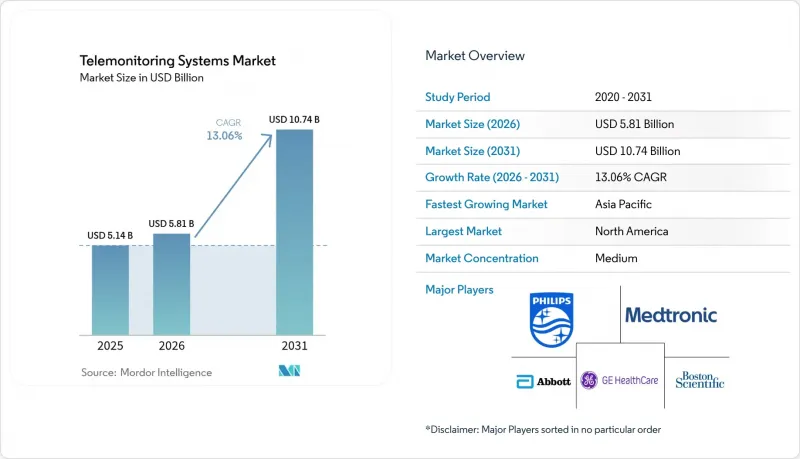
본 보고서는 제품 유형별(COPD 원격 모니터링 시스템, 혈당 원격 모니터링 시스템 등), 구성 요소별(디바이스, 소프트웨어 플랫폼 등), 연결 기술별(블루투스/저전력 등), 용도별(심혈관 질환 등), 최종 사용자 환경별(병원 및 전문 클리닉 등) 및 지역별로 분류되어 있습니다. 시장 예측은 금액(달러) 기준으로 제시되어 있습니다.
세계의 원격 모니터링 시스템 시장 동향 및 인사이트
증가하는 만성 질환 부담과 고령화
전례 없는 다중 질환 병존 증가와 인구 고령화가 기존 의료 기관의 범위를 훨씬 뛰어넘는 지속적인 모니터링에 대한 수요를 뒷받침하고 있습니다. 일본은 이러한 과제를 여실히 보여주고 있습니다. 국민의 29%가 이미 65세 이상이며, 인력 부족 해소를 위한 해결책으로 원격 모니터링을 자리매김하는 전국적인 디지털 헬스 이니셔티브가 추진되고 있습니다. 일본 종합건강검진학회가 다중 매개변수 MCG 스크리닝을 권장하고 있는 것은 기술을 활용한 예방적 만성 질환 관리에 대한 임상의들의 신뢰를 뒷받침하고 있습니다. 중국의 농촌 지역에서는 교육 수준과 소득이 원격 의료 수용 의지에 영향을 미치고 있어, 전체 인구의 건강상의 이점을 극대화하기 위해서는 도입 프로그램이 사회경제적 장벽을 해결해야 함을 시사합니다. 만성 질환 관리의 원격 모니터링 비용은 환자 1인당 1일 약 10달러인 반면, 병원 병상 1개당 비용은 500달러이므로, 이는 의료 제공업체에게 프로그램을 확대할 강력한 경제적 인센티브가 되고 있습니다.
RPM 및 원격의료 보상 코드의 확대
CMS의 2025년 의사 보수 일정에 따라 의료 제공업체는 기존 RPM 코드에 더해 ‘고급 1차 진료 관리’ 보수를 추가로 청구할 수 있게 되어, 등록 환자 1인당 수익이 향상되었습니다. 음성만 이용한 진료에 대한 영구적인 보험 적용 및 연방 공인 보건 센터(FQHC)의 청구 절차 간소화를 통해 자원이 부족한 지역의 의료 접근성이 확대되고 있습니다. 그러나 메디케이드(Medicaid) 하에서 ‘재택 병원(Hospital-at-Home)’ 비용을 보상하는 미국 주(州)는 불과 12개 주에 불과하며, EU의 지급 정책도 국가마다 크게 다릅니다. 특히 독일과 벨기에는 디지털 기기 통합 측면에서 다른 국가들을 크게 앞서고 있습니다. 임상의들은 미국 의사협회(AMA)가 새로 추가한 RPM 코드를 환영하고 있지만, 여전히 복잡한 문서화 규정에 직면해 있으며, 이는 사업 확장의 걸림돌이 될 수 있습니다.
지방의 ICT 및 광대역 격차
‘광대역 사막’이라 불리는 지역에 거주하는 약 300만 명의 미국인들은 고해상도 센서 데이터를 전송할 수 없어, 만성 질환 유병률이 종종 가장 높은 이 지역에서 원격 모니터링의 적용 범위가 제한되고 있습니다. 예를 들어, 앨라배마주 그린 카운티 헬스 시스템에서는 전자 건강 기록 요건의 10분의 1 속도로만 운영할 수 있어, 간호사들은 수동으로 활력 징후를 확인하는 방식으로 되돌아갈 수밖에 없는 상황입니다. 디지털 격차는 기기 보유 현황과 디지털 문해력에도 미치고 있습니다. 유선 광대역 인터넷을 가입한 농촌 지역 가구는 46%에 그치는 반면, 도시 지역의 해당 가구는 67%에 달할 전망입니다.
부문 분석
2025년, 심장 모니터링 플랫폼은 원격 모니터링 시스템 시장 점유율의 30.92%를 차지했습니다. 이는 확립된 보험 환급 제도에 더해, 애보트(Abbott)사의 ‘Assert-IQ’와 같은 FDA 승인 기기가 기여했기 때문입니다. 이 기기는 6년의 배터리 수명과 AI를 활용한 부정맥 감지 기능을 갖추고 있습니다. 혈당 모니터링 기기는 소비자의 웰니스 트렌드 확산과 OTC(일반의약품) CGM의 승인을 호재로 삼아 연평균 성장률(CAGR) 17.02%로 확대될 것으로 예측됩니다. 이 부문의 부상은 대사 기능 유지에 관심을 가진 비당뇨병 환자를 유치함으로써 원격 모니터링 시스템 시장의 확장을 뒷받침하고 있습니다.
예방 의료 모델은 심전도(ECG), SpO2, 혈압을 하나의 웨어러블 기기에 통합한 다중 매개변수 모니터의 보급을 촉진하고 있으며, 이는 단일 지표 도구에서 종합적인 플랫폼으로 시장 전환을 반영합니다. 만성폐쇄성폐질환(COPD) 및 고혈압용 기기는 틈새 수요를 충족시키고 있지만, 보다 광범위한 임상 지침에서 원격 관리를 권장하기 전까지는 성장 속도가 둔화될 전망입니다.
2025년에는 하드웨어가 매출의 81.55%를 차지했으나, 소프트웨어는 연평균 성장률(CAGR) 15.05%로 확대되었으며, 이는 데이터 통합과 알고리즘을 통한 인사이트력이 가치를 창출한다는 업계의 인식을 반영합니다. Philips의 viQtor 통합은 임상의의 대시보드를 효율화하는 소프트웨어 중심 생태계의 좋은 예입니다. AI 모델이 성숙해지고, 의사결정 지원 성과에 대한 보험사의 보상이 확대됨에 따라, 클라우드 우선 분석 모듈을 갖춘 원격 모니터링 시스템 시장 규모는 꾸준히 확대될 것으로 예측됩니다.
도입부터 교육에 이르는 서비스는 기기와 플랫폼을 연결하는 접착제 같은 역할을 수행하며, 사용자의 장기적인 정착을 보장합니다. GE 헬스케어의 ‘CareIntellect’는 생성형 AI를 활용해 암 환자의 기록을 요약함으로써 데이터 검색 시간을 단축하고, 소프트웨어가 인지적 부하를 경감하는 방식을 여실히 보여주고 있습니다.
지역별 분석
북미는 선진적인 보험 환급 제도와 성숙한 의료 제공업체 네트워크를 바탕으로 2025년 원격 모니터링 시스템 시장 점유율의 39.41%를 차지했습니다. CMS 데이터에 따르면, 2020년 이후 ‘Hospital-at-Home’을 통해 3만 1,000명의 환자가 치료를 받았으며, 사망률과 의료비가 감소함에 따라 원격 진료에 대한 보험사의 신뢰가 높아지고 있습니다. 매사추세츠 종합병원·브리검(Mass General Brigham)의 70병상 수용 능력은 대규모 의료 시스템이 원격 모니터링을 활용하여 중증 환자를 위한 입원 병상을 확보하는 구조를 보여줍니다. Philips와 주요 의료 시스템 간의 기업 간 계약을 통해 AI 기반 대시보드가 전미 규모로 도입되고 있습니다.
아시아태평양은 적극적인 디지털 헬스 정책에 힘입어 2031년까지 연평균 성장률(CAGR)이 14.29%에 달하며 가장 빠르게 성장이 전망되는 지역입니다. 일본의 7.29%라는 시장 성장률은 인구 통계학적 압력이 기술 도입을 촉진하고 있음을 보여주는 반면, 중국의 5G 전용 네트워크는 상시 연결형 모니터링을 위한 인프라 구축을 가능하게 하고 있습니다. 문헌계량학적 분석에 따르면, 팬데믹 이후 중국의 원격의료 관련 논문 발표 건수는 10위에서 6위로 도약했으며, 이는 혁신에 대한 투자 확대를 반영하고 있습니다.
유럽에서는 WHO의 ‘지역 디지털 헬스 행동 계획’을 기반으로 꾸준한 성장이 나타나고 있으며, 노르웨이의 AI를 활용한 원격 방사선 진단 프로그램은 국경을 초월한 데이터 공유의 벤치마크가 되고 있습니다. 그러나 보상 제도의 불균일성이 도입 속도를 저해하고 있습니다. 향후 도입될 ‘유럽 헬스 데이터 스페이스’ 및 HTA(의료기술평가) 규제는 평가 기준의 조화를 도모하는 것을 목적으로 하고 있어, 이를 통해 도입까지의 기간을 단축할 가능성이 있습니다.
그 밖의 지역인 중동 및 아프리카, 남미는 여전히 발전 단계에 있지만, 미래 전망은 밝다고 할 수 있습니다. 아랍에미리트와 브라질에서 진행된 시범 프로그램은 규제 체계와 광대역 네트워크 구축이 진전된다면 실용화가 가능함을 보여주고 있습니다.
기타 혜택 :
- 엑셀 형식 시장 예측(ME) 시트
- 3개월간의 애널리스트 지원
자주 묻는 질문
목차
제1장 서론
제2장 조사 방법
제3장 주요 요약
제4장 시장 구도
제5장 시장 규모 및 성장 예측
제6장 경쟁 구도
제7장 시장 기회 및 향후 전망
AJY 26.09.09According to Mordor Intelligence, the telemonitoring systems market size is expected to grow from USD 5.14 billion in 2025 to USD 5.81 billion in 2026 and is forecast to reach USD 10.74 billion by 2031 at 13.06% CAGR over 2026-2031.
This report is Segmented by Product Type (COPD Telemonitoring System, Glucose Level Telemonitoring System, and More), Component (Devices, Software Platforms and More), Connectivity Technology (Bluetooth / Low-Energy and More), Application (Cardiovascular Diseases and More), End-User Setting (Hospitals & Specialty Clinics and More) and Geography. The Market Forecasts are Provided in Terms of Value (USD).
Global Telemonitoring Systems Market Trends and Insights
Growing Chronic Disease Burden & Ageing Population
An unprecedented rise in multimorbidity and an aging demographic underpin demand for continuous monitoring far beyond traditional clinical walls. Japan illustrates the challenge: 29% of its citizens are already over 65, spurring nationwide digital-health initiatives that position telemonitoring as a workforce-saving solution. The Japanese Society of Ningen Dock's endorsement of multi-parameter MCG screening underlines clinician confidence in proactive, tech-enabled chronic-disease management. In rural China, education and income shape willingness to adopt telemedicine, suggesting implementation programs must address socioeconomic hurdles to unlock full population health benefits. Chronic-care telemonitoring, costing roughly USD 10 per patient-day versus USD 500 for a hospital bed, gives providers a compelling economic incentive to scale programs.
Expansion of Reimbursement Codes for RPM & Telehealth
CMS's 2025 Physician Fee Schedule allows providers to layer Advanced Primary Care Management payments on top of existing RPM codes, boosting revenue per enrolled patient. Permanent coverage for audio-only visits and simplified Federally Qualified Health Center billing expands access in low-resource settings. Yet only a dozen US states reimburse Hospital-at-Home under Medicaid, and EU payment policies vary sharply, with Germany and Belgium far ahead of peers in digital-device integration.Clinicians welcome the American Medical Association's newly added RPM codes, but still face complex documentation rules that can slow scaling.
Rural ICT & Broadband Gaps
Roughly 3 million Americans living in broadband "deserts" cannot transmit high-resolution sensor data, limiting telemonitoring reach where chronic-disease rates are often highest. Greene County Health System in Alabama, for instance, operates with speeds a tenth of what electronic health records require, forcing nurses to revert to manual vitals checks. Digital inequities also span device ownership and literacy; only 46% of rural households subscribe to fixed broadband versus 67% of urban peers.
Other drivers and restraints analyzed in the detailed report include:
- Tech Advances in Wearables & 5G Connectivity
- Pressure to Cut Readmissions & Hospital Costs
- Cyber-Security / Privacy Breaches
For complete list of drivers and restraints, kindly check the Table Of Contents.
Segment Analysis
Cardiac platforms held 30.92% of telemonitoring systems market share in 2025, thanks to well-established reimbursement and FDA-cleared devices such as Abbott's Assert-IQ, which offers six-year battery life and AI-enhanced arrhythmia detection. Glucose-monitoring devices are projected to expand at 17.02% CAGR, propelled by consumer wellness trends and OTC CGM approvals. This segment's rise widens the telemonitoring systems market by attracting non-diabetic users keen on metabolic fitness.
Preventive care models are spurring multi-parameter monitors that aggregate ECG, SpO2, and blood pressure in one wearable, echoing the market's pivot from single-metric tools to holistic platforms. COPD and hypertension devices fill niche needs but face slower growth until broader clinical guidelines endorse remote management.
Hardware captured 81.55% revenue in 2025, but software is advancing at a 15.05% CAGR, reflecting the industry's recognition that data unification and algorithmic insights drive value. Philips' viQtor integration exemplifies software-centric ecosystems that streamline clinician dashboards. Telemonitoring systems market size for cloud-first analytics modules is expected to grow steadily as AI models mature and payors reimburse decision-support outputs.
Services-from implementation to training-form the glue that binds devices and platforms, ensuring long-term user adoption. GE HealthCare's CareIntellect uses generative AI to condense cancer patient records, cutting data-retrieval time and underscoring how software reduces cognitive load.
Complete Report Scope:
- By Product Type
- COPD Telemonitoring Systems
- Glucose Level Telemonitoring Systems
- Cardiac Telemonitoring Systems
- Blood-Pressure Telemonitoring Systems
- Multi-parameter/Other Systems
- By Component
- Devices
- Software Platforms
- Services
- By Connectivity Technology
- Bluetooth / Low-Energy
- Cellular / NB-IoT
- Wi-Fi / WLAN
- Wired
- By Application / Condition
- Cardiovascular Diseases
- Diabetes
- Respiratory Diseases (e.g., COPD, Asthma)
- Other Chronic & Acute Conditions
- By End-User Setting
- Hospitals & Specialty Clinics
- Home-care Settings
- Long-term Care Facilities
- Ambulatory Surgical & Out-patient Centers
- By Geography
- North America
- United States
- Canada
- Mexico
- Europe
- Germany
- United Kingdom
- France
- Italy
- Spain
- Rest of Europe
- Asia-Pacific
- China
- Japan
- India
- Australia
- South Korea
- Rest of Asia-Pacific
- Middle East and Africa
- GCC
- South Africa
- Rest of Middle East and Africa
- South America
- Brazil
- Argentina
- Rest of South America
- North America
Geography Analysis
North America commanded 39.41% of telemonitoring systems market share in 2025 on the back of reimbursement leadership and mature provider networks. CMS data show 31,000 patients treated via Hospital-at-Home since 2020 with lower mortality and spending, reinforcing payor confidence in remote care. Mass General Brigham's 70-bed capacity demonstrates how large systems leverage telemonitoring to free inpatient beds for higher acuity cases. Enterprise deals between Philips and leading health systems are translating into nationwide rollouts of AI-enabled dashboards.
Asia-Pacific is the fastest-growing territory with a 14.29% CAGR to 2031, supported by proactive digital-health policies. Japan's 7.29% market expansion underscores how demographic pressure catalyzes technology uptake, whereas China's 5G private networks create infrastructure readiness for always-on monitoring. Bibliometric analysis reveals China jumped from 10th to 6th in telemedicine publications post-pandemic, reflecting amplified innovation spending.
Europe posts steady growth anchored by the WHO Regional Digital Health Action Plan, with Norway's AI-assisted teleradiology programs setting benchmarks for cross-border data-sharing. Yet reimbursement fragmentation slows deployment speed. The forthcoming European Health Data Space and HTA regulation aim to harmonize evaluation criteria, which could reduce launch timelines.
Elsewhere, Middle East, Africa, and South America remain nascent but promising. Pilot programs in the United Arab Emirates and Brazil demonstrate viability once regulatory guardrails and broadband build-outs advance.
- Koninklijke Philips
- Medtronic
- GE HealthCare Technologies Inc.
- Abbott Laboratories
- Resideo (Honeywell HomMed)
- Boston Scientific
- OMRON
- Nihon Kohden
- Dexcom
- Teladoc Health
- Masimo
- Aerotel Medical Systems
- InfoBionic Inc.
- iRhythm Technologies
- AliveCor
- VitalConnect Inc.
- Care Innovation LLC (Intel-GE JV)
- AMD Global Telemedicine
- SHL Telemedicine Ltd.
- Resmed
- Qardio Inc.
- Withings
- VivaLNK
Additional Benefits:
- The market estimate (ME) sheet in Excel format
- 3 months of analyst support
TABLE OF CONTENTS
1 Introduction
- 1.1 Study Assumptions and Market Definition
- 1.2 Scope of the Study
2 Research Methodology
3 Executive Summary
4 Market Landscape
- 4.1 Market Overview
- 4.2 Market Drivers
- 4.2.1 Growing Chronic Disease Burden & Ageing Population
- 4.2.2 Expansion Of Reimbursement Codes For RPM & Telehealth
- 4.2.3 Tech Advances In Wearables & 5G Connectivity
- 4.2.4 Pressure To Cut Readmissions & Hospital Costs
- 4.2.5 Capacity-Driven "Hospital-At-Home" Roll-Outs
- 4.2.6 AI-Powered Predictive Analytics Turns RPM Data Into Billable Insight
- 4.3 Market Restraints
- 4.3.1 Rural ICT & Broadband Gaps
- 4.3.2 Cyber-Security / Privacy Breaches
- 4.3.3 Clinician Workflow Overload From Raw RPM Data
- 4.3.4 Patchy Non-US Reimbursement & Evidence Thresholds
- 4.4 Value / Supply-Chain Analysis
- 4.5 Regulatory Landscape
- 4.6 Technology Outlook
- 4.7 Porter's Five Forces Analysis
- 4.7.1 Bargaining Power of Suppliers
- 4.7.2 Bargaining Power of Buyers
- 4.7.3 Threat of New Entrants
- 4.7.4 Threat of Substitutes
- 4.7.5 Intensity of Competitive Rivalry
5 Market Size and Growth Forecasts (Value-USD)
- 5.1 By Product Type
- 5.1.1 COPD Telemonitoring Systems
- 5.1.2 Glucose Level Telemonitoring Systems
- 5.1.3 Cardiac Telemonitoring Systems
- 5.1.4 Blood-Pressure Telemonitoring Systems
- 5.1.5 Multi-parameter/Other Systems
- 5.2 By Component
- 5.2.1 Devices
- 5.2.2 Software Platforms
- 5.2.3 Services
- 5.3 By Connectivity Technology
- 5.3.1 Bluetooth / Low-Energy
- 5.3.2 Cellular / NB-IoT
- 5.3.3 Wi-Fi / WLAN
- 5.3.4 Wired
- 5.4 By Application / Condition
- 5.4.1 Cardiovascular Diseases
- 5.4.2 Diabetes
- 5.4.3 Respiratory Diseases (e.g., COPD, Asthma)
- 5.4.4 Other Chronic & Acute Conditions
- 5.5 By End-User Setting
- 5.5.1 Hospitals & Specialty Clinics
- 5.5.2 Home-care Settings
- 5.5.3 Long-term Care Facilities
- 5.5.4 Ambulatory Surgical & Out-patient Centers
- 5.6 By Geography
- 5.6.1 North America
- 5.6.1.1 United States
- 5.6.1.2 Canada
- 5.6.1.3 Mexico
- 5.6.2 Europe
- 5.6.2.1 Germany
- 5.6.2.2 United Kingdom
- 5.6.2.3 France
- 5.6.2.4 Italy
- 5.6.2.5 Spain
- 5.6.2.6 Rest of Europe
- 5.6.3 Asia-Pacific
- 5.6.3.1 China
- 5.6.3.2 Japan
- 5.6.3.3 India
- 5.6.3.4 Australia
- 5.6.3.5 South Korea
- 5.6.3.6 Rest of Asia-Pacific
- 5.6.4 Middle East and Africa
- 5.6.4.1 GCC
- 5.6.4.2 South Africa
- 5.6.4.3 Rest of Middle East and Africa
- 5.6.5 South America
- 5.6.5.1 Brazil
- 5.6.5.2 Argentina
- 5.6.5.3 Rest of South America
- 5.6.1 North America
6 Competitive Landscape
- 6.1 Market Concentration
- 6.2 Market Share Analysis
- 6.3 Company profiles (includes Global level Overview, Market level overview, Core Segments, Financials as available, Strategic Information, Market Rank/Share for key companies, Products and Services, and Recent Developments)
- 6.3.1 Koninklijke Philips N.V.
- 6.3.2 Medtronic plc
- 6.3.3 GE HealthCare Technologies Inc.
- 6.3.4 Abbott Laboratories
- 6.3.5 Resideo (Honeywell HomMed)
- 6.3.6 Boston Scientific Corp.
- 6.3.7 Omron Corporation
- 6.3.8 Nihon Kohden Corporation
- 6.3.9 Dexcom Inc.
- 6.3.10 Teladoc Health Inc.
- 6.3.11 Masimo Corporation
- 6.3.12 Aerotel Medical Systems Ltd.
- 6.3.13 InfoBionic Inc.
- 6.3.14 iRhythm Technologies Inc.
- 6.3.15 AliveCor Inc.
- 6.3.16 VitalConnect Inc.
- 6.3.17 Care Innovation LLC (Intel-GE JV)
- 6.3.18 AMD Global Telemedicine Inc.
- 6.3.19 SHL Telemedicine Ltd.
- 6.3.20 ResMed Inc.
- 6.3.21 Qardio Inc.
- 6.3.22 Withings
- 6.3.23 VivaLNK
7 Market Opportunities and Future Outlook
- 7.1 White-Space and Unmet-Need Assessment


