
|
시장보고서
상품코드
2122640
인적 자본 관리(HCM) 소프트웨어 시장 : 시장 점유율 분석, 업계 동향 및 통계, 성장 예측(2026-2031년)Human Capital Management Software - Market Share Analysis, Industry Trends & Statistics, Growth Forecasts (2026 - 2031) |
||||||
 Mordor Intelligence
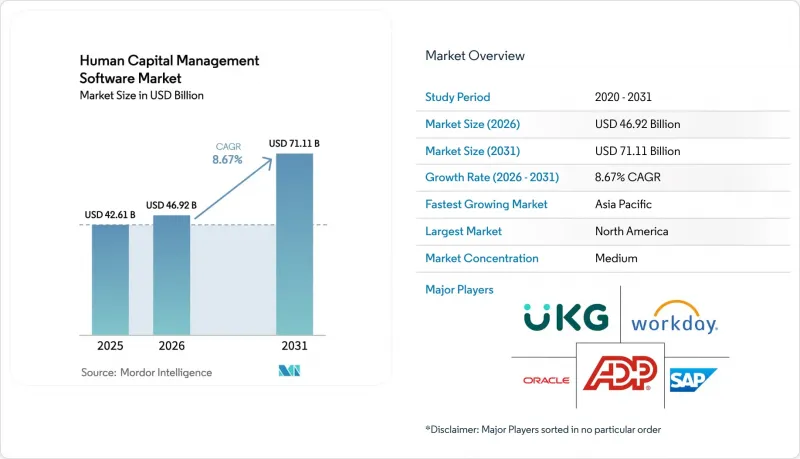
Mordor Intelligence에 의하면, 인적 자본 관리(HCM) 소프트웨어 시장 규모는 2025년 426억 1,000만 달러로 평가되었고, 2026년에는 469억 2,000만 달러로 추정되고, 2026-2031년 CAGR 8.67%로 성장을 지속할 전망이며, 2031년에는 711억 1,000만 달러에 이를 것으로 예측됩니다.
본 보고서는 솔루션별(급여 관리, 인재 관리 등), 배포 방식별(온프레미스, 클라우드), 조직 규모별(대기업, 중소기업), 산업 분야별(IT 및 통신, 제조, 소매 및 전자상거래, 정부·공공 부문 등), 그리고 지역별로 분류되어 있습니다. 시장 예측은 금액(달러) 단위로 표시됩니다.
세계의 인적 자본 관리(HCM) 소프트웨어 시장 동향 및 인사이트
클라우드 네이티브 HCM 플랫폼으로의 전환
클라우드 네이티브 아키텍처는 컴퓨팅 계층, 스토리지 계층, 용도 계층을 분리함으로써 벤더가 매주 기능 업데이트를 제공하고 혁신 주기를 가속화할 수 있게 합니다. 2025년 9월에 출시된 ‘Workday Data Cloud’는 오픈 API를 통해 직원, 재무, 운영 데이터를 실시간으로 스트리밍하여 배치 ETL을 제거하는 동시에 부서 간 분석을 지원합니다. 기업은 인재 자원의 수용 능력을 수요 예측과 일치시키는 능력을 확보하여 의사 결정 속도를 높이고 통합 비용을 절감할 수 있습니다. 델로이트의 2025년 전환 설문조사에 따르면, 기업의 68%가 클라우드 도입의 주요 촉진요인으로 비용 절감보다 혁신 가속화를 선택했습니다. 보안은 여전히 매우 중요하기 때문에 ISO 27001 및 SOC 2 Type II 인증이 조달 워크플로우에 직접 통합되어 리스크 검토 시간을 단축하고 있습니다. 이러한 요인들이 결합되어 기술 부채를 줄이고 가치 실현까지의 시간을 단축함으로써, 인적 자본 관리(HCM) 소프트웨어 시장에 지속적인 성장을 가져오고 있습니다.
통합형 인사·급여 관리 제품군의 보급 가속화
기업들은 급여 계산 주기마다 재무 부서가 15-20시간이나 소요될 수 있는 대조 작업의 지연을 해소하기 위해, 여러 개의 포인트 솔루션을 통합 제품군으로 집약하고 있습니다. 2025년 11월에 출시된 ‘ADP Workforce Suite’는 직원 수 1,000명 미만의 기업을 대상으로 급여 계산, 근태 관리, 복리후생, 인재 관리 각 모듈을 통합하여 도입 기간을 수 분기에서 수 주일로 단축하고 있습니다. Deel은 150개국에서 총 220억 달러 규모의 세계 급여 계산을 처리하고 있으며, 분기마다 변경되는 사회보험 및 세무 신고를 자동화함으로써 데이터 흐름의 통합이 규정 준수 측면에서 가져다주는 이점을 입증하고 있습니다. 또한 통합 플랫폼을 통해 보상 변경과 이직 위험을 연관 짓는 예측 분석이 가능해집니다. 이는 맥킨지가 고성과자의 유지를 위해 필수적이라고 지적한 기능입니다. 운영상의 과제를 해결하고 전략적 인사이트를 제공함으로써, 통합 제품군은 대상 사용자층을 대폭 확대되고 있습니다.
사이버 보안 및 데이터 개인정보 보호에 대한 우려
HCM 플랫폼은 기밀성이 높은 개인정보와 보상 정보를 보관하고 있기 때문에 랜섬웨어의 주요 표적이 됩니다. 2024년 12월에 발생한 Cleo의 데이터 유출 사건에서는 다국적 기업의 급여 기록이 유출됨과 동시에, 타사 파일 전송 도구의 취약점이 드러났습니다. GDPR(EU 개인정보보호규정) 및 CCPA에 따른 벌금은 수억에 달할 가능성이 있으며, 2023년 Meta에 부과된 12억 유로(14억 1,000만 달러)의 벌금이 그 예입니다. 이에 따라 구매자들은 공급업체의 관리 체제에 대한 심사를 강화하고 있습니다. 현재 기업들은 제로 트러스트 아키텍처, 다단계 인증, 저장 및 전송 중 암호화를 기본 요건으로 요구하고 있으며, 이로 인해 소규모 공급업체의 개발 비용이 증가하고 조달 주기가 길어지고 있습니다.
부문 분석
급여 관리는 2025년 매출의 43.78%를 차지하며 가장 큰 비중을 차지했습니다. 이러한 위상은 점점 더 복잡해지는 세법, 사회보험 의무, 실시간 신고 의무에 의해 뒷받침되고 있습니다. Deel이 150개국에서 연간 220억 달러 규모의 급여 계산을 자동화하고 있다는 사실은 기업들이 현지 법규 및 통화 변환을 대규모로 통합한 플랫폼을 우선시하는 이유를 보여줍니다. 급여 계산이 인적 자본 관리(HCM) 소프트웨어 시장에서 차지하는 비중은 급여 계산의 부정확성에 따른 직접적인 금전적 벌금을 반영하고 있습니다. 한편, 학습 및 개발 분야는 연평균 성장률(CAGR) 9.72%로 확대되어 솔루션 부문 중 가장 높은 성장률을 보였습니다. 이는 맥킨지 조사에서 경영진의 87%가 심각한 기술 부족에 직면해 있다고 보고한 사실과도 관련이 있습니다. 2025년 11월 워크데이(Workday)가 11억 달러에 사나(Sana)를 인수함에 따라, AI 기반 지식 관리가 통합되어 직원의 숙련도에 실시간으로 적응하는 역량 강화 경로가 가능해졌습니다.
이러한 융합 추세로 인해 기존 솔루션의 경계는 점차 모호해지고 있습니다. 현재 인재 관리 모듈은 급여 데이터를 활용해 보상 변동과 이직 위험 간의 상관관계를 분석하는 한편, 노무 관리 엔진은 학습 기록을 통합하여 교육 요건 준수 여부를 검증하고 있습니다. ADP Workforce Suite는 급여 계산, 근태 관리, 복리후생을 단일 구독 서비스로 통합함으로써 데이터 대조 지연을 해소하고, 중견 기업 구매자의 총 소유 비용(TCO)을 절감하고 있습니다. 벤더가 과거에는 독립적이었던 기능을 통합된 워크플로우로 묶어감에 따라, 구매자는 모듈의 수가 아니라 내장된 인텔리전스의 폭넓음에 따라 제품을 평가하게 되었습니다. 이러한 추세로 인해 인적 자본 관리(HCM) 소프트웨어 시장은 2031년까지 GDP 성장률을 상회하는 속도로 계속 성장할 전망입니다.
2025년 지출 중 온프레미스 도입은 여전히 55.83%를 차지했으며, 그 주된 요인은 데이터 주권 및 감사 추적 요건을 이유로 꼽는 BFSI(은행 및 금융 및 보험) 및 정부 기관 때문입니다. 그러나 ISO 27001 및 SOC 2 Type II 인증이 규제 대상 부문 전반에 걸쳐 신뢰를 쌓아가면서, 클라우드 구독은 2031년까지 연평균 성장률(CAGR) 9.11%로 증가할 것으로 예측됩니다. Workday Data Cloud의 실시간 API 액세스를 통해 기존 ETL 프로세스에서 볼 수 있는 배치 처리 지연이 해소되어, 재무, 공급망, 인사 각 팀이 로컬 서버 없이도 공통 데이터 세트를 기반으로 업무를 수행할 수 있게 됩니다. 딜로이트의 2025년 조사에 따르면, 클라우드를 도입한 기업의 68%가 비용 절감보다 주 단위의 혁신 주기를 더 중요하게 여기고 있으며, 이는 전환의 이유가 단순한 경제적 이유가 아니라 전략적인 것임을 보여줍니다.
하이브리드 모델은 전환 경로를 제공하며, 기업들은 법정 급여 계산을 온프레미스로 유지하면서 인재 관리 및 학습 모듈을 클라우드로 이전하고 있습니다. 각 벤더들은 GDPR(EU 개인정보보호규정) 및 CCPA 규정을 준수하기 위해 데이터센터의 현지화를 추진하고 있으나, 이러한 확장으로 인해 인프라 비용은 20-30% 증가합니다. 컴플라이언스 엔진과 AI 코파일럿이 ‘클라우드 퍼스트’ 방식으로 출시됨에 따라 온프레미스 환경과의 격차는 확대되고 있으며, 도입이 지연되고 있는 기업들에게는 위험과 수익의 균형을 재평가할 동기가 되고 있습니다. 이러한 동향은 인적 자본 관리(HCM) 소프트웨어 시장에서 구독형 수익원으로의 장기적인 전환을 뒷받침하고 있습니다.
지역별 분석
북미는 높은 인건비, SaaS의 높은 보급률, 그리고 지속적인 플랫폼 업그레이드를 촉진하는 활발한 규제 환경에 힘입어 2025년 매출의 37.62%를 차지했습니다. 이 지역의 구매자들은 인사 업무의 수작업 부담을 줄이고 인사이트 생성을 가속화하기 위해 AI 코파일럿을 가장 먼저 도입하고 있습니다. 유럽은 이에 근소한 차이로 뒤를 잇고 있지만, GDPR(EU 개인정보보호규정)에 따른 데이터 현지화 의무로 인해 벤더들은 지역별 데이터센터를 운영하고 고급 암호화 기술에 투자할 수밖에 없어, 그 결과 총 소유 비용(TCO)이 상승하고 있습니다. 2024년 8월에 시행될 EU AI법은 편향성 감사 및 설명 가능성 보고서 제출을 의무화함으로써 시장을 더욱 차별화하고, 신규 시장 진출기업에 대한 진입 장벽을 높이고 있습니다.
아시아태평양은 2031년까지 연평균 성장률(CAGR) 9.61%라는 견조한 성장세를 보이며 시장을 주도할 전망입니다. 이러한 급성장의 원동력은 인도의 GST(상품 및 서비스세) 디지털화 추진, 중국의 성(省) 단위 사회보험 제도 도입, 일본의 새로운 초과근무 제한 등이며, 이 모든 요인이 급여 계산의 복잡성을 가중시키고 있습니다. Ramco Systems와 같은 현지 기업들은 이러한 추세를 활용하여 45개국 이상의 각국 급여 계산 규정을 지원하고 있습니다. 이러한 노력을 통해 현지 문화에 부합하는 대응과 규정 준수를 확보함으로써, 지역 고객들에게 우선적으로 선택받는 기업으로 자리매김하고 있습니다.
중동 및 아프리카에서의 도입은 걸프협력회의(GCC) 회원국에 집중되어 있습니다. 이들 국가에서는 외국인 근로자 관리 및 현지화 프로그램 시행에 따라 다중 통화 지원 급여 계산 및 비자 추적 기능이 요구되고 있습니다. 남미 지역에서는 환율 변동이나 세제 개정이 빈번하게 이루어지기 때문에 실시간 규정 준수 정보 파악이 필수적입니다. 이러한 지역별 요인들이 맞물리면서 인적 자본 관리(HCM) 소프트웨어 시장은 기존의 주요 시장을 넘어 확대되고 있으며, 수익원의 다각화가 진행되고 있습니다.
기타 혜택 :
- 엑셀 형식 시장 예측(ME) 시트
- 3개월간의 애널리스트 지원
자주 묻는 질문
목차
제1장 서론
제2장 조사 방법
제3장 주요 요약
제4장 시장 구도
제5장 시장 규모 및 성장 예측
제6장 경쟁 구도
제7장 시장 기회 및 향후 전망
AJY 26.09.09According to Mordor Intelligence, the human capital management software market size is expected to grow from USD 42.61 billion in 2025 to USD 46.92 billion in 2026 and is forecast to reach USD 71.11 billion by 2031 at 8.67% CAGR over 2026-2031.
This report is Segmented by Solution (Payroll Management, Talent Management, and More), Deployment (On-Premise, and Cloud), Organization Size (Large Enterprises, and Small and Medium Enterprises), Industry Vertical (IT and Telecom, Manufacturing, Retail and E-Commerce, Government and Public Sector, and More), and Geography. The Market Forecasts are Provided in Terms of Value (USD).
Global Human Capital Management Software Market Trends and Insights
Shift to Cloud-Native HCM Platforms
Cloud-native architecture decouples the compute, storage, and application layers, enabling vendors to deliver weekly feature updates that accelerate innovation cycles. Workday Data Cloud, released in September 2025, streams real-time employee, financial, and operational data through open APIs, eliminating batch ETL and supporting cross-functional analytics. Enterprises gain the ability to align workforce capacity with demand forecasts, improving decision speed and reducing integration costs. Deloitte's 2025 migration survey showed that 68% of firms selected faster innovation over cost savings as the primary driver of cloud adoption. Security remains crucial, so ISO 27001 and SOC 2 Type II attestations are now embedded directly into procurement workflows to shorten risk reviews. Combined, these factors add durable lift to the human capital management software market by lowering technical debt and increasing time-to-value.
Integrated Talent and Payroll Suites Gain Traction
Organizations are collapsing multiple point solutions into unified suites to remove reconciliation delays that can consume 15-20 finance hours per pay cycle. ADP Workforce Suite, launched in November 2025, bundles payroll, time tracking, benefits, and talent modules for sub-1,000-employee firms, cutting implementation timelines from quarters to weeks. Deel processes USD 22 billion in global payroll across 150 countries, automating social-insurance and tax filings that shift quarterly, illustrating the compliance advantage of consolidated data flows. Unified platforms also enable predictive analytics that link compensation changes to attrition risk, a capability McKinsey identified as critical for retaining high performers. By resolving operational pain points and enabling strategic insights, integrated suites materially expand the addressable user base.
Cyber-Security and Data-Privacy Concerns
HCM platforms store sensitive personal and compensation information, making them prime targets for ransomware. The Cleo breach in December 2024 exposed payroll records at multinational employers and highlighted vulnerabilities in third-party file-transfer tools. GDPR and CCPA fines can reach hundreds of millions, exemplified by Meta's EUR 1.2 billion (USD 1.41 billion) penalty in 2023, increasing buyer scrutiny of vendor controls. Enterprises now demand zero-trust architectures, multifactor authentication, and encryption at rest and in transit as baseline requirements, raising development costs for smaller suppliers and slowing procurement cycles.
Other drivers and restraints analyzed in the detailed report include:
- Workforce Analytics and AI for Strategic HR
- Compliance Mandates for Global Payroll and Taxation
- Legacy Migration Cost and Complexity
For complete list of drivers and restraints, kindly check the Table Of Contents.
Segment Analysis
Payroll management accounted for the largest slice of 2025 revenue at 43.78%, a position underpinned by increasingly complex tax codes, social-insurance mandates, and real-time filing obligations. Deel's automation of USD 22 billion in annual payroll across 150 nations shows why enterprises prioritize platforms that embed local statutory logic and currency conversion at scale. The human capital management software market share of payroll reflects the direct financial penalties tied to pay inaccuracies. Meanwhile, learning and development advanced at a 9.72% CAGR, the quickest among solution segments, as McKinsey recorded 87% of executives facing critical skills shortages. Workday's USD 1.1 billion Sana acquisition in November 2025 integrated AI-driven knowledge management, enabling upskilling paths to adapt to employees' proficiency in real time.
The convergence trend blurs traditional solution lines. Talent modules now tap payroll data to correlate compensation shifts with attrition risk, while workforce management engines integrate learning records to verify compliance with training requirements. ADP Workforce Suite bundles payroll, time tracking, and benefits in a single subscription to eliminate reconciliation delays and lower the total cost of ownership for mid-market buyers. As vendors package once-discrete functions into cohesive workflows, buyers judge offerings by the breadth of embedded intelligence rather than module count, a dynamic that will keep the human capital management software market growing above GDP levels through 2031.
On-prem deployments still accounted for 55.83% of 2025 spending, chiefly in BFSI and government organizations that cite data-sovereignty and audit-trail mandates. Yet cloud subscriptions are projected to rise at a 9.11% CAGR through 2031 as ISO 27001 and SOC 2 Type II certifications foster trust across regulated sectors. Workday Data Cloud's real-time API access eliminates the batch latency of legacy ETL processes, enabling finance, supply chain, and HR teams to operate from a common dataset without local servers. Deloitte's 2025 survey revealed that 68% of cloud adopters valued weekly innovation cycles above cost savings, indicating a strategic, not merely economic, rationale for migration.
Hybrid models offer a transition path, with companies anchoring statutory payroll on-premises while shifting talent and learning modules to the cloud. Vendors are responding by localizing data centers to comply with GDPR and CCPA rules, even though such expansion increases infrastructure expenses by 20-30%. As compliance engines and AI copilots are released cloud-first, on-premises lag will widen, incentivizing late adopters to re-evaluate risk-reward trade-offs. These dynamics reinforce the long-term tilt toward subscription revenue streams in the human capital management software market.
Complete Report Scope:
- By Solution
- Payroll Management
- Talent Management
- Workforce Management
- Core HR Administration
- Learning and Development
- By Deployment
- On-Premise
- Cloud
- By Organization Size
- Large Enterprises
- Small and Medium Enterprises
- By Industry Vertical
- IT and Telecom
- Banking, Financial Services, and Insurance (BFSI)
- Manufacturing
- Healthcare
- Retail and E-Commerce
- Government and Public Sector
- Other Industry Verticals
- By Geography
- North America
- United States
- Canada
- Mexico
- Europe
- Germany
- United Kingdom
- France
- Russia
- Rest of Europe
- Asia-Pacific
- China
- Japan
- India
- South Korea
- Australia
- Rest of Asia-Pacific
- Middle East and Africa
- Middle East
- Saudi Arabia
- United Arab Emirates
- Rest of Middle East
- Africa
- South Africa
- Egypt
- Rest of Africa
- Middle East
- South America
- Brazil
- Argentina
- Rest of South America
- North America
Geography Analysis
North America accounted for 37.62% of 2025 revenue, driven by high labor costs, mature SaaS penetration, and an active regulatory landscape that fosters continuous platform upgrades. The region's buyers quickly embrace AI copilots to reduce manual HR workloads and speed insight generation. Europe follows closely, but GDPR-driven data-localization obligations force vendors to operate regional data centers and invest in advanced encryption, elevating the total cost of ownership. The EU AI Act, effective in August 2024, further distinguishes the market by requiring bias audits and explainability reports, thereby raising barriers to entry for newcomers.
Asia-Pacific is set to lead with a robust 9.61% CAGR growth rate through 2031. This surge is driven by India's push for GST digitization, the introduction of province-level social-insurance grids in China, and Japan's new overtime limits, all of which heighten payroll complexities. Local players like Ramco Systems are capitalizing on this trend, adapting indigenous payroll rules across over 45 countries. Their efforts ensure cultural resonance and compliance, making them a preferred choice for regional clients.
Middle East and Africa uptake clusters in Gulf Cooperation Council economies, where expatriate workforce management and nationalization programs require multi-currency payroll and visa-tracking features. South America faces currency volatility and frequent tax rule changes, making real-time compliance intelligence critical. Together, these regional catalysts push the human capital management software market beyond its historical strongholds and diversify revenue streams.
- SAP SE
- Oracle Corporation
- Workday Inc.
- ADP LLC
- Ceridian HCM Holding Inc.
- Ultimate Kronos Group
- Infor Inc.
- Cornerstone OnDemand Inc.
- IBM Corporation
- Ramco Systems
- BambooHR LLC
- Zoho Corporation
- Namely Inc.
- Gusto Inc.
- Paycom Software Inc.
- Sage Group plc
- Epicor Software Corporation
- SumTotal Systems LLC
- PeopleFluent Inc.
- Cegid Group SA
- Talentia Software
- OrangeHRM Inc.
- Deel Inc.
Additional Benefits:
- The market estimate (ME) sheet in Excel format
- 3 months of analyst support
TABLE OF CONTENTS
1 INTRODUCTION
- 1.1 Study Assumptions and Market Definition
- 1.2 Scope of the Study
2 RESEARCH METHODOLOGY
3 EXECUTIVE SUMMARY
4 MARKET LANDSCAPE
- 4.1 Market Overview
- 4.2 Market Drivers
- 4.2.1 Shift to Cloud-Native HCM Platforms
- 4.2.2 Integrated Talent and Payroll Suites Gain Traction
- 4.2.3 Workforce Analytics and AI for Strategic HR
- 4.2.4 Compliance Mandates for Global Payroll and Taxation
- 4.2.5 Generative-AI Co-Pilots Accelerate HR Service Delivery
- 4.2.6 Skills-Based Workforce Planning Models Replace Job-Centric Structures
- 4.3 Market Restraints
- 4.3.1 Cyber-Security and Data-Privacy Concerns
- 4.3.2 Legacy Migration Cost and Complexity
- 4.3.3 Low End-User Adoption of Complex Suites
- 4.3.4 Algorithmic Bias Litigation Risk Restricts Roll-outs
- 4.4 Industry Value Chain Analysis
- 4.5 Technological Outlook
- 4.6 Porter's Five Forces Analysis
- 4.6.1 Threat of New Entrants
- 4.6.2 Bargaining Power of Buyers
- 4.6.3 Bargaining Power of Suppliers
- 4.6.4 Threat of Substitutes
- 4.6.5 Intensity of Competitive Rivalry
- 4.7 Impact of Macroeconomic Factors on the Market
5 MARKET SIZE AND GROWTH FORECASTS (VALUE)
- 5.1 By Solution
- 5.1.1 Payroll Management
- 5.1.2 Talent Management
- 5.1.3 Workforce Management
- 5.1.4 Core HR Administration
- 5.1.5 Learning and Development
- 5.2 By Deployment
- 5.2.1 On-Premise
- 5.2.2 Cloud
- 5.3 By Organization Size
- 5.3.1 Large Enterprises
- 5.3.2 Small and Medium Enterprises
- 5.4 By Industry Vertical
- 5.4.1 IT and Telecom
- 5.4.2 Banking, Financial Services, and Insurance (BFSI)
- 5.4.3 Manufacturing
- 5.4.4 Healthcare
- 5.4.5 Retail and E-Commerce
- 5.4.6 Government and Public Sector
- 5.4.7 Other Industry Verticals
- 5.5 By Geography
- 5.5.1 North America
- 5.5.1.1 United States
- 5.5.1.2 Canada
- 5.5.1.3 Mexico
- 5.5.2 Europe
- 5.5.2.1 Germany
- 5.5.2.2 United Kingdom
- 5.5.2.3 France
- 5.5.2.4 Russia
- 5.5.2.5 Rest of Europe
- 5.5.3 Asia-Pacific
- 5.5.3.1 China
- 5.5.3.2 Japan
- 5.5.3.3 India
- 5.5.3.4 South Korea
- 5.5.3.5 Australia
- 5.5.3.6 Rest of Asia-Pacific
- 5.5.4 Middle East and Africa
- 5.5.4.1 Middle East
- 5.5.4.1.1 Saudi Arabia
- 5.5.4.1.2 United Arab Emirates
- 5.5.4.1.3 Rest of Middle East
- 5.5.4.2 Africa
- 5.5.4.2.1 South Africa
- 5.5.4.2.2 Egypt
- 5.5.4.2.3 Rest of Africa
- 5.5.4.1 Middle East
- 5.5.5 South America
- 5.5.5.1 Brazil
- 5.5.5.2 Argentina
- 5.5.5.3 Rest of South America
- 5.5.1 North America
6 COMPETITIVE LANDSCAPE
- 6.1 Market Concentration
- 6.2 Strategic Moves and Developments
- 6.3 Market Share Analysis
- 6.4 Company Profiles (includes Global Level Overview, Market Level Overview, Core Segments, Financials as Available, Strategic Information, Market Rank/Share for Key Companies, Products and Services, and Recent Developments)
- 6.4.1 SAP SE
- 6.4.2 Oracle Corporation
- 6.4.3 Workday Inc.
- 6.4.4 ADP LLC
- 6.4.5 Ceridian HCM Holding Inc.
- 6.4.6 Ultimate Kronos Group
- 6.4.7 Infor Inc.
- 6.4.8 Cornerstone OnDemand Inc.
- 6.4.9 IBM Corporation
- 6.4.10 Ramco Systems
- 6.4.11 BambooHR LLC
- 6.4.12 Zoho Corporation
- 6.4.13 Namely Inc.
- 6.4.14 Gusto Inc.
- 6.4.15 Paycom Software Inc.
- 6.4.16 Sage Group plc
- 6.4.17 Epicor Software Corporation
- 6.4.18 SumTotal Systems LLC
- 6.4.19 PeopleFluent Inc.
- 6.4.20 Cegid Group SA
- 6.4.21 Talentia Software
- 6.4.22 OrangeHRM Inc.
- 6.4.23 Deel Inc.
7 MARKET OPPORTUNITIES AND FUTURE OUTLOOK
- 7.1 White-Space and Unmet-Need Assessment